
A dispute involving APM Peptides escalated after a customer published testing that found multiple products containing no detectable peptide, incorrect quantities, low purity and traces of heavy metals.
The customer says he tested 24 different SKU’s sold by APM, and 12 of the 24 products failed for at least one reason. Although some the products did test well, others didn’t come close.
The customer says he gave APM almost three weeks to warn other buyers before finally publishing the results himself.
What followed wasn’t simply a disagreement over laboratory testing. As the dispute unfolded, APM’s explanation repeatedly changed. The company admitted raw-material and quality-control failures, apologised, dismissed staff and compensated the customer, while also questioning the laboratory, disputing the results and accusing the customer of extortion. It later went further, claiming the reports were fake and the products had been perfectly good all along.
Twelve Products That Failed
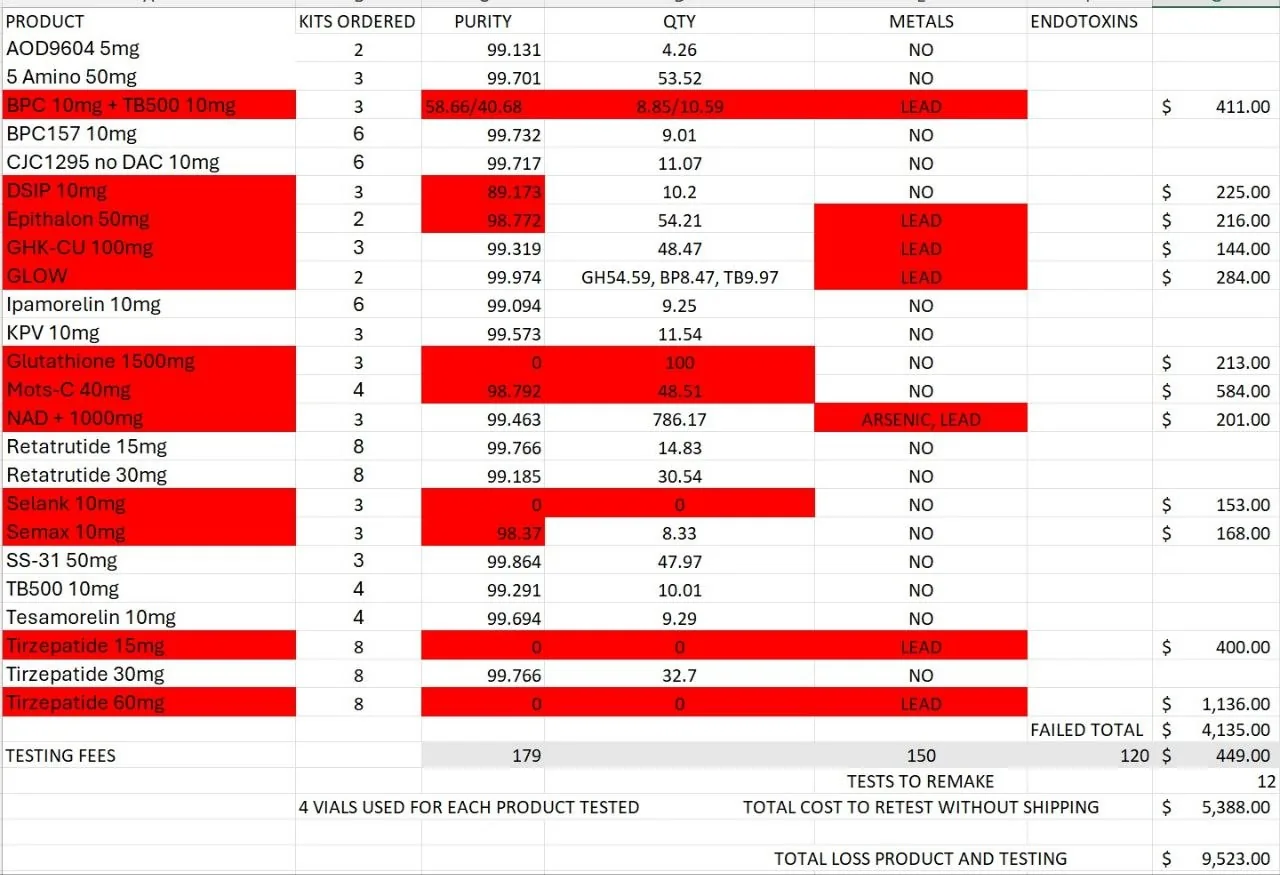
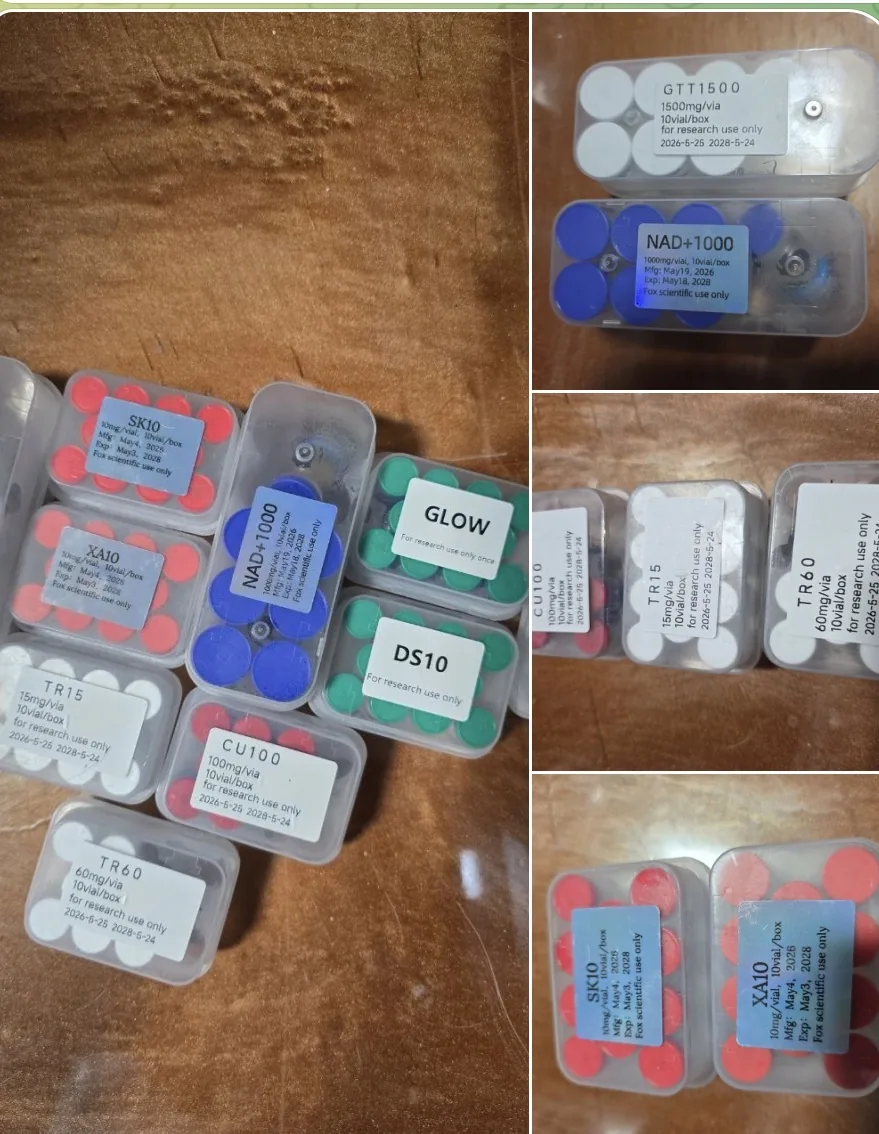
The customer produced a spreadsheet listing the 24 products tested, the number of kits ordered and the reported findings.
According to that summary, the failed products included:
BPC-157 10 mg with TB-500 10 mg
DSIP 10 mg
Epithalon 50 mg
GHK-Cu 100 mg
GLOW
Glutathione 1500 mg
MOTS-C 40 mg
NAD+ 1000 mg
Selank 10 mg
Semax 10 mg
Tirzepatide 15 mg
Tirzepatide 60 mg
Four products were found to contain no detectable peptide at all: glutathione 1500 mg, Selank 10 mg, tirzepatide 15 mg and tirzepatide 60 mg.
The BPC-157 and TB-500 combination contained 8.85 mg and 10.59 mg rather than the expected 10 mg of each component. Its two purity results were just 58.66% and 40.68%.
GHK-Cu 100 mg contained 48.47 mg. Semax 10 mg contained 8.33 mg, while DSIP was listed at 10.2 mg but with a purity of 89.173%.
The customer also reported lead in several products and both arsenic and lead in NAD+.
His spreadsheet placed the combined cost of the failed products and testing at $9,523. He says almost 50 kits from his own order were connected to the failed products.
The spreadsheet is the customer’s summary rather than the complete collection of laboratory reports. The significance of the reported metals should be assessed using the full reports, including the measured amounts, detection limits and methods used. However, APM’s own subsequent statements show that the company initially accepted that at least some of the metal results had failed.
A Pre-emptive PR Post
The first public mention of any issues from APM appeared on 25 June. By then, Amy already knew there were serious problems with their products. Instead of telling the group which products had failed, she posted a long statement presenting APM as a growing factory with strict quality control, better raw materials and a reliable compensation policy. She even claimed the company had lost some money to get better quality raw materials. She told members:
“You can use our products with confidence.”
She also stressed that everything APM did was intended to protect its reputation. The timing makes the post look like an attempt to get ahead of what might become public. Amy referred vaguely to compensating customers when problems occurred, but didn’t mention the products containing no detectable peptide, the purity failures or the metals found in several products. It allowed APM to present itself as transparent and responsible without revealing the information customers actually needed.
Members recognised the omission immediately. One replied that if APM knew about batch problems, it should contact every customer who may have received the affected stock. APM didn’t publish its formal notice until two days later. Even that notice failed to identify the products or batches involved.
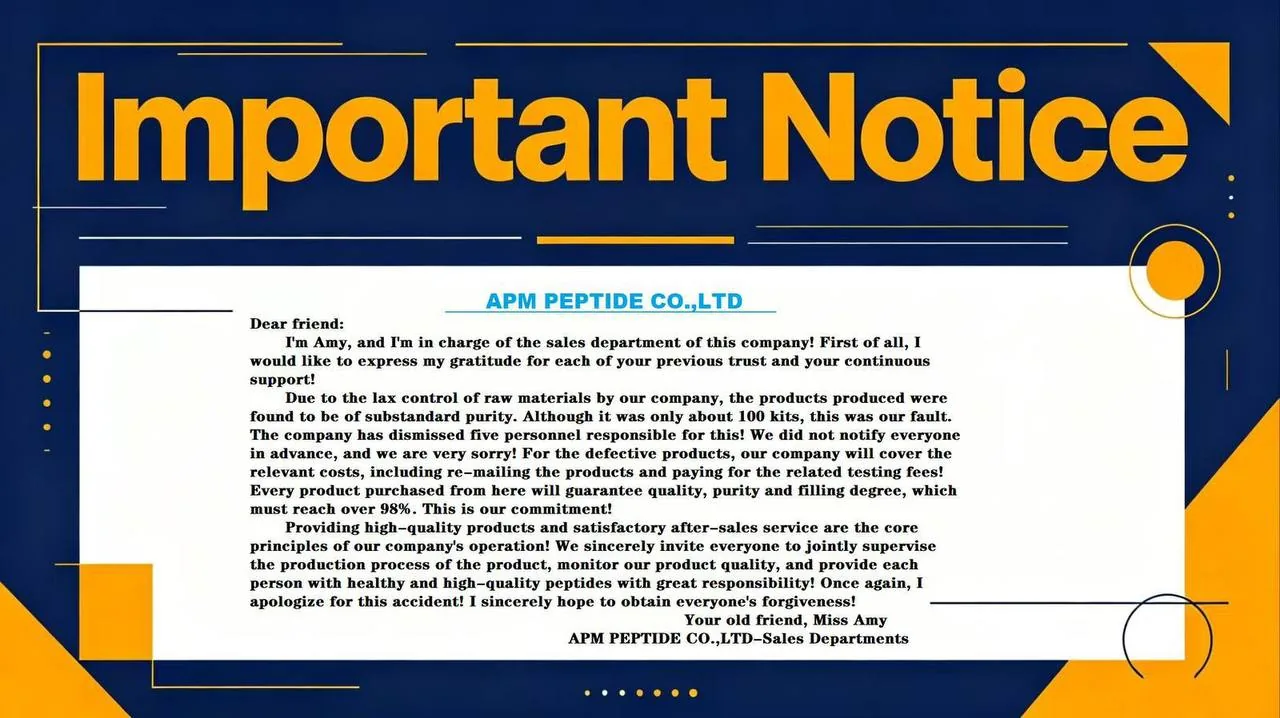
Two days after the first public discussion, APM finally issued its “Important Notice.” The notice admitted that lax control of raw materials had produced products of substandard purity. It claimed the problem affected approximately 100 kits, said five members of staff had been dismissed and acknowledged:
“We did not notify everyone in advance, and we are very sorry!”
APM promised to cover the cost of defective products, resend them and pay the related testing fees.
This is important because the formal admission didn’t appear until members had already begun raising the issue publicly. Even then, the notice didn’t identify which products or batches were affected or mention the failed products. Customers were told there had been a problem, but weren’t given enough information to determine whether the products in their possession were involved.
Customers Asked Which Products Were Affected
The vague notice immediately created more questions. Members asked whether everyone affected had been contacted and called on APM to publish a detailed list of the products involved. One explained exactly why this was necessary:
“This is to ensure those of us who have purchased them do not use or resell them to someone else.”
Instead of receiving a confirmed list, members began guessing. Amy said the products being discussed weren’t affected and that the relevant stock had already been destroyed, but she still didn’t provide the requested list.
This was the obvious consequence of APM issuing an apology without naming the products or batches. Customers knew substandard stock had been sold, but they were left trying to work out among themselves what it was.
The Buyer Finally Speaks
On 4 July, after waiting almost three weeks for APM to warn its customers, the customer finally published the laboratory reports himself. He said APM had failed to announce the bunk products, despite having the results for weeks. He also challenged the claim that only 100 kits were affected, explaining that his order alone contained almost 50 kits connected to failed products. He then disclosed that lead and arsenic had been found in several products and said APM had asked him to keep the matter secret.
Amy immediately rejected his testing:
“Your test wasn’t proper, so we redid it.”
She posted passing ILS Labs reports and then accused the customer’s laboratory of deliberately reporting APM’s products as non-compliant. But members quickly noticed that the tirzepatide 15 mg used for APM’s passing test had a purple cap, while the customer’s failed product had a white cap. It wasn’t the same stock. APM’s MOTS-C report was also for 10 mg, while the customer had tested MOTS-C 40 mg.
The passing reports therefore didn’t reproduce the failed tests or clear the products he’d received. The customer also questioned why a laboratory supposedly trying to harm APM would pass 12 of the 24 products:
“Why did they pass 12 of 24 tests and fail the rest?”
Instead of explaining the different products, caps and strengths, Amy reposted APM’s notice and said:
“This is our quality statement. We admit our mistake.”
Within minutes, APM had offered three conflicting responses: The customer’s testing was improper, the laboratory had deliberately produced failures, and APM admitted that it had made a genuine quality-control mistake.
The customer responded by publishing part of their private conversation. In it, he’d already told Amy:
“Everything I have given you was a true and correct copy of what I received from the lab.”
In that private conversation, Amy had agreed to process the refund and said the reports didn’t show APM’s company name and therefore meant nothing to the company. She also asked him;
“Please don’t say anything negative about us”
“I’ll keep the evidence”
When the customer told her that the QR codes could be scanned and the reports verified directly on the laboratory’s website. Amy replied:
“You can use it, but I can’t because it doesn’t show our company name.”
This supports the customer’s statement that APM wanted the results kept out of public view. The request for silence is particularly concerning because APM had still not identified the affected products. Customers were asking what was unsafe to use or resell, while the person holding the complete results was being asked not to say anything negative.
APM Turns the Focus to Compensation
Amy then tried to move the discussion away from the unidentified products and onto the money paid to the customer. She claimed:
“I already compensated you ten thousand dollars, and now you’re demanding a full refund and still slandering me.”
The customer posted a screenshot of their payment discussion and challenged Amy to show exactly what compensation she’d provided. He didn’t deny that money had been sent. His point was that compensating him didn’t remove APM’s responsibility to warn everyone else. He told her:
“You have had every opportunity to be transparent with these other customers of your knowing exactly which products failed, you have NOT done so yet!”
Amy repeatedly responded by asking him to “be a kind person” and said:
“Otherwise you’ll never get the real deal.”
She also described the problem as a single mistake and promised to compensate him fully. This exchange shows the two sides arguing about different things. Amy treated his compensation as the resolution. The customer continued asking why customers who’d purchased the same stock had not been told which products failed.
Amy promised to show purity tests for all APM products and said the company would continue providing high-quality products and honest after-sales service but she still didn’t publish the missing list.
By this point, APM had acknowledged the mistake, claimed it affected around 100 kits, said the stock had been destroyed and referred repeatedly to compensation.
“The Company Was in Complete Chaos”
When the customer asked why APM had delayed warning its customers, Amy gave another explanation:
“We were firing people at the time, and the company was in complete chaos, which delayed the process.”
She said APM was working through “all the after-sales issues,” asked for more time to resolve them and claimed that the company had already destroyed a large amount of raw material. Amy then claimed:
“We test every single product in the pictures before shipping! Quality guaranteed.”
That claim is difficult to believe with products reaching the customer that failed testing. If every product had been properly tested before shipping, those failures should have been detected before the order left APM. The customer continued explaining that the problem wasn’t simply that APM had made a mistake. It was how the company had handled the customers who might still possess the affected stock. Amy responded by comparing the failures to unsuccessful surgery:
“No company can make every product flawless, and doctors can’t guarantee every surgery will be successful either!”
The comparison avoided the actual issue. Customers weren’t demanding that every product be flawless. They were asking APM to identify known defective stock after the company had already admitted selling it.
APM Minimises the Scale
Amy continued to reduce the problem to “just a few batches” and insisted:
“We’ve already dealt with that. All other products are completely fine!”
She, continued claiming that all unaffected products were “completely fine” without producing evidence covering all of them.
The customer again questioned the claim that only 100 kits were involved. His order contained eight kits of one tirzepatide strength and nine of another. Combined with the other failed products in his order, this made APM’s figure difficult to understand unless very little of each affected product had ever been produced or sold. The company didn’t provide the calculation. It simply kept describing a widespread collection of failures as one mistake involving a few batches.
APM Attacks the Laboratory and Downplays the Metals
On 5 July, the argument shifted again. After members criticised APM’s handling of the failures and questioned whether every affected customer had been warned, Amy attacked the laboratory that produced the results. She wrote:
“The heavy metal content in your water is even higher than what our peptide heavy metal test shows! A certificate issued by an unqualified lab! And you actually believe it! Ridiculous!”
She later went on to say;
“We’ve already had our products tested by professional laboratories, and there’s absolutely no issue with any exceedances!
His test results are completely invalid and won’t have any effect on anyone’s health at all! This is something even a professor in the US has acknowledged! Anyway, we’ve always been relying on data to back up our claims.”
Members asked Amy to identify what she considered a qualified laboratory and why APM hadn’t immediately tested retained stock through one. She didn’t name the alleged US professor or provide the evidence behind the comparison.
Comparing drinking water with an injectable product is also misleading without the measured concentrations, exposure route, dose and applicable limits. The presence of metals in drinking water doesn’t automatically make the same finding acceptable in a product intended for injection.
APM Rewrites the Story
By 19 July, APM’s explanation had changed again, and this time completely. Amy now accused the customer and others of extortion. She claimed he had deliberately provided a fake laboratory report, causing APM to believe its quality control was inadequate and pay him $10,000. She then alleged that he’d filed a claim through Alibaba, received another $10,000 and kept products that were “perfectly good.”
She also accused him of demanding $8,000 worth of goods before he would stop criticising APM. These are serious accusations, but Amy didn’t publish the documents she said proved them. She invited people to contact her privately for the “full story.”
More importantly, this new version contradicted almost everything APM had said previously. APM hadn’t merely accepted the customer’s word in private, it had publicly admitted lax control of raw materials, acknowledged products of substandard purity, dismissed five employees, destroyed raw materials or inventory, issued an apology and promised to cover the defective products and testing fees. Amy also said APM had
“quickly issued statements on all channels and public platforms, fired the staff ……Without receiving any notice, we compensated all our customers”.
The timeline shows otherwise. The first public discussion began on 25 June. APM’s vague notice appeared two days later and didn’t identify the affected products. Customers continued asking for that information, and the full results only became public when the customer released them on 4 July.
A Newcomer Reopens the Discussion
Next a new member who hadn’t followed the earlier dispute suggested that the zero-peptide findings should be confirmed through another laboratory. The comment was reasonable. She said laboratories could make mistakes and suggested sending several samples elsewhere for retesting because finding no detectable peptide in multiple products seemed extraordinary.
The customer replied by explaining what had already happened. He agreed that a laboratory could make an error, but said four zero-peptide results across 24 tested products were unlikely to be accidental. Three separate tirzepatide strengths had been tested: the 15 mg and 60 mg contained no detectable peptide, while the 30 mg passed. He added that the results had been reviewed several times. His response also returned to the main issue:
“The fact that a seller stays quiet rather than be upfront and owning the problem should tell you all you need to know about that vendor.”
The next day, on 20th July, Amy tagged the customer at the centre of the dispute saying:
“You must be the good client who cost me 20,000 bucks.”
She then demanded that he step forward and explain what he had done. By this stage, the conversation had moved a very long way from APM’s original admission. A raw-material failure became improper testing, then deliberate laboratory misconduct, then completely fake reports, perfectly good products and a $20,000 extortion claim.
Each new explanation appeared after the previous one became difficult to defend.
What Amy Told Me Privately
Amy’s private messages to me tell a very different story from the one she is telling now. On 25 June, she sent me the same promotional statement she had posted publicly, followed by an admission:
“We had an issue with our raw materials.”
She said the customer had been compensated for all the goods and testing fees but was continuing to “slander” APM. When I asked whether this was the case involving heavy metals, Amy confirmed that it was:
“Yes, but we can’t guarantee heavy metal testing. I told him that in advance.”
She added:
“I said I guarantee it’s pure.”
Amy didn’t tell me the reports were fake or that the products had been perfectly good. She admitted there was a raw-material problem, acknowledged the heavy-metal findings and defended APM by saying metal testing was not included in its guarantee.
She also sent screenshots showing payments of $5,000 and $5,960, totalling $10,960 before fees. Amy presented these as evidence that APM had compensated the customer, while also accusing him of demanding further payment.
On 27 June, Amy contacted me again and said APM had made improvements, issued an apology, compensated the products and testing costs, and dismissed the relevant quality-inspection staff. She sent me the “Important Notice” and two passing reports.
When the customer finally published the failed reports on 4 July, Amy contacted me again. She sent the two passing ILS Labs reports and declared:
“Our products passed all the tests.”
She complained that the customer was still in APM’s channel criticising the company. When I asked whether the passing results came from the exact same batch that had failed, Amy replied:
“We’ve destroyed the failed products.”
She said APM had only experienced problems with a few raw materials and that compensation had been issued immediately. This meant the passing reports she was circulating couldn’t clear the customer’s stock because the products that required direct retesting had supposedly been destroyed.
On 5 July, Amy contacted me because she thought I’d published something negative about APM. She argued that a better-known laboratory had produced passing results. I told her APM needed to test the same affected batch through a different laboratory. Amy agreed and said:
“Yes, we’re working on it.”
She again apologised for “the issue with the raw materials” and said APM had arranged refunds and compensation for products from the same batch. However, when I asked whether samples from that batch still existed, she said:
“Products from the same batch have been destroyed and are not available for sale.”
Later, Amy sent a video involving the destruction of NAD+. When I asked what had been wrong with it, she answered:
“Raw materials, low purity.”
Throughout these conversations, Amy consistently described a genuine product failure. She admitted problems with raw materials, low purity and heavy metals. She said the affected products had been destroyed, customers had been compensated, staff had been dismissed and replacements were being arranged.

Comments