
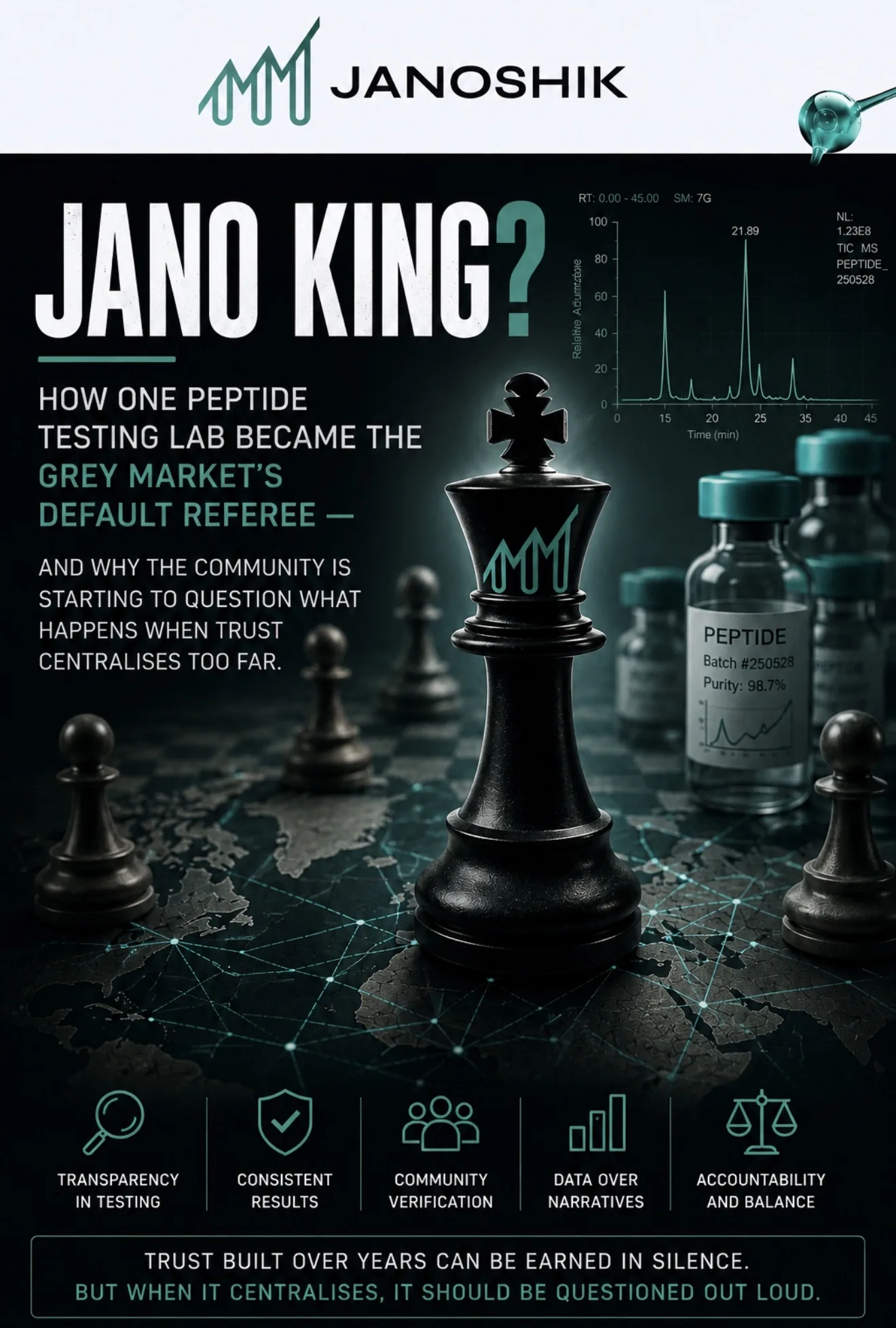
Off the back of his apparent victory in the recent SS-31 testing debate, Janoshik has now announced price increases.
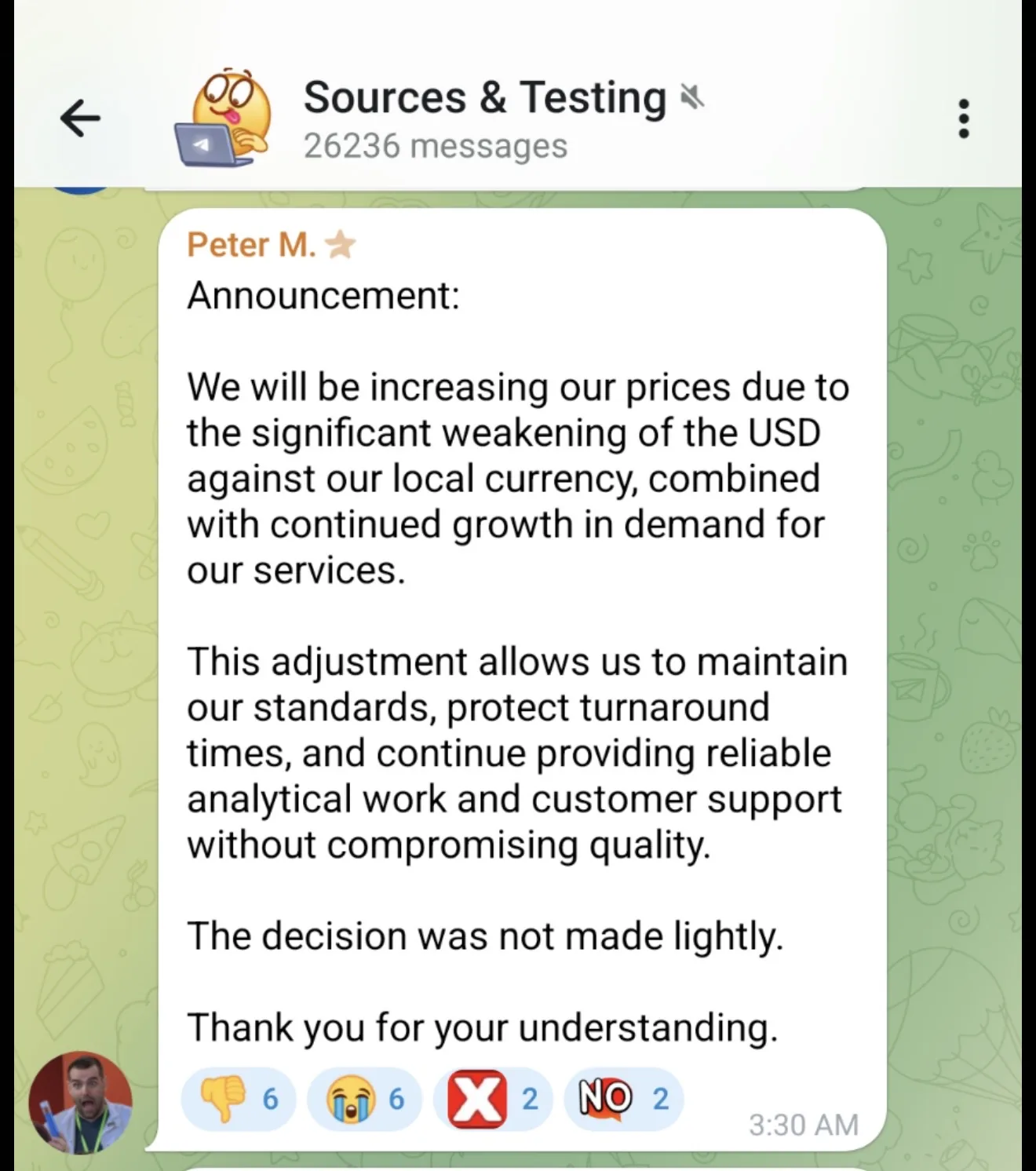
The announcement itself was fairly straightforward, the company cited a weakening USD against the Czech koruna, continued growth in demand, pressure on turnaround times, and the need to maintain quality, analytical work and customer support.
On paper, that isn’t an outrageous explanation. Any international lab dealing with staffing, infrastructure and scaling issues will eventually hit the same wall, demand grows faster than capacity.
The emojis beneath the announcement reveal the immediate reaction of the community and it’s this reaction where the real story begins as it says a lot about where the peptide testing market now sits.
Within minutes, users were already challenging the USD/CZK justification, arguing the currency movement alone didn’t fully explain the increase and accusing the lab of simply charging “what the market will bear.” But interestingly, the debate quickly moved beyond exchange rates to reveal the real tension underneath the thread which was dependence.
Many people openly admitted they may dislike the increases while simultaneously feeling there are very few trusted alternatives capable of replacing Janoshik at scale.
One detail that came up repeatedly throughout the discussion was that the strain does appear to be operationally real. Janoshik repeatedly described a situation where demand had outpaced infrastructure. According to him, customer care was already failing under the workload, staff were overwhelmed, IT systems were struggling under repeated cyber attacks and the lab was no longer able to comfortably absorb additional work without scaling aggressively. At one stage he stated demand had surged roughly 50% within a month.
He also referenced the USD falling from roughly 25 CZK/USD when earlier pricing structures were created to closer to 21 CZK/USD more recently, alongside broader inflationary pressure and rising operating costs.
But perhaps more revealing than the pricing argument itself was the way the discussions unfolded publicly.
The complaints centred around administrative issues, not the actual quality of the testing results and instead of avoiding the criticism, Janoshik responded directly, having dug through, according to him 800 emails, to find and try to replicate the issues.
Elsewhere he openly admitted customer support was “collapsing” under demand and confirmed they had already doubled IT support staffing within roughly 30 days.
That visibility matters more than it might seem. The peptide grey market is filled with vendors, middlemen and labs that often disappear entirely when operational problems begin. In contrast, much of Janoshik’s reputation appears tied, not just to analytical performance, but to remaining publicly visible during periods of failure, criticism and overload.
At the same time, there was still a clear distinction being made between operational instability and analytical trustworthiness. And that distinction may ultimately explain the central paradox of the entire discussion, the very operational chaos making people nervous is also part of what reinforces trust in him. Because people are not only evaluating lab reports anymore, they’re evaluating who continues engaging publicly once things stop running smoothly.
But the discussion also revealed something else that often gets lost when people talk about “trust” in this space:
How Janoshik become the vendor’s “most trusted Lab”
It’s no secret that most vendors will only accept a third party test from Janoshik for refunds, replacements and dispute resolution. But many might ask why? That trust wasn’t created through formal partnerships or exclusive agreements.
Janoshik became the dominant lab largely because he was the first major consumer-recognised peptide testing lab during the early growth of PTDS, the Discord testing server in the summer of 2023.
As more tests were being ordered from Janoshik, more and more products were discovered to be under dosed or of sub 98% purity, and the community started to hold the vendors publicly accountable. As a result, vendors quickly realised buyers were paying attention to these results and in response increasingly began sending their own products to Janoshik for testing to maintain credibility and sales. While Janoshik remained the gold standard for a long time, other companies eventually recognised the demand and began offering consumer-facing peptide testing too.
But by then, the community had already pushed vendors heavily in Janoshik’s direction. Buyers trusted his reports, disputes were increasingly judged against his results, and vendors who wanted credibility often had little choice but to follow the standard the community had already created.
That influence became visible enough that Tracy from QSC is even said to have visited Janoshik’s lab.
This trust was also reinforced through head-to-head blind comparisons between multiple labs using known-result samples, organised by PTDS. Samples were sent to various labs, unbeknownst to them. This included both mislabelled and underdosed vials. It turned out that some alternative labs struggled in those comparisons, while Janoshik consistently remained trusted enough to become the default reference point for disputes, refunds and replacements.
The results of one of those Peptide Test Lab Comparison is below;
Peptide Test Lab Comparison
Here’s a reorganized summary of the lab results divided by each peptide, showing both expected and actual results for each lab:
Tirzepatide (Dirty Pink 15 mg)
- Janoshik: 15.72 mg, 98.665%
- MZ Biolabs: 3.85 mg, 93.35%
- Creative Proteomics: 63.8 mg, 99.87%
- Analyx Biolabs: 15.37 mg, 98.92%
- Analiza Bialek: 15.65 mg, 98.45%
- Prime Analytical Laboratories: 16.94 mg, 97.34%
BPC-157 (5 mg with known contamination)
- Janoshik: 5.08 mg, 83.525%
- MZ Biolabs: N/A (90.24%, does not test quantity)
- Creative Proteomics: 47.50 mg, 76.22%
- Analyx Biolabs: 5.89 mg, 98.90%
- Analiza Bialek: 5.52 mg, 81.38%
- Prime Analytical Laboratories: 5.10 mg, 98.21%
BPC-157 (5 mg)
- Janoshik: 5.02 mg, 99.737%
- MZ Biolabs: N/A (99.84%, does not test quantity)
- Creative Proteomics: 48.90 mg, 97.41%
- Analyx Biolabs: 10.65 mg, 99.17% (noted as a 10mg sample)
- Analiza Bialek: 5.98 mg, 98.65%
- Prime Analytical Laboratories: 5.74 mg, 98.45%
Retatrutide (10 mg)
- Janoshik: 11.35 mg, 99.808%
- MZ Biolabs: 12.04 mg, 99.83%
- Creative Proteomics: 48.80 mg, 99.40%
- Analyx Biolabs: 10.49 mg, 98.94%
- Analiza Bialek: 9.96 mg, 97.41%
- Prime Analytical Laboratories: 11.95 mg, 100.00%
NAD+ (500 mg)
- Janoshik: 563.61 mg (no purity percentage provided)
- MZ Biolabs: N/A (99.89%, does not test quantity)
- Creative Proteomics: 580 mg, 95.92%
- Analyx Biolabs: 501.19 mg, 99.17%
- Analiza Bialek: 429.68 mg, 96.21%
- Prime Analytical Laboratories: 434.65 mg, 94.55%
Note: Results from MZ Biolabs for peptides other than GLP-1 do not include quantity measurements as per their testing policy. It’s clear some discrepancies were extreme. One Tirzepatide sample expected around 15 mg came back at over 63 mg from another lab. Certain BPC-157 samples expected near 5 mg were measured close to 50 mg elsewhere.
Of course this doesn’t include the newer labs since this was done a few years ago, but it seems that Janoshik has earnt his reputation in the community.
Trust, Incentives and the Problem with One Referee
The discussion around Janoshik ultimately became much bigger than one lab. It evolved into a debate about how trust is built inside a technically opaque grey market where most buyers cannot independently verify the analytical work themselves.
Analytical chemistry is far more complex than many outsiders realise. Variables like reagent choice, column selection, filters, equipment calibration, excipients, interpretation methods and general lab practice can all affect outcomes. In that environment, experience itself becomes valuable because long-running labs are assumed to have already encountered, and learned from, many common pitfalls.
That logic helps explain why many buyers still gravitate toward Janoshik despite growing competition.
But expertise cuts both ways. When buyers lack the technical knowledge to fully evaluate the service they are purchasing, the gap between customer and provider creates the potential for manipulation, intentional or otherwise. A polished website, professional-looking COAs and confident technical language can create trust long before the underlying work is truly understood.
That is why blind testing comparisons kept returning as a central theme. Other labs have reportedly struggled during blind comparison exercises, reinforcing scepticism toward newer entrants. But no lab, including Janoshik, should ever become beyond scrutiny.
This is less about institutional trust and more about incentives, transparency and community oversight.
The underlying assumption is that Janoshik currently benefits far more from protecting his long-term reputation than from risking it through manipulation or unethical behaviour. Maintaining credibility over years is viewed as more profitable than jeopardising it through short-term gains.
But at the same time, over-centralisation creates its own risks. The more dominant one lab becomes, the more important continued scepticism, blind testing and public comparison become. Otherwise the market risks drifting into the exact type of unquestioned authority it originally evolved to avoid. And that may be the central paradox running through the entire thread, that people trust Janoshik largely because the community never fully stopped questioning him.
I’m very excited to be visiting Janoshik Lab next week, which should give me a chance to see the operation first hand, better understand the workflow behind one of the grey market’s most influential testing labs, and report back with a more grounded perspective beyond just community discussion threads.
And judging by some of the recent infrastructure chaos, I may even end up offering a little IT assistance while I’m there.

Comments