
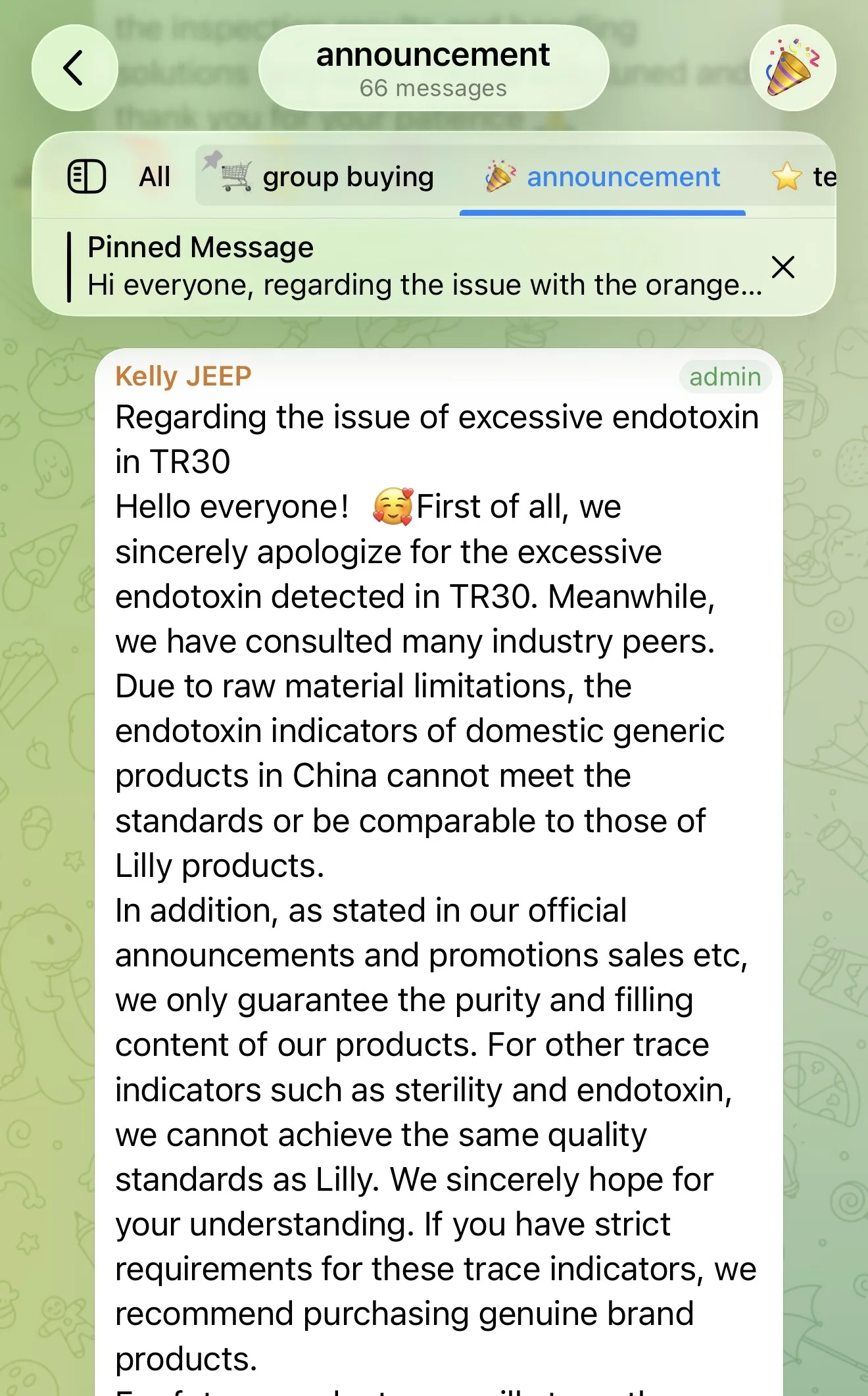
After their April 9th placeholder announcement asking for patience, JEEP finally released a full statement two days later.
In it, they apologised for the excessive endotoxin levels and, after consulting “many industry peers,” concluded that domestic generic products in China cannot meet the same standards as Eli Lilly products due to raw material limitations. In other words:
the grey market cannot meet the same standards as big pharma.
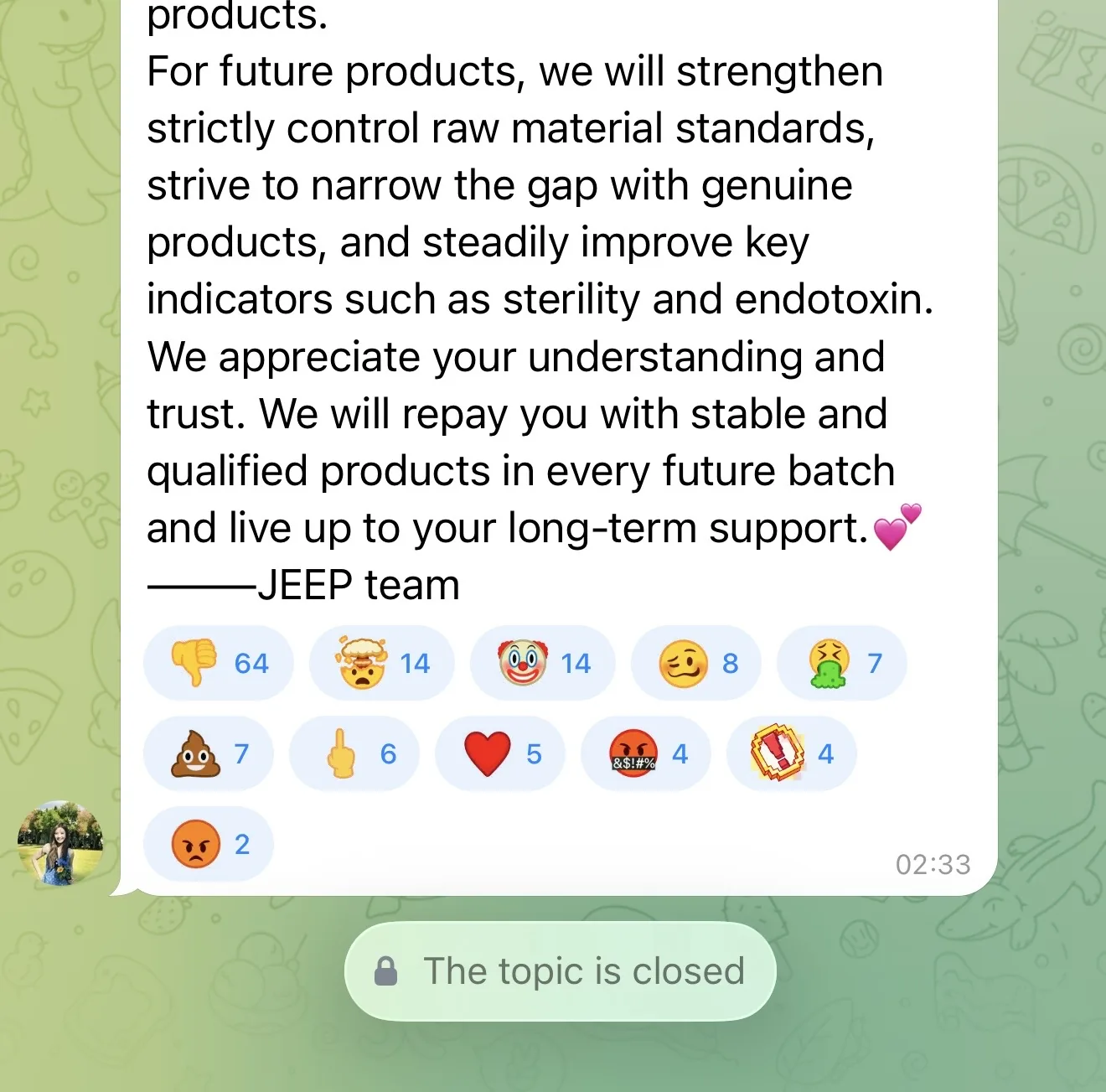
They advised that anyone concerned about these “trace indicators” should purchase genuine branded products instead, while promising improvements going forward which left a more important question, Is that an explanation, or an excuse?
But Is what Jeep claims actually true?
At face value, the claim sounds straightforward: that domestic generic products cannot meet the same standards as Eli Lilly because of raw material limitations. But that statement needs to be examined carefully, because it mixes together three different things: capability, consistency, and proof.
Capability vs reality
There is nothing inherent about domestic generics or Chinese manufacturing that makes them incapable of meeting pharmaceutical standards. Manufacturers in China produce APIs for global pharma, operate under GMP conditions, and in some cases supply regulated markets. So the issue is not capability. The issue is whether those standards were applied to the product in question.
Where the distinction actually sits
This is where JEEP’s statement shifts. They are not saying the batch failed unexpectedly. They are saying this level of quality should not have been expected in the first place. That is a different position entirely, not a failure but a limitation.
What is the technical reality?
In synthetic peptide production, usually via SPPS, endotoxins can enter at multiple points in the process: through water systems, equipment and cleaning, handling and environmental exposure, filtration and filling steps, and lyophilisation. So endotoxin contamination is not tied to one step. It reflects overall process control.
Where does this case point?
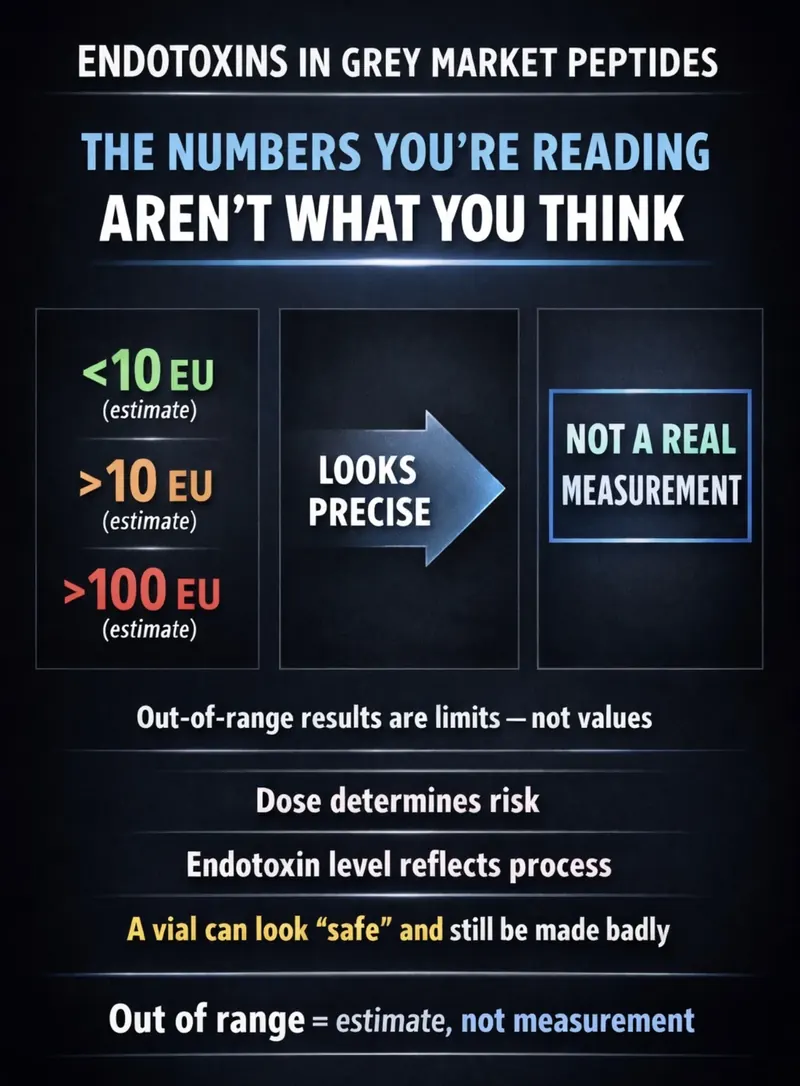
Low-level endotoxin findings can sometimes be ambiguous, shaped by assay conditions, sample clarity, or minor process variation. But this case was not that.
The JEEP case involved repeated results from the same batch, at levels measured in the thousands. At that point, the question is no longer whether contamination occurred, but where such a significant endotoxin load entered the process. The most likely explanation shifts upstream, toward raw materials or early-stage processing.
This is important because JEEP’s defence moves from “this batch failed” to “these standards cannot be met.” Those are not the same claim. Their product may not have met pharmaceutical-level standards, but that does not make those standards impossible. The issue is not capability. It is whether that capability was applied.
The contradiction inside the defence
One of the most revealing responses came from a chemist who has a background working for Eli Lilly. His view did not challenge the idea that grey-market products may fall short of Eli Lilly’s standards, but it did highlight the real distinction that JEEP’s response tried to blur, which is that there is a difference between not matching branded pharmaceutical standards and producing endotoxin levels this high. One may reflect a lower standard, the other, reflects an unacceptable failure.
That is the point JEEP’s defence avoids. This was not just “not Eli Lilly.” It was a repeated extreme result, far outside normal variation and far outside what most other vendors have historically shown ( see later tables).
What the exchange really shows
The more this was discussed, the clearer the contradiction became. JEEP’s defence relied on the idea that this gap is built into the market itself, but the discussion around it pointed somewhere else, that cleaner grey-market products do exist, that bad material can enter upstream and that comparisons to Eli Lilly were being made without equivalent endotoxin data in hand. So the real issue is not that these standards are impossible, it’s that once the results appeared, impossibility became the explanation.
JEEP said they consulted “many industry peers,” but never said who those peers were, what expertise they had, or what evidence they relied on. That matters, because most of the vendors in this market are commercial competitors and, more importantly, none of the historical results suggest that endotoxin levels this high are simply a standard feature of this market.
In that sense, JEEP did more than mishandle one endotoxin issue. It ended up reinforcing many of the arguments long made by critics of the grey market, from the FDA to the Flower and Co, that grey market sourced peptides really aren’t suitable for human use, operating without the quality controls, sterility assurance, and accountability expected of regulated medicines and that when something goes wrong, buyers are left carrying the risk.
Put in context: what “normal” numbers actually look like
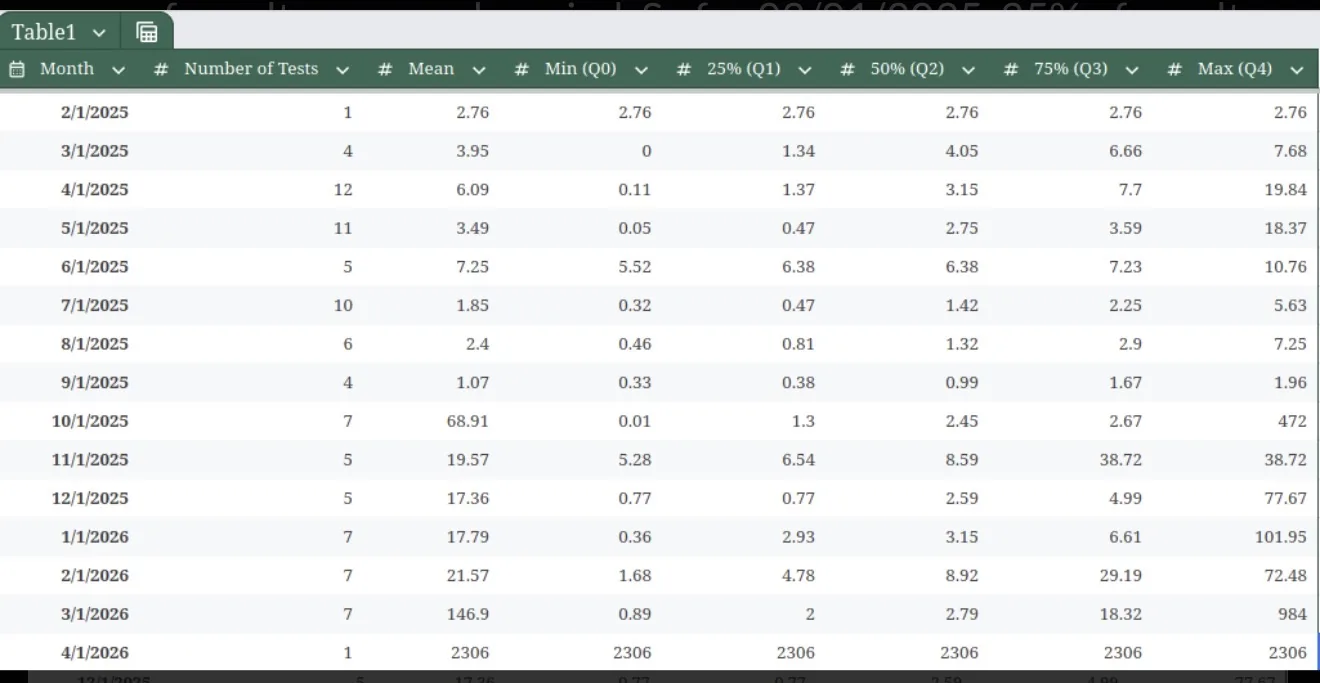
Looking beyond a single vendor, a broader dataset gives useful context. The following analysis draws on endotoxin testing results from two large testing groups, STG and FPPG, from the past 12 months, compiled from third-party testing across multiple vendors.
Across multiple suppliers, most endotoxin results cluster at relatively low levels. Even allowing for variation between vendors and occasional spikes, the majority of readings sit within a range that is at least broadly consistent and interpretable.
For example, median values for most vendors remain low, typical results often fall within single-digit EU/vial ranges and even higher quartiles, in most cases, stay far below extreme outliers
The table below breaks down levels by month. This is total endotoxins, not EU/mg. Quartiles are added to give an idea of the range of results over each period. So for 03/01/2025, 25% of results had levels <= 1.34 EU/vial, 50% of results had levels <= 4.05 EU/vial etc…
Below is a similar table for all vendors for all time, useful to see how a vendor has been doing overall.
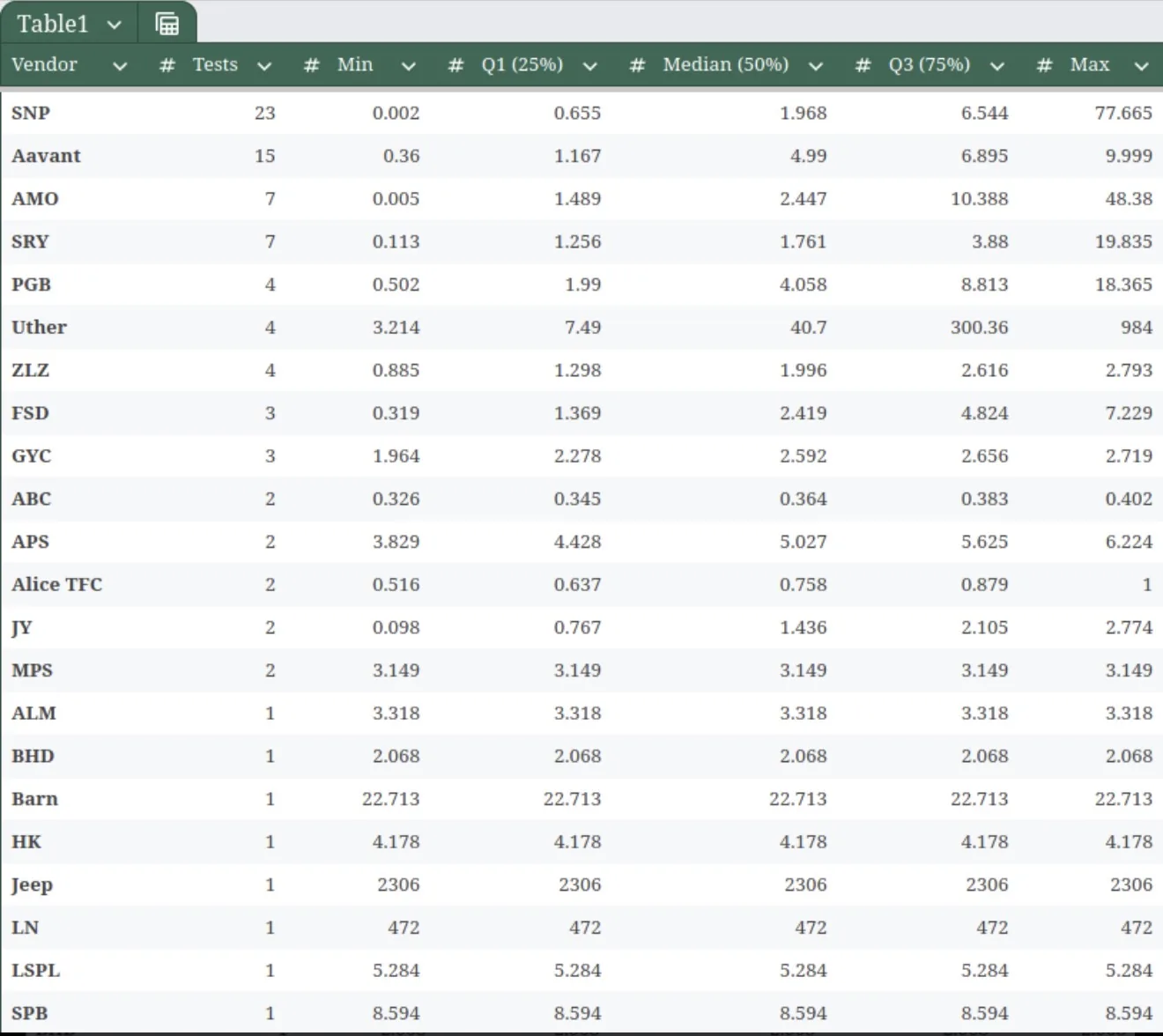
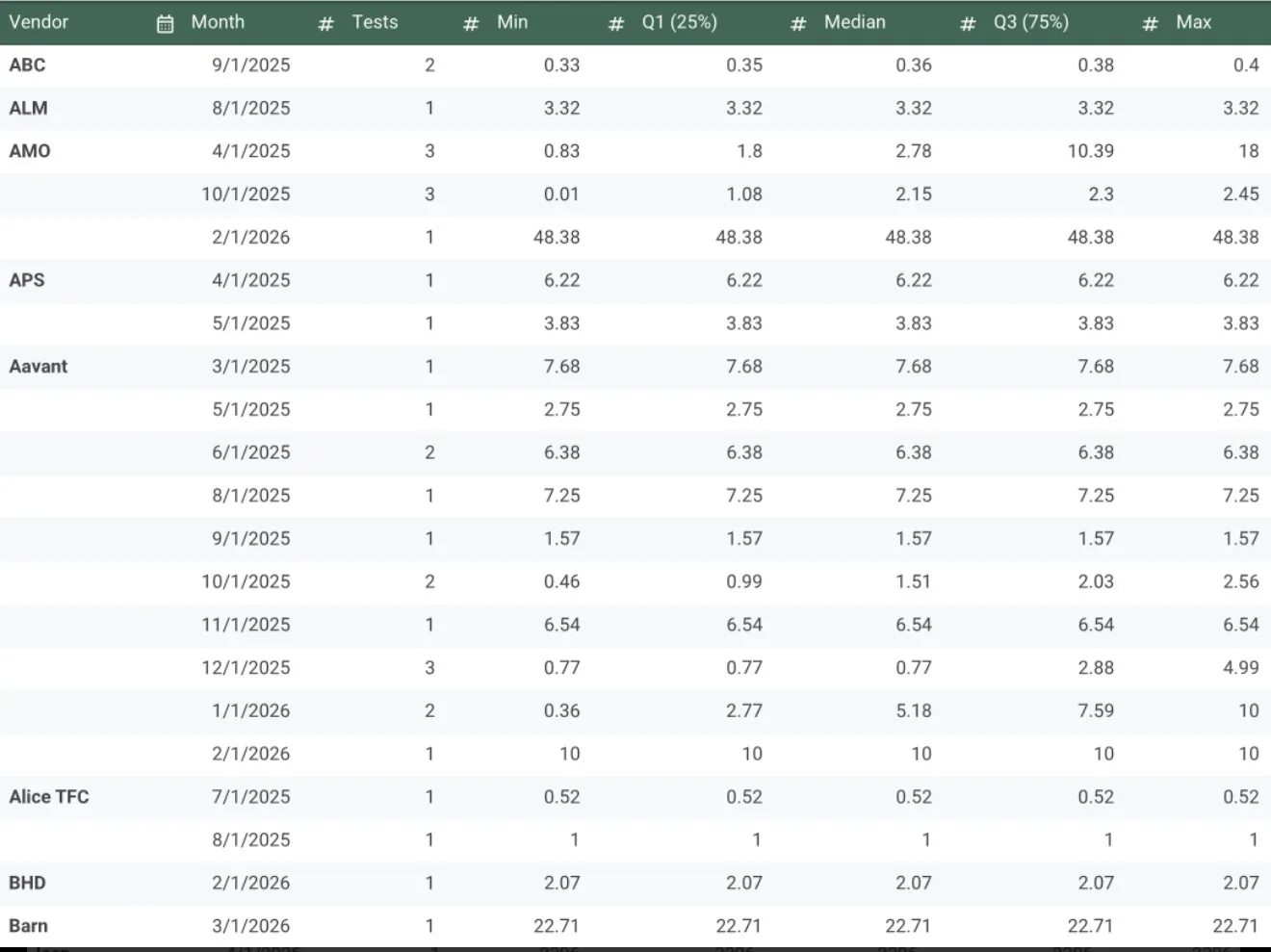
There are exceptions. Some vendors show occasional spikes, and a small number of samples reach higher levels. But these tend to appear as isolated “hot” results rather than a consistent pattern. Most of the dataset reflects variability, however, JEEP is clearly illustrated as an outlier.
Where JEEP diverges
It has a single test at 2306 EU/vial. This is not a marginal elevation or a statistical spike, it sits way above the range where most other vendors cluster, even the higher-end outliers in the dataset, whether 50, 100, or even several hundred EU, do not approach this level.
What that suggests
Taken together, the dataset shows two things at once:
Most vendors are capable of achieving relatively low endotoxin levels, even if consistency varies
Extreme readings like this are not typical background noise
That does not make any individual vendor “safe” by default, but it does challenge the idea that this outcome is simply unavoidable across the entire market. If most vendors can achieve lower levels, then results at this level are not an inherent limitation, but a failure somewhere in the process.
What happens when the data changes
At this point, the discussion is no longer just about one vendor or one batch. It is about what happens when clear, repeated data appears, and whether the response matches it. Once results at this level are established, the situation changes. This is no longer uncertainty, anecdote or isolated variation. It is a defined risk factor. So when this happens, continuing as normal is no longer neutral, it becomes a decision.
The response gap
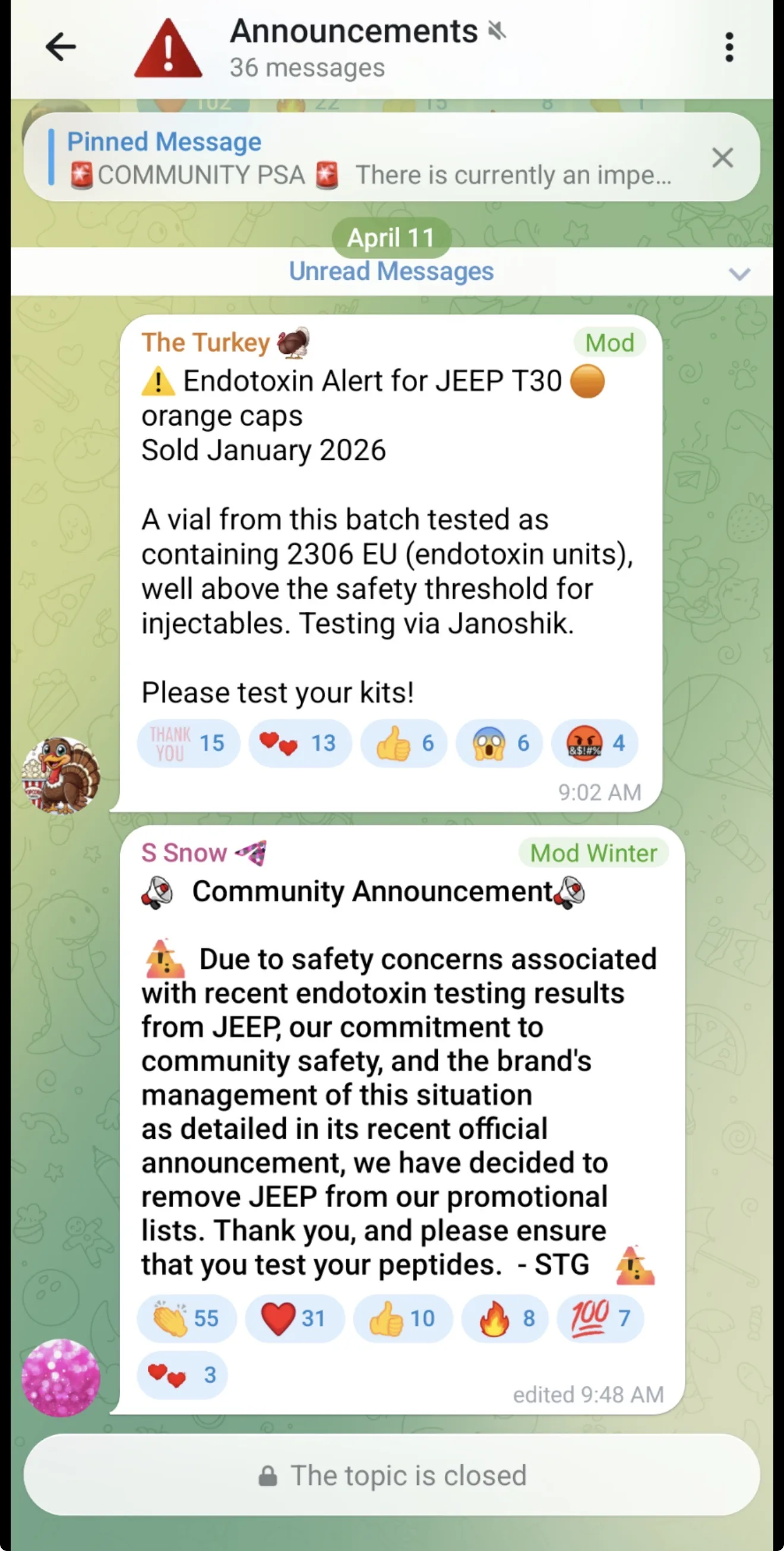
Different parts of the community responded in different ways. Some moved immediately to remove the vendor, flag the issue and pause trust pending further evidence
STG announcing they have dropped JEEP as a recommended vendor
Others did not.
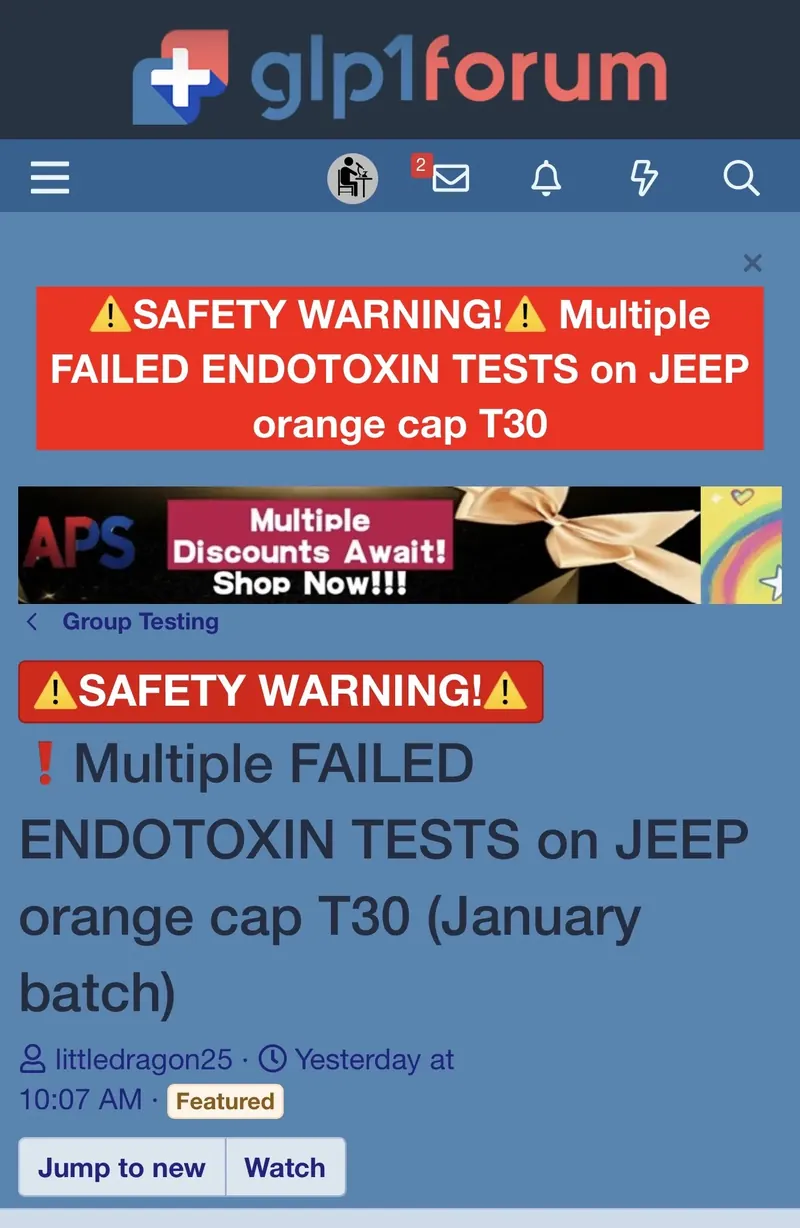
GLP1Forum are keeping JEEP, who is a paying member, on
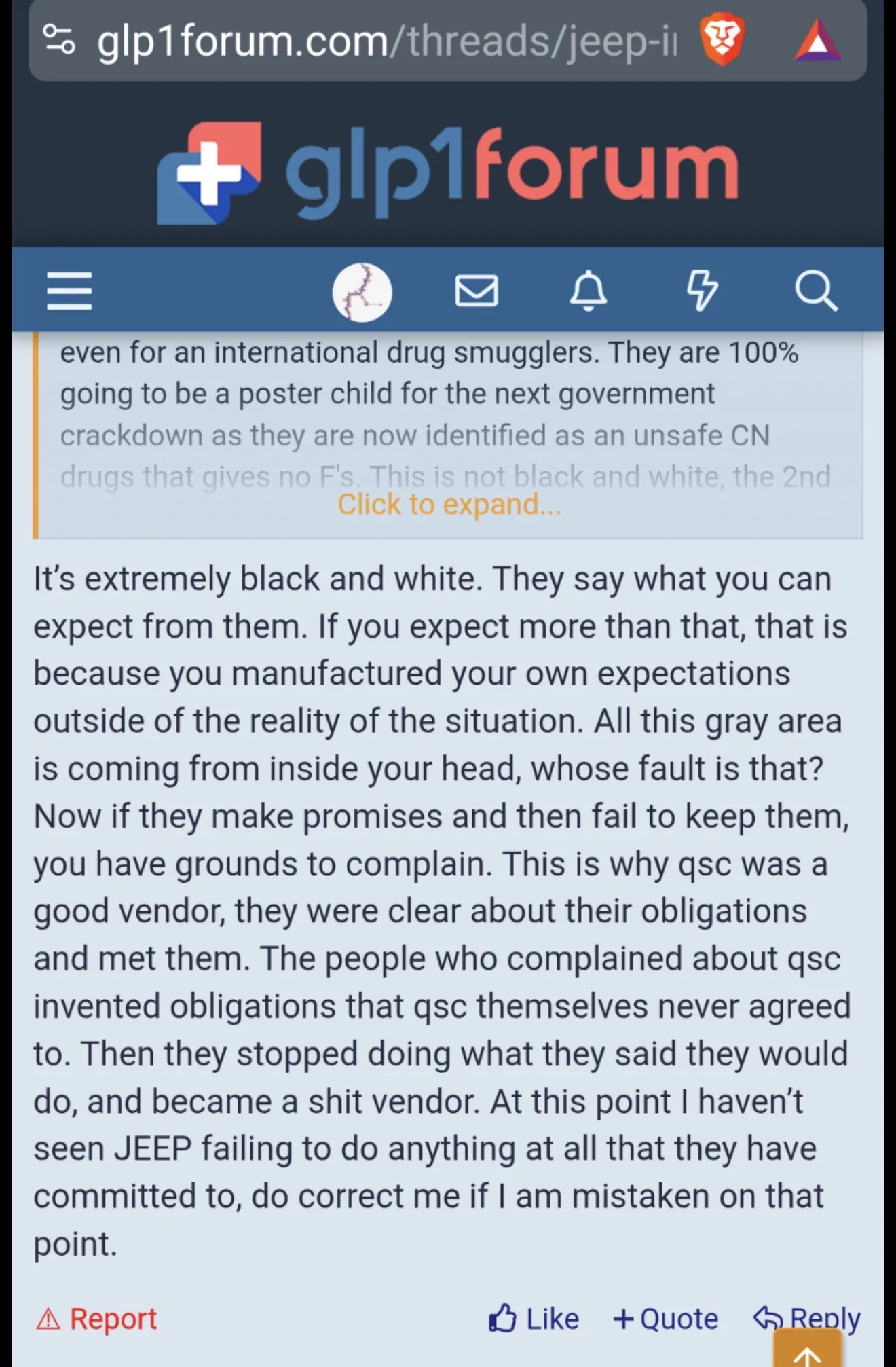
In some cases, vendors remained listed and promoted, with the reasoning that expectations had already been set and that buyers understood the risks involved.
These cases reflect two different approaches, one based on precaution and risk management, the other on contracts, expectations, and existing positioning
When incentives meet risk
This is where the tension becomes visible. Platforms that charge vendors, host them or benefit financially from their presence are not operating from a neutral position. That does not automatically make their decisions wrong, but it does mean those decisions are not made in isolation from financial incentives, relationships and platform dynamics, and when new risk appears, those incentives are tested.
The Guarantee Gap
Most vendors still stop at purity and fill guarantee. Sterility and endotoxin remain outside the guarantees they are willing to make. But a minority eg. Daniel Novalabs are now starting to market those checks as part of their standard.
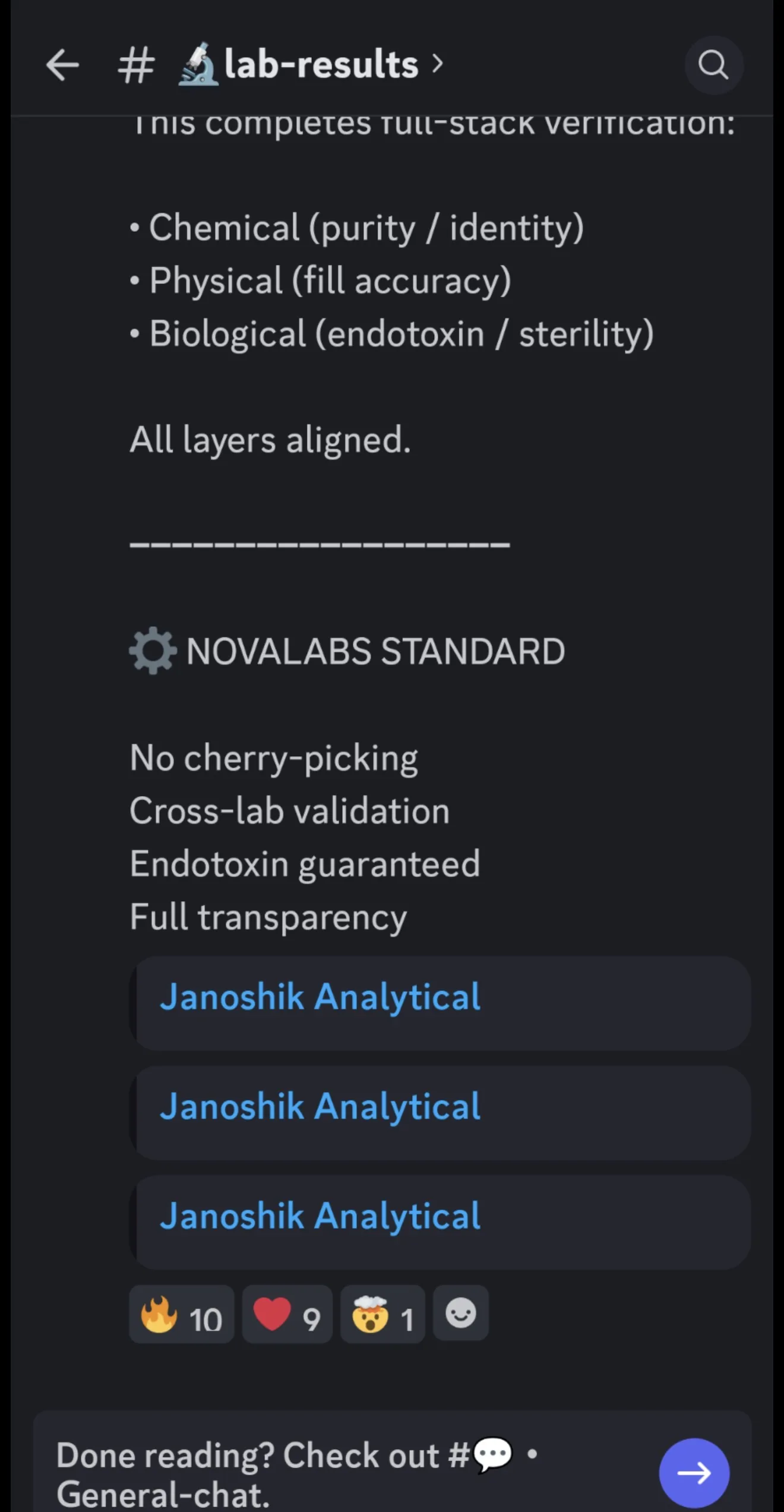
So once some vendors begin treating biological safety as something worth standing behind, it becomes harder for everyone else to argue that it simply cannot be done.
In summary
JEEP framed the issue as a limitation of the market. The data suggests something narrower, lower endotoxin levels are achievable, results this extreme are not typical, and once they appear, responses start to diverge.
Comments