
By now Jeep have provided three statements. The most recent statement posted on 13 April is summarised below
JEEP’s final statement
Within this ( too long to post) response, they acknowledged the endotoxin issue in TR30 and described it as a critical oversight, accepting full responsibility.
They announced:
Free replacement of affected products or store credit compensation
A stop sell on the orange cap TR30 batch
A recommendation that users discontinue use if experiencing issues
They stated that a root cause analysis had identified raw material procurement as the source of the problem, and committed to stricter raw material controls, expanded monitoring across production and testing and improved batch traceability systems
The statement closed with a focus on rebuilding trust, promising stronger quality control and more consistent future output.
From one explanation to another
This was not JEEP’s first attempt to explain the issue.
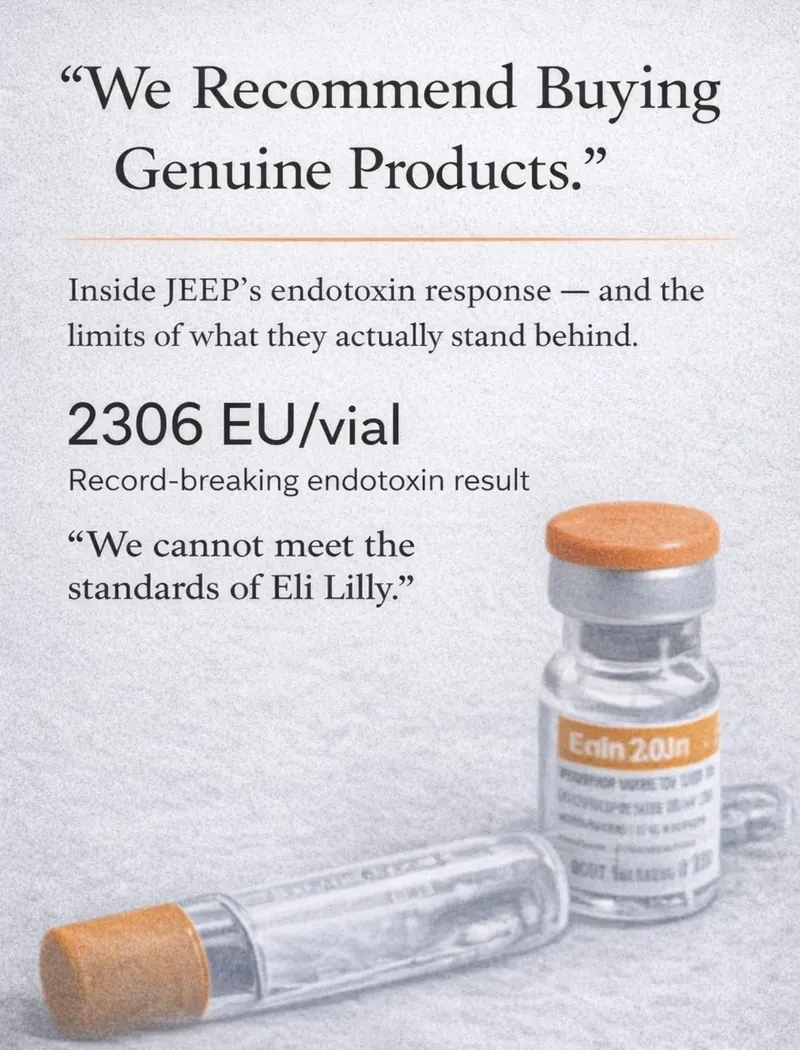
In an earlier statement, they had already framed the problem very differently. After consulting “many industry peers,” they suggested that domestic generic products in China could not match Eli Lilly’s standards on endotoxin and sterility due to raw material limitations. They also made clear that they only guaranteed purity and fill, not “trace indicators” such as endotoxin or sterility, and that customers with stricter expectations should purchase genuine branded products instead.
That was not a statement about one failed batch. It was a broader claim about the limits of the market.
This final statement shifts away from that position. Instead of describing the issue as an inherent limitation, it presents it as a specific failure within JEEP’s own process, attributed to raw material procurement.
Those are not the same explanation.
From investigation to certainty
The progression across the statements is important. The issue moves from something under review, to a general limitation, to a confirmed, specific cause. So by the final statement, the language is no longer cautious.
“Root cause analysis confirms…”
That phrasing carries weight. It implies that the uncertainty has been resolved, that alternative explanations have been considered and ruled out, and that the cause is understood. But what is presented alongside that conclusion is limited to the conclusion itself. There is no supporting data, no description of the analysis, no indication of how other possible causes were evaluated or how extensive the problem may be.
The result is a statement of certainty without the underlying work being made visible.
What is not being addressed
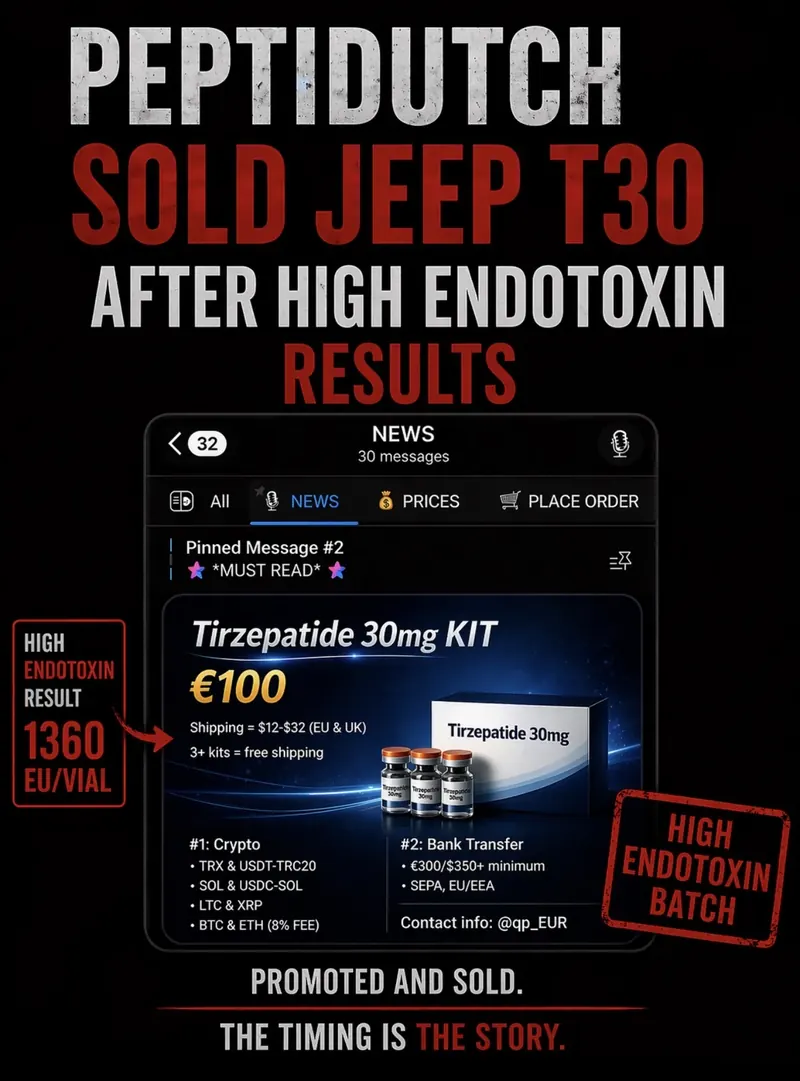
The explanation focuses on raw material procurement, but the issue itself, repeated, extreme endotoxin results, does not point exclusively to a single stage of the process. Endotoxin contamination can arise at multiple points, from water systems, equipment and cleaning, handling and environmental exposure, filtration and filling as well as raw materials
The statement does not explain how these possibilities were examined or excluded. It presents one answer, without showing how it became the only answer.
The batch problem
At the same time, separate questions began to emerge around batch integrity. Community discussion highlighted that the same batch code appeared across products sold at different times. There were visible differences between supposedly identical batches and not all users experienced the same outcomes. This raises a more fundamental issue.
What exactly constitutes a “batch” in this context?
If a batch label does not map clearly to a single, traceable production run, then both quality investigation and customer reassurance become more difficult. Variability in results may not simply reflect contamination, it may also reflect how batches are defined, handled, or combined.
JEEP’s final statement acknowledges this indirectly, promising improvements to batch traceability, but it also confirms that this was already a weakness.
Community reaction
As the statements evolved, so did the reaction. In some parts of the community, the explanation was questioned. Users raised alternative possibilities, pointed to production hygiene and process control, and highlighted inconsistencies in batch labelling and product appearance.
Others focused on what the results meant more broadly. Endotoxin testing, once treated as optional or excessive, was now being discussed as something that should be standard. Contributors who had previously dismissed it began to reconsider once results moved from the tens into the hundreds and then into the thousands.
A different reaction on GLP forum
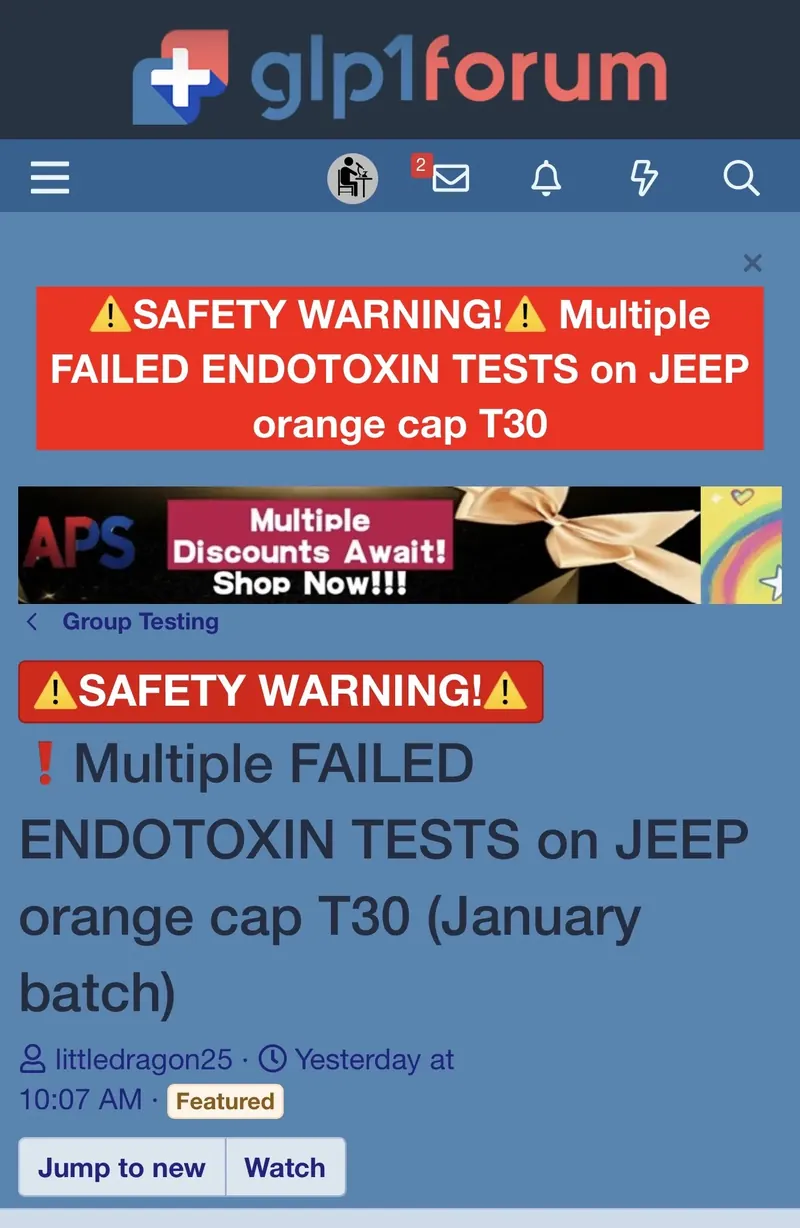
On GLP forum ( the one forum who did not boot JEEP ) the response to JEEP’s final statement was mixed, but still notably more receptive than in other spaces.
Some commenters thanked JEEP for responding, described the statement as a step forward, and said this was the kind of behavior they wanted to see. Others suggested that, if JEEP followed through on its promises, the company could recover, improve its reputation, and even help push the wider market toward higher standards through routine endotoxin testing and better QC.
At the same time, not everyone was persuaded. Some users pointed out that this was not JEEP’s first response, and argued that the earlier statements had already revealed too much. Others remained skeptical about whether the promised fixes would actually be implemented in practice, especially around compensation, batch numbering, and the use of one COA across multiple batches.
That split is important.
Because even where criticism remained, the discussion had already begun to move away from the failure itself and toward what JEEP might become if it delivered on its promises. The question was no longer just what had happened, it was whether the company could turn the response into a comeback.
From failure to reassurance
Elsewhere, the failure itself became secondary. The emphasis moved to whether JEEP had taken responsibility, whether corrective actions were outlined and whether future improvements would restore trust.
The existence of a “root cause analysis” and a plan for change was treated as evidence of a functioning system, rather than something that needed to be examined in detail. In effect, the response was judged by whether it followed the expected structure, not by what it demonstrated.
Taken together, the three statements and the reactions to them reveal a clear pattern. The explanation changed, the certainty increased, and parts of the community moved surprisingly quickly from scrutiny to reassurance. JEEP’s final statement was not only accepted in some spaces, but actively praised as a step forward. All of that happened before the supporting evidence behind the settled explanation was made visible.
The problem was not just the batch, it’s how quickly the explanation settled and how readily the response was allowed to become the story.
Comments