

Entering the grey market can feel overwhelming. Between the exit scams, mixed reviews, and conflicting advice, it’s rarely obvious where you should start.
There isn’t a single “safe” route, but there is a smarter way to approach the chaos. If I were starting over today, knowing what I know now, this is exactly how I’d handle my first move.
Learn how vendors actually operate
Take the time to read through the vendor interviews properly. While many of the answers might sound similar at first glance, a few will always stand out. Make a note of those, both the impressive ones and the ones that feel “off.”
Use these interviews to understand the mechanics of the trade:
Payment methods: Crypto is the standard now, though some still offer alternatives.
Shipping & Timelines: Pay close attention here if you’re outside the US. UK buyers generally have a smoother time, but if you’re in Canada, Brazil, or Australia, the risk profile changes significantly.
Reship policies: What happens if your package vanishes?
Guarantees: Learn to spot the difference between a real guarantee and vague marketing fluff. Think about that guarantee and ask yourself, if I have a problem “how” are they going to honor it. Wording that suggests a credit is different than wording that suggests a refund or reship. Are they going to expect you to send more money to reship? If it doesn’t say, you can’t assume.
This is how you learn to speak “vendor.” You’ll start to hear what’s being said, what’s being avoided, and what actually matters.
Protect yourself before you buy
Before you contact vendors or send money, think about basic OPSEC. Many people use a separate email, a pseudonym, and crypto for a reason. You don’t need to make yourself easy to identify just because you’re new.
Also understand the language being used. Most vendors will describe these products as “research chemicals” or “not for human consumption.” That wording isn’t random. It’s part of the legal positioning this market relies on.
There are also different buying routes. Domestic resellers are usually faster, more expensive, and may carry less customs risk. International or Chinese vendors are often cheaper and more bulk-heavy, but shipping and customs risk can be higher depending on where you live.
Beginners often don’t realise they have a choice. Don’t just copy what someone else does. Choose the route that fits your own risk tolerance
Join vendor groups (but keep your guard up)
Most vendors have migrated to PepChat or Telegram because Discord is too prone to sudden shutdowns. Join a few of these groups to see how they run.
One golden rule: If you get a “personal welcome” DM from a vendor the second you join, delete it. That’s almost always an impersonation scam. Real vendors are busy; they don’t reach out to you first.
Inside the groups, look for balance. A few unhappy customers are normal (and actually a sign of an honest group). However, a group that is 100% glowing praise, or 100% toxic vitriol, is a red flag.
Watch the “Live” feed
The most valuable information isn’t in the pinned posts; it’s in the messy, everyday conversations. Watch how things unfold when a shipment is late or a batch looks different.
Look for:
Changing explanations from the vendor.
The frequency of delays
How they handle refunds or complaints.
The general mood and reaction of long-time customers.
How a vendor acts when things go wrong tells you infinitely more than when things are going right. If you have questions, ask them, but do your homework first. Asking “Who is the best vendor?” will usually get you ignored. Show that you’ve put in the effort, and the community will usually help you out.
The reality of COAs
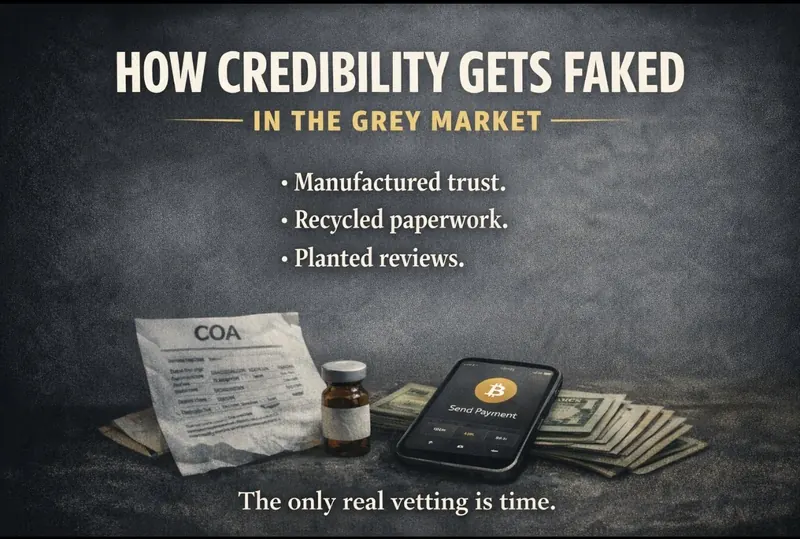
Check the test results section and review the Certificates of Analysis (COAs). While a lack of COAs is a massive red flag, remember that a piece of paper isn’t a holy relic. It’s just one data point. A vendor-provided COA shows they are at least bothering to test, but it doesn’t guarantee that the specific vial in your hand is identical to the one they sent to the lab. The test is only valid for that particular batch.
Understanding the testing “Tax”
Testing is expensive, usually £200 to £300 per test (north of $200 to $300 + in USD). Because of this, it’s rarely realistic for one person to test everything they buy. Instead, the community relies on:
Dedicated independent testing groups.
Crowdfunded “group buys” for specific batches.
Even with a “passed” test, you’re still betting that the sample sent to the lab was representative of the whole batch. You’re also relying on the process and the machines the lab uses to test. Test results on the same batch can vary widely among various labs, bringing to question which lab did what process with what machine and how was that machine maintained and calibrated. Testing significantly lowers your risk, but it never eliminates it.
Every batch is a new decision
This is the most important lesson: A vendor is only as good as their most recent batch.
Manufacturers often use the same equipment for different products. If the cleanup isn’t perfect, you get cross-contamination.
This is how you end up with
Unexpected peaks on the COA
Contamination (like cresols, endotoxins, or a different research products)
Unexpected side effects
“Off” colors
High “purity” numbers that don’t tell the whole story.
Don’t fall into the trap of having a “trusted vendor” for life. Treat every new product as a brand new transaction with a brand-new risk profile.
Also don’t fall for “same batch, same color” for multiple months. If a vendor is selling much, stock will rotate and turn over quickly, meaning more will need to be produced. Producing more is a totally different batch. Just because they use the same raws and the same machine and finishing process doesn’t mean it is the same batch.
Balance risk, cost, and convenience
In this world, you usually get to pick two, but rarely all three.
Cheaper doesn’t mean safer.
Fast shipping doesn’t mean the product is quality.
Buying in bulk is only a “deal” if the product is actually good.
Buying more is not a better value if something goes wrong
When determining costs factor in;
the shipping risk (Are you going to come to the attention of customs officials? For USA, do you have global Entry to worry about keeping?)
Testing costs, It isn’t cheap, as we noted above
The amount, are you buying a whole kit or just a vial or two to try the product first.
The Golden Rule: Never spend more than you can afford to lose. For your first order, keep it small. Treat it as a trial run to see how the vendor communicates and how the shipping performs.
Don’t rely on unbalanced or biased reviews
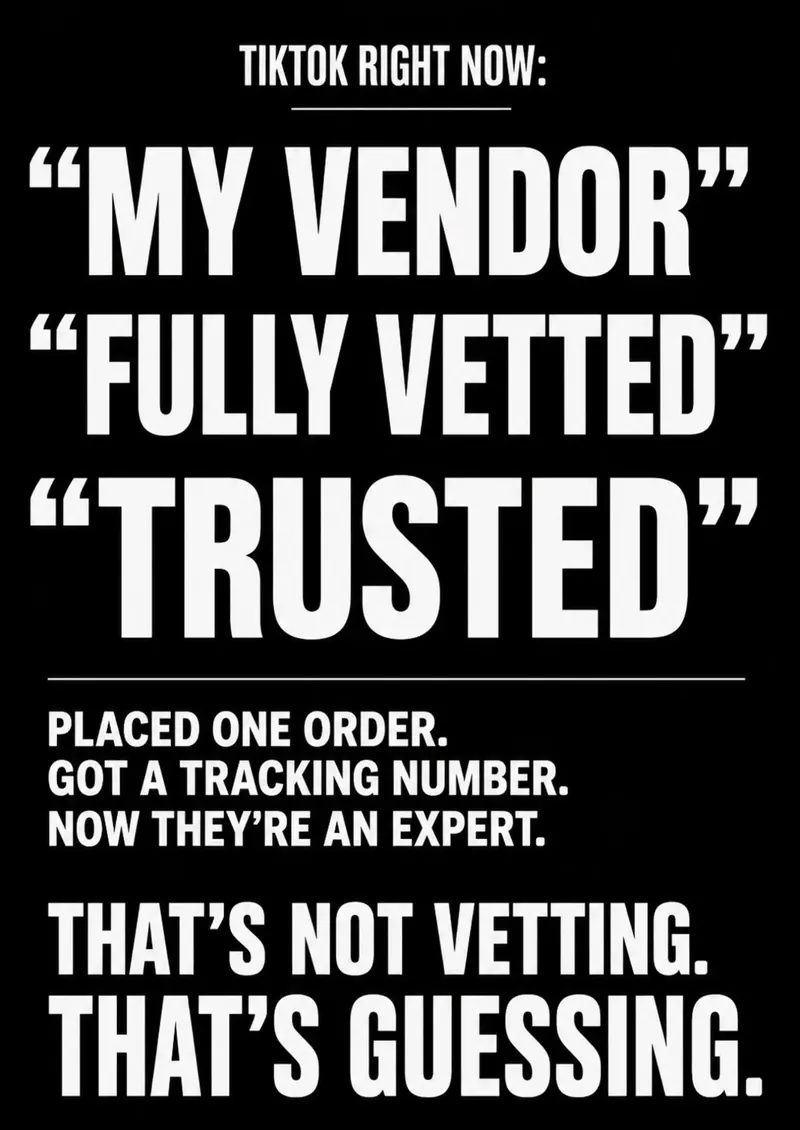
Reviews are often just a snapshot of a single moment in time. Positive reviews are usually written during the “honeymoon phase,” and negative reviews might be specific to a batch that is long gone.
Use reviews as a guide, but prioritize the live, ongoing conversations happening in the chats right now. They are one of many “dots” along your decision timeline. Reviews should not be the only decision-making point you use.
Final Point
There is no “perfect” vendor. This is a DIY environment that requires active participation and constant skepticism. Your first purchase isn’t a lifetime commitment, stay mobile, stay informed, and always be ready to switch if the quality starts to dip.
Comments