
It started with someone asking why UZORAK was considered unfavourable and whether there were any specific problems with the laboratory.
One member replied that “people are just like that,” before saying they’d compared UZORAK and Janoshik head-to-head and received the same results. They later added that they’d carried out more than ten tests with UZORAK while also using Janoshik.
Another member suggested that people remembered the public battle between Janoshik and UZORAK but didn’t necessarily have anything negative to say about UZORAK’s actual laboratory results.
The first member agreed. Their argument was that if UZORAK was considered unreliable, Janoshik should be considered just as unreliable because Janoshik had made multiple mistakes with their testing.
They then gave one example.
They claimed Janoshik had tested a sample as severely underfilled before later admitting that the result was wrong. They tagged Janoshik and asked to be reimbursed for the money they’d spent having the batch retested by Freedom Diagnostics.
What began as a question about UZORAK was already turning into a complaint about Janoshik, and Janoshik had not even entered the conversation yet.
Then Peter M. Janoshik himself, appeared and asked for the report numbers.
Someone else claimed UZORAK had been caught outsourcing its testing despite presenting itself as having its own laboratory. It was also alleged that UZORAK may now be closing down.
Within minutes, the vendor poll channel had become a laboratory comparison, a refund request, an outsourcing allegation and an unexpected Janoshik customer-service desk.
The NAD+ Result
The disputed sample was a vial labelled as containing 1,000 mg of NAD+.
Janoshik had initially reported the content at approximately 387 mg, making the vial appear more than 60% underfilled. However, vials from the same batch had been tested by five different laboratories, with the other results placing the content around the expected 1,000 mg.
A Freedom Diagnostics report shared during the discussion showed two vials measuring approximately 1,097 mg and 1,086 mg, producing an average of around 1,091 mg.
The member explained that five laboratories had tested vials from the same NAD+ batch and claimed that only Janoshik had returned the severely underfilled result. Janoshik initially misunderstood this as one sample producing five separate reports. While correcting him, the member suddenly realised who they were speaking to.
“Wait, you are Janoshik?”
Yes. They’d spent several minutes complaining about Janoshik to Janoshik without realising Janoshik was Janoshik.
Once that minor identity crisis had been resolved, Janoshik said he recognised the mistake and had already offered a refund. The member apologised for being aggressive, explaining that they’d assumed he was simply some random person questioning their account.
Janoshik replied:
“No problem.”
However, the member made it clear that the refund wasn’t really the point. Their concern was how such a large error had passed through Janoshik’s system and reached the customer in the first place.
Janoshik agreed that they had every right to be angry and said two chemical engineers had made the mistake. That didn’t make the situation sound better.
The member’s response was essentially: hire better people. If two chemical engineers had both been involved, why had nobody double-checked the result before releasing a report showing the vial as severely underfilled?
At this point, the conversation stopped being about compensation and became a public examination of Janoshik’s quality-control system.
How 8 ml Became 3 ml
Janoshik explained that the sample had been dissolved in 8 ml, but somewhere during the process the volume was misread as 3 ml. He said the sample had been tested twice. However, because the same incorrect dilution volume was used in the calculations, the second test merely confirmed the first mistake.
Excellent repeatability. Slight problem with accuracy.
The customer said none of this appeared on the final report, which was why they’d assumed Janoshik hadn’t even repeated the test. Janoshik explained that solvent volumes were kept within the laboratory’s internal records. His response to the staff error was brief:
“There goes their bonuses.”
So two chemical engineers had tested the sample twice and successfully reproduced the same wrong answer because both calculations began with the same incorrect number.
Janoshik also said that, unlike some laboratories, his team had not simply copied the 1,000 mg written on the vial label into the result field.
Fair enough. The reported figure may have been wrong, but at least it was independently wrong.
Then Freedom’s Report Came Under Fire
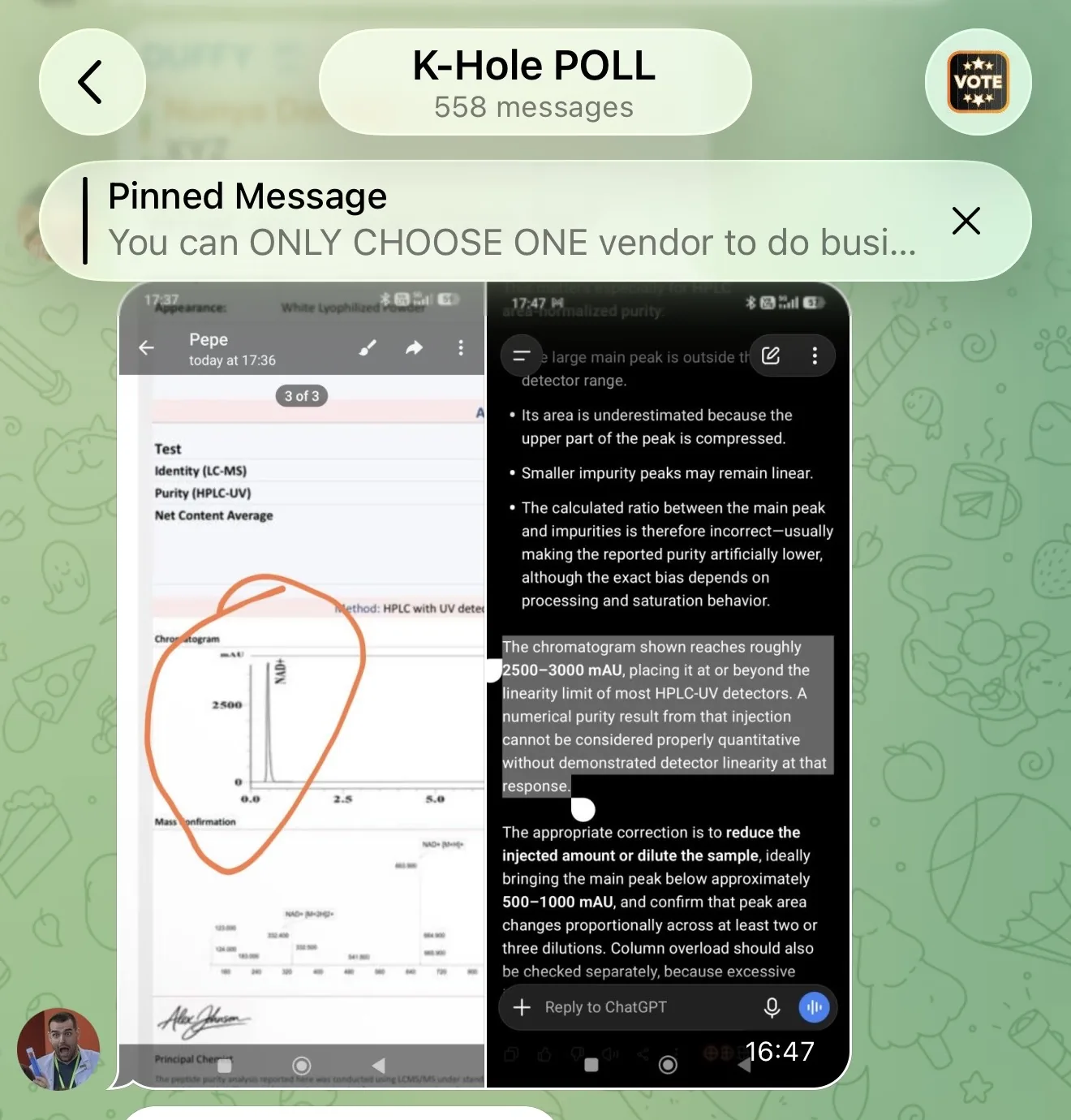
Janoshik then turned his attention to the Freedom Diagnostics report and claimed that it had a separate problem.
The chromatogram showed a peak exceeding approximately 2,500 mAU, which he said was outside the detector’s reliable linear range. That concern related to the reported purity figure rather than explaining Janoshik’s incorrect net-content result.
When someone asked whether the Freedom figure was effectively nonsense or the result of a machine problem, Janoshik answered yes and offered to provide a ChatGPT explanation.
Someone replied:
“OK UZORAK.”
Janoshik asked for a moment to proofread the answer first, adding:
“UNLIKE UZORAK.”
Unfortunately, someone else had already made the joke.
“Fuck,” he replied. “Beat me to it.”
The promised ChatGPT explanation suggested that the Freedom peak may have exceeded the detector’s linear range, meaning the purity figure couldn’t be treated as properly quantitative without diluting and retesting the sample. The response from the group was immediate:
“Fuck off, that cannot be true.”
Apparently, laboratory disputes have now reached the stage where the machines, the analysts and ChatGPT are all being called as witnesses. So there were potentially two different problems in the same set of results:
Janoshik used the wrong dilution volume and substantially underreported the NAD+ content.
Freedom Diagnostics appeared to produce a chromatogram with a peak outside the detector’s reliable range, calling its reported purity figure into question.
One batch, five laboratories and more than one opportunity for either the machines or the people operating them to have a bad day.
The original complainant still maintained that UZORAK had returned the same purity and content results as Janoshik during blind comparisons. Their position was that people could criticise UZORAK’s processes but should not dismiss its results merely because of the public feud between the two laboratories.
Janoshik also alleged that a previously reported security flaw on UZORAK’s website hadn’t been fixed and that information could still be changed.
By this stage, the answer to the original question was less clear than ever. Janoshik had admitted one serious calculation error, raised a separate concern about Freedom’s report and then called in ChatGPT to explain the science.
The emerging conclusion appeared to be that one laboratory might no longer be enough. For complete peace of mind, customers may now require two laboratories, a calculator and an AI subscription.
No More Handwritten Dilution Volumes
Janoshik said the laboratory had changed its process so that dilution volumes were no longer handwritten. He explained that handwritten records had worked when the laboratory had ten employees, but it now had 55. At some point between employee ten and employee 55, the handwriting stopped being a laboratory system and became a game of chemical Chinese whispers.
Members welcomed the fact that he was taking accountability and joked that the best Janoshik customer support could apparently be found inside the K-Hole.
They also began offering candidates for several new positions, including a chief meme officer, a personal driver, a car washer and someone to make tea for the driver.
The driver’s position was already taken, although Janoshik clarified that this was private staff rather than company staff.
Important corporate distinction.
The discussion then moved to why multiple samples submitted together could sometimes be tested several days apart rather than consecutively.
Janoshik said the laboratory receives around 1,000 samples a day. Different types of samples follow different routes, are handled by different people and are not simply placed into one long queue. He also said the laboratory operates more than ten HPLC machines.
A member then quoted Janoshik’s explanation and asked whether anyone could get “@Janoshik” to comment.
Janoshik replied:
“That’s literally me.”
For the second time in the same conversation, someone had managed to speak directly to Janoshik while simultaneously asking where Janoshik was. Despite the accidental identity confusion, Janoshik said he was always happy to answer questions from a friendly community.
What began as a complaint about one incorrect report had now developed into an informal customer-support session, a laboratory workflow explanation and a recruitment fair, all without anyone needing to leave the K-Hole.
The Impromptu Business Interview
The conversation then evolved into an unexpected business interview. Asked what advice he would give someone starting a peptide-testing laboratory today, Janoshik said to expand as much as possible and, if quality-control problems began appearing, to look closely at the people around them.
He said he had lost a great deal of patience trying to keep everything operating at “110%,” while watching competing laboratories attract supporters despite what he described as unreliable practices.
He specifically accused AFI of inventing figures on reports and UZORAK of selling Claude-generated output for $1,000.
Those were Janoshik’s allegations, but they certainly kept the friendly question-and-answer session moving. Janoshik said his main problem was not a lack of business but too much of it. The laboratory was already operating at capacity and refusing work.
Asked whether the peptide-testing boom might simply be another temporary hype cycle, he said he had expected demand to peak around ten times already.
It had apparently ignored every opportunity. Once all staff were trained, he expected the laboratory to handle approximately 1,000 samples per day without a backlog. One member helpfully summarised peptide testing as:
“Petri dish. Microscope. Baddabing, baddaboom. 98%.”
Janoshik’s expansion plans were slightly more complicated. He said the laboratory would need to grow from approximately 1,000 to 2,000 square metres, but the required space simply didn’t exist.
Opening another location was suggested, although Janoshik noted that small laboratories were “all fun and games” until the scale of the operation caught up with them.
There were also questions about opening a US laboratory. Instead, Janoshik said they were working on free shipping from the US to the existing laboratory for orders over approximately $300.
Then came the question everyone really cared about: if capacity was increasing, would prices go up or down?
Janoshik revealed that prices had already been increased partly in the hope that the higher cost would reduce demand.
A bold strategy. Unfortunately, customers continued sending samples anyway. So Janoshik’s business model appeared to involve raising prices to discourage customers, refusing work because too many customers remained and trying to double the size of a laboratory inside a building where the additional space did not exist.
The peptide-testing boom was going extremely badly, in the most commercially successful way possible.
Two Hundred Bad Results in One Day
The discussion also turned to the apparent rise in failed products. Janoshik said that, on the previous Friday, approximately 200 out of 1,600 samples had tested badly.
One member briefly interpreted this as one failure in 800 before being reminded that 1,600 was the total number of samples, not the denominator in a particularly optimistic fraction.
Janoshik then admitted there was one small advantage to the growing number of bunk peptides:
“I love bunk peptides. Less work.”
If a sample contains nothing useful, there is apparently far less to process manually. Terrible news for the customer, but excellent for laboratory efficiency.
How Many Manufacturers Are Really Behind the Market?
The discussion then became considerably more interesting. Janoshik was asked whether the laboratory could use its accumulated data to connect products from apparently different batches, for example, vials with different coloured caps that contained the same unidentified substance or shared the same analytical characteristics.
He said it could.
He also said he could probably identify the recurring substance because the laboratory was seeing “the same thing again and again.”
This led to the obvious question: with access to such a large number of test results, could Janoshik estimate how many actual manufacturers sat behind the enormous number of vendors, brands, cap colours and supposedly separate product lines?
“I do have a pretty good idea,” he replied.
That may have been one of the most interesting comments in the entire conversation.
Thousands of sellers may exist, but their chemical fingerprints could point back to a much smaller group of manufacturers. Different labels, different caps and the same mystery substance enjoying another tour of the grey market.
The grey market may have hundreds of vendors. The chemistry appears rather less imaginative.
The Parcel Trolley
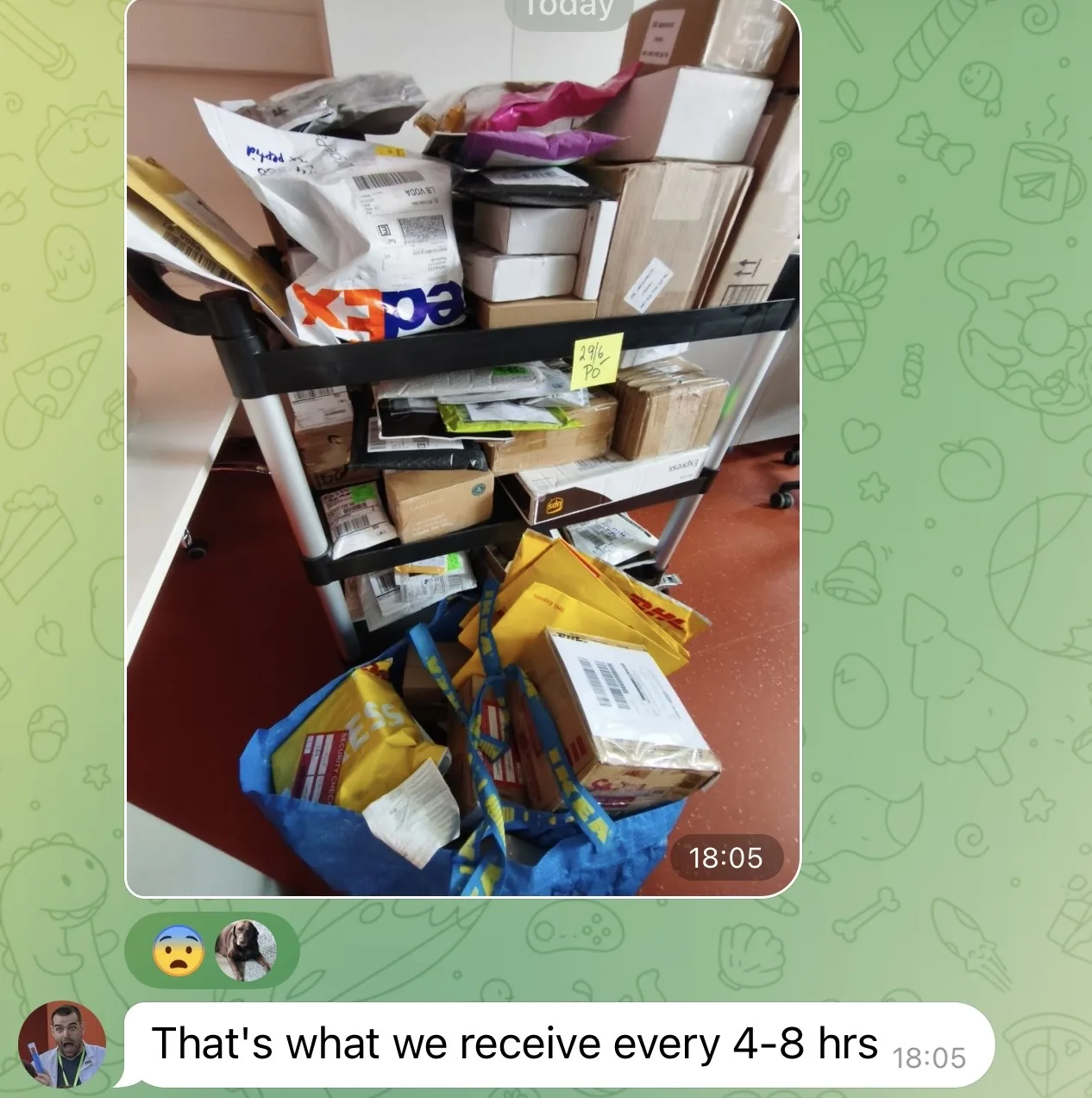
Janoshik then shared a photograph of a trolley overflowing with parcels and said this was roughly what the laboratory receives every four to eight hours. Someone admitted they would be tempted to steal the packages before immediately reconsidering. A trolley full of unlabelled research chemicals is not quite the lucky dip it first appears to be.
Janoshik said the laboratory has round-the-clock security because it works with scheduled substances. He claimed there were 38 cameras on one network and another 32 in a second building. Seventy cameras in total, presumably enough to identify exactly who wrote “3 ml” instead of “8 ml” from several different angles.
Asked whether the laboratory had some form of permission from the authorities to receive these substances, Janoshik said it had the required paperwork, unlike “mostly everyone else.”
He also confirmed that sample disposal had to be properly documented, complete with timestamps, signatures and other records.
One member wondered why the authorities permitted the laboratory to receive parcels when everyone knew what some of them might contain. They then answered their own question: if one country prohibited the work, another would allow it and collect the tax instead.
Janoshik appeared quite taken with that argument.
“That’s what I’ll tell them,” he said.
He added that the company could move to Slovakia, Poland or the US and leave the current country with none of its tax revenue.
Why Not Move to America?
The US presented another problem.
Janoshik claimed that around 30% of the laboratory’s present work could not legally be performed there. He specifically mentioned HGH testing and handling, saying HGH is scheduled in the US and that a business-to-consumer laboratory would be unlikely to obtain the required permit.
The conversation then moved to the UK, where someone wondered why there were not more testing laboratories.
Next came a question about Class A and B substances.
Janoshik initially appeared unsure what that meant. They were described to him as white powders that could be smoked or taken through the nose.
“We don’t do those,” he replied.
Then added:
“Cartels respect me tho.”
By this stage, the vendor poll had covered laboratory errors, handwritten dilution figures, lost staff bonuses, 1,600 daily tests, scheduled substances, international relocation, tax policy, 70 security cameras and Janoshik’s alleged standing within organised crime.
All because someone originally asked why people disliked UZORAK.
What About Elora?
The discussion finally turned to Elora. Janoshik was asked how many failed Elora tests he’d seen and whether the results suggested several manufacturers were attempting to produce it, given the belief that only one source was currently producing an acceptable version.
His answer was zero.
That sounded remarkably encouraging until he added that the laboratory had only tested around ten Elora samples in total. Zero failures, therefore, but from a sample size small enough to fit comfortably inside one of the parcels on the trolley.
The answer also did not establish how many manufacturers were actually producing it.
The Most Important Decision of the Evening
The search for a UK testing laboratory didn’t get very far. Lab4Tox was suggested, but Janoshik pointed out that it was actually in Poland. Faced with the prospect of continuing to send samples to Janoshik, one member accepted that they would simply have to contribute towards his next supercar.
Janoshik agreed that it might be time to try a Lamborghini.
The conversation then moved seamlessly from peptide testing to helping him choose between a Ferrari 849 Testarossa Spider and a Lamborghini Revuelto. A Ferrari 812 Superfast was also suggested, because apparently one expensive option was not enough.
Meanwhile, someone was still trying to find out when the proposed free US shipping would begin. Janoshik said there was no specific date yet. So the final tally included:
One incorrect Janoshik NAD+ result.
A separate concern about the Freedom Diagnostics purity result.
Five laboratories testing one batch.
Two chemical engineers losing their bonuses.
ChatGPT acting as the emergency third laboratory.
A new ban on handwritten dilution volumes.
Two people speaking to Janoshik without realising they were speaking to Janoshik.
More than ten HPLC machines.
Around 1,600 tests in one day, with approximately 200 testing badly.
Seventy security cameras.
Zero failed Elora results from roughly ten tests.
No newly identified UK laboratory.
No confirmed date for free US shipping.
No final decision on the next supercar.
The testing question was eventually answered.
The truly difficult choice, Ferrari or Lamborghini, remained unresolved.
I’d don’t know about everyone else, but I’m definitely looking forward to more Janoshik appearances. His presence is certainly comedy gold

Comments