
The discussion began with a customer questioning the detail provided in Janoshik’s eloralintide NMR reports. Comparing recent reports with earlier examples, they said the PDFs offered little beyond “bridge present” and described the accompanying graphs as incomplete and unhelpful, citing feedback from experienced users.
Janoshik said the reports were deliberately kept to a “bare minimum”, explaining that “less data = less confusion and less stuff to explain”. What followed was a debate about what customers should receive for their money. Some wanted the evidence behind the conclusion; others were happy with a simple yes or no, provided further information could be obtained when needed.
The sums involved help explain why customers wanted more detail. An itemised quote shared in Peppers in June listed eloralintide analysis at US$600, NMR eloralintide analysis at US$900 and LC-HRMS/MS eloralintide analysis at US$1,400. These were separately priced services in a quote reproduced by a group member. At those prices, customers asking for supporting evidence wanted to understand what their money was buying and how the conclusion had been reached.
There’s a reasonable case for keeping a report easy to read. Some people wanted confirmation that their vial contained what they expected, perhaps with a few numbers and an easy way to obtain more data. They worried that additional work would increase prices and discourage testing. But customers asking for more detail were already paying substantial sums. For them, the question was whether the price included access to the evidence behind the answer.
A longer report doesn’t automatically offer better value, and unexplained graphs may leave a customer no better informed. The price covers the analytical work and the expertise needed to interpret it, as well as the report. Even so, a clear summary and supporting evidence can sit alongside each other. Someone who wants a quick answer can read the conclusion; someone who wants a second opinion can pass the supporting material to a qualified person.
That was the substance of the original complaint: when customers pay hundreds of dollars for testing, is a statement that the bridge is present enough, or should they also receive enough supporting information for someone else to assess the conclusion?
Janoshik said that, of approximately 30 eloralintide bridge NMR orders, only one customer had understood the purpose of the analysis. He also expressed the view that regular HPLC testing was sufficient, saying bridge defects would affect retention or molar mass, while referring to some unlikely exceptions.
For customers who had nevertheless chosen to pay for NMR, the practical question remained: what did that purchase include? A targeted check for a particular feature, a broader structural investigation and a report containing the supporting spectra are different expectations. Those expectations need to be clear before the sample is submitted.
The debate then widened to an earlier TFA test. A customer shared an email asking why their report contained only “not detected”, without quantification or instrument data. They said they had spent almost $400 and pointed to an older report that included more information.
(Below; Janoshik TFA reporting: “not detected” on the left, with an accompanying NMR plot shown on the right)
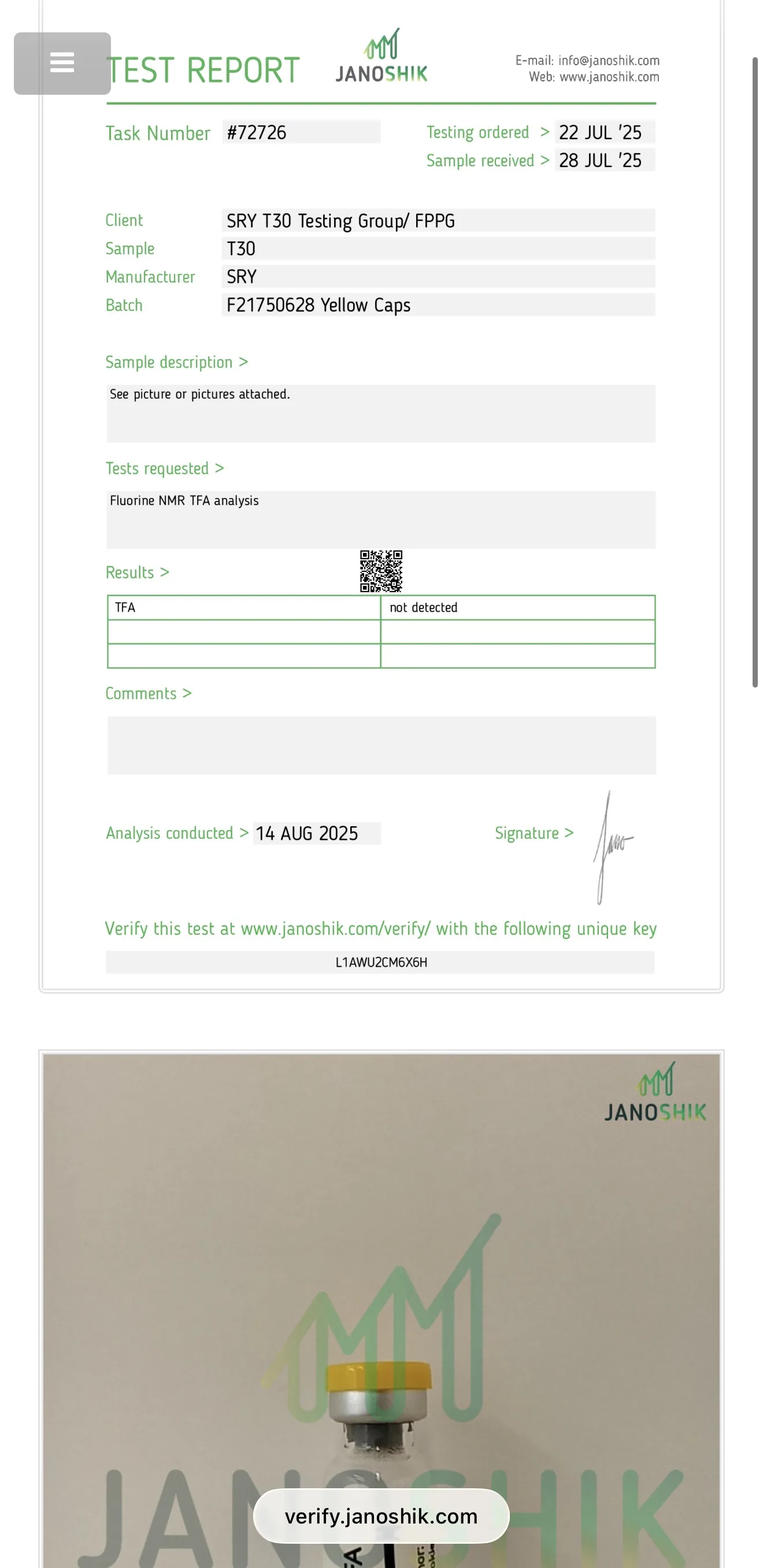
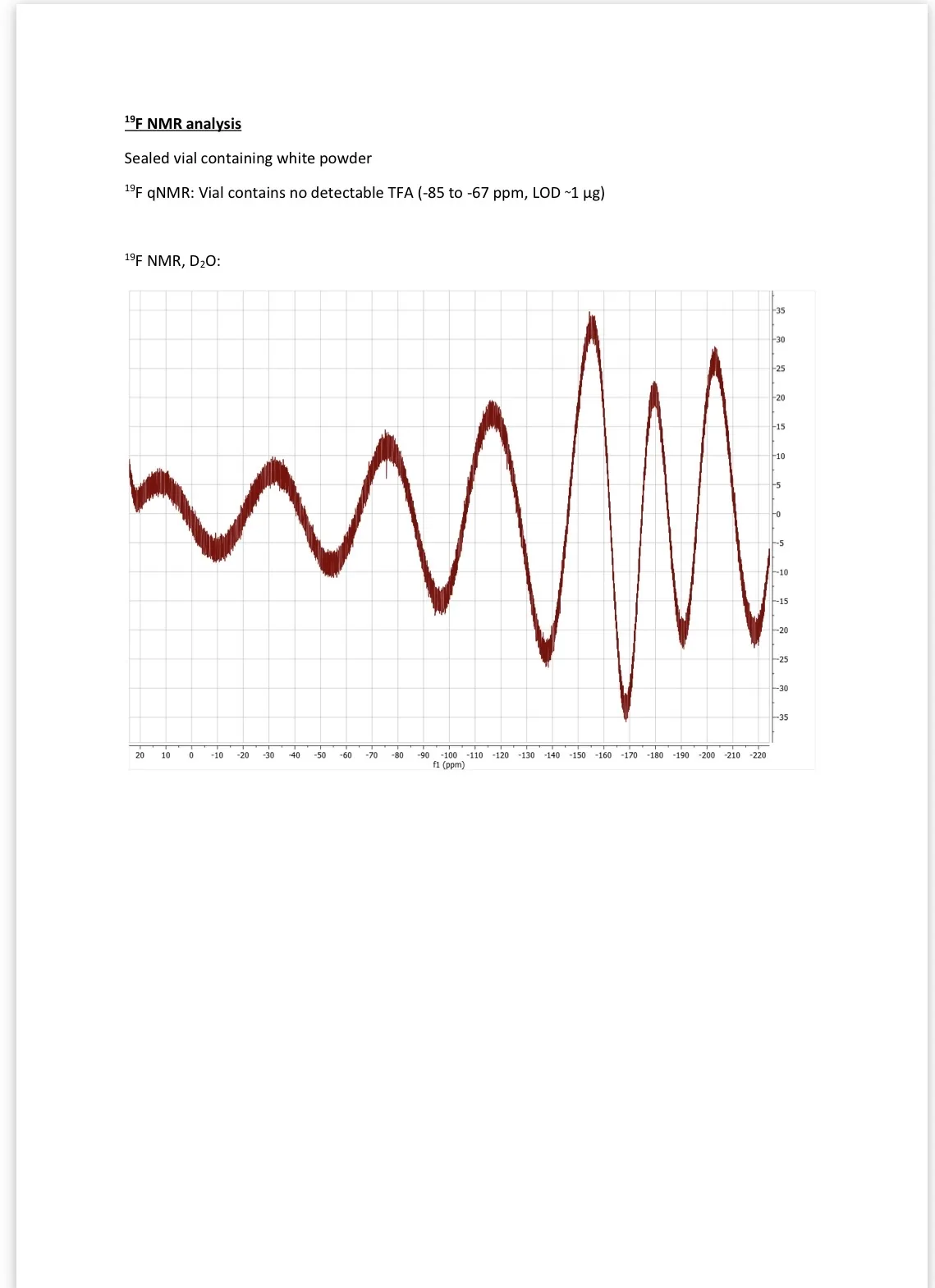
The displayed response from Janoshik customer care, dated 23 June, explained that the laboratory’s workload had grown to eight times its earlier volume. Exporting raw data for every sample would take hours each week, it said, and the staff weren’t available to do that.
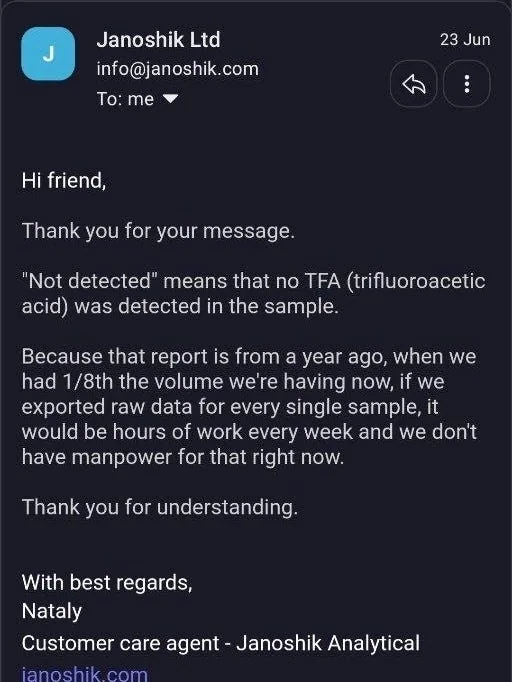
Janoshik’s response was that exporting raw data takes time, citing staff handing in their notice because they were overworked. He described choosing between running three GLP tests worth approximately $1,000 and exporting a set of raw data for free. He also said the lab had acquired a new NMR machine over the summer and needed a couple of weeks to work out how to export its data efficiently. His position was that the sample queue and staff training took priority over additional work that hadn’t been agreed beforehand.
He also acknowledged staffing problems during rapid growth, but said most teams had more than doubled in fewer than three months. He said every TFA report since August included raw data at no additional charge and that further information had been added to reports when clients contacted the laboratory. The customer disputed whether their own raw-data request had been fulfilled, saying they had paid for it. The customer also referred to a charge of 700 for NMR, arguing that providing supporting information was part of a paid service rather than a favour. When the customer supplied the task number, Peter offered to add the graph, describing it as ‘literally a blank line’. The customer declined, saying the broader reporting issue was their concern.
This explains the operational difficulty from the laboratory’s perspective. It also exposes the disagreement over what constitutes an additional service. The lab described exporting data as work beyond the testing itself. The customer regarded supporting information as part of what made the purchased result worthwhile.
There was evidence of a different customer experience, too. Others reported receiving satisfactory additional information after contacting Janoshik. That doesn’t resolve the complaint, but it shows why the exchange shouldn’t be treated as proof that every request met the same response.
As the discussion returned to NMR, the customer asked for full ¹H and COSY spectra. Peter invited them to request the material they wanted and said clients could specify what should be exported, sent or performed. He stated that ¹H was not done unless requested because he didn’t consider it absolutely necessary, and suggested that COSY could suffice.
That distinction matters to the purchase. Requesting an existing record and requesting an additional test are different things. Customers need to know which tests their quoted price covers, what evidence will accompany the conclusion and whether further work carries an additional charge. Otherwise, both sides can believe they’ve been clear while understanding the order differently.
The discussion eventually became more constructive. Janoshik was encouraged to use its reputation to establish a higher reporting standard by routinely including supporting evidence. Routinely including that evidence could also help customers assess competing laboratories and challenge unsupported claims. Peter said he would keep the suggestion in mind. When the original customer said the criticism came from caring about the lab, Peter replied that the laboratory was improving because he cared about its customers.
That ending should be acknowledged. He engaged with the criticism, described changes to TFA reporting and offered a route to more detailed NMR material. There was, however, no specific commitment in the supplied exchange to make fuller NMR reports standard.
Final Thoughts
The issue comes back to what customers can reasonably expect when they pay substantial sums for specialist testing. Some will be satisfied with a short conclusion; others will want an explanation and enough supporting material to have the result reviewed. A report can accommodate both by making the answer easy to find and explaining what was tested, what the conclusion covers and how to obtain the evidence behind it. If that costs extra or requires a different testing package, customers should know before paying.
Customers shouldn’t have to become chemists to ask questions about a service they’ve bought. They may rely on the lab’s expertise or seek another opinion, but they should understand what their money has purchased.
What do you expect when you pay for testing: a clear yes or no, or the supporting data as well? Would you pay extra for that information, or should it already be included in the price?

Comments