
As the fallout over Jack’s bunk peppers continued, a live discussion began inside XYZ Jack’s channel in K-Hole about HGH testing.
After I shared the preliminary findings from Jack’s HGH sample which showed just 3.3 IU rather than the claimed 15 IU, Pacific Coast Biologics went on to discuss other HGH samples they’d tested by SDS-PAGE, claiming samples one and three appeared to have at least 98% purity. Sample two appeared slightly heavier, which he suggested could indicate a 192-amino-acid form of HGH.
Then Peter M., better known as Janoshik, appeared in the channel (invited by myself the day before)
He immediately challenged the conclusions being drawn from the SDS-PAGE results. Janoshik said it was inappropriate to infer purity or the absence of dimers using that method and argued that LC-MS and SEC-HPLC would be more suitable.
Pacific Coast Biologics (not realising this was Janoshik), defended his interpretation, saying he’d manufactured recombinant proteins for 20 years and completed thousands of protein refoldings. Janoshik replied that he’d worked in analytical chemistry for 15 years, tested more than 4,000 HGH samples and had never encountered the claimed 192-amino-acid version.
What began as a discussion about Jack’s severely underfilled HGH quickly turned into an argument between two people claiming decades of laboratory experience.
Pacific Coast Biologics told Janoshik to “check what dimer is,” asked how many proteins he’d folded during his career and suggested he take a course on protein folding. Janoshik called the comments insulting and repeatedly asked for a single publication showing SDS-PAGE being used to measure HGH dimers.
Most members admitted they’d no idea what either man was talking about, but that didn’t stop them enjoying it.
One member announced that he was uploading the exchange to ChatGPT to find out who was right. The answer posted back into the channel found Janoshik to be “more correct overall,” stating that Pacific Coast Biologics was drawing conclusions from the gel that it could not reliably prove.
When someone finally asked the question everyone wanted answered, whether dimers are relevant in HGH, Janoshik said they were and that the pharmacopoeia specifically addresses them. However, he added that too many factors were involved to give a simple conclusion about their effect.
Pacific Coast Biologics continued to predict that sample two contained an additional methionine and said he would conduct N-terminal sequencing the following week. Janoshik told him to run LC-MS immediately because it would take only two minutes.
One member summed up the unexpected arrival perfectly:
“Somehow Jack managed to bring Jano in here. Probably his biggest success.”
The argument soon moved well beyond Jack’s HGH.
Members began debating the credibility of both testers. Some defended Pacific Coast Biologics because he was reportedly completing much of the testing free for the community. Others questioned his COA verification system and the evidence supporting his claimed 20 years of experience.
Janoshik asked where his LinkedIn profile, publications, podcasts and interviews were. When the discussion turned towards Janoshik’s own absence from LinkedIn, members pointed out that his name had been known across testing forums for around 15 years.
Then the exchange took another unexpected turn.
Someone joked that a Ferrari was better than LinkedIn. Janoshik responded, “How about Porsche,” before posting photographs of sports cars from his garage. Another photograph showing him beside a Ferrari followed.
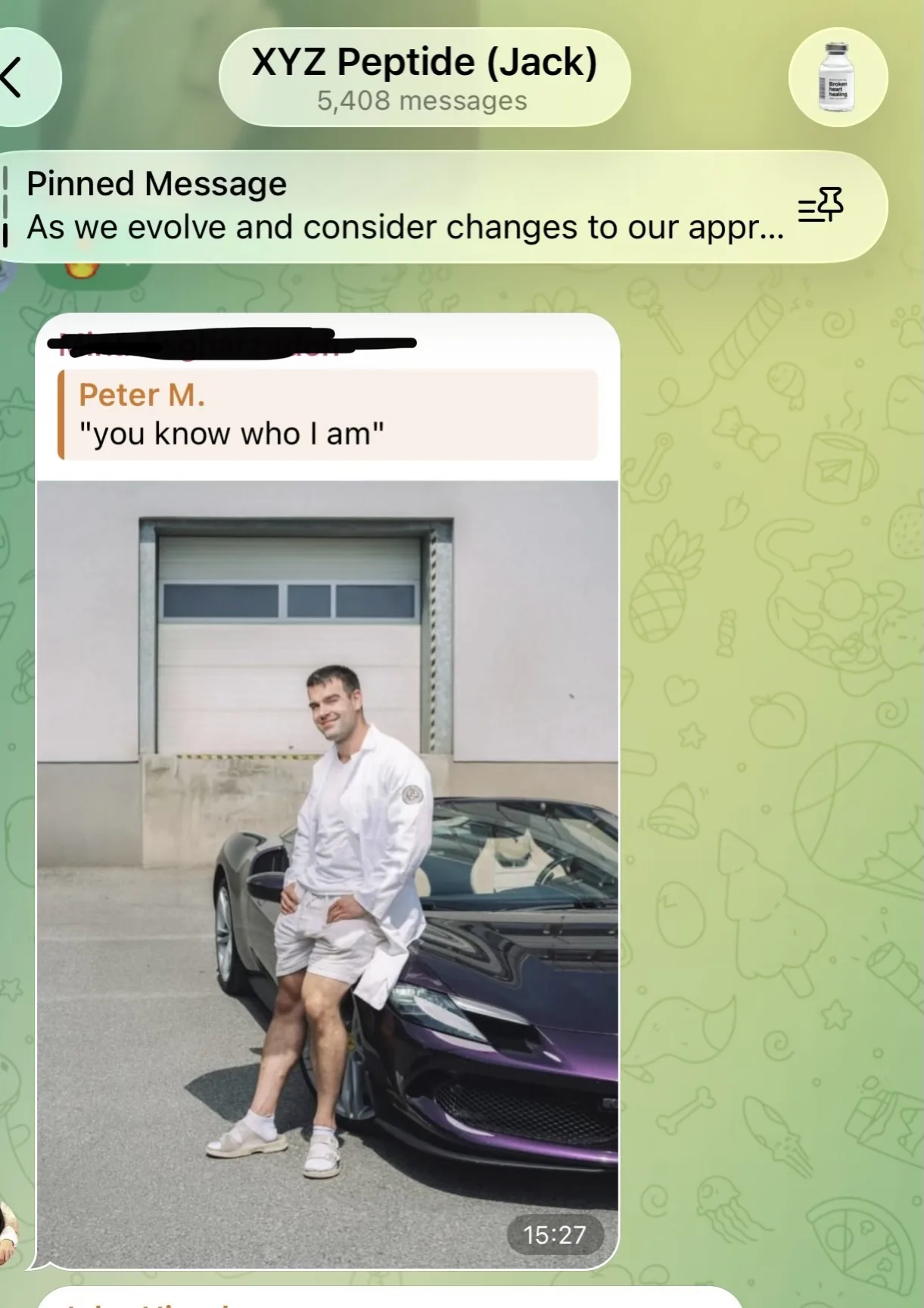
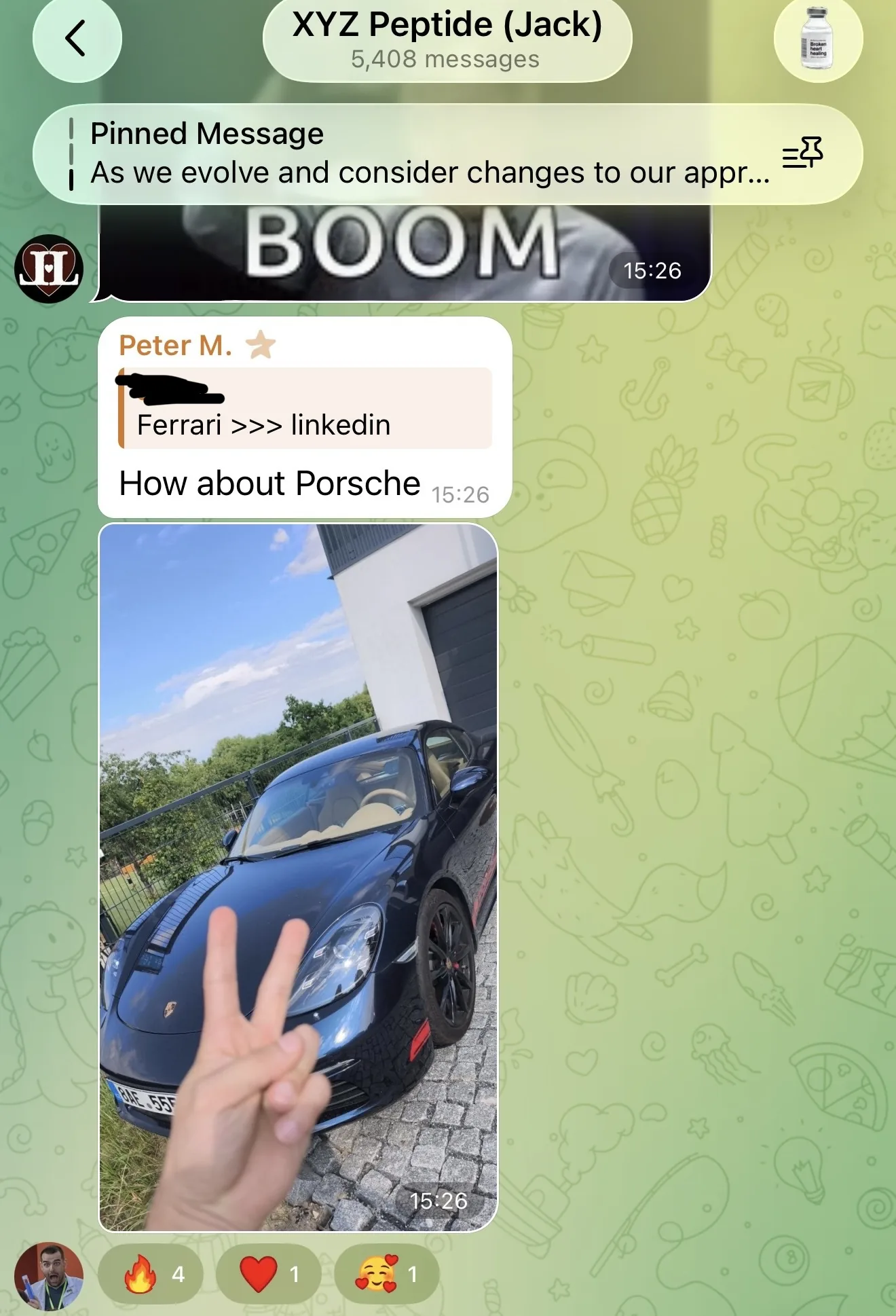
One member joked:
“I can see my GH test money are put in good use.”
Asked whether he already had the photographs ready or had run to his garage to take them, Janoshik replied:
“I am literally in my garage. I just arrived at home.”
He then added:
“What sort of an analytical chemist are you, if you don’t have a sports car collection?”
Pacific Coast Biologics attempted to return to the professional dispute by proposing that the pair be placed in a recombinant protein manufacturing laboratory to see who could produce the better HGH. The highest ED50 result would win.
One member compared that challenge to Janoshik proposing a Ferrari race in an area where only one of them specialised.
The conversation later drifted towards duplicate Janoshik reports. Members raised concerns that an original customer could pay for copies carrying different names, allowing one test to appear connected to numerous companies.
They suggested that duplicate reports should be identified and linked back to the original. The administrator pointed out that any wording added to the report could simply be removed using Photoshop.
Janoshik said the system was intended partly to accommodate large manufacturers and claimed the biggest customers were not the ones abusing it. Members remained concerned that a single manufacturer could operate through numerous company names and request multiple versions of the same COA. Customers could then see identical reports carrying different names without knowing whether the businesses were connected or whether each had tested separate stock.
By then, Jack’s HGH had almost disappeared from its own discussion. His channel had gone from preliminary HGH results to an argument over SDS-PAGE and SEC-HPLC, professional credentials, sports-car photographs, a protein-manufacturing challenge and finally a debate about duplicate COAs.
Jack’s HGH may have tested at only 3.3 IU instead of 15 IU, but it did manage to bring Janoshik directly into his channel and start an impromptu scientific symposium.
Jack may have crashed and burned, but his channel had somehow become the most entertaining discussion of the day.

Comments