
TL;DR
Eloralintide kits labelled 10 mg have produced sharply conflicting laboratory results. Vanguard repeatedly reports 15 to 18 mg, while Janoshik and Chromate find approximately 10 to 11 mg. Is the Chinese manufacturer deliberately overfilling an expensive peptide, or are the laboratories measuring it differently?
The dispute has expanded beyond quantity. Chromate reports 120 to 160 micrograms of retatrutide in three eloralintide vials, while Vanguard has encountered similar contamination in other samples. Peter from Janoshik says an additional peak could represent degraded retatrutide or an eloralintide degradation product with similar mass characteristics.
The Chinese supplier has also confirmed manufacturing retatrutide/eloralintide blends, raising further questions about production practices.
Two questions remain: why are the quantity results so different, and what exactly is responsible for the additional peaks? Further laboratory testing is underway.
The Dispute Begins: 10 mg or 15 mg?
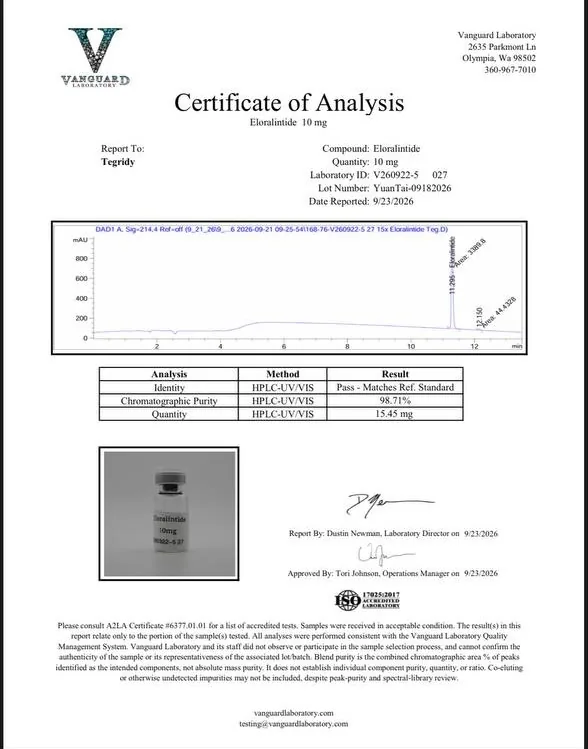
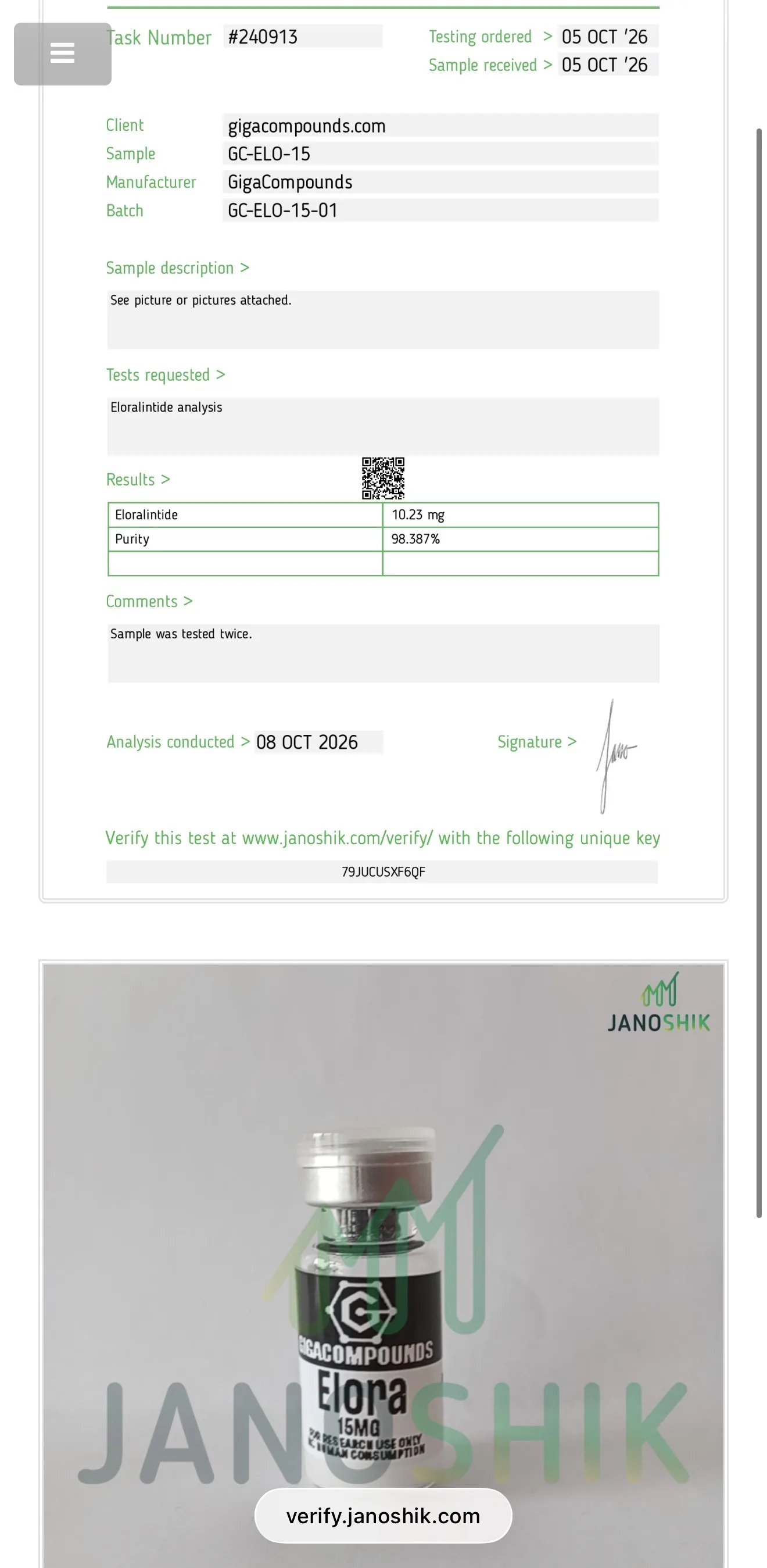
The argument began when a customer challenged Vanguard Laboratory over an eloralintide result substantially higher than the manufacturer’s label. The product was sold as 10 mg, but a vial submitted by group-buy organiser Tegridy returned 15.45 mg at 98.71% purity. Another customer had submitted eloralintide to Janoshik, entering 15 mg as the expected quantity after seeing Vanguard’s result. Janoshik reported approximately 10 mg.
The customer questioned whether a Chinese manufacturer would voluntarily overfill an expensive peptide by 50%, suggesting that a laboratory measurement problem might be more believable than such generosity. Dustin from Vanguard defended the findings, explaining that the samples had been tested repeatedly against reference standards, including a secondary check standard.
He also questioned whether the vials genuinely came from the same manufacturing batch. Matching production dates and vial caps, he argued, don’t establish batch identity without access to manufacturing records.
The customer accused Dustin of trying to play gotcha, arguing that laboratories can benefit from the same uncertainty they attribute to Chinese manufacturers. He acknowledged that uncertainty about Chinese production is precisely why independent testing exists, but added:
“But never knowing with labs is equally terrifying.”
Both sides ultimately acknowledged that the evidence was inconclusive and agreed further testing was necessary.
Vanguard Had Already Produced High Results Twice
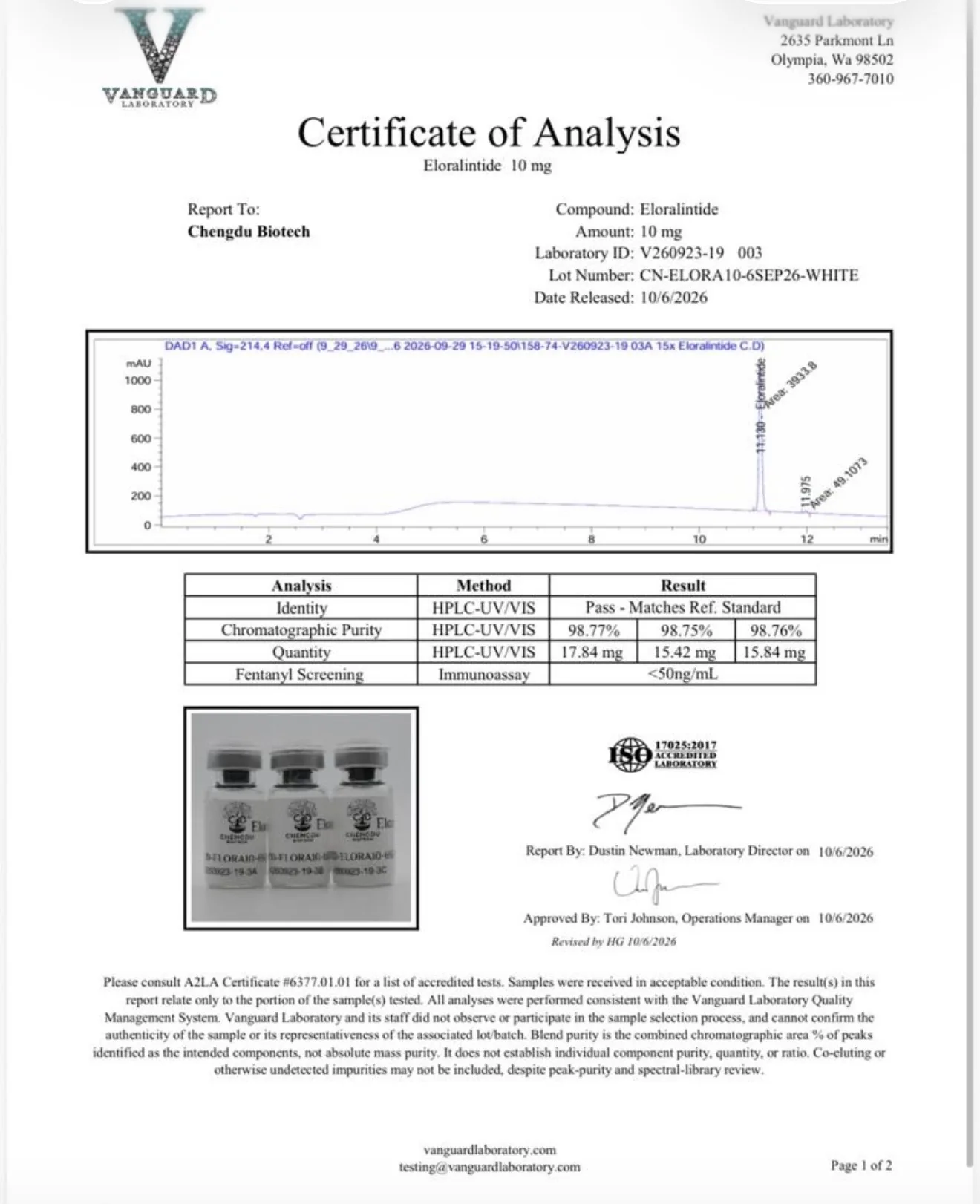
The original 15.45 mg result wasn’t Vanguard’s only high finding. A separate certificate issued to Chengdu Biotech on 6 October 2026 reported three additional eloralintide measurements: 17.84 mg, 15.42 mg and 15.84 mg, averaging 16.37 mg.
The certificate identifies lot CN-ELORA10-6SEP26-WHITE, with a stated label quantity of 10 mg. Vanguard’s three-vial average therefore represents a 63.7% overfill.
The separate submissions matter. Vanguard’s high findings weren’t confined to one isolated measurement, and its reported purity results were also closely grouped. However, consistency within one laboratory doesn’t establish agreement with other laboratories.
Tracing the ELORA10 Batch Across Different Resellers
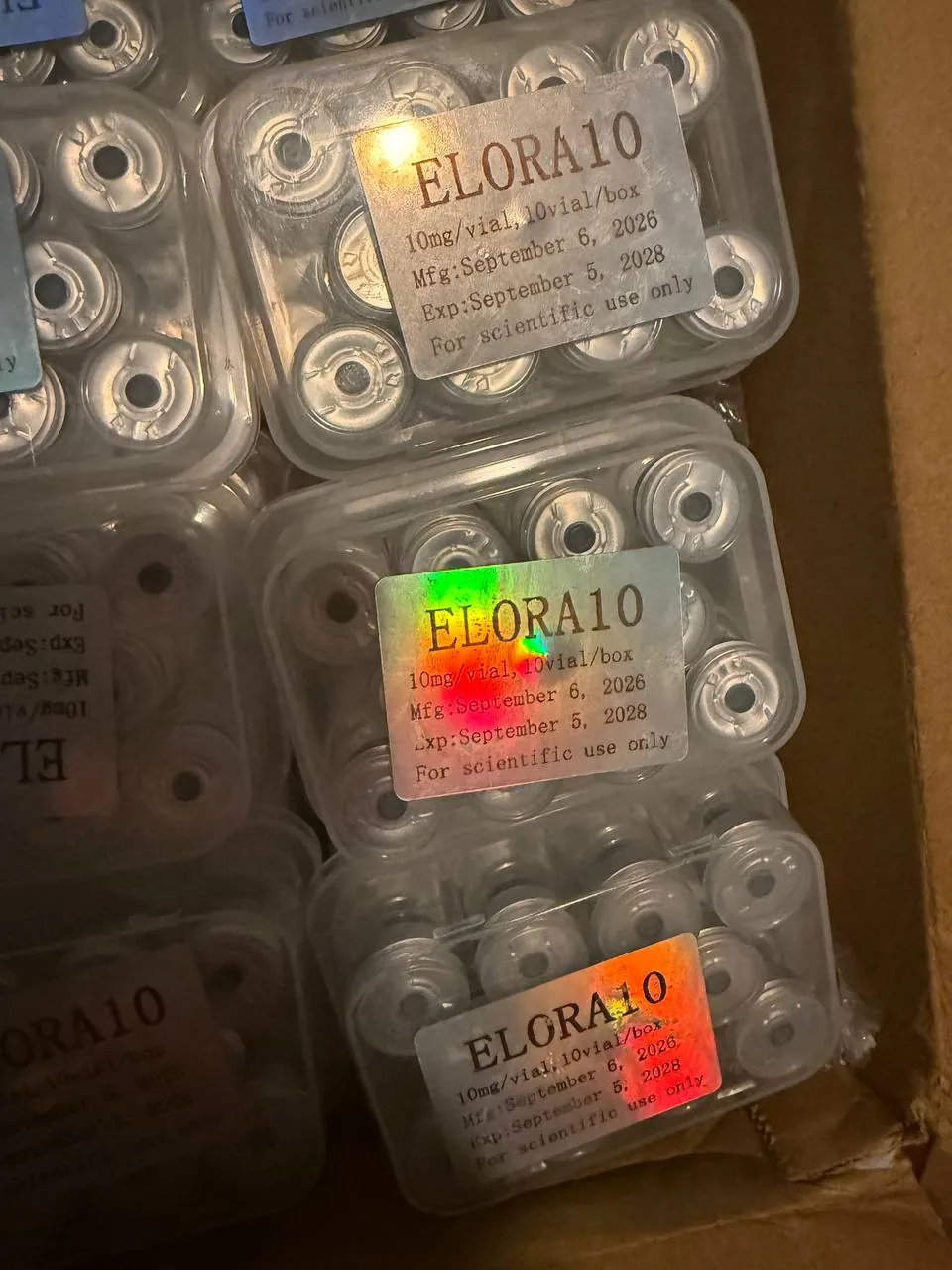
The eloralintide kits supplied by Chengdu Biotech and those supplied by Tegridy had matching packaging, including clear or silver-coloured vial caps. Both were labelled ELORA10, containing ten vials of 10 mg each, with a manufacturing date of 6 September 2026.
The group-buy organiser also disputed the suggestion in the earlier discussion that multiple 10 mg silver-cap batches could explain the results. According to his account, there was one 10 mg silver-cap batch, one 5 mg gold-cap batch and one 10 mg red-cap batch. He said the manufacturer generally aims for approximately 10% overfill, although he considered a 50% overfill unusually large.
The matching packaging and reported batch confirmation strengthen the connection between the disputed samples, but don’t establish that every vial was filled identically. The distinction between the same manufacturing batch, the same kit and the same vial remains important.
The Supplier Responds
When questioned about Vanguard’s reported 50% overfill, the Chinese supplier explained that he routinely uses additional raw material during peptide production:
“all Peptide i add 1.3times raw”
He said this practice applied to other peptides as well as eloralintide.
When pressed on why Vanguard was reporting approximately 50% overfill, he added that individual vials sometimes contain more and laboratory results sometimes come back higher. He then stated:
“The average is around 12.5”
That suggests a typical finished quantity of approximately 12.5 mg for a 10 mg product, although it wasn’t established whether he was referring specifically to the disputed batch.
Adding 1.3 times the nominal raw material doesn’t necessarily mean the finished product contains 30% extra peptide, since production losses and other factors can affect the final quantity.
The supplier’s explanation makes deliberate overfilling plausible, but doesn’t fully account for Vanguard’s 15 to 18 mg findings or the lower results reported elsewhere.
Chromate Enters the Discussion
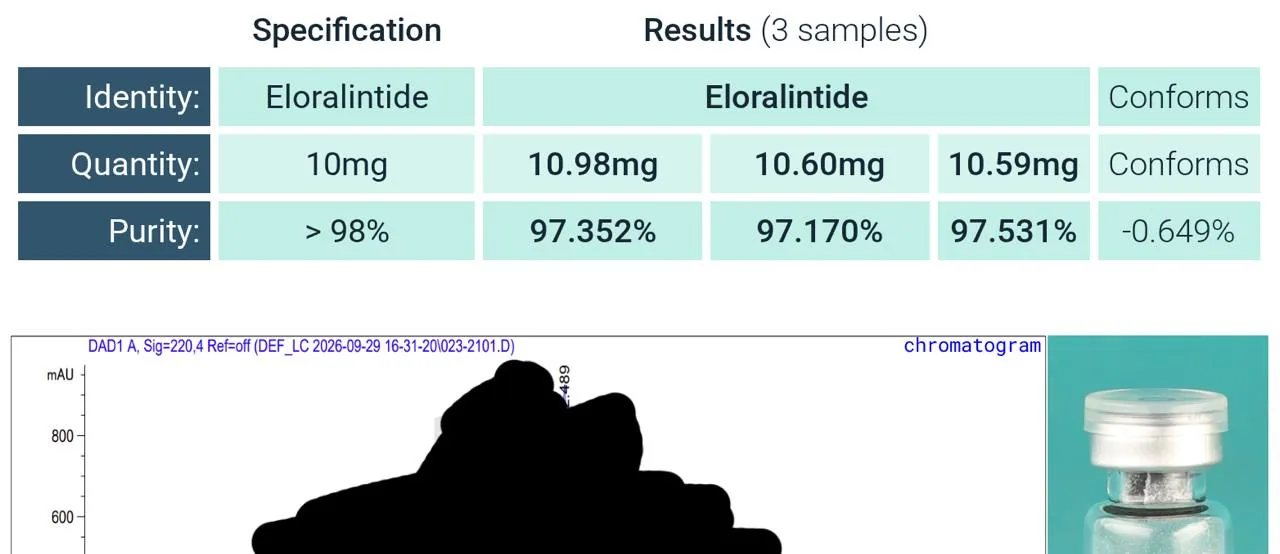
Chromate also disclosed that it had tested eloralintide with the same type of clear-cap packaging. Its three results were substantially closer to the manufacturer’s 10 mg label and to Janoshik’s findings.
Vanguard’s Eloralintide Results
Original group-buy sample: 15.45 mg, 98.71% purity
Chengdu Biotech submission:
Sample 1: 17.84 mg, 98.77% purity
Sample 2: 15.42 mg, 98.75% purity
Sample 3: 15.84 mg, 98.76% purity
Average: 16.37 mg, 98.76% purity
Janoshik’s Eloralintide Results
Sample 1: Approximately 10 mg, approximately 98.3% purity
Chromate’s Eloralintide Results
Sample 1: 10.98 mg, 97.352% purity
Sample 2: 10.60 mg, 97.170% purity
Sample 3: 10.59 mg, 97.531% purity
Average: 10.72 mg, 97.351% purity
The difference between the two laboratories’ three-vial averages is considerable. Vanguard reported 16.37 mg, while Chromate reported 10.72 mg, approximately 53% higher relative to Chromate’s average.
Chromate suspected its samples came from the same batch because they were 10 mg eloralintide vials with matching clear caps and traces of retatrutide. When asked how they knew, Chromate replied:
“No clue, unless there are multiple batches of clear top elora 10 with residual reta floating around.”
Chromate’s exact batch connection therefore remains unconfirmed.
Then Came the Retatrutide Finding
Chromate also reported an additional late-eluting peak in its eloralintide chromatograms, which the laboratory identified as retatrutide, estimating 120 to 160 micrograms per vial across three samples.
The product was sold as eloralintide, not a retatrutide/eloralintide blend.
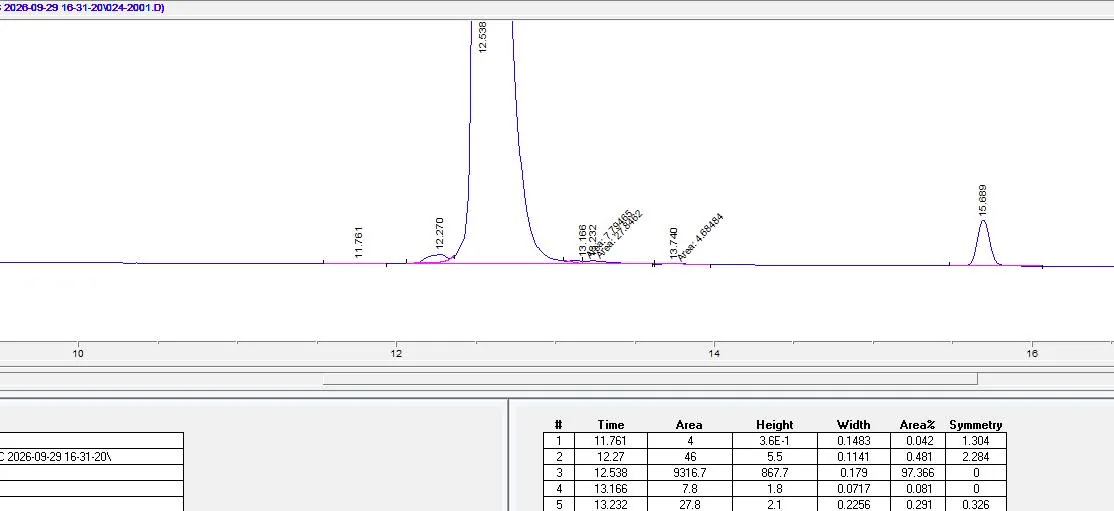
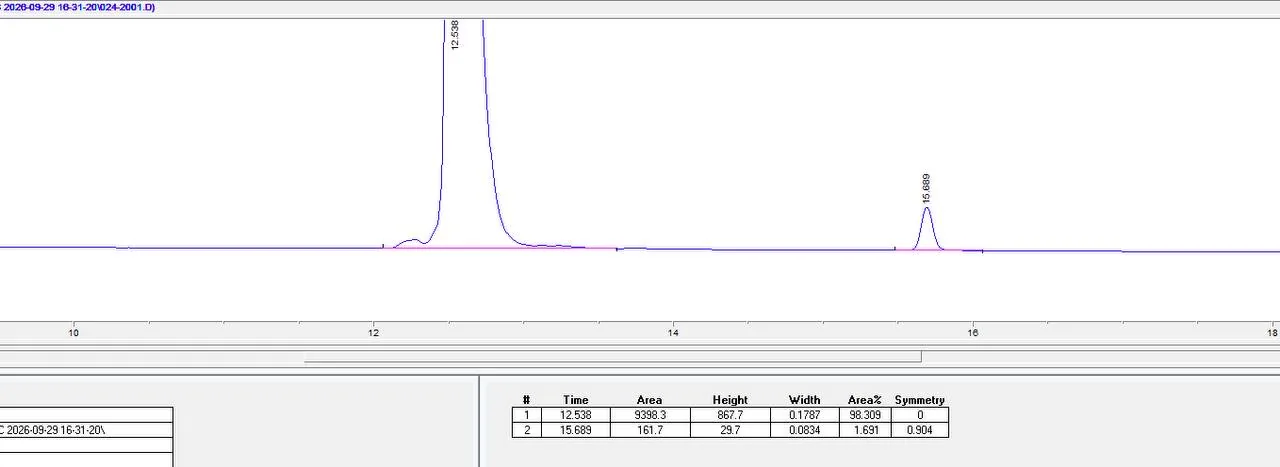
The finding raises questions about manufacturing controls, particularly because the Chinese supplier also manufactures blends containing both compounds.
Dustin from Vanguard responded that his laboratory had encountered retatrutide in eloralintide samples on several occasions. He shared an example involving a matrix-spike experiment in which Vanguard estimated approximately 100 micrograms of retatrutide.
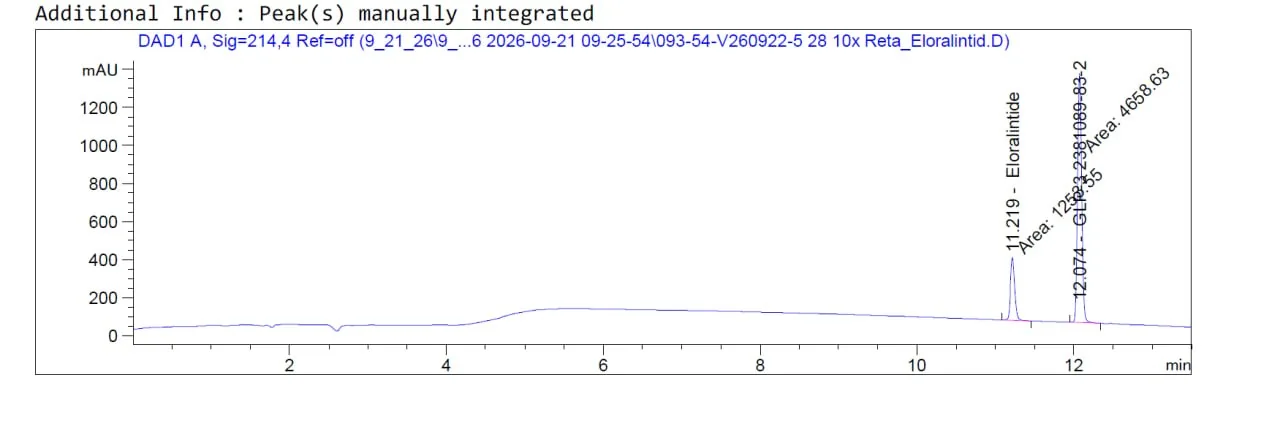
That example didn’t establish that Vanguard’s original disputed samples contained retatrutide. It demonstrated that the laboratory had encountered and investigated the same unexpected combination elsewhere.
Nevertheless, two laboratories independently reporting retatrutide in eloralintide samples is an important finding.
The Supplier Confirms Manufacturing Eloralintide/Retatrutide Blends
The Chinese supplier confirmed that his business manufactures retatrutide/eloralintide blends, including combinations labelled TR+ELORA and RT+ELORA, and claimed to sell thousands of kits.
This raises the possibility of cross-contamination during production.
When asked whether the retatrutide could have been left over from equipment previously used to manufacture blends, Chromate considered this likely. The laboratory pointed to the substantial variation in retatrutide concentrations between vials, which showed no correlation with eloralintide concentrations.
Chromate interpreted this as indicating that residual solution hadn’t been evenly mixed with the new batch.
The explanation remains a hypothesis. Neither the production sequence nor the source of the residual material has been independently established.
Why Chromate Reported Different Purity Figures
Chromate’s official eloralintide purity results were approximately 97.2 to 97.5%.
The laboratory explained that its samples contained significant close-eluting impurity peaks. When those peaks were excluded from the chromatographic calculation, the resulting purity was approximately 98.3%, similar to Janoshik’s reported figure.
Chromate also commented that including the retatrutide peak alongside eloralintide would produce a hypothetical blend purity of around 99%.
The close-eluting impurities are separate from the later-eluting peak identified as retatrutide. The product, however, was sold as eloralintide alone.
Janoshik Responds: The Extra Peak Might Be Retatrutide
Attention then turned to the Vanguard and Janoshik certificates.
Both Vanguard reports show small additional peaks following the main eloralintide peak. The YuanTai report gives 98.71% chromatographic purity, while the Chengdu report records approximately 98.75 to 98.77%. Those additional peaks haven’t been identified as retatrutide in the supplied reports.
Different chromatographic methods can produce different retention times, so Chromate’s late-eluting retatrutide peak cannot be directly matched to Vanguard’s peaks simply by comparing their positions.
When Peter from Janoshik was asked whether the sample covered by his COA could also contain retatrutide, he replied:
“yeah it might be reta”
He subsequently clarified:
“but I wouldn’t be as quick as to call it reta with 100% confidence, like 90%”
He then added:
“I don’t know how chromate ID’d it, lcms looks like reta, but not intact, slightly degraded ... but might be just a coincidence of elora degradation having similar masses in the MS”
Peter said he would review the existing LC-MS data more thoroughly after the weekend to investigate whether the additional peak represents degraded retatrutide or an eloralintide degradation product with similar mass characteristics.
His comments also raise a question about how Chromate established the identity of its retatrutide peak. Peter hasn’t completed his further investigation, and the two laboratories may be examining different impurities in different samples.
At this stage, Chromate reports 120 to 160 mcg of retatrutide per vial across three eloralintide samples. Vanguard has identified approximately 100 mcg in a separate eloralintide sample, while Janoshik considers retatrutide a possibility but hasn’t confirmed it.
Even if Chromate’s identification is correct, the reported retatrutide quantity is too small to explain the disagreement over eloralintide content. At 160 mcg, it represents just 0.16 mg, compared with the approximately 5 to 7 mg difference between the higher and lower laboratory measurements.
Vanguard Explains the Round-Robin Plan
The customer who originally challenged Vanguard has arranged additional testing intended to establish whether the higher measurements can be reproduced. A vial from the same kit previously sampled for Janoshik has been shipped to Vanguard. A second vial from that kit is already at Janoshik awaiting confirmatory testing. Three additional vials, randomly selected from three different kits, are also planned for Janoshik, while the group-buy organiser is arranging another independent submission.
Dustin has explained how Vanguard intends to conduct the round robin. The laboratory will receive the vial, reconstitute it and send the remaining prepared solution by overnight delivery to other laboratories willing to participate. BT Labs has offered to take part. Dustin said the results could be submitted to an independent third party. He also noted that round-robin comparisons are generally kept private between laboratories because they are intended to improve analytical processes, and public disclosure can discourage participation. However, he believed the intention in this case was for the results to be made public.
That would allow laboratories to compare measurements using material prepared from the same original vial, reducing the uncertainty caused by testing different vials. The preparation procedure will still need to be taken into account when interpreting the results. The final participation and publication arrangements remain to be confirmed.
What Remains Unanswered?
Several important questions remain about the ELORA10 product.
The quantity discrepancy. Vanguard has repeatedly reported 15 to 18 mg from vials labelled 10 mg, while Janoshik and Chromate have reported approximately 10 to 11 mg. The Chinese supplier acknowledges deliberate overfilling and claims an average of around 12.5 mg. Is there substantial variation between vials from the same batch, or are the laboratories producing systematically different measurements?
The manufacturing batch. Chengdu has confirmed that their kits look the same as the kits sold by Tegridy. Chromate suspects its samples are also from that batch, but cannot confirm it. Were all the vials prepared and filled in one production run, and what do the manufacturer’s batch records show?
The suspected retatrutide contamination. Chromate reports 120 to 160 mcg per vial, while Janoshik is investigating whether its additional peak represents degraded retatrutide or an eloralintide degradation product. How did Chromate establish the identity of its peak, and will Janoshik’s further LC-MS evaluation support that finding?
The manufacturing process. The supplier has confirmed producing retatrutide/eloralintide blends, and Chromate considers residual material from previous production a likely explanation for its findings. Were the same preparation or filling facilities used for both products, and could inadequate cleaning or uneven mixing explain the varying retatrutide concentrations?
Vanguard’s unidentified peaks. Both Vanguard certificates show additional chromatographic peaks, but their identities remain unconfirmed. Could these also represent retatrutide, and were the original samples specifically assessed for it?
The round robin. Vanguard has agreed to prepare and distribute material from a single vial for comparison with other laboratories, with BT Labs offering to participate. Will the results reproduce Vanguard’s higher quantities or support the lower measurements from Janoshik and Chromate? And will the full findings and analytical methods be made public?
TO BE CONTINUED…
Comments