
https://www.peptidescore.com/
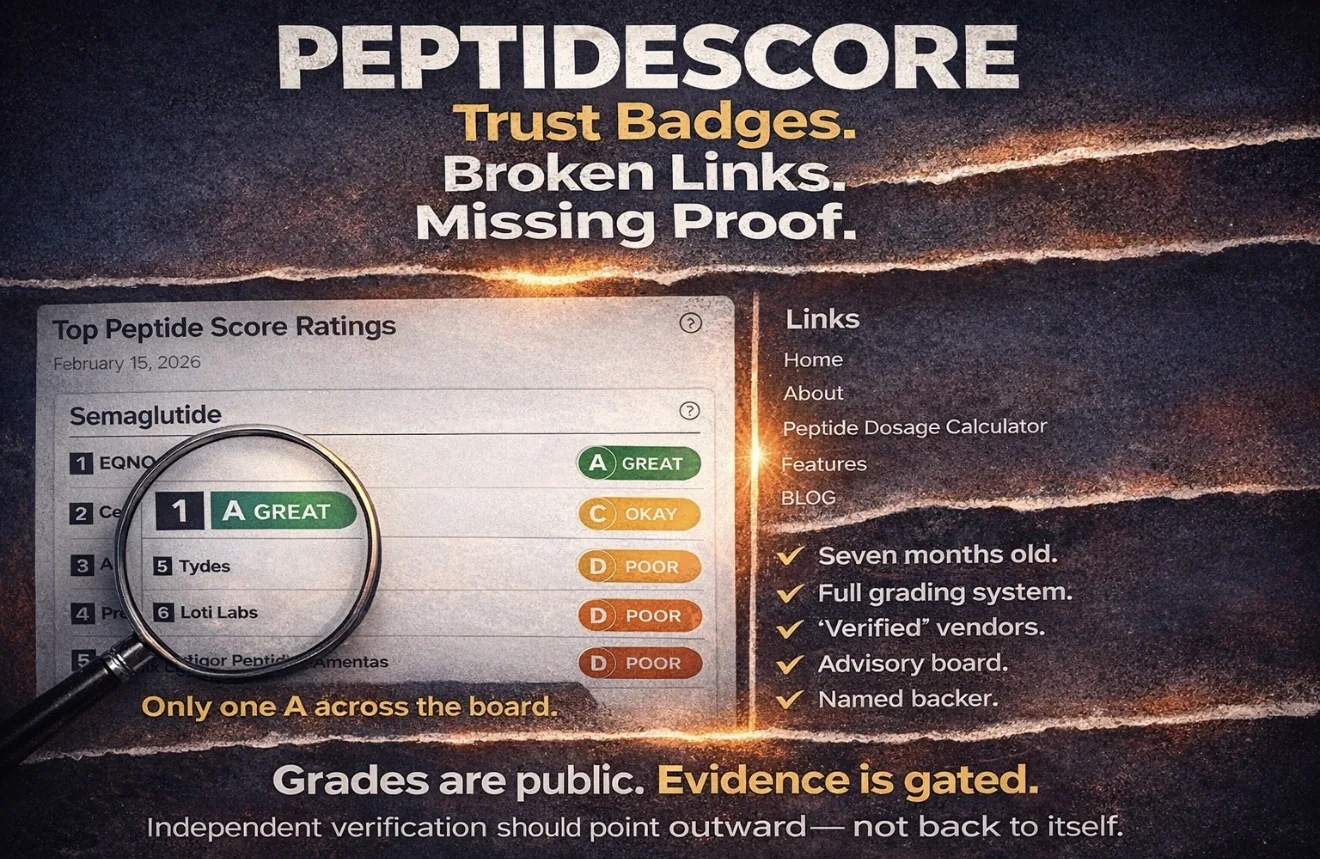
The PeptideScore website presents itself as:
An independent third party testing platform
A vendor grading authority
Backed by advisors
Backed by a named backer
Operating commercial lab testing
Providing verification badges
That’s the front layer.
But when we look at what’s underneath, the grades are easier to find than the evidence
1. The Timeline
Domain created: July 11, 2025
Terms of use “last updated”: May 6, 2025
Peptidescore.com was created on July 11, 2025. As of February 2026, that makes the platform roughly seven months old, yet it already presents a full grading system, “verified” vendors, named backers, and a medical advisory layer. That speed isn’t mysterious here: large parts of the site’s structure and wording match Finnrick so closely they can reasonably be described as copied. The question isn’t whether a site can be built quickly; it’s whether the documentation and governance match the authority it claims.
2. The Structure that Mirrors Finnrick
Same A-E grading format.
Same colour coded presentation.
Same “free testing” framing.
Same “we don’t sell peptides” positioning.
Same lab language structure.
As well as many other similarities
This isn’t inspiration. It’s near replication.
3. The Calculator
The dosage calculator is exactly the same as the calculator on the Particle Peptides website, including imagery showing vials labelled Particle Peptides.
That’s not a minor coincidence.
4. The Grading System
This is where it breaks.
You have vendors marked:
E, BAD
Some labelled as bad have 0 tested samples
No data provided
You have product pages showing
Identical same day timestamp tests
Identical MIN/MAX/AVG value
Majority of the tests supposedly performed are for heavy metals rather than fill or purity
Locked reports
You have “View report” buttons that:
Return “Test not found”
Or require researcher level access
So grades are public.
Reports are not.
That’s inverted transparency.
5. The Vendor Mapping
One vendor link routes to:
A gym equipment site (Modfitsupps)
That means the verification layer isn’t even consistently checking that the vendor is a peptide business.
6. The Advisory Board
PeptideScore presents a structured medical advisory layer:
Multiple MDs listed by full name
Professional headshots
“Medical Advisor” titles
LinkedIn icons under each profile
A named “Lead Scientist”
On the surface, this signals authority.
But when examined:
The LinkedIn icons do not function.
Even when I searched the names directly and checked the profiles I could find, I didn’t see any public mention of PeptideScore or any documented affiliation that backs up the “advisor” titles shown on the site
There is no dedicated page outlining:
The advisors’ roles
Scope of involvement
Oversight responsibilities
Whether they are paid advisors, contractors, or founders
Additionally:
Reverse image checks add further concern:At least one headshot resolves to a completely different named individual elsewhere online, suggesting the image may not be original to the role it’s being presented under. That raises obvious questions about whether the identities and titles shown are accurately represented.
No formal advisory charter, board structure, or conflict of interest policy is visible.
The result:
Authority is implied.
Oversight is not documented.
In a platform that assigns public A-E grades to vendors, an advisory board is not cosmetic, it suggests scientific accountability. But without verifiable links, governance explanation, or documented involvement, the advisory layer appears structured for perception, not for transparent scientific oversight.
7. The Backers
PeptideScore names “PeptideScore Backers led by Vincent Briatore.”
However, the publicly visible profile of Vincent Briatore presents him as an entrepreneur and crypto focused investor.
There is no public announcement, press release, or visible disclosure on his profile referencing PeptideScore.
8. The Grade vs the Data Problem (Example: Perfect Peptides)
Perfect Peptides is a good example of why PeptideScore’s grading logic doesn’t hold together on its own pages.
At the vendor profile level, Perfect Peptides is presented as B (Good).
On the vendor’s product list, NAD+ also appears as B (Good).
But when you click into the actual NAD product page, the story changes:
the NAD product is graded D (Poor)
it’s marked “Outside Specification”
and the visible results indicate heavy metals flagged, with only a small number of samples shown
So which is the real message PeptideScore is sending?
Is the vendor “Good”… while the tested product is “Outside Specification”?
Or is the product grade meant to override the vendor grade?
The platform doesn’t explain:
how vendor grades are calculated
how product grades feed into vendor grades (if they do)
what weighting system is used
what thresholds move a result from B → D → E
Without that, the grades aren’t just “locked behind researcher access”they’re internally contradictory even before you hit the paywall.
9. The Only A
Across the platform, one vendor sits at the top consistently with an A rating: EQNO Scientific. EQNO is also the only one shown with a set of visible, clustered test entries (mostly logged around the same dates) and a Peptide Score Badge on its website. None of that proves coordination, but it does create a noticeable imbalance in how the site presents “proof.”
The Peptide Score badge links back to PeptideScore itself, while the underlying reports aren’t publicly viewable without gated access. So the grade is visible, but the documentation isn’t.
And the bigger problem is how the “independent” verification is presented. The badge doesn’t point to an external lab, a public COA, or a downloadable report. It points back to PeptideScore itself, and the underlying reports remain locked unless you have paywalled access. So the structure becomes circular:
PeptideScore assigns the grade → EQNO displays the badge → the badge links back to PeptideScore → the source documents stay behind a gate.
An independent verification system shouldn’t loop back into itself. It should point outward to data that can be checked.
What This Actually Means
This is not about whether any specific vendor is good or bad.
It’s about the grading architecture.
A ratings authority needs:
Transparent methodology
Accessible evidence
Clear ownership
Consistent scoring logic
PeptideScore currently shows:
Authority first
Documentation second (or locked)
Inconsistent data presentation
Structural opacity
Until that changes, the grades function as presentation, not verification.
If PeptideScore is legitimate, the fix is simple: publish the methodology, make reports accessible in a consistent way, explain what “verified” means, and clearly document governance, advisors, backers, ownership, and oversight. Until then, the platform isn’t asking people to evaluate evidence. It’s asking people to accept labels. And in a grey market where people lean on ratings to make real purchasing decisions, that’s not just sloppy. it’s dangerous.
Comments