
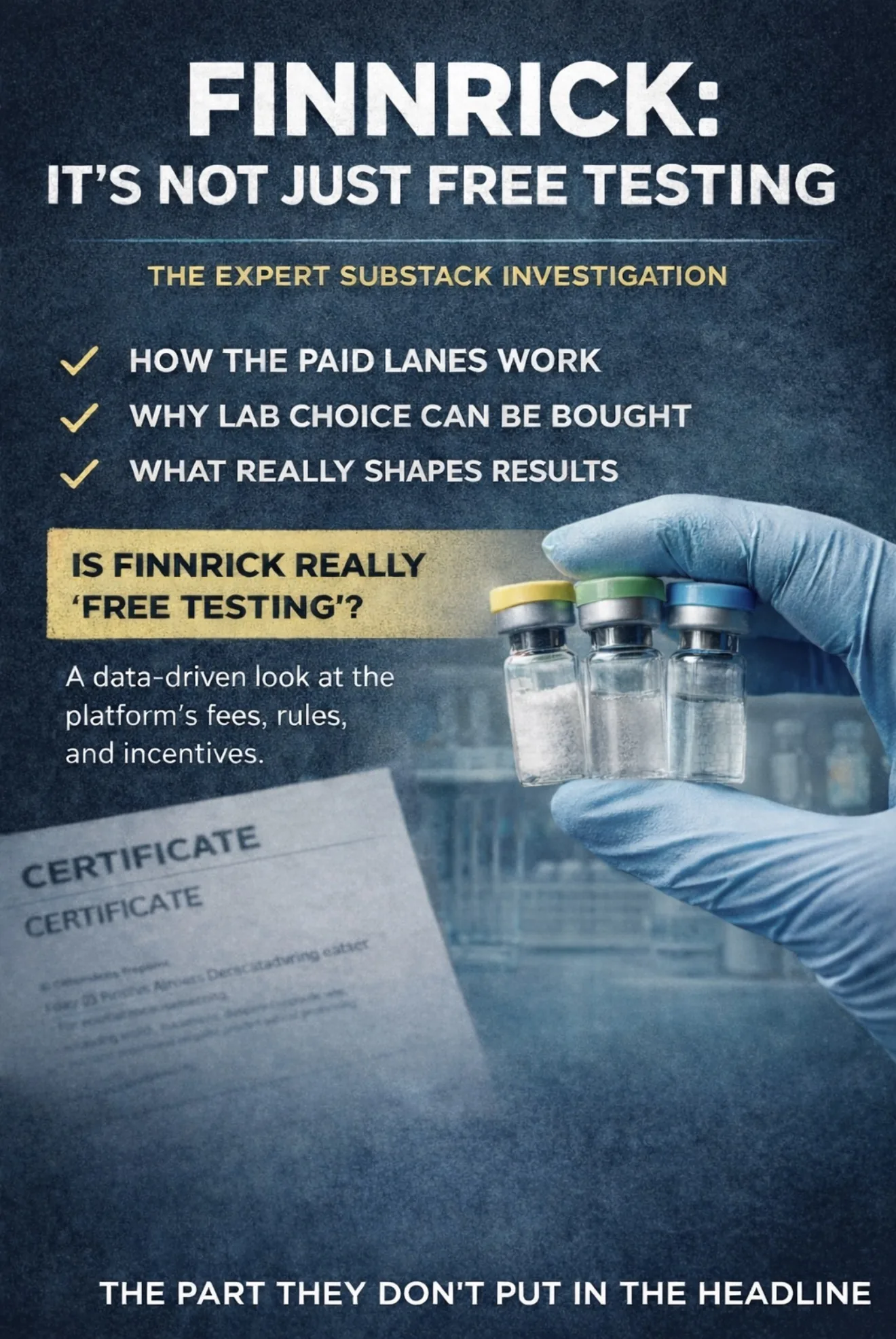
This post was inspired by Finnrick’s recent job ad for a Community Engagement Lead, “Grey-Market Whisperer.” The actual advertisement is linked below.
https://finnrick-analytics.breezy.hr/p/f72ebb84111e01-community-engagement-lead-gray-market-whisperer
Finnrick didn’t just post this role yesterday. Their LinkedIn shows the “Community Engagement Lead, Grey-Market Whisperer” job was being promoted around three months ago, described as a “strategic hire”
By now Finnrick is a pretty well known entity in this grey market community but if you’re not from this community and reading this or if you’ve been living under a rock here is Finnrick in a nutshell. They are a company offering free community testing (USA submissions only) and they have a vendor score rating that can be accessed so researchers can compare test results for different vendors and different products. That’s the headline but this post is to delve deeper into finnrick to examine what’s under the headline.
Apart from the ridiculous name “grey market whisperer” and the cringy way the advert is worded trying to sound cool, one thing is very clear: Finnrick isn’t just a testing service. It’s trying to be the platform sitting in the middle of the grey-market peptide ecosystem, the place where results get collected, published, ranked, and then used in public.
This post is a breakdown of what Finnrick is, based on their own pages: the public testing flow, the vendor programs, the Partner Terms, and what vendors can pay for.
No conspiracy. No “they’re evil.” Just the facts explained.
Why people care
On paper, Finnrick is offering what people say they want: independent testing, with relatively easy access for U.S. researchers, including those for whom private testing would otherwise be unaffordable, public display of COAs, and transparency and accountability to the grey market research community
The problems start when Finnrick’s outputs, COAs, scores, ratings, stop being treated as evidence and start being treated as conclusions.
That’s when the details matter: who chooses the lab, who controls publication, what’s public vs private, what vendors can pay for, and how samples get into the system in the first place.
The job post: this is not a lab hire
Finnrick isn’t hiring a scientist.
They’re hiring someone who can live inside Reddit, X, TikTok, Telegram, and private Discords, and translate lab results into content that spreads, calms arguments, and pulls people into their testing pipeline.
Call it marketing, community ops, growth, whatever label you want. The point is simple:
Finnrick understands that the “testing” part is only half the game. The other half is how the results get framed, shared, and used.
That doesn’t automatically make it bad. But it tells you what they’re building.
Free community testing: what it actually is
Finnrick’s free testing lane looks like this:
US submissions only
You mail in one vial to their Texas facility
They send it to a commercial lab
Standard testing is identity / purity / quantity
Method is stated as HPLC
Lab selection is “Finnrick choice” (you don’t choose)
You receive the COA before publication
Only common single peptides in lyophilised powder form
Blends not accepted
Tablets/capsules, sprays/liquids/gels, reconstituted peptides excluded
So yes, it’s free, and yes, it’s real testing. But it’s limited in scope, and the lab choice is not yours.
Lab names are visible. Comparability is the issue.
The labs aren’t a secret. Finnrick’s published certificates show which lab ran each test, and multiple labs appear across the database. The real question isn’t “who are the labs?” it’s how Finnrick treats results from different labs as comparable inside one scoring and ranking system, especially when lab selection can vary by tier and, in some cases, be chosen from Finnrick’s partner network
Terms of Service: who controls the results
Finnrick’s Terms of Service establishes the governance model:
They publish test results and ratings
They don’t guarantee accuracy or completeness
Results are informational only
Test results remain Finnrick property and are provided “as a courtesy”
They can suspend accounts
Use and redistribution of results is restricted
That’s basically: “we run the platform, you can view it, don’t treat this as medical advice, don’t assume it’s complete, and don’t reuse our content”
Standard legal language, but it tells you the relationship: Finnrick owns the data and controls publication.
Partner Terms: “Partners” are part of the model
Finnrick also has Partner Service Terms, which confirm:
Anyone doing business with Finnrick becomes a “Partner”
Statements of Work / invoices / fees exist
Finnrick owns all data and derived insights
Finnrick decides whether and how to publish
Ratings are framed legally as opinion
There is an appeals/dispute process
Published results are designed to remain available (no removal requests once published)
There are explicit rules against manipulation and “astroturfing”
This isn’t just a public testing project. It’s a platform with paid relationships and governance structures.
Vendor Support: the paid lanes are real and clearly described
Finnrick’s Vendor Support pages lay out multiple vendor pathways.
Vendor registration + subscription
Vendors can register for free, but there’s also an optional premium service at $279/month (custom logo and discounts on Launch orders).
So a subscription lane exists.
Launch with Finnrick (public listing + “tentative rating”)
Finnrick says it does not accept samples directly sent by vendors into its public testing database except through its restricted Launch with Finnrick program.
Launch is essentially a paid onboarding route for new vendors or new products. It gives vendors a limited ability to submit samples for testing so they can get an initial listing on Finnrick with a tentative rating.
How it works (as Finnrick describes it)
A vendor sends 4 samples per product to Finnrick’s Texas facility
2 samples are tested (this generates the “tentative” rating)
2 samples are kept as reference materials
The resulting tests are marked as “vendor submitted” on the Finnrick website
The vendor can review and approve the results before publishing
The service fee is non refundable
The program is available once per product
Once results are published, they cannot be “un-published”
Vendor anonymity: what’s anonymous, what isn’t
Finnrick also states that the COA will include a Finnrick watermark and feature no vendor identification.
So the certificate itself does not name the vendor.
However: the test is still explicitly labelled vendor-submitted on Finnrick’s site, and it is still used to create an initial product listing and rating.
In other words, the vendor is anonymous on the COA, but the submission is not treated as a normal customer submission inside the system.
Service tiers (and lab choice)
Launch has tiered pricing:
Basic ($130): identity/purity/quantity; lab chosen by Finnrick
Enhanced ($285): adds endotoxin testing
Ultimate ($510): vendor can choose the testing lab among Finnrick partner labs, plus faster turnaround
This matters because lab choice is fixed in the free lane and lower launch tiers, but becomes a paid feature at the top tier.
This wording is also important: “testing labs among Finnrick partners.” That implies the labs are part of a defined partner network, not random third parties selected fresh each time.
That doesn’t mean the labs are bad. But it does mean these are ongoing relationships, and in the highest paid tier, lab choice becomes a purchasable feature.
Finnrick’s Launch pricing indicates that at the “Ultimate” tier, vendors can choose the testing lab from Finnrick’s partner lab network, whereas lower tiers specify “Lab: Finnrick choice.”
If results aren’t good
Finnrick’s own guidance:
Under/overfill but consistent → publish a “batch claim”; no score penalty as long as the public is informed
Fill inconsistency/purity/identity problems → discard batch
Vendor can withdraw and reapply (new fee), sending fresh samples from a new batch
Tentative vs confident ratings
Tentative rating requires 2 tested samples
Confident rating requires at least 6 published test
After Launch, vendors can’t submit more samples directly. Instead they’re encouraged to increase test volume by encouraging customers to submit, and can offer incentives as long as customers have a choice of which sample to send.
Finnrick explicitly allows vendors to encourage customer submissions and does not object to incentives, including free product, provided customers have a choice of which vial to send from the same batch.
This doesn’t imply manipulation, but it does mean customer submitted testing is not the same as random sampling. Incentives affect timing, participation, and batch selection. In practice, testing volume can increase without becoming more representative.
Private Peptides Testing: the quiet lane
Finnrick also sells Private Peptides Testing for Vendors, and it’s explicit that the results are not published on Finnrick.com and are confidential.
This lane includes:
COAs with vendor brand + batch IDs
Up to 60 peptides, including blends
All form factors (raw, capsules, tablets, gels, liquids)
Test types beyond the standard bundle;
endotoxins
heavy metals (FDA 4 or full panel)
residual solvents
sterility
Pricing options;
one-off orders (volume pricing starting at 10 samples)
monthly subscription (discount)
yearly subscription (bigger discount)
Workflow:
1.configure quote (select lab, products, test types)
2.review & pay
3.ship samples to Texas
4.receive certificates by email
Service details include ~10 business day turnaround (best effort), prepaid credits usable for 45 days, partial shipments allowed
Results are private and shared only with the vendor
This creates an obvious split:
Public testing feeds rankings and reputation.
Private testing does not.
Bad results here never hit the public database. Vendors can disclose only what they want.
Full Data Access / “Researcher Access”: another gated tier
Finnrick also advertises Full Data Access: Researcher Exclusive.
This is described as:
unlimited database access
downloadable test documents, including COAs, purity reports, and analytical data files
detailed test information, including HPLC data and analytical reports
To even request this, you have to be logged in.
In my case, when I tried to request researcher access, it sent me back to the register/login flow. When I reached the application form and submitted it, it responded that I had already submitted this request, but I clearly do not have access, because the site still routes me back to registration pages when I try to reach the gated dataset.
So the practical reality is:
Full Data Access exists
It’s approval-based
It’s not automatically granted
There is no visible status tracker
The public does not see what approved “researchers” can download
This matters because it means there are at least three visibility tiers:
1.the public facing database
2.vendor only private testing data
3.researcher only full dataset access
When people treat public rankings as complete, this gating matters.
Sample selection: the bias that doesn’t go away
This isn’t about accusing anyone. It’s about how systems behave.
Vendor-submitted samples
When vendors can submit samples, even in a restricted onboarding program, they can choose what they submit.
That means best case sampling is always possible.
A COA can be accurate for that vial and still not represent what customers typically receive.
Customer submissions + incentives
Customer submissions are not automatically random when vendors are explicitly encouraged to encourage submissions and offer incentives.
Incentives shape behavior:
submissions cluster around launches or good batches
satisfied buyers are more likely to participate
dissatisfied buyers are less likely to engage with optional testing programs
timing becomes marketing driven
Even if customers technically choose which sample to send, incentives still influence what gets sent.
More samples is not the same as representative samples.
A practical example of how “free testing” is being tightened
One recent case illustrates how Finnrick’s free testing program is evolving in practice.
A non vendor user attempted to submit seven vials for testing, spread across two different vendors and multiple products. Finnrick flagged the submission as potential vendor activity and advised the user to sign up for vendor services, despite the user stating they were not a vendor.
There was no previously stated limit on how many vials a member of the public could submit, and the same user had successfully submitted multiple vials in the past without issue. Finnrick later confirmed the submission but also introduced additional requirements, including requests for proof of purchase and pricing information, requirements that were not present in earlier submissions.
This suggests that Finnrick is actively tightening controls on the free testing program as usage increases. While understandable from a capacity and abuse prevention perspective, it also means that “public submissions” are no longer entirely open or uniform, and are subject to discretionary review.
That discretion, deciding who looks like a vendor, what volume is acceptable, and what documentation is required, becomes another layer of governance in a system whose outputs are increasingly treated as authoritative.
So what is Finnrick?
Finnrick isn’t just free testing.
It’s a multi lane platform:
free community testing (limited scope; lab chosen by Finnrick)
paid onboarding into the public database with vendor submitted samples (Launch)
paid tiers where lab choice becomes purchasable among Finnrick partner labs
private vendor testing that is not published
vendor subscriptions and paid programs
partner terms that govern disputes, publication control, and permanence
a researcher only full dataset request that is gated and approval based
None of this automatically makes Finnrick wrong.
But it does mean their outputs shouldn’t be treated as final verdicts. They’re outputs from a structured platform with incentives, paid pathways, and multiple visibility tiers.
If people want to use Finnrick as part of vendor evaluation, fine, but do it with eyes open.
Comments