
An earlier version of this article was briefly published, then taken down when additional Reta stability data became publicly available. I wanted to check the new information properly rather than leave an incomplete version up. This article has now been updated to include it.
The evidence is considerably less emphatic. A discussion in Lab Chat about whether reconstituted peptides can be frozen led to something much more useful than the usual collection of opinions: actual retatrutide testing.
I now have three sets of testing to look at: a Janoshik R30 experiment following a single freeze/thaw cycle and subsequent storage, a PTDS R60 study with a much more alarming result, and a separate experiment involving five freeze/thaw cycles. Unfortunately, they don’t all tell the same story.
So I went looking for the original data and tried to establish exactly what was tested, rather than simply counting how many people said Reta shouldn’t be frozen.
The practical reason for asking is fairly simple. Higher-mass Reta vials can be cheaper, but may take a long time to use. If reconstituted Reta can tolerate a single freeze/thaw cycle, a larger vial could potentially be divided into smaller aliquots and frozen, with each aliquot thawed only once when needed. So the useful question isn’t really whether Reta can survive being repeatedly frozen and thawed. It’s what happens after one freeze and one thaw?
The Jeep R30 test
The strongest evidence against the idea that you should never freeze reconstituted Reta, even once, comes from a four-point Janoshik test series on Jeep R30 by the LS Testing group. The experiment looked at what happened to reconstituted Reta after a single freeze/thaw cycle. The sample was tested before freezing, frozen for approximately a week, then thawed and tested again. Further tests followed during refrigerated storage at 21 and 35 days.
The Jeep R30 results
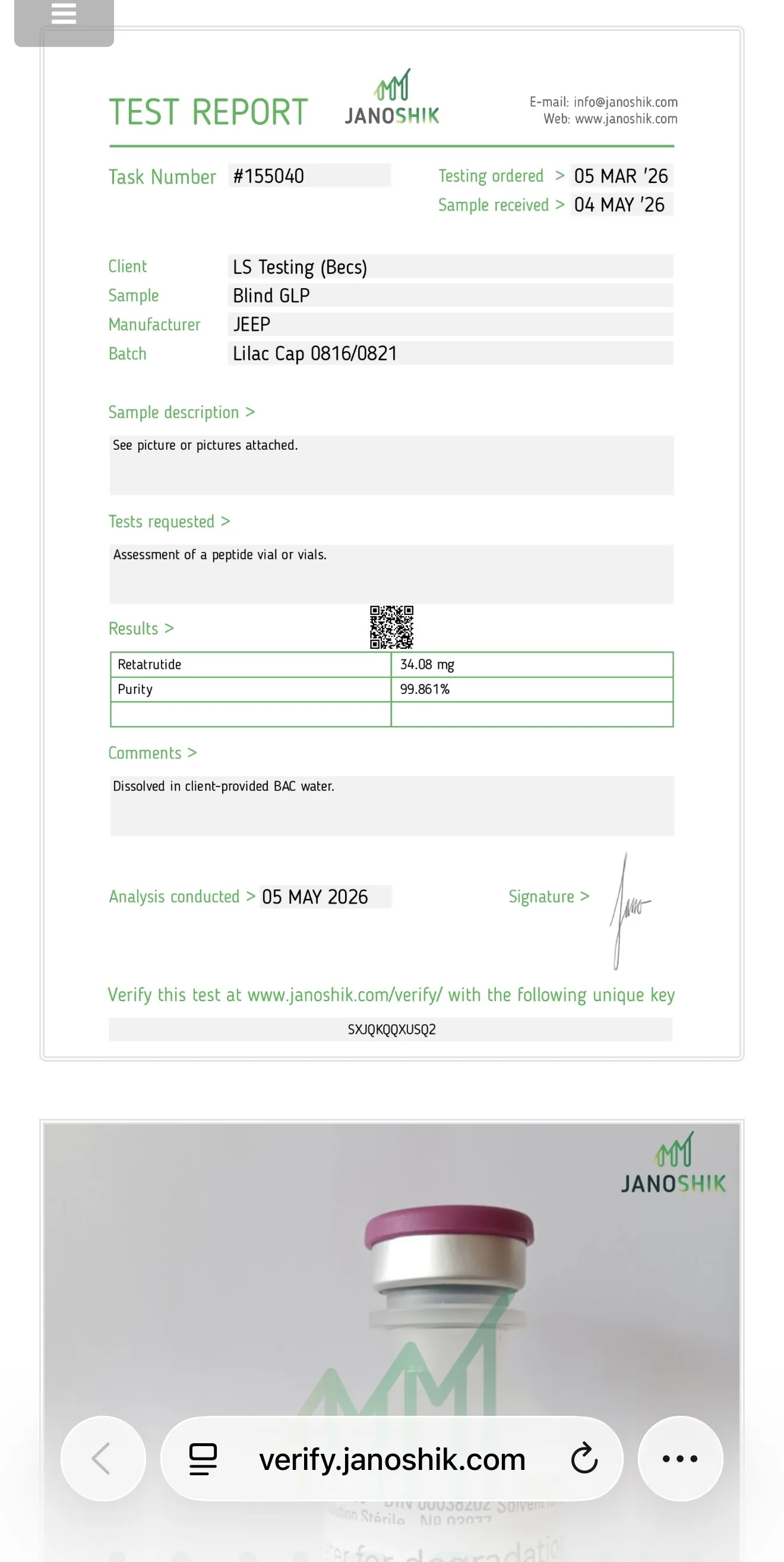
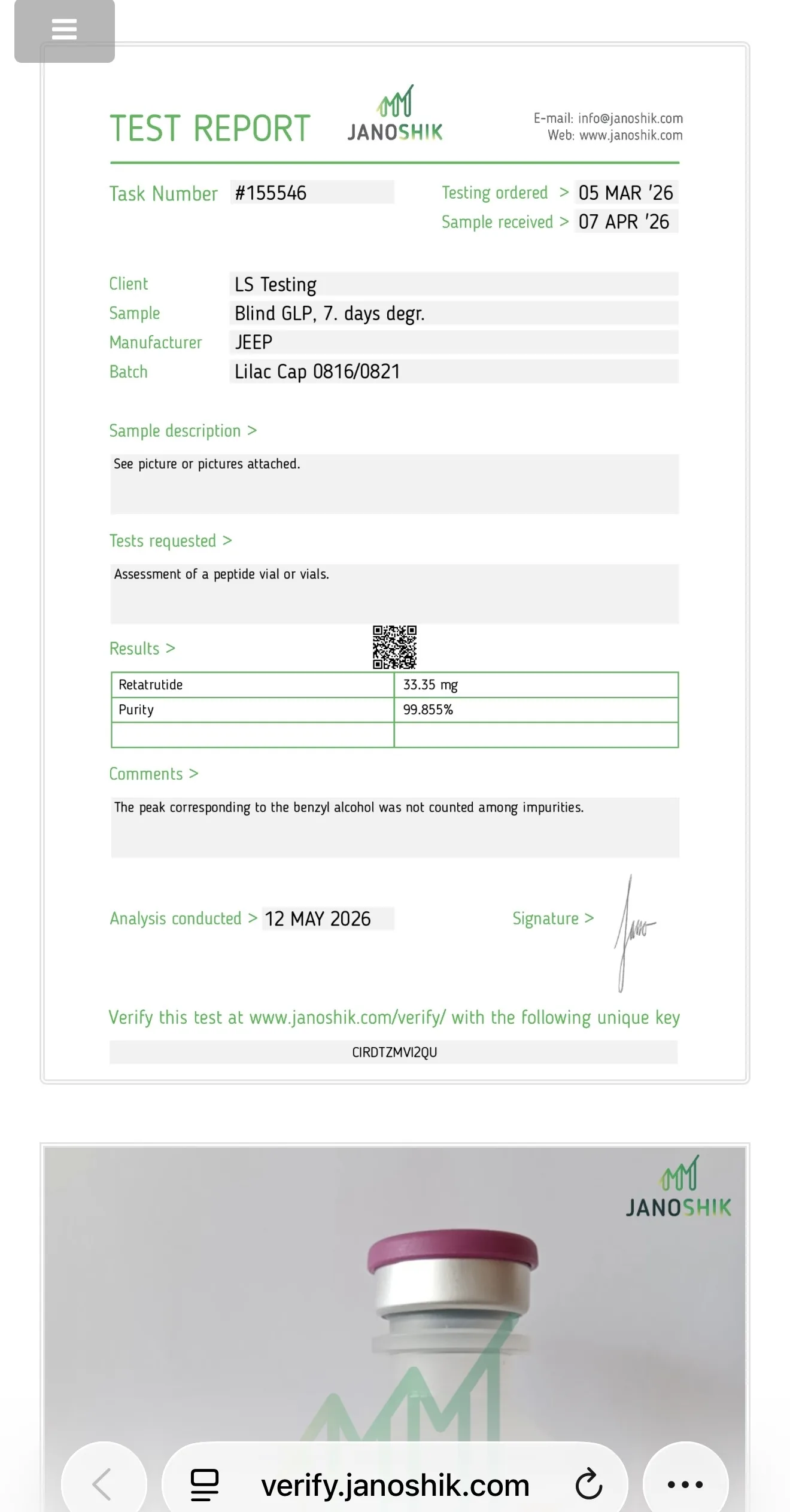
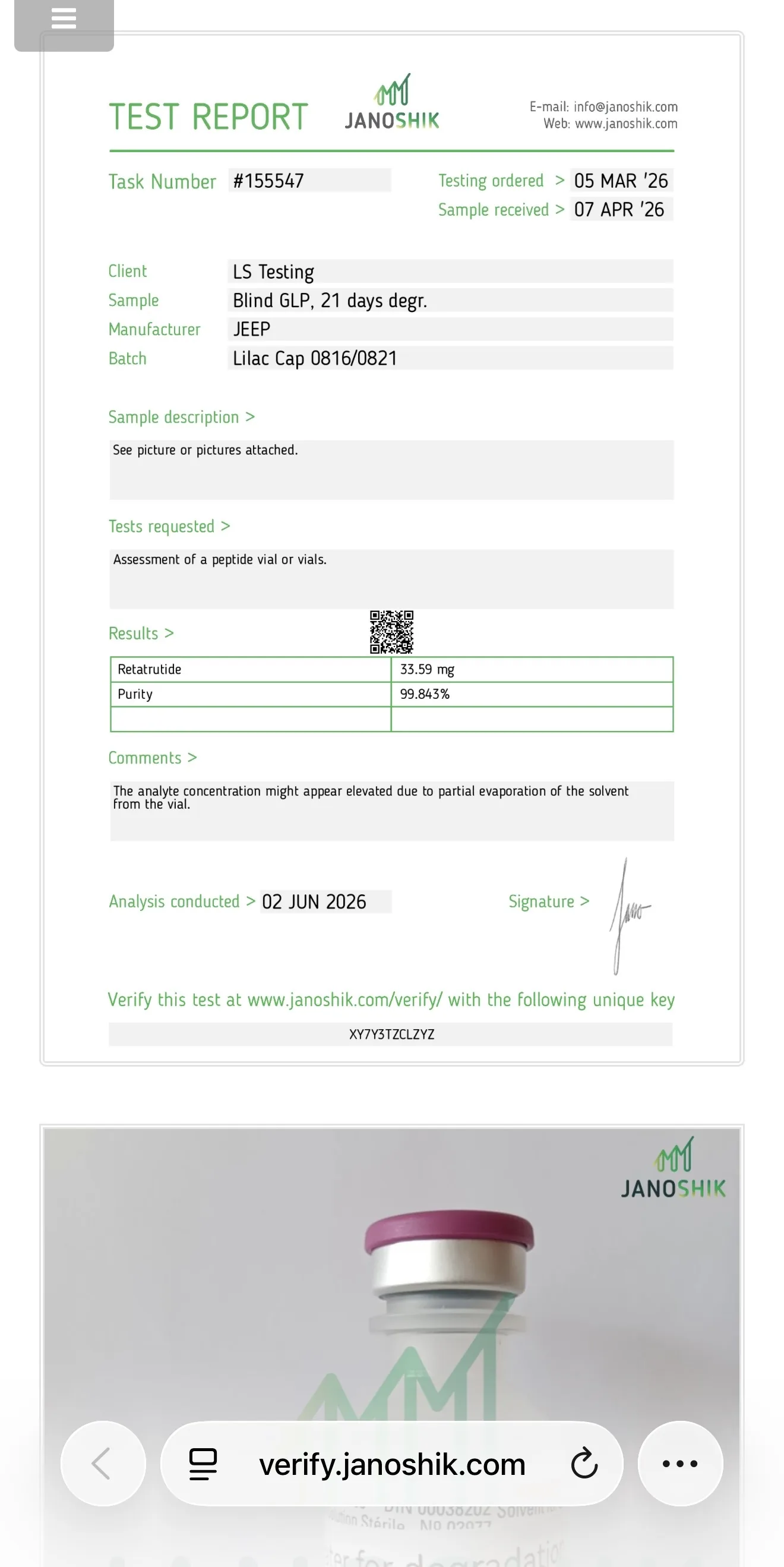
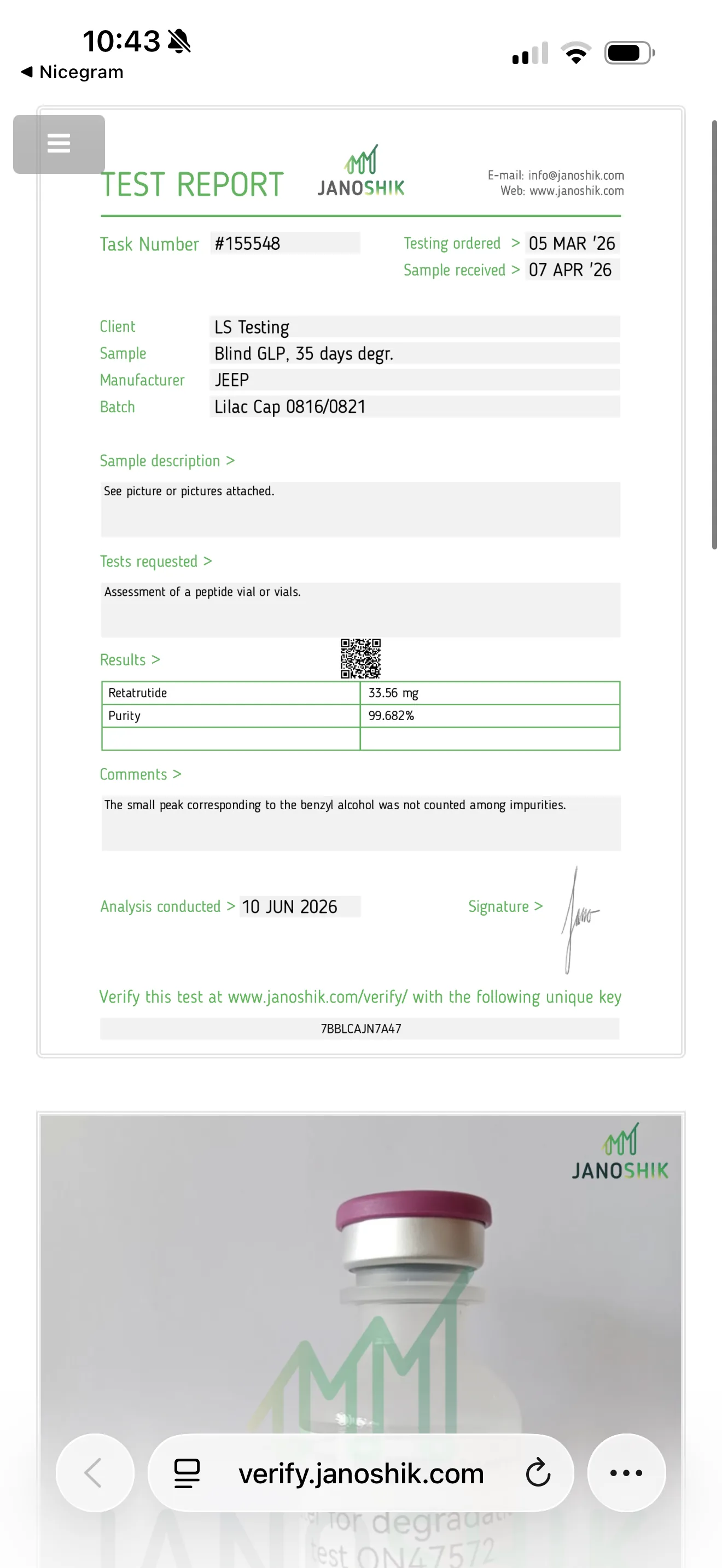
Pre-freeze, 34.08 mg | 99.861% purity
View Janoshik report (Janoshik comment; dissolved in client provided Bac water)
7-day thaw, 33.35 mg | −2.14% from baseline | 99.855% purity
View Janoshik report (Janoshik Comment; the benzyl-alcohol peak was excluded from impurities)
21 days, 33.59 mg | −1.44% from baseline | 99.843% purity
View Janoshik report (Janoshik comment; The analyte concentration might appear elevated due to partial evaporation of solvent from the vial)
35 days, 33.56 mg | −1.53% from baseline | 99.682% purity
View Janoshik report (Janoshik comment; The benzyl-alcohol peak was excluded from impurities)
The first measurement after freezing was 2.14% lower than baseline, but calling that 2.14% degradation would be a stretch. Analytical variability and sample preparation could contribute to a difference of this size.
After thawing, the reported quantities were 33.35 mg, 33.59 mg and 33.56 mg. There is no obvious progressive decline, although Janoshik specifically cautioned that the 21-day concentration could appear elevated because of partial evaporation of solvent from the vial. So the small rise at that point shouldn’t be interpreted as Reta somehow recovering.
This experiment addressed the question that started the discussion: what happens to reconstituted Reta after a single freeze/thaw cycle? In this particular R30 experiment, the answer was considerably less dramatic than the warnings suggested.
Purity tells a slightly different story
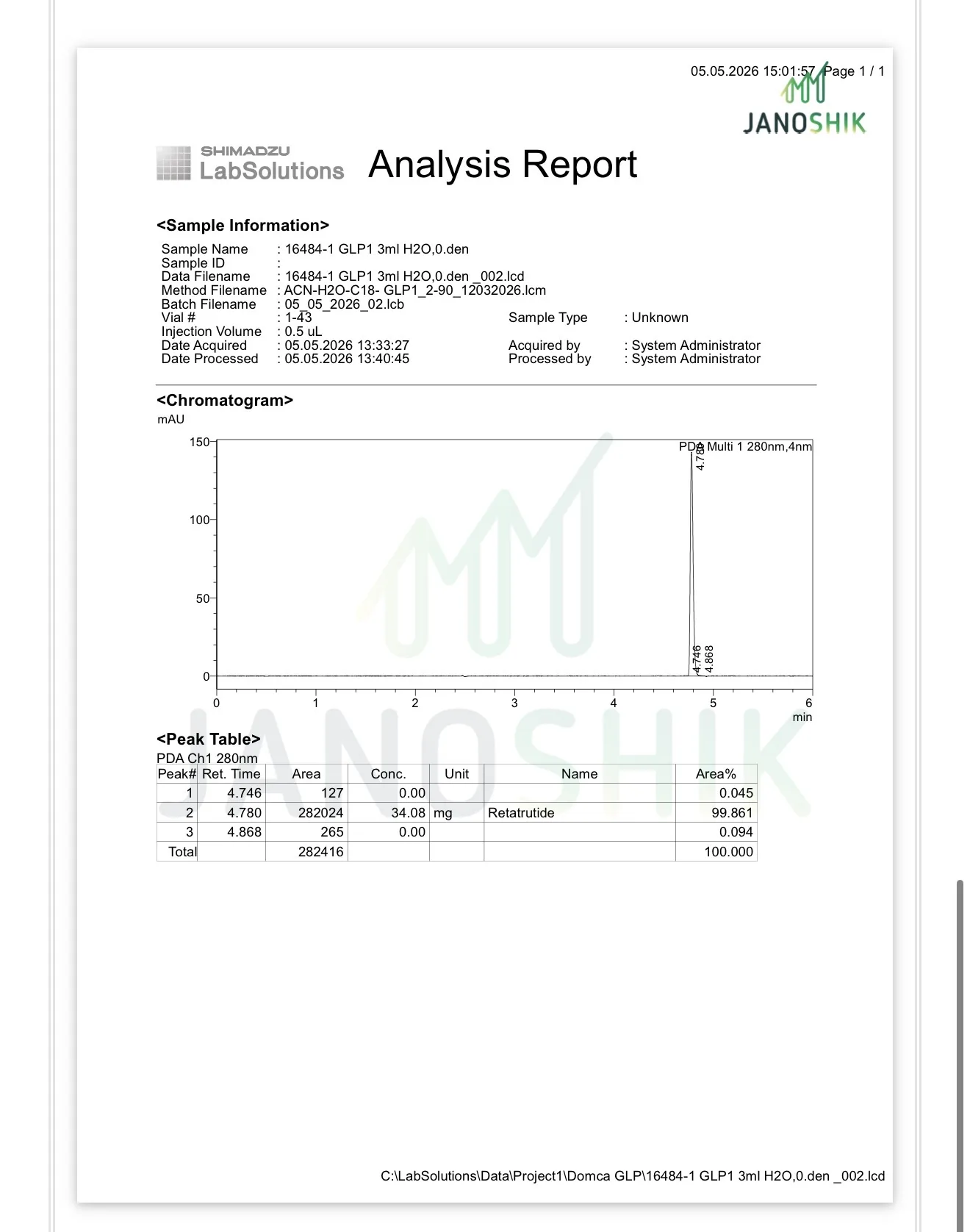
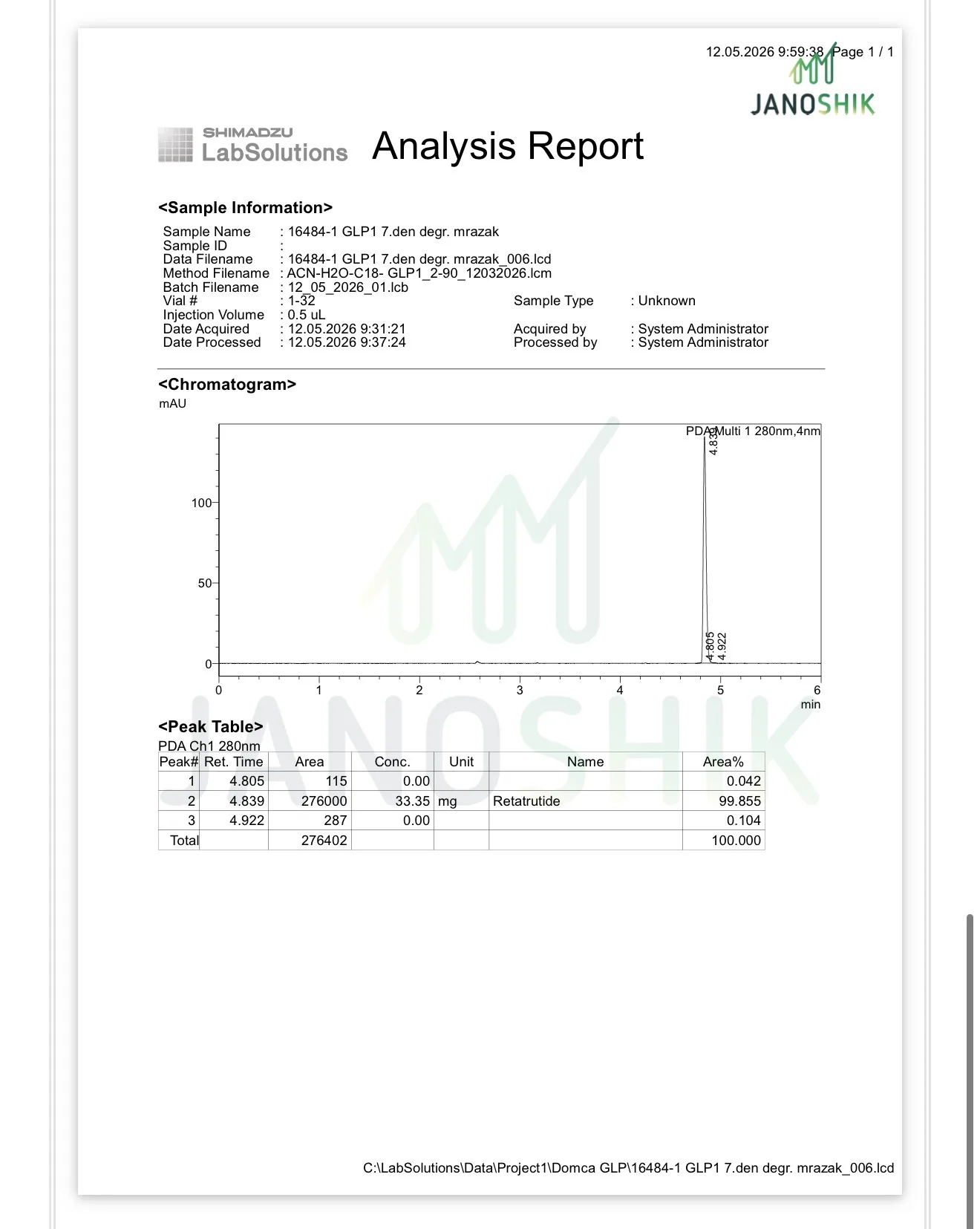
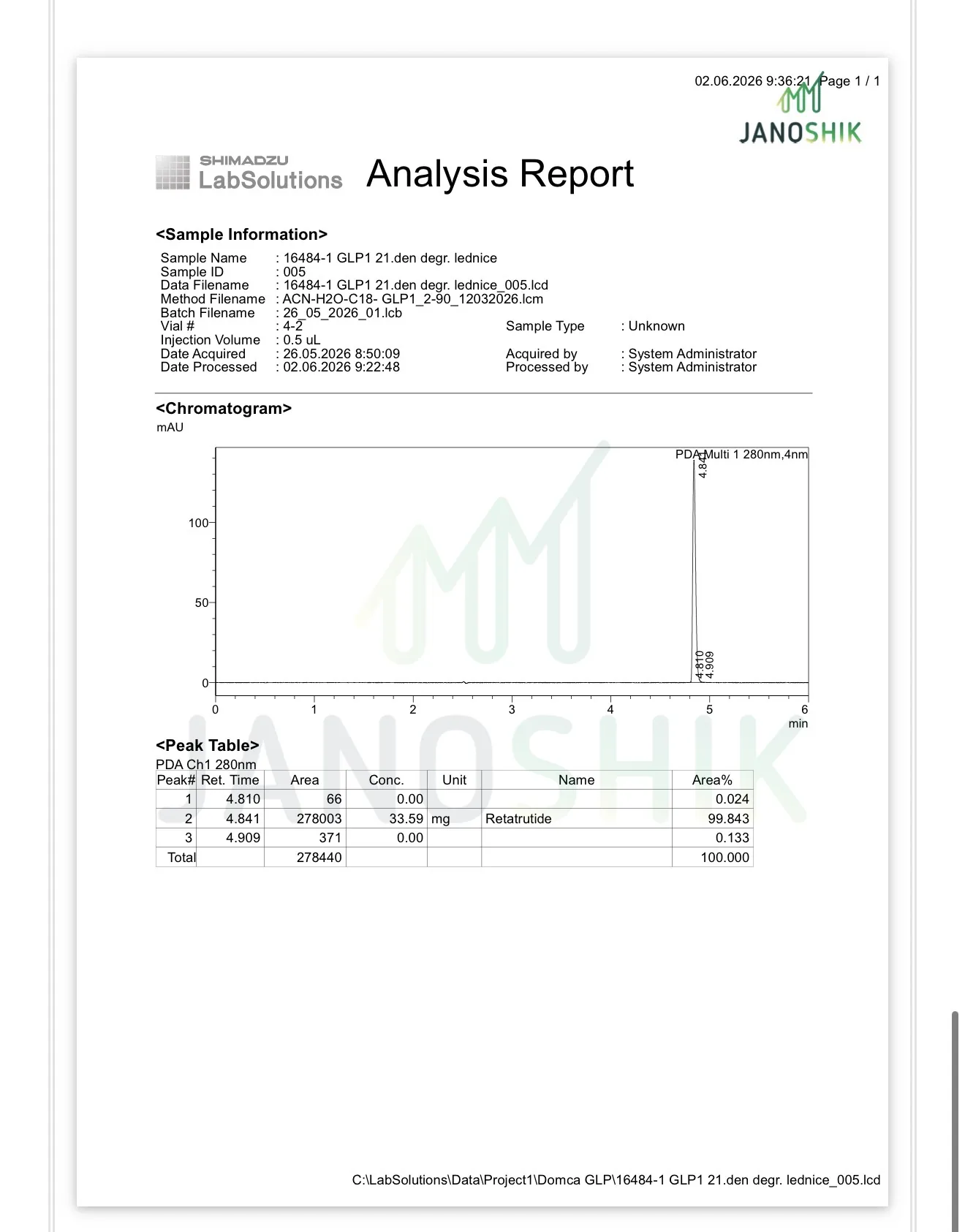
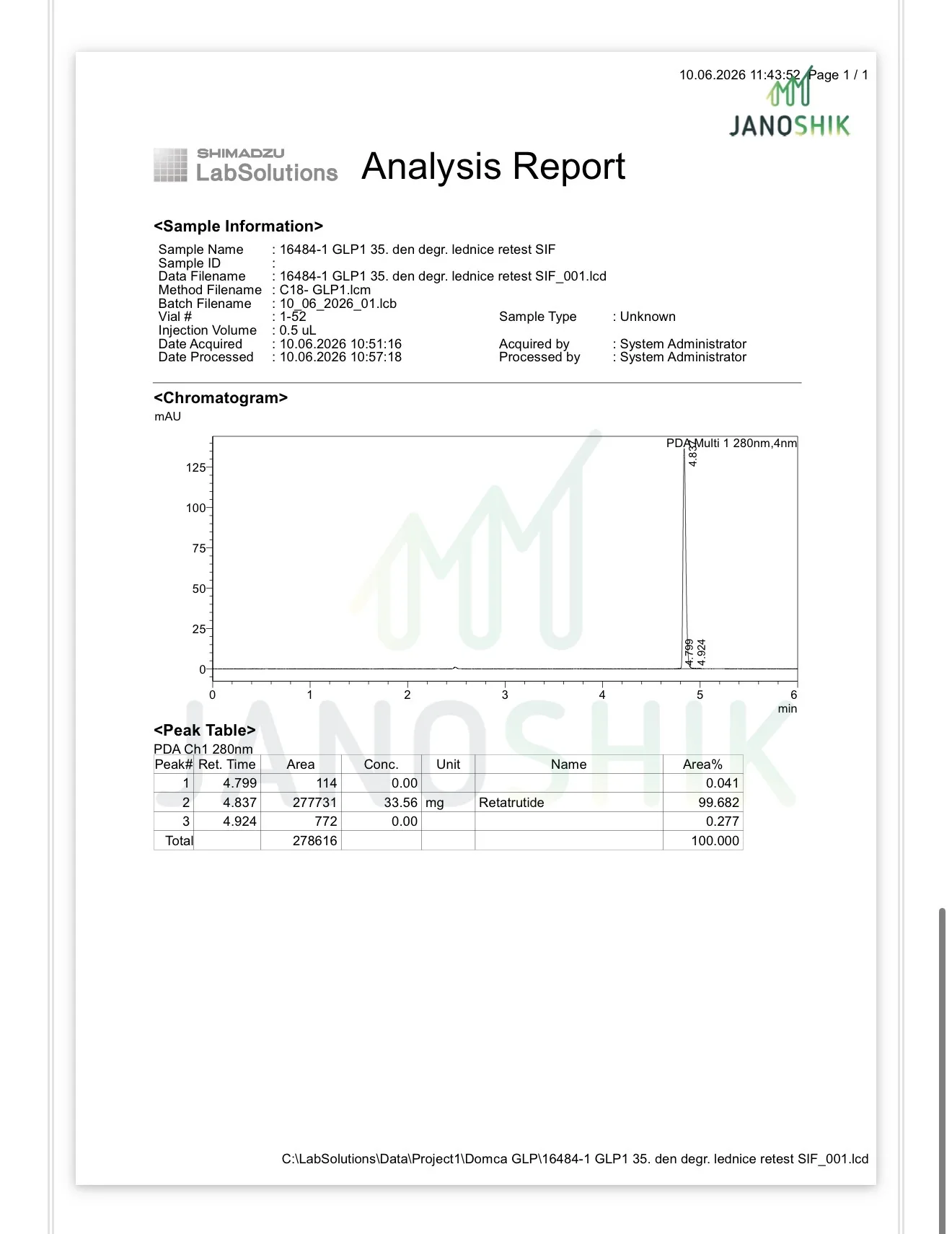
Quantity isn’t the whole story. Reported purity changed slightly over the course of the experiment: 99.861% → 99.855% → 99.843% → 99.682%. One small unidentified chromatographic peak also increased from 0.094% at baseline to 0.104%, 0.133% and finally 0.277%. That could be consistent with an increasing impurity or degradation product, but the reports don’t identify the peak as either, so its cause remains uncertain. Janoshik also specifically notes that the peak corresponding to benzyl alcohol from the BAC water wasn’t counted among impurities.
For the freezing question, the timing is important. Purity barely changed across the freeze/thaw itself, moving from 99.861% before freezing to 99.855% at the thaw point. Most of the later change occurred while the sample was being stored refrigerated. So the R30 remained overwhelmingly intact by the reported measurements following a single freeze/thaw cycle. There was a small subsequent decline in reported purity, but the data don’t establish that freezing caused it.
A separate stability study conducted by PTDS produced a much more dramatic result.
Test 624 followed two reconstituted R60 vials. Both were reconstituted with Hospira bacteriostatic water and frozen on Day 0, but were then stored differently.
Vial 1 was thawed on Day 5 and subsequently refrigerated. By Day 45 it retained 85.6% of its starting mass, a loss of 14.4%.
Vial 2 underwent repeated freeze/thaw cycling and retained 86.6% at Day 45, a loss of 13.4%.
Despite the different handling, the two results were remarkably similar: both retained around 86% of their starting mass by Day 45. The repeatedly frozen vial actually retained slightly more, although with only one vial under each condition, that shouldn’t be taken as evidence that repeated freeze/thaw cycling makes no difference
What about simply keeping Reta in the fridge?
PTDS also ran Test 616, using the same GBBB-ZJC 60 mg product as Test 624 by design, but this time two vials were kept under steady refrigeration. After 90 days, the two refrigerated vials retained 91.0% and 90.4% of their starting mass. By comparison, the two Test 624 vials retained only 85.6% and 86.6% after 45 days under their respective freezing protocols.
So in this same-product comparison, both refrigerated vials retained more mass after 90 days than either of the initially frozen vials did after only 45 days. That clearly favours refrigeration in this particular dataset, although the numbers are still too small to turn it into a universal rule.
Read the full PTDS retatrutide stability dataset published on PepRecon:
PTDS retatrutide stability data
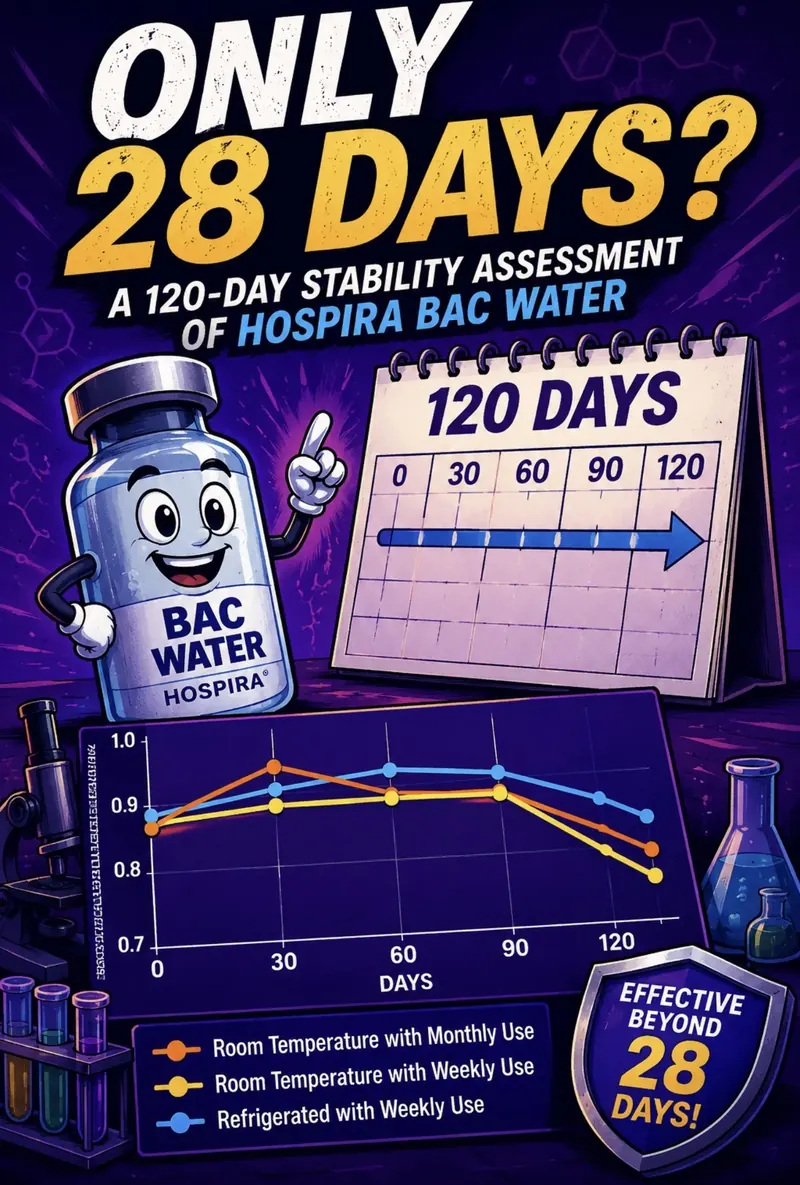
There’s also an interesting BAC-water comparison conducted by PTDS. Two vials from the same kit were reconstituted side by side and refrigerated for 90 days. The vial made with Hospira BAC water lost 2.4%, while the one made with ultrapure water lost 7.9%.
Phil Finish (@lifeoflyo) raised another variable that wasn’t measured: the pH of the finished reconstituted solutions. The difference could be related to the diluents themselves, different final pH, or a combination of factors. The starting pH of the water alone wouldn’t answer that because the peptide, counterions and excipients can all affect the pH of the final solution.
Why R30 and R60 disagree
The R30 and R60 experiments still don’t sit comfortably together. R30 showed very little change following its single freeze/thaw cycle, while the R60 experiment showed around 13 to 14% lower recovered mass by Day 45.
Finished-solution pH is another unmeasured variable that could potentially contribute to the different results. Storage time, formulation, diluent and pH may all matter, but the available experiments don’t establish which factor explains the very different R30 and R60 outcomes.
So the discrepancy is real. The explanation isn’t yet.
What about freezing and thawing Reta five times?
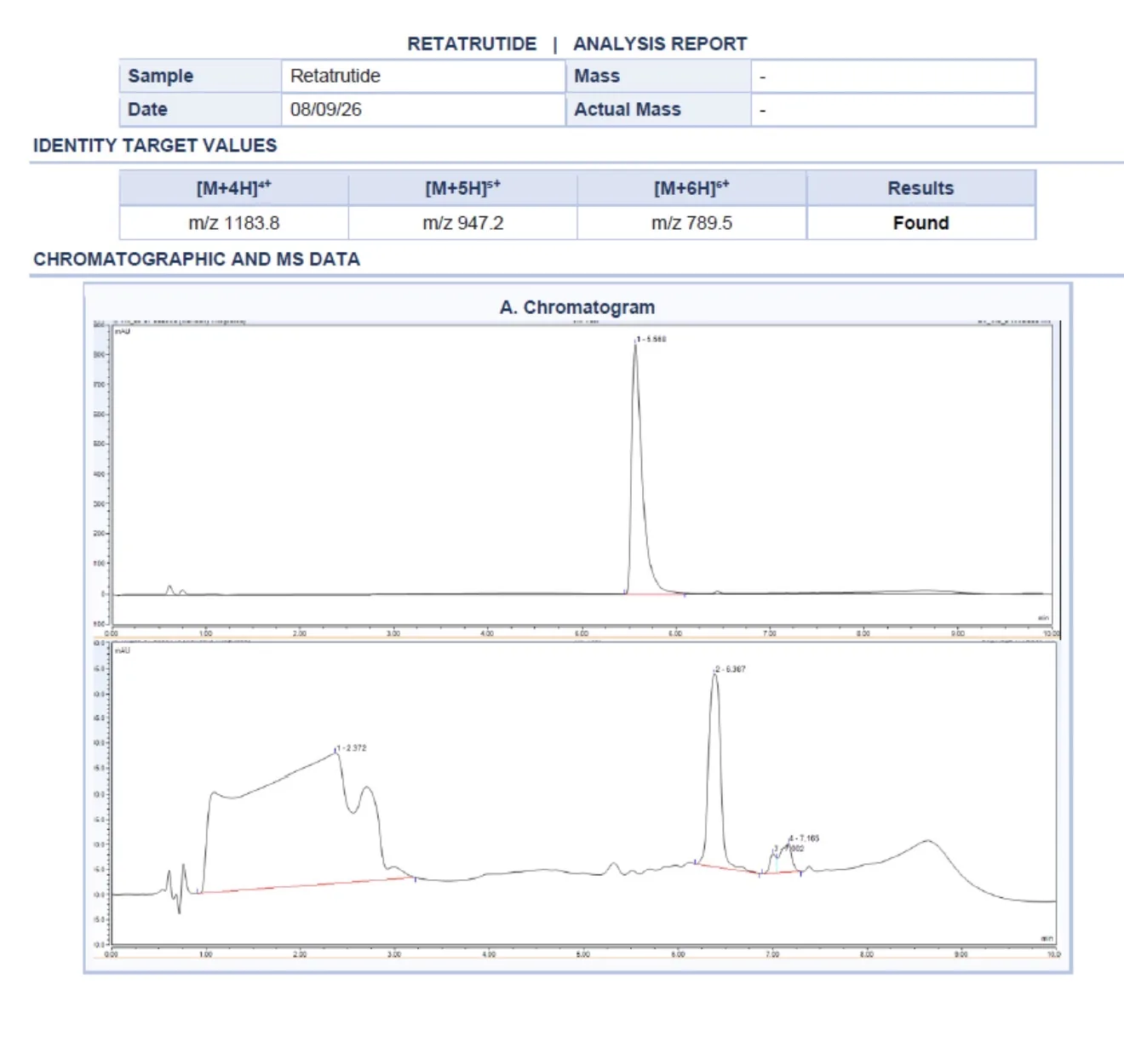
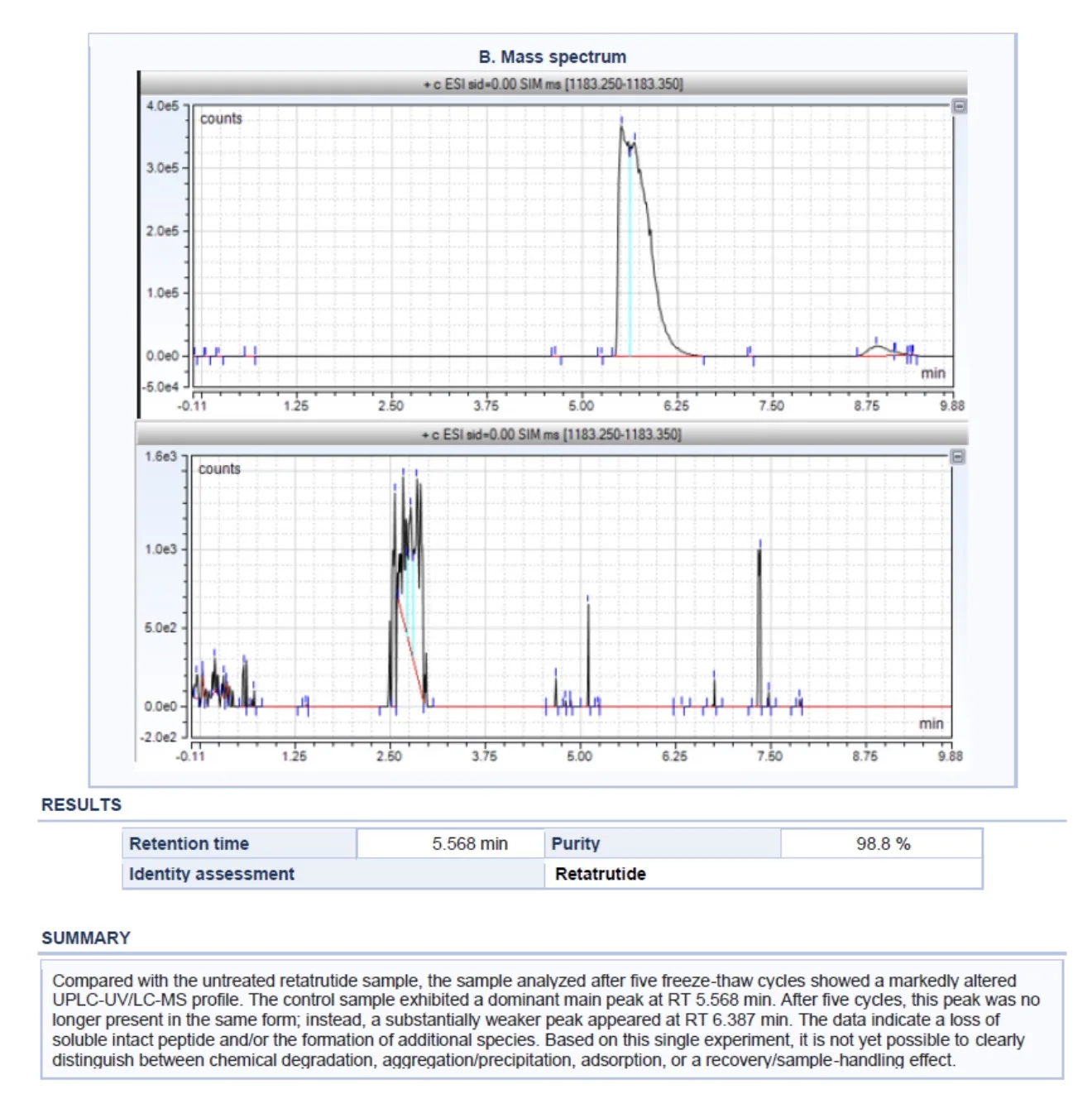
A separate experiment posted on Reddit looked at what happened after five complete freeze/thaw cycles.
Each cycle involved freezing for 2 to 3 hours at −20°C, followed by 30 to 60 minutes thawing at room temperature. After five cycles, the author reported pronounced changes in the UPLC and LC-MS profiles, including a strong reduction in the signal attributed to intact retatrutide.
Importantly, the author didn’t claim this proved that the missing signal represented chemical degradation. Other possibilities included aggregation or precipitation, adsorption to surfaces, and differences in sample handling or recovery. What the experiment does show is that five repeated freeze/thaw cycles produced a substantial analytical change under those particular conditions.
But five cycles aren’t one cycle. For the original question, what happens when reconstituted Reta is frozen and thawed once? the R30 experiment is much more directly relevant.
Read the original five-cycle experiment on Reddit:
https://www.reddit.com/r/Biohacking/comments/1waw5v8/freezethawing_reconstituted_retatrutide_uplclcms/
So, should you freeze reconstituted Reta?
There still isn’t enough evidence for a blanket answer.
Does Reta remain intact after one freeze/thaw cycle?
The best directly verifiable evidence suggests that it can. R30 measured 2.14% lower at the thaw point, while purity barely changed from 99.861% to 99.855%. That small difference in measured quantity can’t simply be attributed to degradation caused by freezing.
Can reconstituted Reta be stored frozen for months?
Still unknown. None of these experiments answers that properly.
Is refrigeration better than freezing?
The PTDS comparison points that way. Two vials of the same R60 product retained 91.0% and 90.4% after 90 days refrigerated, while the two vials subjected to the freezing protocols retained 85.6% and 86.6% after only 45 days. The dataset is still small, but both refrigerated vials performed better over twice the period.
What about repeated freeze/thaw cycles?
There’s reason for caution. The separate five-cycle experiment produced substantial analytical changes, although it doesn’t tell us exactly how much change occurs with each additional cycle.
The bottom line
The evidence doesn’t support the categorical rule “don’t freeze reconstituted Reta, not even once.” The R30 experiment suggests that a single freeze/thaw cycle can be tolerated remarkably well, while the PTDS R60 results are considerably less reassuring.
For longer-term storage, refrigeration currently has the more reassuring evidence. Repeated freeze/thaw cycling is harder to justify, and prolonged frozen storage remains largely unanswered.
Why R30 and R60 behaved so differently is still unresolved, with formulation, diluent and finished-solution pH among the variables that need separating.
Sometimes the data really does insist on ruining a perfectly good absolute statement.

Comments