
Q: Can You Really Filter Dimers Out of HGH?
How a discussion about sterile filtering reconstituted HGH quickly exposed a much bigger question.
There are actually three completely different issues being bundled together whenever people talk about “filtering HGH.”
1. Will HGH actually pass through a 0.22 µm filter?
HGH is roughly 4 to 5 nm across, depending on its folding, while a 0.22 µm filter has pores around 220 nm. So HGH itself is considerably smaller than the pores. The basic idea that HGH can’t pass through a 0.22 µm filter because the pores are too small doesn’t make sense. Pacific Coast Biologics reported routinely sterile filtering protein preparations once , sometimes twice, without an apparent problem. But whether HGH fits through the pores isn’t the whole story.
2. Will HGH stick to the filter?
This is a different question entirely. Pore size alone doesn’t determine how much protein makes it through a filter. Proteins can adsorb onto the membrane itself, despite being much smaller than its pores. That means membrane material matters. PES is commonly used as a low-protein-binding membrane, while PVDF can have considerably greater protein binding depending on the particular membrane and protein.
Surface area may matter too. A larger filter provides more membrane for the protein to interact with. So asking whether HGH is smaller than 0.22 µm answers one question: Can it physically pass through? It doesn’t necessarily answer another: How much HGH comes out the other side?
3. Can a filter actually remove HGH dimers?
This is where things get much more interesting. A 0.05 µm filter has pores around 50 nm. HGH monomer is still considerably smaller than that. During the discussion, the claim that a 0.05 µm filter could be used to filter out HGH dimers was challenged. Pacific Coast Biologics said he’d never seen monomer separated from dimer simply through filtration. The methods he’s seen used included ion-exchange chromatography, hydrophobic chromatography and HPLC purification. And that’s an important distinction. A filter may remove particulates and sufficiently large aggregates, but that doesn’t automatically mean it can selectively separate an HGH monomer from its dimer. If both are substantially smaller than the membrane pores, simply saying something was “filtered” doesn’t demonstrate that the dimers disappeared.
4. But Does That Loss Matter in Practice?
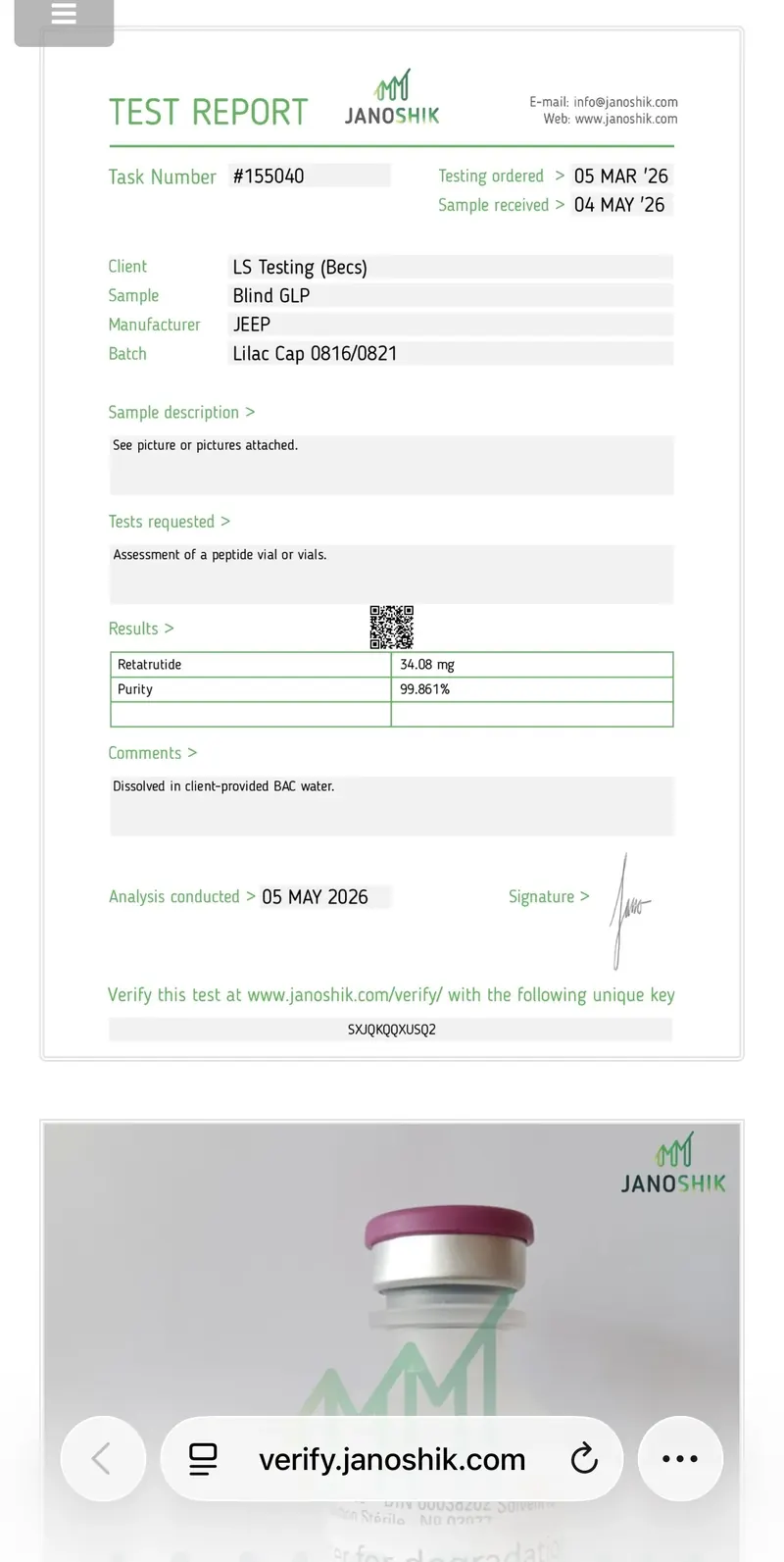
There was some disagreement over whether protein adsorption would actually matter at the small volumes and milligram quantities being discussed. Janoshik questioned whether binding was really an issue at those quantities. The response was that it could be, depending on the membrane material and surface area of the filter. A larger filter, particularly one that strongly adsorbs the protein because of its surface chemistry, could potentially cause measurable losses even in the milligram range.
Janoshik’s counterpoint was practical: for the volumes being discussed, a 3 mm filter is enough, meaning very little membrane surface area is required. He later added that binding with 3 mm hydrophilic PTFE filters was not measurable.
So this isn’t as simple as saying filters make you lose HGH. Whether meaningful adsorption occurs depends on the membrane chemistry, filter construction, surface area, protein and volume involved. With an appropriately selected small filter, Janoshik’s position was that any binding could be below measurable levels.
5. The Filter Itself Can Introduce Something
Protein recovery isn’t the only consideration when choosing a filter for material intended for injection. The discussion also raised particulate shedding, extractables and leachables from the filter itself. Membrane material and construction can affect what potentially ends up in the filtrate. So the question isn’t merely: “What size is the filter?” It’s also: “What is the filter actually made from?”
And none of that answers the separate, and much more interesting claim, that a filter can selectively remove HGH dimers.
The question that should be asked is what does “filtered HGH” actually mean? Was it sterile filtered? Was the aim to remove particles or larger aggregates? Or is someone claiming that filtration actually separated HGH monomer from dimer? Those aren’t interchangeable claims. If the claim is specifically that a filter removes HGH dimers, then the important evidence isn’t merely the pore size or the fact that filtration occurred. Show what was present before filtration. Show what was present afterwards. Otherwise, “we filtered out the dimers” is a claim, not a demonstration.
Q; Does Freezing Reconstituted GLP-1s Degrade Them?
Another simple question in Lab Chat produced an interesting answer: Does freezing a GLP-1 after it has been reconstituted cause it to degrade?
Pacific Coast Biologics said they had put reconstituted reference materials through two to three freeze-thaw cycles, analysed them soon afterwards and saw no degradation. That’s useful real-world laboratory experience, but it needs an important qualification. It doesn’t establish that every GLP-1 can repeatedly be frozen and thawed without degradation, or tell us what happens after longer storage periods. Different peptides, formulations, concentrations and storage conditions may behave differently. What it does show is that the assumption that one freeze automatically destroys a reconstituted peptide isn’t supported by what was observed in those particular samples.
And that discussion led to another question.
What Are Labs Actually Testing Your Peptide Against?
When a laboratory tells you that the material in your vial is a particular peptide, what is it comparing it with? This is where reference standards come in. The discussion revealed just how variable obtaining those standards can be.
Pacifica Coast Biologics said reference material can cost anywhere from approximately $27 to $3,200. If the compound has a CAS number and is readily available, sourcing it may be relatively straightforward. If it isn’t, the laboratory may have to synthesise the material itself or have a reference custom-made. He said it keeps reference materials for most popular peptides and adds others when economically sensible.
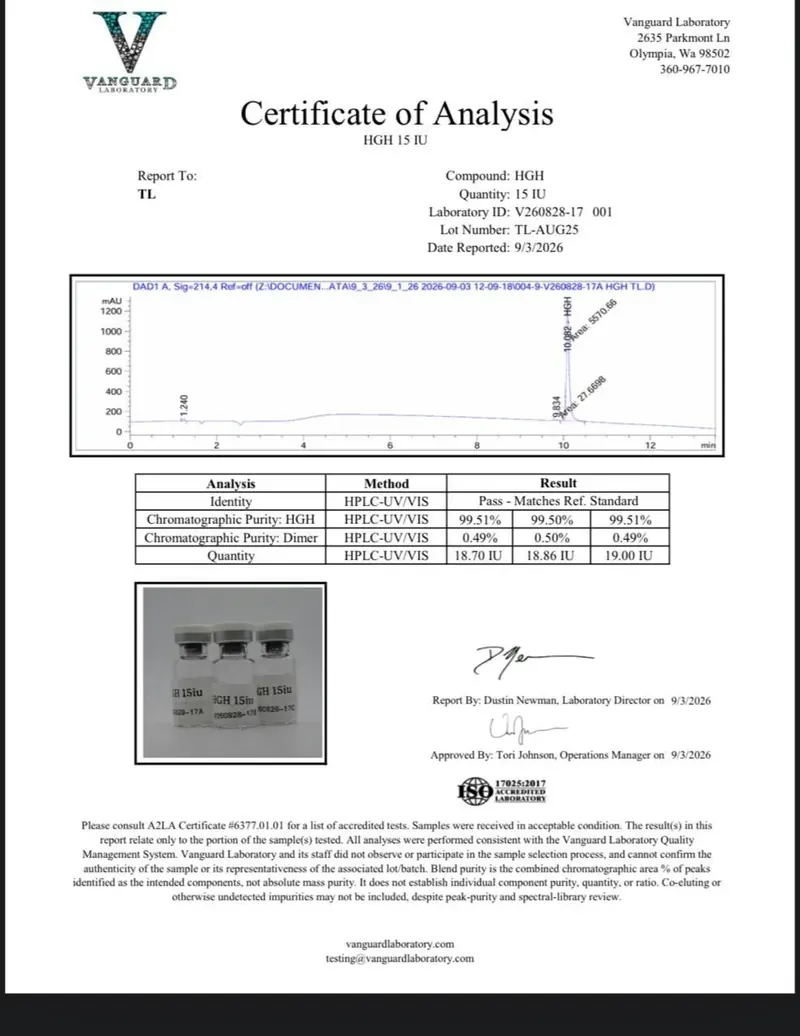
Vanguard said it uses a reference standard for all of its methods and had accumulated more than $100,000 worth of standards during the previous year alone, stored across multiple freezers, refrigerators and at room temperature as appropriate. That gives some useful context to a line on a laboratory report that most customers probably never think about. A reference standard isn’t simply a generic database entry or a name typed into the instrument. It is physical reference material that has to be obtained, stored and maintained, and for less common compounds it may be expensive or difficult to source.
So perhaps another question worth asking a testing laboratory isn’t simply: “Can you test this peptide?” But: “What reference standard are you using to identify and quantify it?” Because the quality of a test doesn’t begin when your vial enters the machine. It begins with what the laboratory has available to compare it against.
Above is a video from Vanguard’s Lab showing his frozen reference samples.
Comments