
Introduction
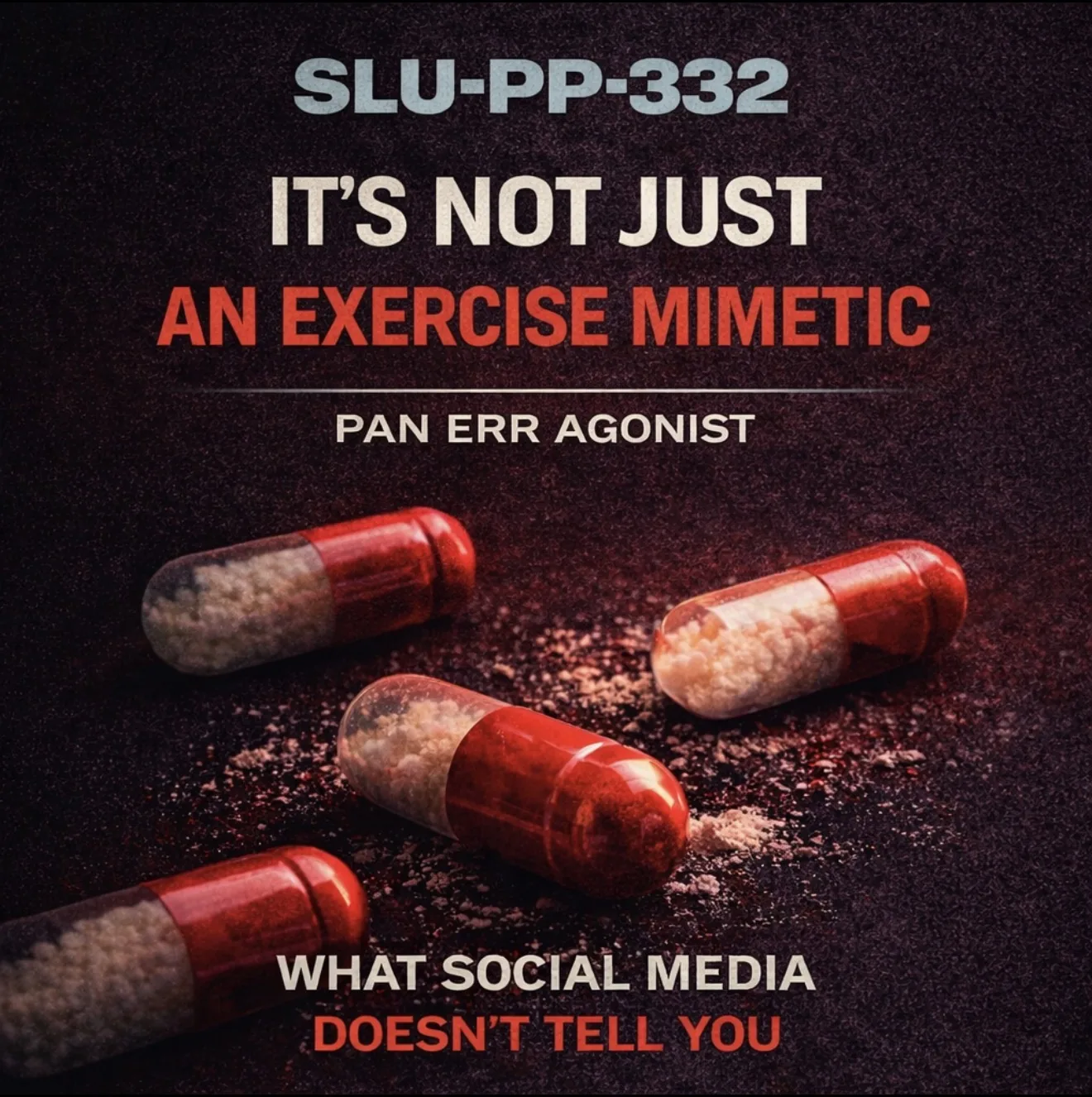
By now, most people in this community have heard of SLU-PP-332, the so-called “exercise mimetic” promoted as an oestrogen-related receptor agonist.
It has been pushed by figures such as Hunter Williams, Jay Campbell and Alex Kikel as something close to a holy grail metabolic compound, with anecdotal claims of noticeable effects at very low doses, around 100 to 600 mcg per day.
But the evidence behind those claims is surprisingly thin.
Almost all of the hype around SLU-PP-332 is based on a handful of preclinical mouse studies, not human trials. In the main published work, male mice were given the compound intraperitoneally at 50 mg/kg, a long way from how people were trying to take it orally in the real world.
On top of that, the original SLU-PP-332 lacks oral bioavailability, which makes some of the more dramatic real world claims even harder to take seriously, especially when, on closer inspection, some of the same people promoting it are also selling it.
An orally active analogue, SLU-PP-915, has since been developed. But that does not change the fact that the original excitement around SLU-PP-332 was built on conditions that do not match how it has been used outside the lab.
What exactly is SLU-PP-332?
SLU-PP-332 is not just another metabolic compound.
It is a pan-ERR agonist, meaning it activates three oestrogen-related receptor isoforms at once:
ERRα
ERRβ
ERRγ
These receptors are part of the nuclear receptor family and regulate:
energy metabolism
mitochondrial function
oxidative phosphorylation
fatty acid oxidation
fuel selection
They are structurally related to classical oestrogen receptors, but they do not bind oestrogen.
That matters, because one of the most common reassurances around SLU-PP-332 is that it is “not oestrogen,” as if that means there is nothing biologically sensitive to worry about.
That does not follow.
The different ERR isoforms, and why they matter
SLU-PP-332 is often talked about as if it activates one simple “metabolism receptor.”
It doesn’t.
Each isoform behaves differently.
ERRα; performance and most of the concern
ERRα is most strongly linked to:
mitochondrial activity
oxidative metabolism
skeletal muscle adaptation
endurance related transcriptional programs
It is also the isoform most responsible for the exercise mimetic effects seen in studies.
But ERRα is also heavily involved in cancer biology, particularly in breast cancer.
It has been linked to:
tumour metabolism
proliferation
angiogenesis
migration
stem cell-like behaviour
poorer clinical outcomes
Because of this, the research focus in oncology has largely been on inhibiting ERRα, not activating it.
ERRγ; a different direction
ERRγ often shows opposing behaviour.
It has been associated with:
tumour suppression
mesenchymal-to-epithelial transition
reduced invasiveness
improved mitochondrial efficiency
In cardiac models, ERRγ appears to drive much of the beneficial metabolic effect.
ERRβ; the least defined
ERRβ is less clearly understood.
It is activated by SLU-PP-332, but plays a less defined role in the effects people typically focus on.
Why pan-ERR agonism is more complex than it sounds
SLU-PP-332 activates all three receptors at once, with somewhat greater activity at ERRα.
That means you are not turning on a single pathway.
You are activating a network of overlapping transcriptional systems that can:
reinforce each other
counteract each other
behave differently depending on tissue
In muscle → improved endurance
In metabolism → beneficial effects
In cardiac tissue → improved mitochondrial function
But in other tissues, including those involved in cancer biology, the outcome is unclear.
What the preclinical studies actually show
SLU-PP-332 has shown promising effects in preclinical models:
improved endurance
improved metabolic markers
reduced fat mass
improved insulin sensitivity
improved mitochondrial function
In the JPET study, it improved metabolic syndrome:
https://pmc.ncbi.nlm.nih.gov/articles/PMC10801787/
In the aging kidney study, it reversed mitochondrial dysfunction and inflammation:
https://pmc.ncbi.nlm.nih.gov/articles/PMC10734281/
On paper, that all looks impressive.
But these are still preclinical findings.
There are:
no human clinical trials
no long-term safety data
no cancer-risk data
no breast-tissue data
no reproductive or endocrine safety data
The jump from “promising mouse data” to real-world human use is enormous.
The theoretical paradox in breast cancer
The ERR-breast cancer relationship is isoform-dependent.
ERRα → pro-tumourigenic
ERRγ → potentially tumour-suppressive
This creates a paradox.
A pan-ERR agonist like SLU-PP-332 may:
activate tumour-supporting pathways (ERRα)
while simultaneously activating opposing pathways (ERRγ)
So the real question is:
Which isoform dominates, in which tissue, under which conditions?
And right now, we do not know.
That does not prove harm, but it does mean the outcome is uncertain in a system already known to be complex.
ERR antagonists in breast cancer research
One of the reasons this raises concern is that researchers often approach the same pathway from the opposite direction, trying to block ERRα, not activate it.
Key papers include:
Stein et al., 2008
https://aacrjournals.org/cancerres/article/68/21/8805/541739
→ ERRα critical for growth in ER-negative breast cancer
Chisamore et al., 2009
https://pmc.ncbi.nlm.nih.gov/articles/PMC2680043/
→ ERRα antagonist studied directly in breast-cancer cells
Chang et al., 2011
https://pmc.ncbi.nlm.nih.gov/articles/PMC3199323/
→ ERRα linked to poorer outcomes and proliferation
May, 2014
https://pmc.ncbi.nlm.nih.gov/articles/PMC4041375/
→ Overview of ERRα-targeting strategies in breast cancer
This does not prove SLU-PP-332 causes cancer.
But it does show that ERRα is not a neutral target, it is already being studied as something to inhibit in oncology.
The real takeaway
SLU-PP-332 is being presented as a simple metabolic tool.
It isn’t.
It is a broad nuclear receptor agonist, acting upstream at the level of gene expression across multiple receptor systems that do not all behave the same way.
That is very different from a straightforward fat-loss aid or endurance booster.
This is not about creating panic.
It is about understanding what you are actually taking.
Because SLU-PP-332 is not just “boosting metabolism.”
It is activating a receptor system biology still hasn’t fully mapped, in ways that are tissue dependent and potentially contradictory.
And that alone should make people far more cautious than they currently are.
Comments