
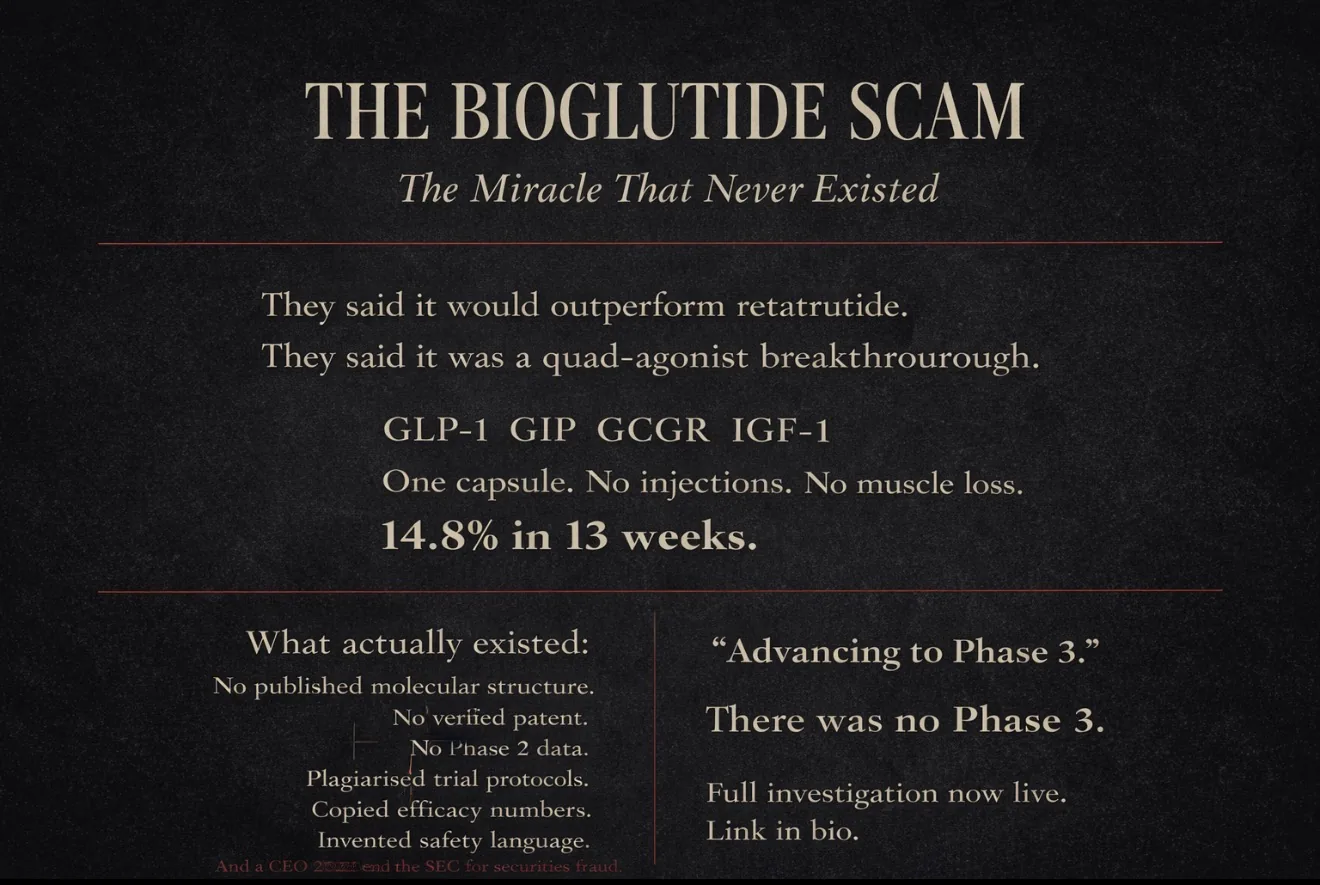
Bioglutide was supposed to be the breakthrough.
Across TikTok and Instagram, it was marketed as a quad-agonist super drug combining:
GLP-1
GIP
Glucagon (GCGR)
IGF-1
All in a single oral capsule.
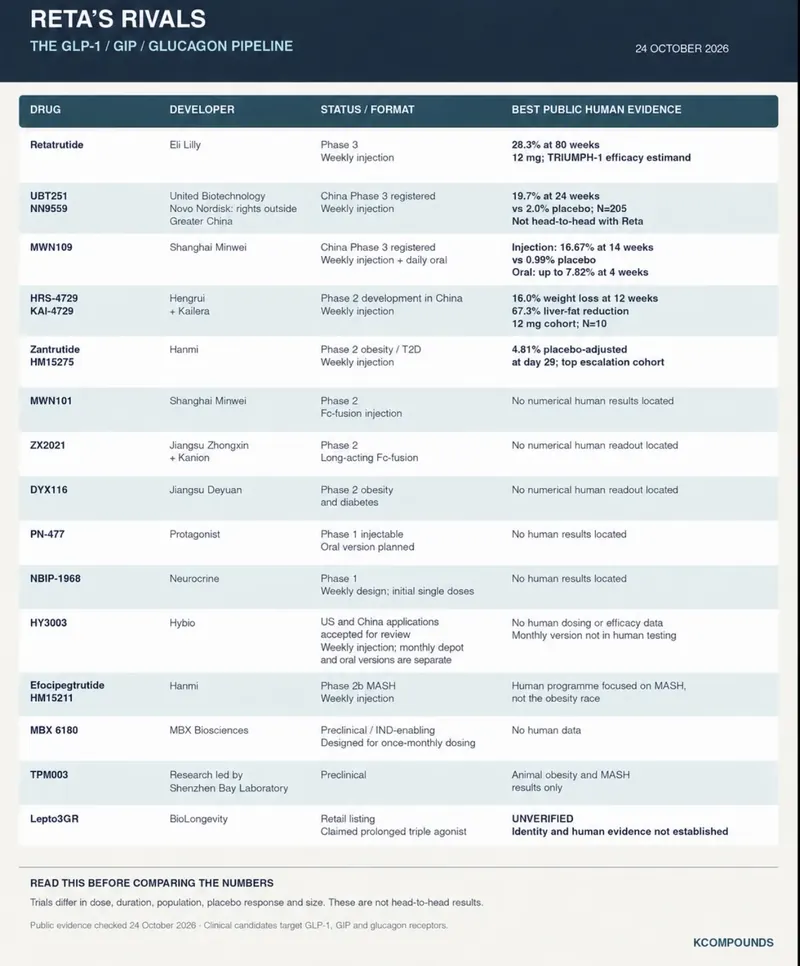
Influencers claimed it would blow retatrutide out of the water, delivering:
14.8% body weight loss in 13 weeks, without losing muscle.
No injections.
No lean mass loss.
No meaningful side effects.
On paper, it sounded like the metabolic holy grail.
In reality, it was something else entirely.
Behind the glossy videos and viral promises, there were:
No verified patents
No peer reviewed data
No legitimate Phase 2 trials
Near verbatim copy paste from another
company’s protocol
Fabricated safety language
And a CEO with a prior SEC fraud injunction
This should have been the biotech shock of 2025.
And yet… it barely registered.
I make no claim to having uncovered this myself. I came across it through a YouTube video. Full credit for the original analysis belongs to Aus Aminos.
But what happened next is what I can’t understand.
This compound wasn’t positioned as incremental. It wasn’t “just another GLP-1.” It was framed as something that would outperform retatrutide, even render it obsolete.
Fitness influencers amplified it. Biohackers discussed it. Vendors prepared for it.
Jay Campbell publicly stated that he paid a significant amount of money for “Bioglutide” and even gave it to his sister to try.
Which raises a very uncomfortable question:
What exactly did he take?
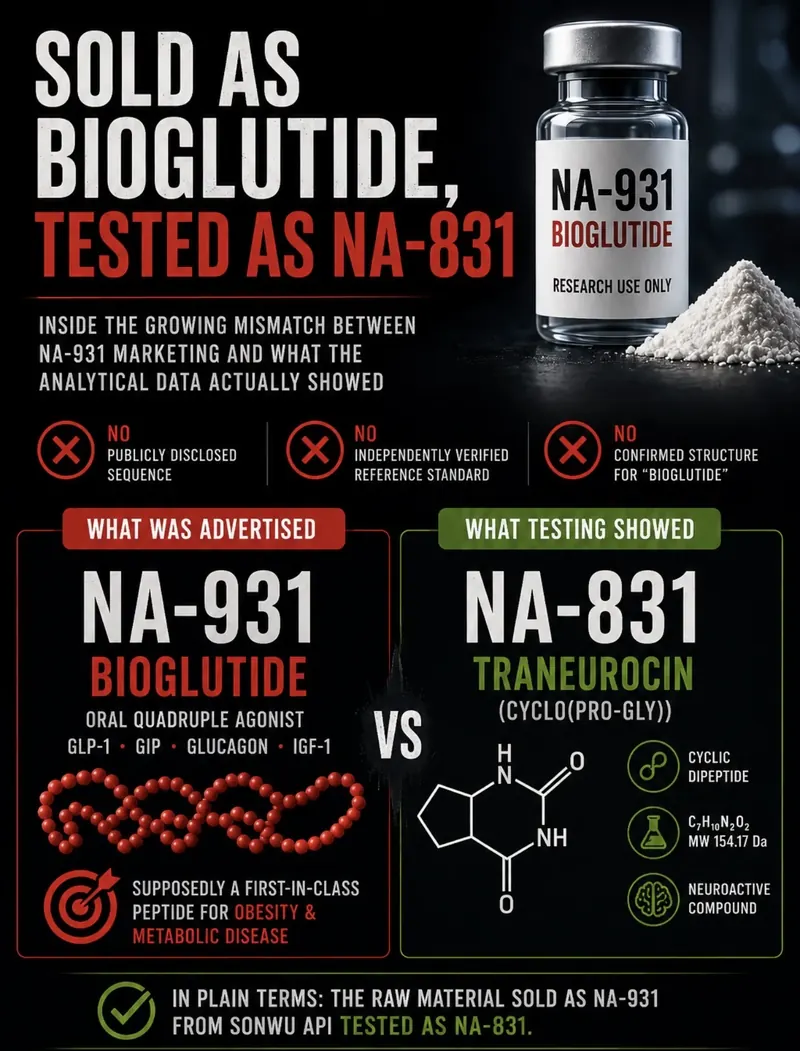
Because by late 2025, a circulating COA for “Bioglutide” showed it contained a mixture of retatrutide and cagrilintide.
Not a novel quadruple agonist.
Not a first-in-class molecule.
Not a GLP-1/GIP/GCGR/IGF-1 breakthrough.
Just a blend of two already known peptides.
Which was never even what the original claims described.
Meanwhile, reports suggested Chinese labs had already synthesised it, allegedly waiting only for the final chemical structure to be released.
Consumers were waiting.
Vendors were preparing.
The supply chain was primed.
That’s the part that should alarm everyone.
This wasn’t just a fake press release. It wasn’t just plagiarised data. It was a narrative that had already entered the grey-market ecosystem.
And somehow, it all just… faded.
Barely a ripple.
In the grey zone, even fraud can become background noise.
Exhibit A
The First “Official” Press Release (February 2024)
On February 1, 2024, Biomed Industries announced NA-931 (Bioglutide™).
It described the compound as:
“A small-molecule oral capsule based on a novel mechanism of action of GLP-1 and IGF-1… Its analogue/prodrug has already been approved by the FDA for a certain rare disease.”
At that point, NA-931 was presented as:
A GLP-1 + IGF-1 dual agonist
“Poised for Phase 2/3 trials”
Already showing minor adverse events in a Phase 2A trial
Capable of reducing BMI without muscle loss
Within months, that description changed.
The Moving Target: Dual → Quadruple Agonist
Originally:
GLP-1 + IGF-1
Later:
GLP-1 + GIP + GCGR + IGF-1
You cannot change receptor targets without redesigning the molecule.
The shift conveniently mirrored the growing hype around multi-agonist drugs like tirzepatide and retatrutide.
It reads less like discovery and more like escalation.
The Mechanistically Impossible Quadruple Agonist
Biomed ultimately claimed NA-931 was:
“A small-molecule, quadruple agonist of IGF-1, GLP-1, GIP, and glucagon receptors.”
This is not just ambitious.
It is mechanistically incoherent.
GLP-1, GIP, and glucagon receptors are Class B GPCRs.
The IGF-1 receptor is a receptor tyrosine kinase.
They are structurally unrelated.
They do not share binding domains.
They do not share activation mechanisms.
There is no known small molecule that directly activates all four.
If NA-931 were real, it would represent a Nobel level breakthrough.
Yet there is:
No published molecular structure
No binding assay
No patent
No in-vitro activation data
The claim exists only in marketing language.
The “Small Molecule” Problem
All legitimate GLP-1 receptor agonists are peptides:
Semaglutide. Tirzepatide. Retatrutide.
Their molecular weights range from 3,700 to 4,900 daltons.
Small molecules are typically under 500 daltons.
A small molecule cannot activate GLP-1 the way peptide hormones do.
Then there’s the name.
Why call it Bioglutide?
The “-tide” suffix comes from peptide nomenclature.
Calling something a small molecule while branding it like a peptide is chemically contradictory.
The Phantom Patent
The press release claimed patent protection had been filed.
No patent filings appear in USPTO, WIPO, or EPO databases.
No application number.
No chemical disclosure.
No public record.
The Imaginary FDA-Approved Analogue
Biomed claimed its analogue/prodrug was already FDA-approved for a rare disease.
The only remotely related IGF-1 therapy is Mecasermin (Increlex), a protein injection approved in 2005 for paediatric growth disorder.
It is not a small molecule.
Not a prodrug.
Not GLP-1 active.
The comparison is misleading.
Phase 2A Before Phase 1?
Tran cited Phase 2A data in February 2024.
ClinicalTrials.gov shows:
Phase 1 began May 2024
Phase 2 began July 2024
Phase 2 claims preceded Phase 1 initiation.
The publicly available timeline does not support the claim that Phase 2A data existed in February 2024.
Exhibit B
The “Journal of Diabetes” Illusion (June 2025)
Sixteen months after the original press release, Biomed returned, this time wrapped in the credibility of the American Diabetes Association.
An abstract appeared in the ADA supplement of the Journal of Diabetes.
At first glance, it looked like validation.
It was not.
It was a conference abstract.
Not peer reviewed.
No raw dataset.
No statistical appendix.
No independent co-authors.
No institutional collaboration.
Yet it was marketed as proof that “Phase 2 results” had been published.
That single shift, from press release to abstract, allowed the narrative to evolve from hype to “science.”
And that is where the story becomes more concerning
The 14.8% Claim
The abstract reported:
14.8% total weight loss
13.2% vs placebo
72% ≥12% responders
These numbers are nearly identical to Viking Therapeutics’ VK-2735 Phase 2 data:
14.7%
13.1%
71%
The difference: +0.1%.
Even the methods section mirrors Viking’s documentation.
The Muscle Preservation Claim
Biomed claimed NA-931 produced:
14.8% body-weight loss in 13 weeks
with “no muscle loss observed.”
That combination is extraordinary.
Rapid weight reduction of that magnitude especially over 13 weeks, almost always includes measurable lean mass loss. Across semaglutide, tirzepatide, and retatrutide trials, approximately 20 to 30% of total weight lost comes from lean mass.
So if NA-931 truly delivered 14.8% total loss with zero muscle reduction, it would represent a genuine physiological breakthrough.
But the abstract provides:
No DXA data
No MRI data
No body composition tables
No baseline vs endpoint lean mass values
No statistical analysis
It simply states:
“No muscle loss was observed.”
Observed how?
By what method?
Against what measurement threshold?
There is no documentation.
In legitimate trials, lean mass preservation requires imaging modality disclosure, quantitative breakdown, and statistical comparison.
None exists here.
The weight loss number was dramatic.
The muscle preservation claim was even more dramatic.
Neither was supported.
Fabricated Safety Language
The abstract states:
“83% reported as insignificant.”
“Insignificant” is not regulatory terminology.
No AE tables.
No denominators.
No discontinuation data.
The language reads improvised.
The Phase 3 Mirage
The abstract concludes:
“Advancing to Phase 3 trials.”
There is:
No IND progression
No Phase 3 listing
No regulatory authorisation.
Phase 3 exists only in press releases.
A Broader Pattern: Not Just Bioglutide
Bioglutide was not an isolated claim.
Biomed Industries promoted multiple “NA-series” compounds across different therapeutic areas, obesity, neurodegeneration, rare diseases, and even vaccines.
The BioCovax Episode
Biomed also promoted BioCovax as a novel oral COVID-19 vaccine, allegedly combining an oral polio vaccine with one of its NA-series compounds.
In practice:
The product imagery appeared to reuse a generic oral polio vaccine label.
The associated clinical trial (NCT04540185) did not progress or publish results.
No independent data validated the claimed mechanism.
As with Bioglutide, the marketing language suggested innovation. The documentation did not.
The Prior SEC Record
In 1991, SEC Digest 91212 documented that Lloyd H. Tran was permanently enjoined for securities violations related to unregistered stock sales and misleading investor communications. The company involved later went bankrupt.
That history does not prove present misconduct.
But when evaluating extraordinary scientific claims that lack documentation, prior regulatory findings become relevant context.
Why This Matters
Bioglutide wasn’t just a flawed weight-loss claim.
It was part of a broader ecosystem of repeated, escalating announcements, each one framed as imminent, breakthrough, and Phase ready.
When the same patterns repeat across multiple products, vaccines, neuro compounds, metabolic drugs, the issue stops being scientific error.
It becomes structural.
Demographic Inconsistency
In his 2025 unlisted YouTube presentation, Lloyd Tran described the alleged Phase 2 participant breakdown as including:
“some Māori people in New Zealand”
“some Native American”
However, the official ClinicalTrials.gov record (NCT06564753) lists five trial sites, all located in Australia.
There are no New Zealand sites listed.
There are no North American sites listed.
Australia’s Māori population is extremely small (well under 1% of the population). In a study of roughly 125 participants, recruiting a meaningful number of Māori, alongside Native American participants, would be statistically unlikely, particularly without any New Zealand trial sites registered.
This discrepancy raises a straightforward question:
If the trial was conducted entirely in Australia, where did the Māori and Native American participants come from?
At minimum, it reflects a mismatch between the CEO’s public statements and the registered trial documentation.
A Pattern of Deception
SEC Digest 91212 (Nov 1991) documents that Lloyd H. Tran was permanently enjoined for securities violations involving misleading stock sales.
The company later went bankrupt.
Today, the same individual promotes a miracle compound built on plagiarised data and unverifiable trials.
Conclusion
When viewed together:
Mechanistically impossible receptor claims
Copy-paste protocols
Fabricated numbers
Chronologically impossible timelines
Misleading regulatory references
No patents
No filings
A documented fraud history
Bioglutide does not look like failed science.
It looks like calculated deception.
No genuine data.
No regulatory progression.
No accountability.
Just recycled promises, from someone who has done it before.
A System That Didn’t Ask Questions
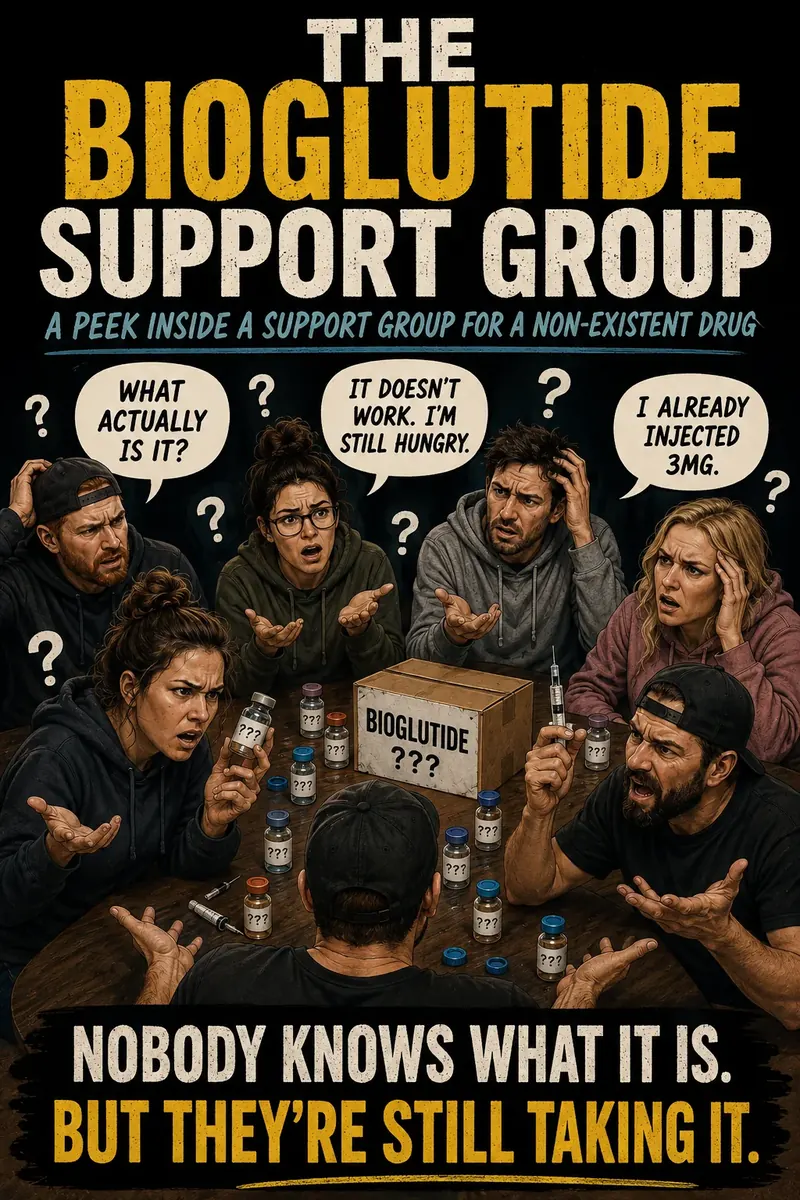
A compound with no published structure, no verified patent, no completed clinical trial, and no regulatory filing was treated as real.
It was discussed.
Priced.
Purchased.
Administered.
Prepared for synthesis.
All without proof that the molecule even existed.
Conference abstracts were mistaken for peer review.
Press releases were mistaken for regulatory progress.
Copy pasted protocols were mistaken for clinical design.
Influencer endorsement was mistaken for validation.
No assay data was demanded.
No independent verification required.
Bioglutide didn’t collapse because regulators intervened.
It collapsed because an independent researcher compared two PDFs.
That’s the part that should stay with us.
Because the next breakthrough will arrive the same way.
And unless the standard of proof changes, it will move just as easily.
Comments