
HGH is one of those products where a COA can tell you a lot, but getting your own vial tested properly isn’t cheap. If all you really want to know initially is whether there is actually HGH in the vial at all, spending hundreds on lab testing can feel like overkill. With the current epidemic of bunk HGH being sold in the grey market, more and more people are resorting to using this quick, simple and more importantly cheap test, just to identify if they have any HGH or not. So I decided to investigate this to see how accurate they actually are and whether they’re worth using.
I’d already started being sent images of the stick tests as evidence the customer had been sent bunk product, but i didn’t know too much about them until they came up in K-Hole Lab Chat. The question was simple: how accurate are these home tests for identifying 191aa HGH, and could they be useful as a cheap first line of defence against completely bunk HGH?
The answer is more interesting than I expected.
What Are These Tests Actually Testing?
The NarcoCheck Pept-ID hGH test currently costs €24.90 and is specifically sold as a rapid presence test for somatropin in injectable solutions. It isn’t testing purity and it isn’t measuring the amount of HGH in the vial. It is an immunochromatographic test, meaning it uses an immunological reaction to recognise the target protein. NarcoCheck says its test detects recombinant 191 amino acid HGH, the somatropin used in most modern pharmaceutical HGH preparations. That distinction came up in Lab Chat when someone asked Janoshik:
“How (in)accurate are homekits from Roidtest (or equivalent) for identifying HGH 191AA? As a first line of defense”
Janoshik’s reply was:
“Well, I hope they’re pretty accurate.”
followed by:
“It’s gh ELISA.”
When it was clarified that the question was about the cheap NarcoCheck/Roidtest-style kits, Janoshik added:
“That’s what we make, as lfia elisa.”
and:
“Others are presumptive reaction assays, which sums it up.”
Technically an LFIA ( lateral-flow immunoassay), isn’t the same format as a traditional laboratory ELISA, but the point is that these HGH sticks are using antibody-based recognition, rather than simply producing a chemical colour reaction when they come into contact with a substance. NarcoCheck itself confirms that its HGH test is immunochromatographic.
How Do You Actually Use One?
This is probably the most useful bit because they are extremely simple. NarcoCheck says the test only requires 0.05 mL of the reconstituted HGH solution. The kit contains the equipment needed to collect, dilute and transfer the sample, and it can be used with both vials and injection pens. The manufacturer’s instructions show the process as:
Collect a small sample from the reconstituted vial or injection pen.
Transfer the sample into the supplied reagent vial.
Shake it gently.
Put two drops of the mixture onto the test cassette.
Wait for the result.
The manufacturer states that results are read at around 10 minutes. No HPLC. No mass spectrometer. No shipping a vial across the world. Just a few minutes and a €25 stick.
But Don’t Read It Like a Pregnancy Test
This is where people can get caught out. The result works in the opposite direction to many lateral-flow tests people are familiar with.
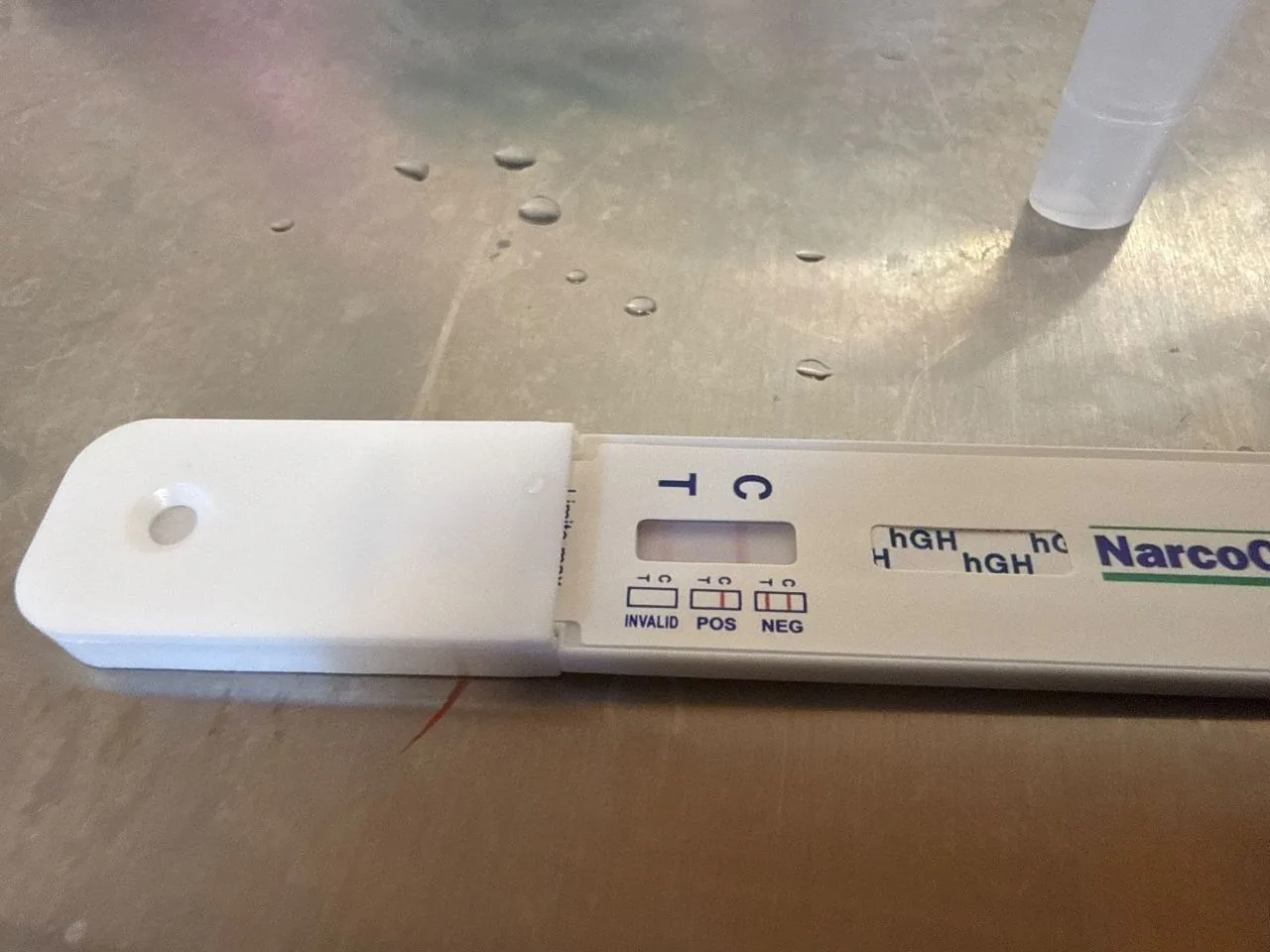
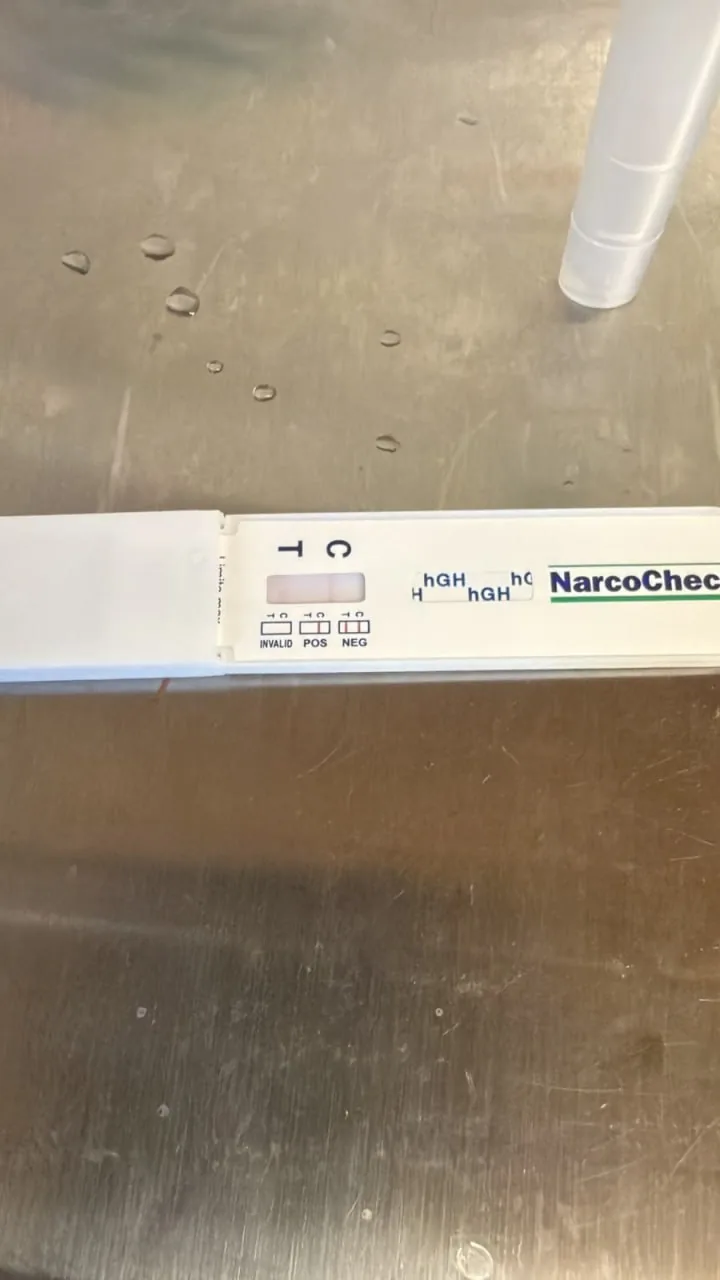
C + T = NEGATIVE
C only = POSITIVE
No control line = INVALID
The manufacturer’s own diagram shows two lines for a negative result and only the control line for a positive result. The examples pictured here were intended to be negative, which is why there is a control line and a test line. So seeing two lines does not mean that HGH has been detected. That’s worth knowing before somebody photographs one, posts it online and announces that their HGH passed when they have actually read the result backwards.
So How Accurate Are They?
This is where it gets more complicated. NarcoCheck says the specificity of its test has been validated in the laboratory against 15 other compounds and related proteins. Among them were: CJC-1295, GHRP-2, GHRP-6, bovine growth hormone, HGH Fragment 176-191, IGF-1, IGF-1 DES, IGF-1 LR3, ipamorelin and sermorelin. According to the manufacturer, those substances remained negative when 191aa HGH was absent, and it says it hasn’t observed adverse cross-reactions with third-party substances to date. That’s useful because one obvious concern would be whether a manufacturer could simply stick a much cheaper GH-related peptide into a vial and fool the test. At least for the substances NarcoCheck says it tested, that apparently didn’t happen. But there’s an important limitation. I can’t find published figures from NarcoCheck giving the actual sensitivity, specificity, false-positive rate or false-negative rate of this HGH test. Nor could I find a published numerical detection limit showing exactly how much HGH has to be present before the test turns positive.
NarcoCheck itself acknowledges that no rapid screening test can be 100% reliable and says laboratory analysis is required if you want to confirm the composition of the sample with certainty.
So calling it “accurate” is one thing. Knowing how accurate it actually is from independently published performance data is another.
A Positive Result Does Not Mean Your HGH Is Properly Dosed
This is probably the biggest limitation of the whole thing. NarcoCheck explicitly says the test can’t determine the proportion of somatropin in the sample. It says the immunological reaction can detect very small traces and that a low-concentration sample can produce the same positive result as a high-concentration sample. A badly underdosed vial could therefore still test positive.
It Isn’t a Mini COA
There is another trap here. A positive HGH stick doesn’t tell you other things that a COA can such as purity, presence of dimers etc… It certainly doesn’t replace HPLC or LC-MS. A positive result basically just answers one much narrower question: Did this immunoassay detect 191aa somatropin in this sample? That is still useful. It just isn’t the same question as “Is this a good vial of HGH?”
What About 192aa HGH?
This came up in Lab Chat as well. Someone wondered whether these tests could distinguish normal 191aa somatropin from 192aa HGH, which is the older recombinant form containing an extra methionine. Janoshik’s response was that he doesn’t believe 192aa HGH is actually circulating commercially to any meaningful degree:
“There’s no 192 around commercial markets.”
He pointed out that if it were common, it would be remarkably lucky for laboratories testing HGH by LC-MS never to encounter it. NarcoCheck specifically describes its product as a test for 191aa recombinant HGH, but I haven’t found public cross-reactivity data showing what the cassette would do if deliberately challenged with 192aa somatrem.
For the purpose of this article, though, that is almost a separate issue. The main use case here isn’t trying to distinguish obscure HGH variants. It’s identifying something far more basic:
Does this vial appear to contain HGH at all?
Are They Worth Using?
For around €25, I can actually see a place for these. If you have an unknown HGH vial and your first concern is that it contains no HGH whatsoever, an immunological presence test gives you a cheap screening option before spending considerably more on a full laboratory analysis. A negative result could help prevent customers from spending more money on further testing and a positive result would be reassuring on one very limited point: HGH was detected.
What I wouldn’t do is turn that positive stick into a certificate of quality. So perhaps the best way to think of these isn’t as an alternative to laboratory testing at all. They are just a first filter.
€25 to ask “Is there actually HGH in this?”
For a product where that is sometimes the first question that needs answering, that may not be a bad little tool.

Comments