
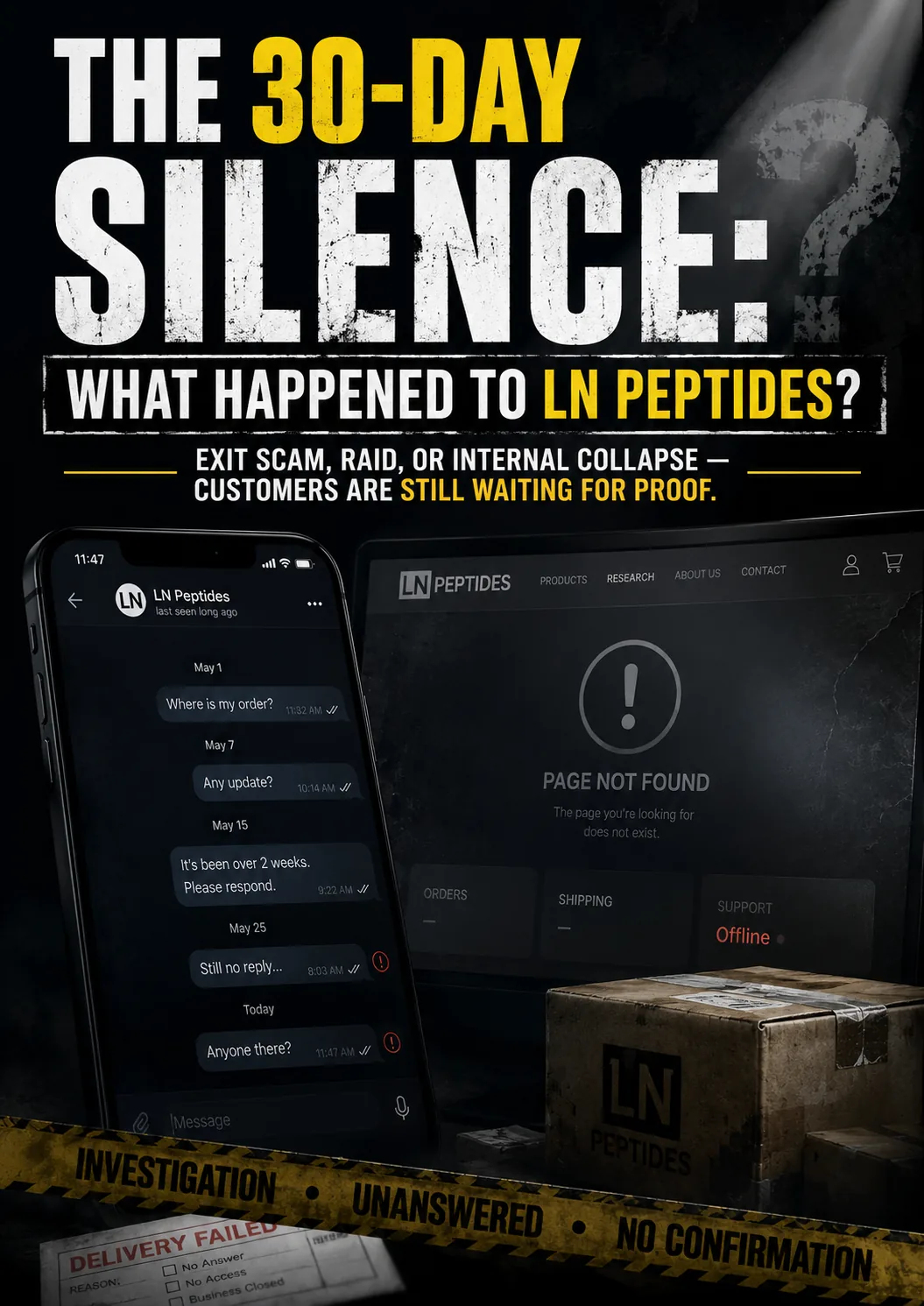
LN Peptides wasn’t a brand-new vendor that appeared overnight and vanished the next day. It was a known name in the research-peptide community. People had ordered from them, discussed them, recommended them, complained about them, defended them, and built strong opinions around them.
That’s why their sudden disappearance caused such a reaction. This wasn’t just another random account going dark. LN had enough reputation that many customers treated it as established.
That doesn’t mean LN was perfect. Far from it. Before the shutdown, there were already complaints about communication, shipping, service, and product quality. Some customers continued to report successful orders, while others had serious issues. Like many vendors in this space, LN had both loyal supporters and vocal critics.
The question now is bigger than whether LN was overrated. The question is: what actually happened?
The sudden shutdown
Around late June, reports started spreading across forums, Discord, Telegram, WhatsApp, and Reddit that LN Peptides had gone silent. Customers said representatives were no longer responding. Telegram groups appeared to be removed or “nuked.” The website stopped functioning. Buyers were left asking whether paid orders would ship, whether tracking numbers were real, and whether LN had disappeared with customer money.
The Exit Scam
According to one customer, they’d placed four orders with LN between May and June. The first was a May 9 order for $870, which they said was misdelivered because of a freight-forwarder issue. After several attempts to get a full refund or reshipment, they said LN only issued a partial refund. The second was a May 18 order for $2,753, which arrived but was missing three PT 141 kits. The third was a June 3 order for $1,470, including money connected to the missing PT 141. That order wasn’t received. The customer said Chinese customs sent the package back or seized it, and before LN reshipped it, the company went silent. The fourth was a June 5 order for $1,430, which the customer said arrived properly.
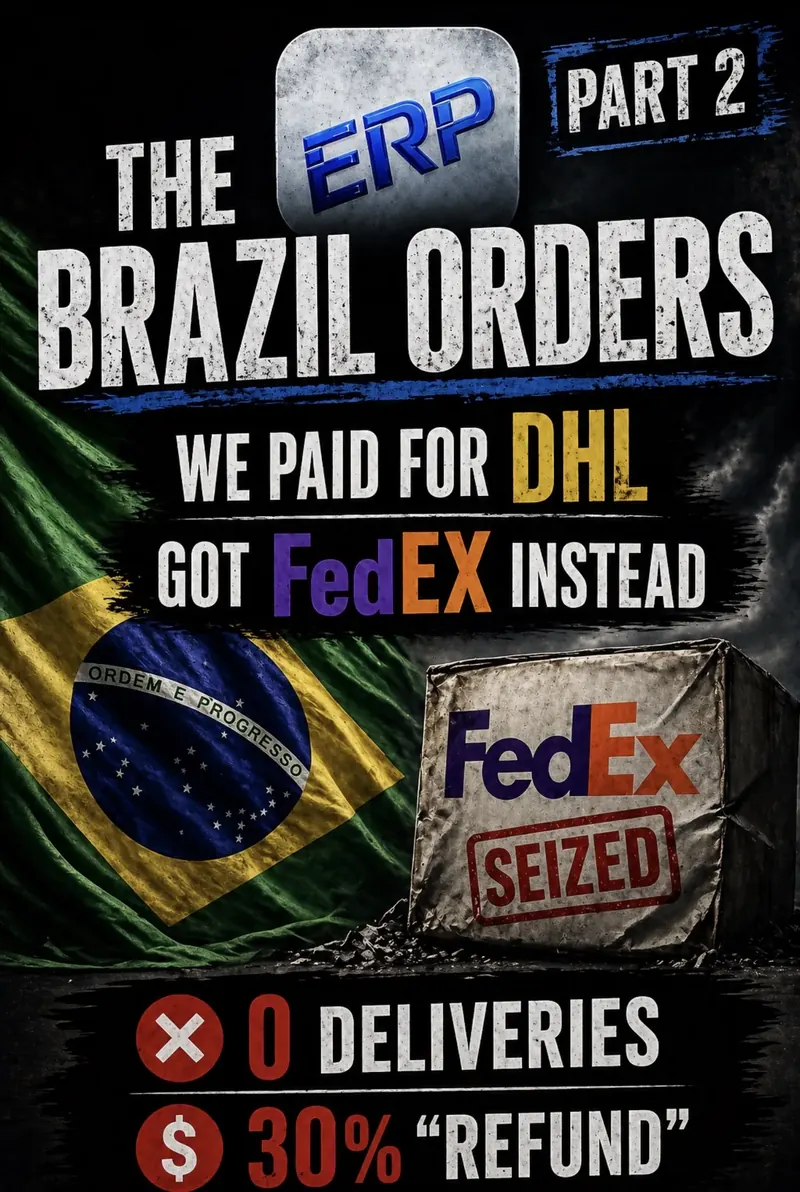
The June 3 order is the one the customer says they lost. They also said they had specifically asked LN to use UPS Express and paid extra for it, but LN still used FedEx. According to the customer, that package was the one that got seized.
The announcement claiming an investigation
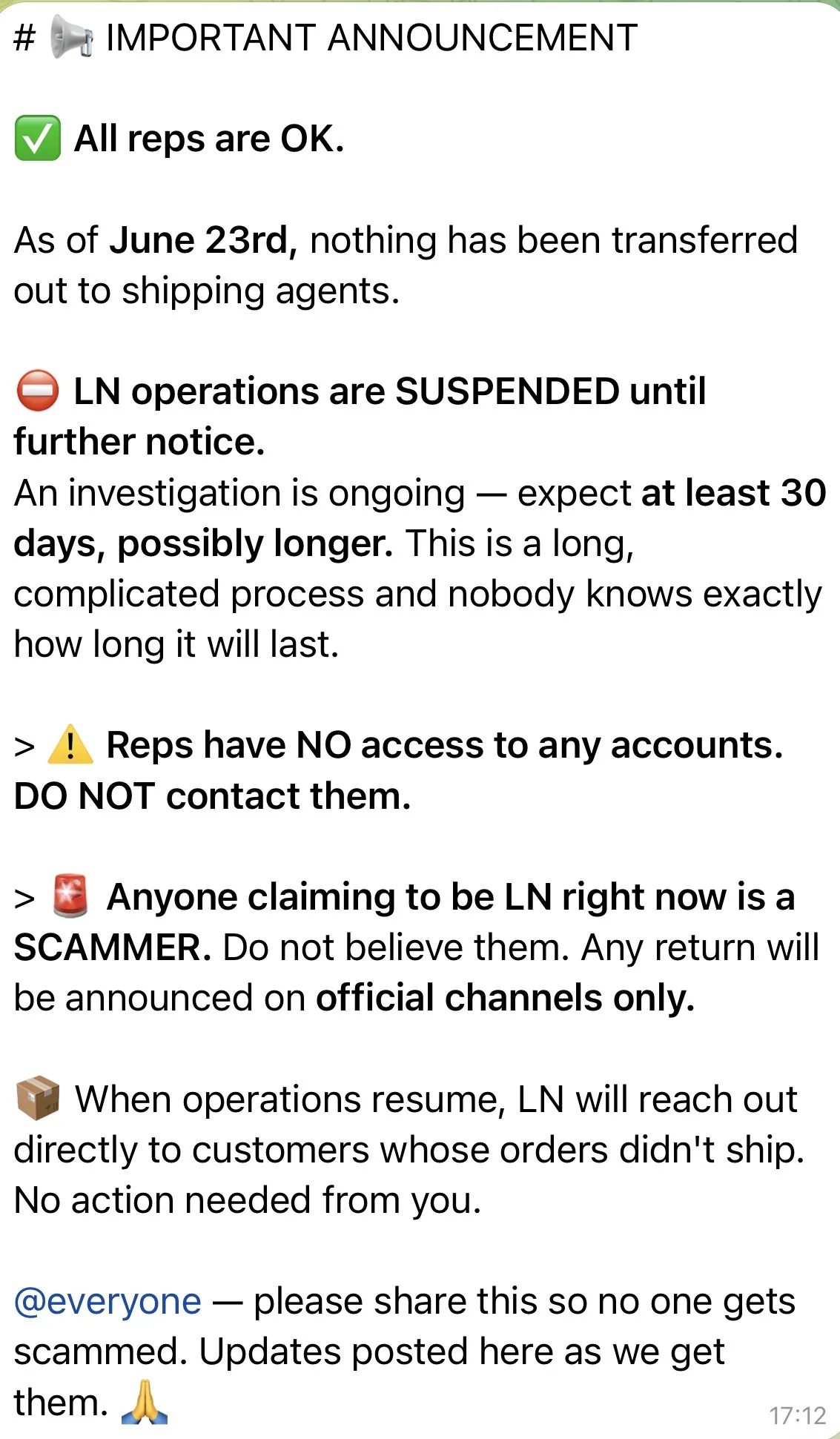
At the end of June, an announcement posted by one of the WhatsApp admin from Cassie’s group gave a different explanation. The announcement said all reps were okay, nothing had been transferred to shipping agents as of June 23, and LN operations were suspended until further notice because of an ongoing investigation expected to last at least 30 days.
The same message warned that reps had no access to any accounts, that customers should not contact them, and that anyone claiming to be LN during the shutdown was a scammer. It also said LN would contact customers whose orders did not ship when operations resumed.
That announcement is the centre of the dispute. If it’s true, LN may have been caught in a raid, investigation, or enforcement action, and the sudden silence may be because accounts, channels, or staff access were disrupted. If it’s false or misleading, then the investigation story could be a way to keep customers calm, slow down complaints, and buy time.
The raid theory
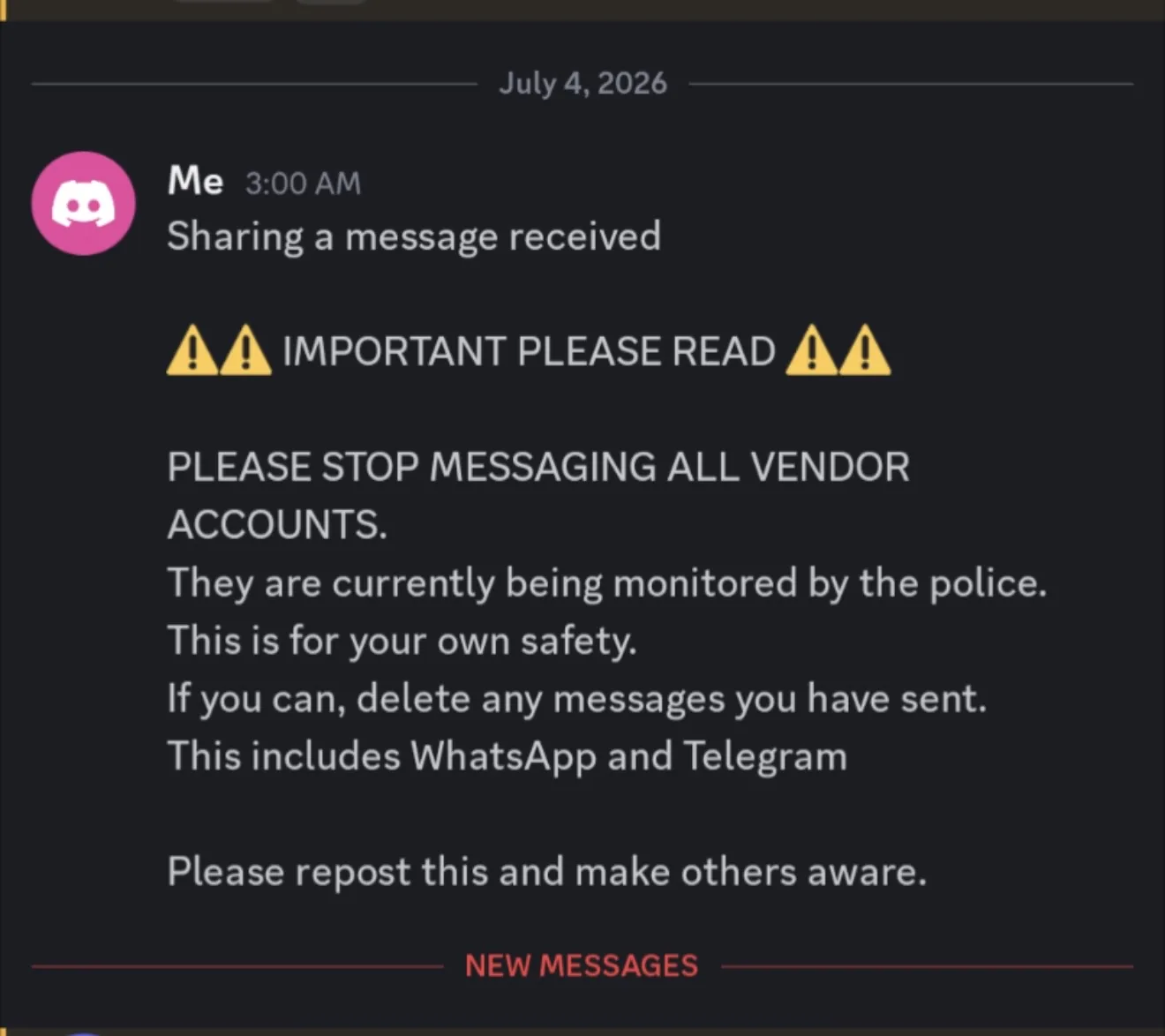
The case for a raid or investigation is not absurd either. One of the strongest pieces of evidence being shared is a discord announcement dated July 4, 2026, where a message says:
“Please stop messaging all vendor accounts. They are currently being monitored by the police. This is for your own safety. If you can, delete any messages you have sent. This includes WhatsApp and Telegram.”
The message also asked people to repost it and make others aware. If genuine, this would support the idea that LN was under some kind of law-enforcement pressure or investigation. It would help explain why vendor accounts stopped responding, why customers were told not to contact reps, and why LN-linked groups were warning people to stay away from anyone claiming to represent the company.
But the post still doesn’t prove a raid. It’s just a message being passed through private community channels. It could be accurate. It could also be a warning repeated in good faith by someone who believed it. Or it could be part of a story used to keep customers calm while the company remained unreachable.
The most concerning part is the instruction to delete messages. Even if the person who shared it meant well, customers should be careful with that advice. If money, orders, tracking, payment wallets, or missing shipments are involved, deleting messages may destroy the only records customers have.
So yes, the raid theory remains possible. The screenshot gives that theory some weight. But it still does not settle the question.
A real investigation could explain the silence. A fake investigation story could also be used to buy time.
That’s why the safest conclusion remains the same: LN was operationally compromised, and no one has publicly proven why.
The earlier Ruby wallet dispute
The June shutdown didn’t happen against a clean background. Months before LN went dark, there had already been a serious dispute involving Ruby, Magic, a customer named Reid, and a wallet address that LN later said wasn’t one of its official payment accounts.
The situation started when Reid placed an order through Ruby. He’d obtained Ruby’s number through an LN-linked Telegram subchannel, so from his point of view, he wasn’t dealing with a random stranger. He believed he was dealing with someone connected to LN. Ruby gave him a wallet address for payment, and he paid. The problem came later, when that wallet address was compared against LN’s official pinned payment list and it wasn’t there.
When the issue was raised with Magic, the response didn’t clear things up. Magic produced a screenshot of Ruby’s phone that showed Ruby had given Reid the correct wallet address. But that screenshot itself raised suspicion. The contact details, formatting, and way the chat appeared looked like it had been reconstructed to make Ruby’s side look cleaner
Then came the blockchain concerns. The wallet Reid had paid into was not just a one-off address. It had hundreds of thousands of dollars in activity, including large inflows and outflows across multiple accounts. Magic denied that the wallet belonged to LN. He also suggested Ruby may have been working for more than one company, then later said there was no evidence of that on her phone.
So the explanation kept shifting.
First, the customer was told the wallet was not official. Then Ruby’s role became unclear. Then the possibility of another company was raised. Then that possibility was walked back. Meanwhile, the original question remained unresolved: how did a customer get directed to that wallet through an LN-linked contact in the first place?
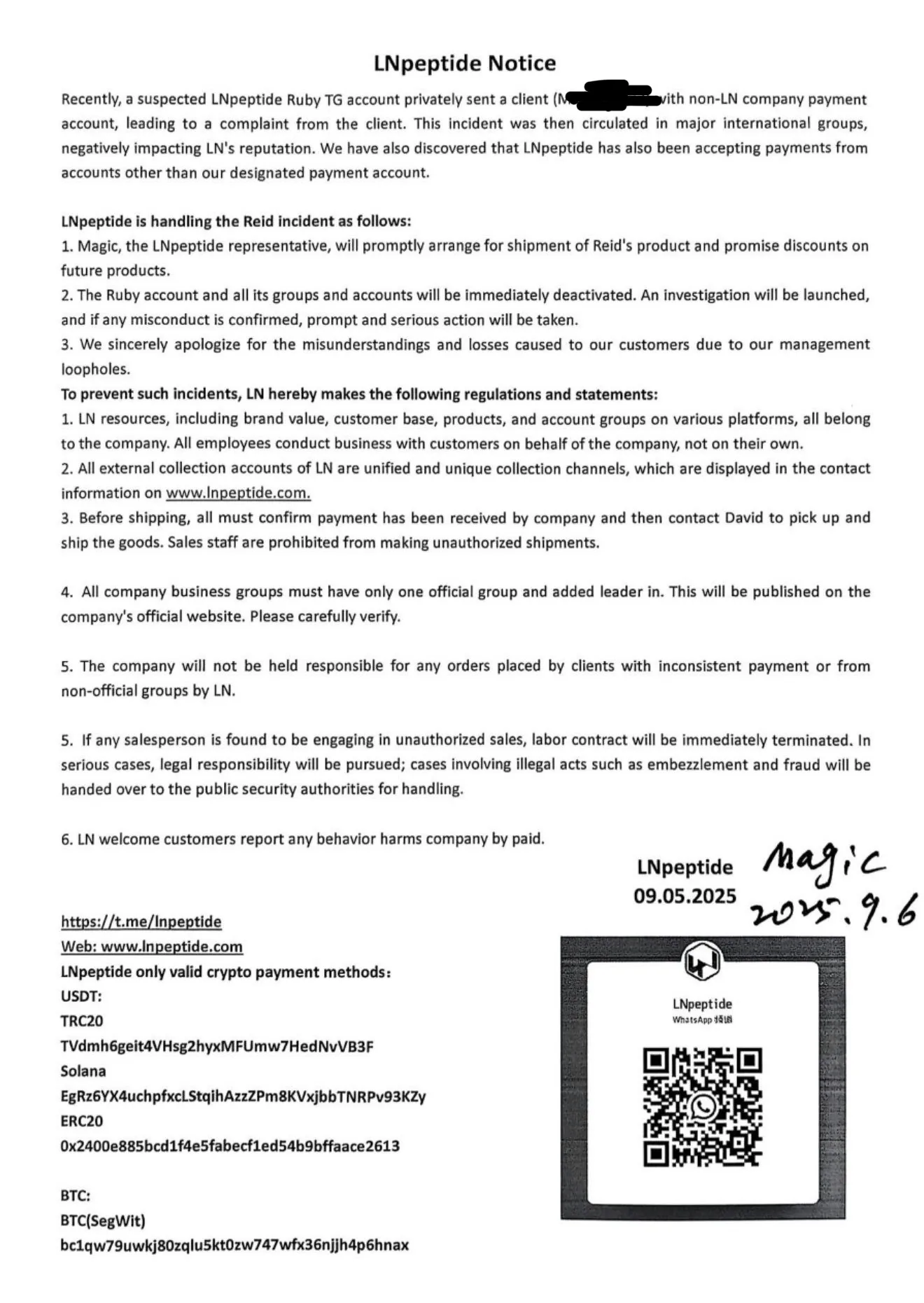
After the wallet evidence was uploaded and circulated, LN issued the LNpeptide Notice. That timing is important. The notice wasn’t a proactive warning sent before customers knew there was a problem. It came after the Ruby/Reid dispute had already been exposed and after the situation had started damaging LN’s reputation.
In the notice, LN said a suspected Ruby Telegram account had directed Reid to a payment account that didn’t belong to the company. LN also acknowledged that payments had been accepted through accounts other than its designated payment account, describing the issue as a management loophole.
On paper, LN appeared to take responsibility. The notice said Magic would arrange Reid’s shipment and offer future discounts. It said Ruby’s account and related groups would be deactivated, and it promised an investigation if misconduct was confirmed.
But the notice also narrowed LN’s responsibility. Customers were told to use only payment accounts listed on the website, avoid unofficial groups, and understand that LN would not be responsible for orders placed through inconsistent payment channels. That shifted the burden back onto buyers. Reid’s complaint was that he believed he was already dealing with an LN-connected contact when he paid.
The public notice also didn’t fully match what Reid was told privately. Publicly, LN made it sound like his shipment would be handled and future discounts would be offered. Privately, Magic told Reid he had already been refunded and needed to choose between refund or shipment. Not both. To the community, LN could appear responsible. Behind the scenes, the resolution was much narrower.
As questions continued, parts of the community turned the focus away from the wallet trail and onto the person asking about it. The issue became whether Reid should “let it go,” not how an LN-linked contact had directed a customer to a wallet LN later disowned.
That’s how the real problem got buried.
Reid’s refund or shipment was never the whole story. The bigger issue was whether LN actually controlled the people collecting money under its name. If a customer could follow instructions from an LN-linked rep and still end up sending money to a non-LN wallet, then the problem was bigger than one disputed order. It raised questions LN never fully answered: who created that payment path, who benefited from it, and why did Ruby apparently continue as an LN Peptide rep after the notice said her accounts would be deactivated?
That earlier dispute matters because the June shutdown repeated the same weakness on a larger scale. Customers were again told to trust company-approved information and avoid random contacts, but the website, groups, and reps were disappearing or impossible to verify. People had unresolved orders, payment records, missing shipments, and an announcement no one outside LN could independently confirm.
The Ruby wallet dispute doesn’t prove LN exit scammed in June, but it does show that LN had already been challenged over rep control, payment accounts, and customer trust before the lights went out.
So the conclusion should stay cautious, but firm: LN Peptides is unverified, high-risk, and operationally compromised.
Maybe LN was raided. Maybe LN exit scammed. Maybe an internal payment mess finally collapsed under pressure. Nobody has proven exactly what happened. But the warning signs were there before the silence.

Comments