
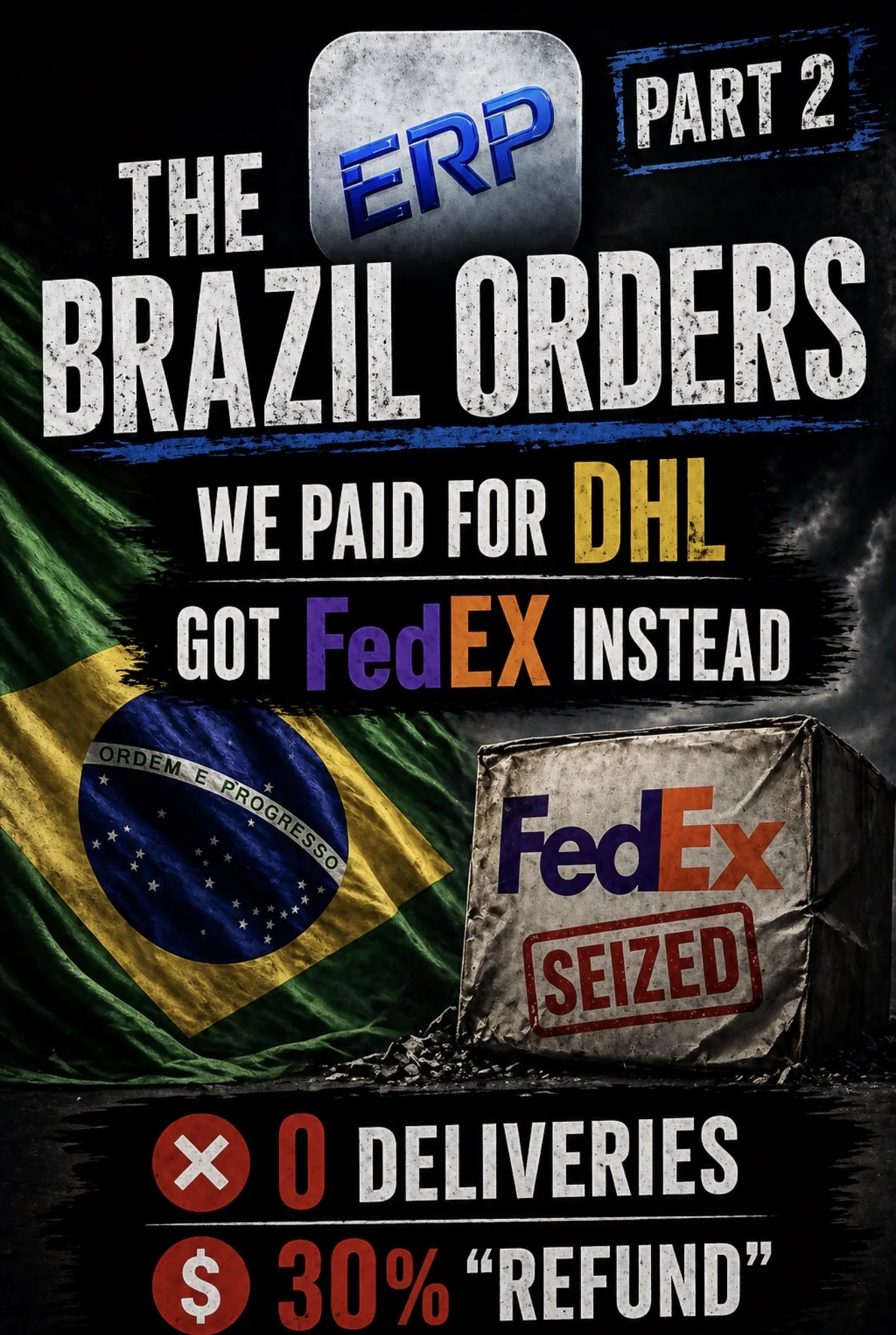
It’s hard to overstate how avoidable this situation was. This was not a random seizure or an unpredictable customs issue. The risk was already known, discussed, and accounted for before the orders were placed. And even then it was ignored.
The Brazilian GB Setup
ERP had been gaining a strong reputation in other communities, particularly in the German server, where buyers reported good experiences and competitive pricing on GLP products. So based on that, ERP was recommended into a Brazilian group. But at the same time, there was already a clear and widely understood issue:
FedEx shipments to Brazil were failing.
Packages were being seized, letters were being sent and entire group buys from other vendors were not arriving. So because of this, the group made a decision:
No FedEx. DHL only.
Buyers agreed to pay extra for DHL ($90 vs $80 for FedEx) specifically to avoid that risk. This condition was clear at the point of order.
What Actually Happened
Despite that, the orders were shipped using FedEx. There was no warning and buyers only realised after receiving tracking numbers, when nothing could be changed. Consequently, the result was exactly what had already been expected, the packages did not arrive.
The Scale of the Loss
Around 10 to 11 orders were shipped. This was not small money. Many members spent over $1,000 each, with a significant total across the group and for Brazilian buyers, this is not disposable money. One buyer managed to stop their order after being told it would be sent via FedEx but even then, it took about a month to recover their funds. The others were not so lucky.
A Brazilian Buyer’s Account
One buyer described the situation as disrespectful and warned that the same handling could affect other countries. Their account begins with a conversation with Louise, an ERP representative. They asked whether shipping to Brazil was possible. Louise confirmed it was and said the cost would be higher due to the shipping method. Based on that, the order was placed. When they asked about refunds or reshipment, they were told that in the event of seizure, customs would send a notice.
What was not stated however, was that reshipment would only apply if the parcel was returned and refunds would be limited to only 30%. Those conditions appeared later, once the dispute had already begun.
One day after purchase, the buyer raised Brazil’s known shipping issues. Louise replied that ERP no longer worked with DHL and that DHL was “a thing of the past.” This had not been made clear beforehand and the buyer also states that the difference in shipping cost was never refunded.
Because Brazilian customs is strict, the buyer asked for care with the invoice. They were told the declared value would be $40 to $60, but according to the buyer, the final invoice did not match that agreement.
The later 30% refund did not feel fair as the loss was not just customs related, it followed unclear shipping terms, shifting explanations and an invoice that did not match what was agreed. The case was escalated, but no concrete resolution followed.
On April 8th, the 30% payment was made, not because it was accepted as fair, but because it was the only option offered.
Another Buyer
Another buyer lost around $1,200. She had initially hesitated and preferred her usual vendor, but followed the group once ERP was recommended. She was told initially that the package would be returned and a refund would follow.
Messages stated:
“The package will be returned to us and we will refund you from the beginning of the refund.”
“Some Brazilian customers have received the refund.”
But that clarity did not hold.
GB Organiser conversation with Linda
The exchange between the GB organiser and Linda adds another layer to how the case was handled. By this point, the buyer had paid extra for DHL, but the order had been sent by FedEx. The organiser’s position was straightforward, DHL was paid for, DHL was promised, and FedEx was used without approval.
Linda said she could apply for a refund if return information was found, and when the organiser stated that the goods had already returned to ERP and that the refund should be issued while ERP dealt with logistics separately, Linda appeared to accept that point.
But the refund still did not move cleanly.
Instead, Linda said she had done everything she could, that many customers were waiting for refunds, and that she did not have the authority to push further. She also said the manager had refused a full refund or special treatment for the buyer.
This matters because the issue was no longer just whether customs had seized the parcel, as according to the organiser, the goods had come back to ERP. If that was the case, the product was no longer lost, it was back with the seller, while the buyer was still being pushed toward a partial outcome. Linda’s explanation was that logistics had described FedEx as successful.
Where It Ends for the Buyer
The pattern remains; escalation attempts, internal limitations, talk of exceptions, but no full refund. Eventually, the buyer disengaged. She deleted the conversation, removed Linda, and stepped away. Her conclusion:
the money was gone, and it would not be recovered
That moment matters as it marks the point where buyers stop trying.
Tone and Handling
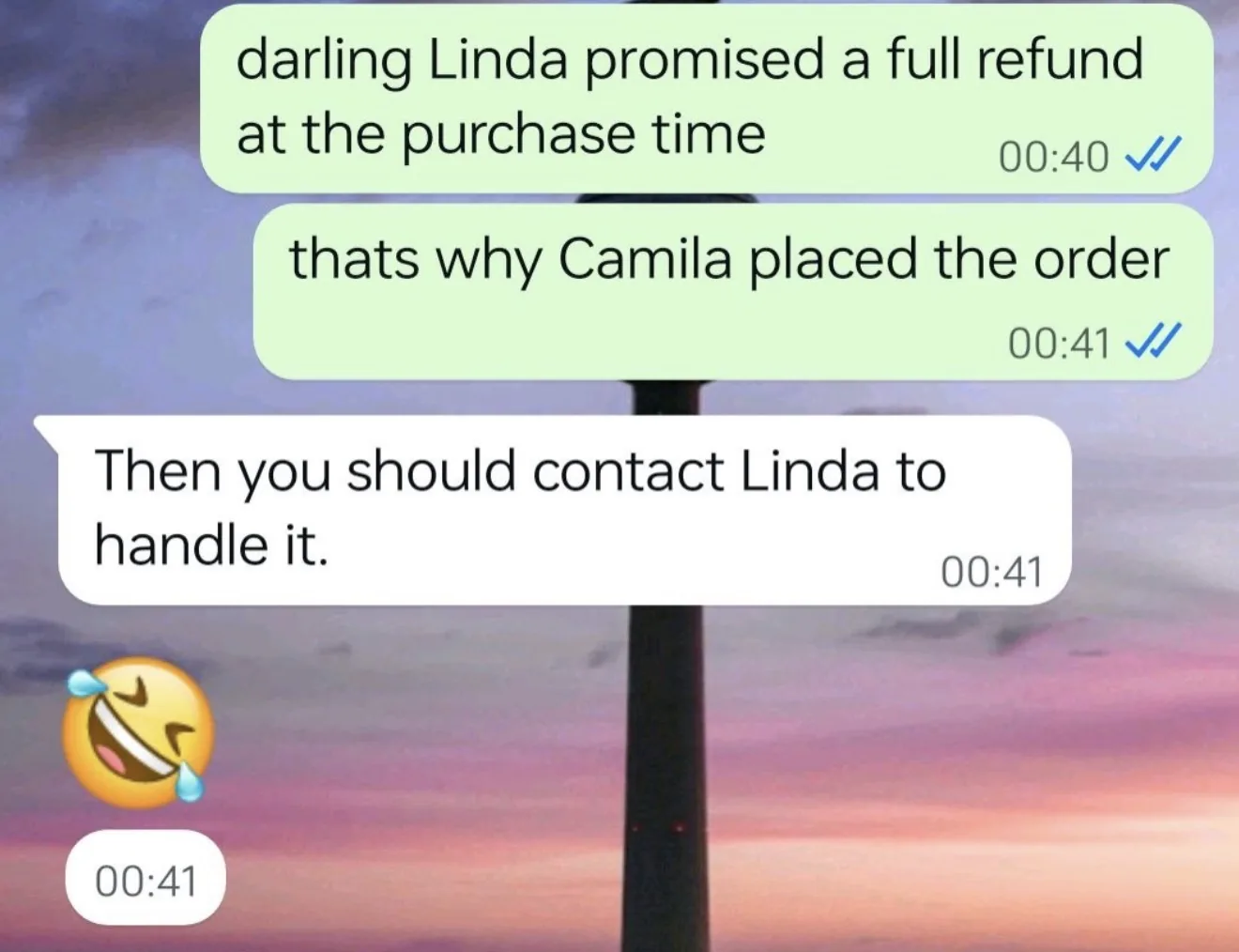
Buyers also describe a difference in response style. Linda was seen as polite but inconsistent, whereas, Louise was described as more direct, sometimes dismissive, including laughing reactions during the dispute. One exchange captures it. The organiser states a full refund was promised, but the response redirects them back to Linda, followed by a laughing reaction.
Similar Complaints Outside the Brazil GB
Other separate cases show the same pattern; lost parcels, shipping mistakes, delayed responses and partial resolutions.
The Australian GB
The Brazil issue was not isolated, in the Australian group, buyers were asking the same basic question, had ERP changed the reship policy?
One buyer asked whether there had been any official announcement that Australian buyers now had to pay 50% for reshipment. They said they had not seen anything from ERP reps, and that the website and GLP1 forum ads still appeared to say parcels would be reshipped if seized, another buyer replied that it had already happened to them:
30% refund or pay 50% for reship.
An admin then said they had already talked about it. And that’s the issue, if the policy had changed, buyers were still unclear on when, where, and how it had been announced.
In another exchange, one buyer says ERP no longer offers free reshipment and that buyers now have to pay 50%. Another responds:
“So I’ve just been lied to?”
The reply was that the policy had changed about two weeks earlier. Again, buyers appear to have been operating under one expectation, only to be told later that the terms had changed.
The Wider Concern
The Australian discussion also points back to Brazil, and when others questioned whether Brazil shipments had returned to normal, the response was blunt:
“Brazil don’t get shit.”
This was no longer just about one route, it was about buyers trying to understand what ERP’s actual policy was before placing or losing more orders.
Case: Wrong Destination
An order placed on April 12th was shipped to the United States instead of Europe, the buyer was told it was a mistake and would be corrected. Two days later, reshipment was promised. Delays and inconsistency followed, leaving uncertainty about whether the order would arrive.
Case: 60 Days in Transit
Another shipment remained in transit for around 60 days.
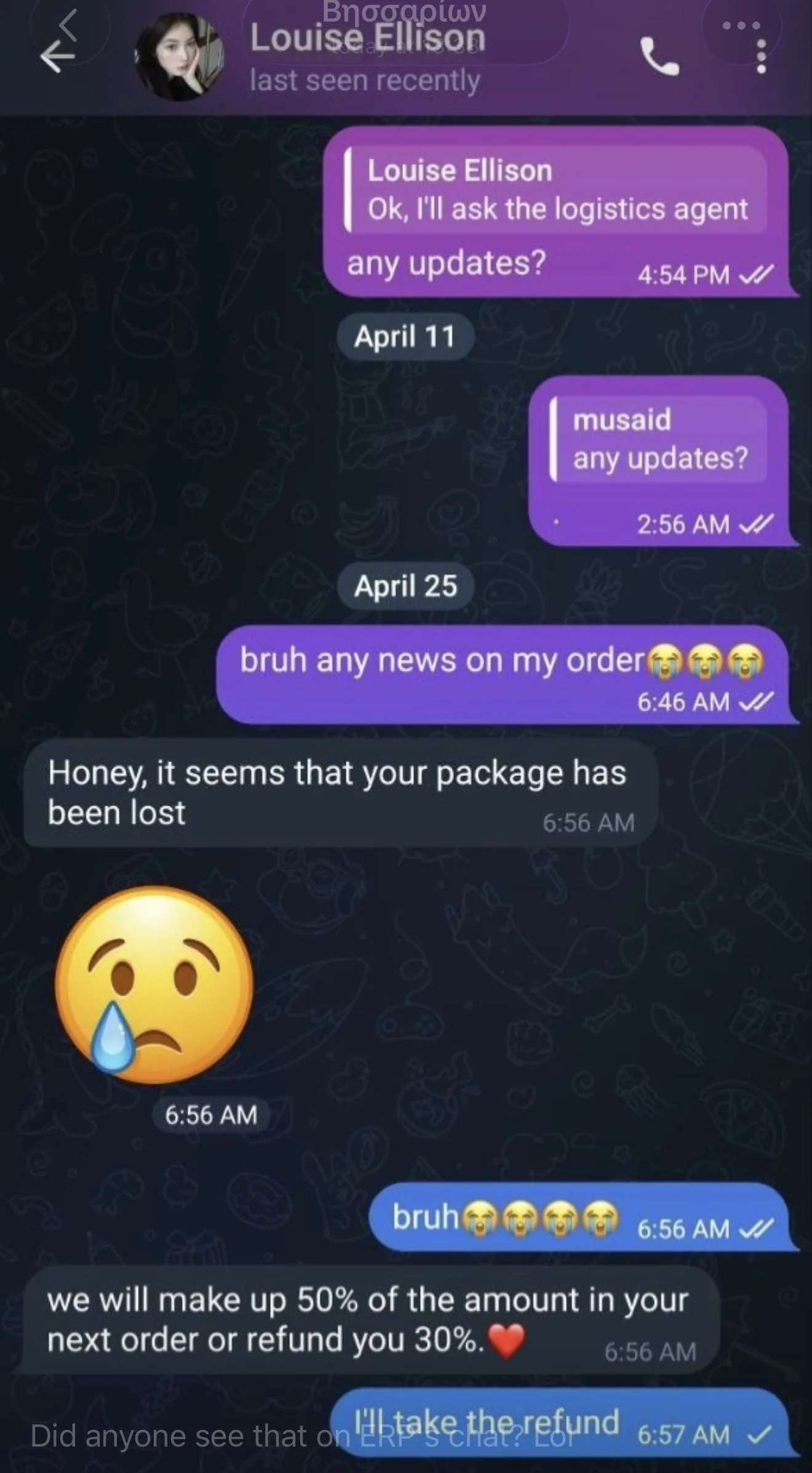
The buyer repeatedly asked for updates (April 11, April 25). Each time, they were told logistics would be contacted, but nothing changed and eventually, the package was declared lost. The solution offered was either a 50% credit or a 30% refund. The buyer chose the refund.
Case: Policy Changed Mid-Order
Initially the terms were that returned parcels would be reshipped and seized parcels would receive 50% credit or 30% refund, but later, the same limited options applied regardless. When the buyer challenged this, noting they had been told there was a guarantee, after that, responses slowed to delays and “wait” messaging.
A reship guarantee became partial compensation once the order was in trouble.
Case: Wrong Tracking
A buyer received a tracking number that was not theirs, the shipment was moving in the opposite direction. USPS confirmed it was not their package and raised concerns about the postage. Different issue but the same underlying problem:
basic order handling failing without clear correction.
Account Bans and Reporting
One user reports being banned without explanation. They received a generic message citing terms violations, with no specifics. An appeal process was offered, but without clear allegations. Prior to this, they had been warning others about ERP-related issues and noticed accounts responding to those warnings across other groups. They describe being challenged across groups and then losing access. The cause is not confirmed, but the experience is consistent:
raising concerns, facing pushback, and then losing access without explanation
What This Adds Up To
Across countries and cases, the same pattern appears, terms do not stay fixed, shipping changes after payment, delays replace clarity, logistics is used as explanation and outcomes become partial compensation
Impact on the Brazilian Group
Unfortunately, the effect extended beyond the orders. The group fractured and the organiser was blamed. Members left, communication broke down and relationships suffered. For some, the loss was financial and for others, it became personal.
Where Things Stood
At the time of writing, multiple buyers have been affected with at least three having accepted the 30% refund, but as others have left the group, records are incomplete. So the total is difficult to reconstruct, not because it was small, but because participation stopped.
ERP, JKL, and Shared COAs
Another concern is overlap between ERP and JKL. Two Janoshik COAs for RT30 show identical results:
Retatrutide 36.15 mg, 99.828% purity
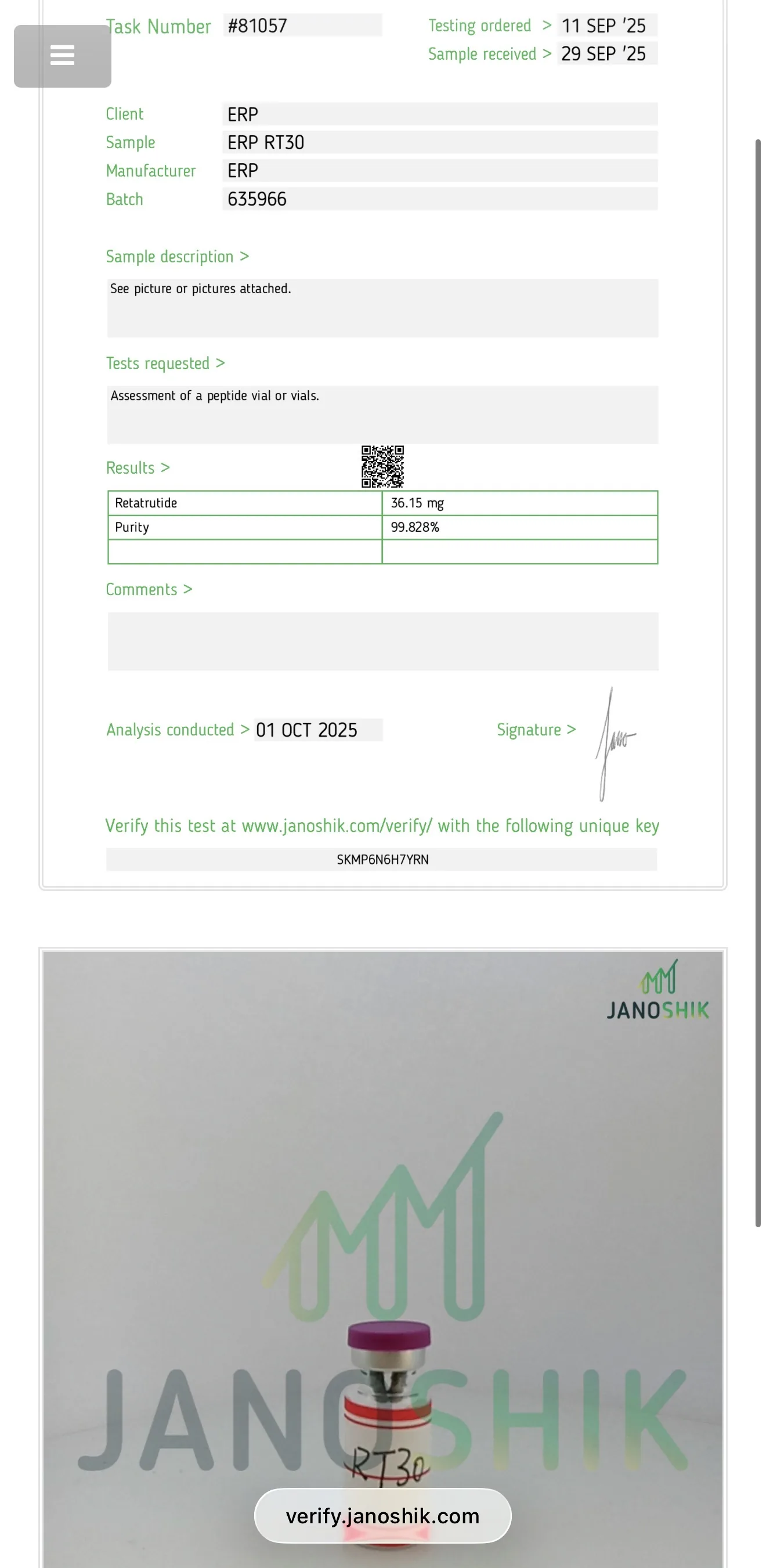
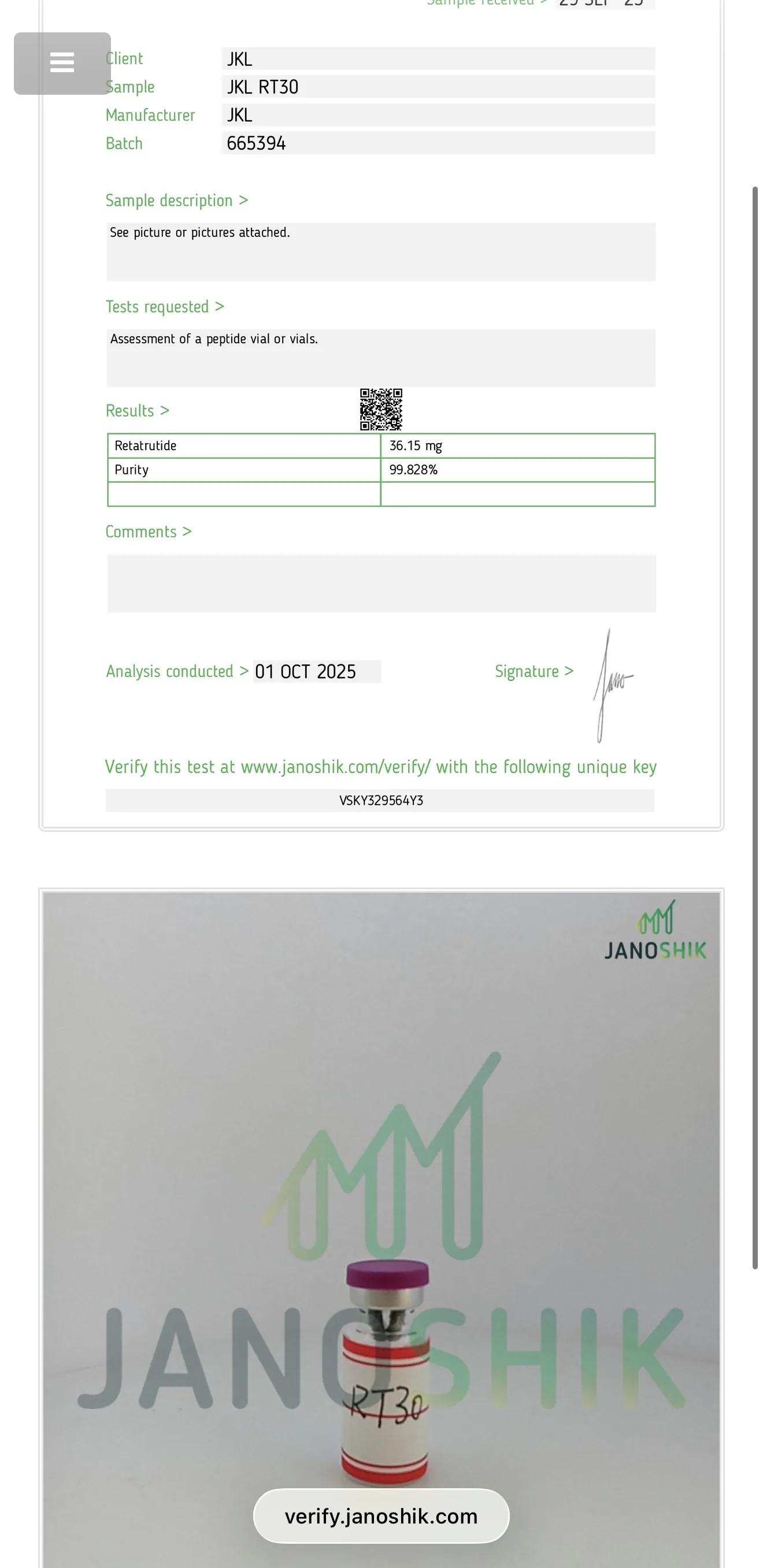
One listed under ERP, one under JKL. Different task numbers, same result and same sample image. Users also point to similar warehouse claims, similar menus, similar images and shared COAs. This does not prove rebranding, but it raises a valid question:
Are these separate vendors, or the same products being presented under different names?
That remains unproven, but the overlap is there.
The Pattern
Taken individually, a seizure, a lost parcel, wrong tracking, a misunderstanding or a delayed refund, each issue could be explained on its own, but together its a pattern. DHL becomes FedEx, guarantees become 30%, returns do not lead to refunds, tracking issues become delays and support becomes escalation and waiting
This is not one failure, it’s the same structure repeating.
What This Shows
This is not just about Brazil, Brazil is where it became visible. Buyers paid to avoid a known risk. That risk was taken anyway and the shipments failed. But the key point is this: according to the organiser, the parcels were returned to ERP. If the goods had disappeared, this could be framed as logistics. But if they returned, then the product was back with ERP, while buyers were only offered 30%. That’s where the outcome becomes difficult to justify.
Final Line
This is not clean customer support. It’s a pattern of avoidable decisions, shifting terms, partial remedies, and buyers being pushed to accept less than they were led to expect, even in cases where the goods appear to have been returned.
Currently the way things are going, the expectation is that ERP will do an exit scam. This is why i am constantly trying to get the point across, that vendors are not “trusted”, even vendors with good track record can do a 180 degree shift if the conditions change. Oh and I was booted from the group despite never posting anything in there.



Comments