
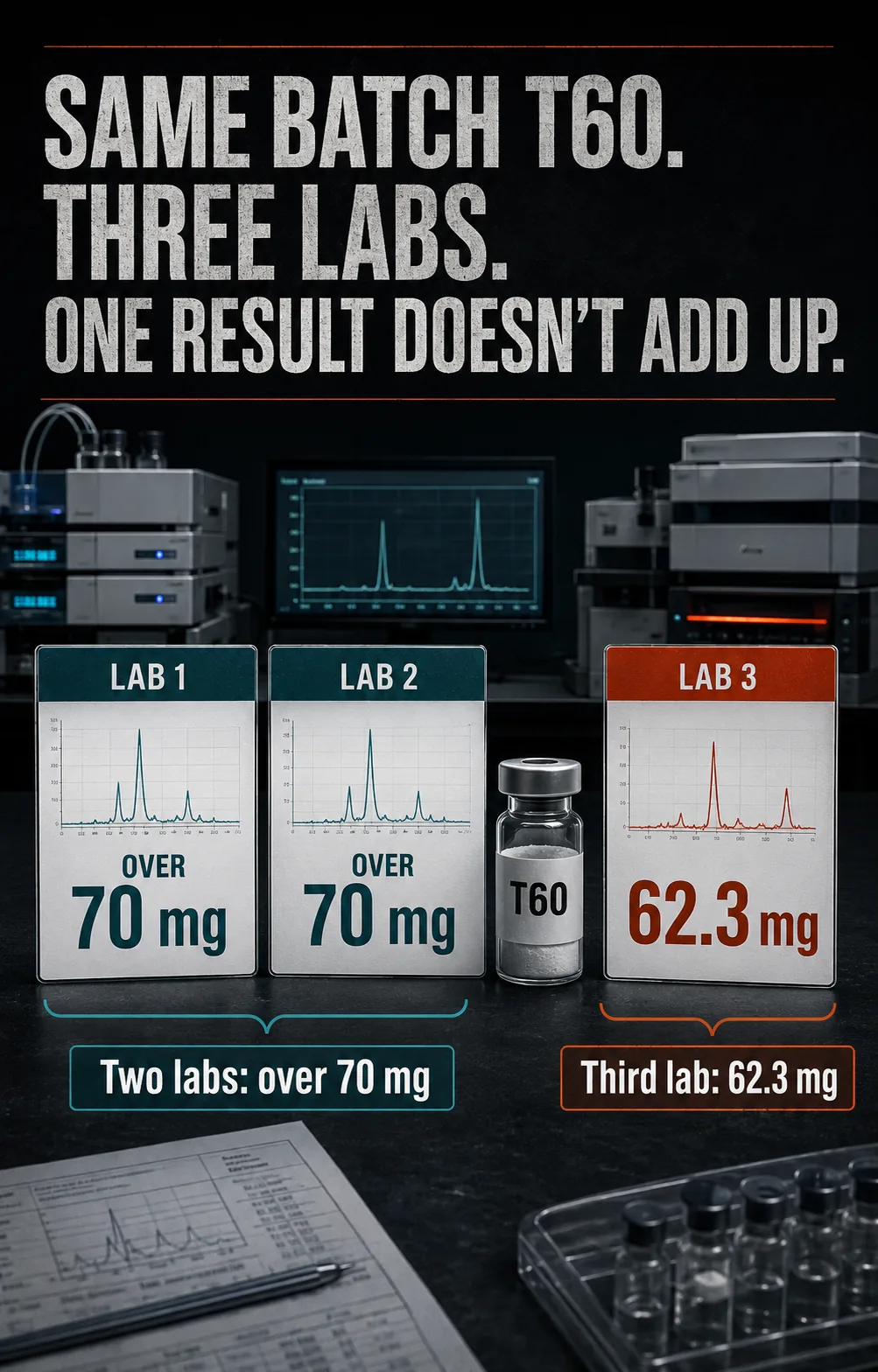
A comparison involving a custom batch of tirzepatide has opened an important discussion about why different labs can produce substantially different quantity results, and whether “different methods” is really an adequate explanation.
The batch was labelled as containing 60 mg per vial. Five vials were selected from different kits and tested across three laboratories:
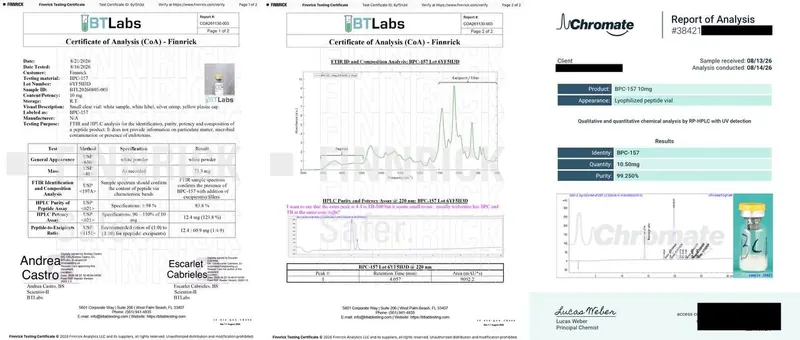
Chromate: 71.63 mg and 70.99 mg
Accumark: 73.72 mg and 75.44 mg
BT Labs: 62.3 mg
All five results showed high purity. The mass results, however, told two very different stories. Chromate and Accumark tested four vials between them, and every result exceeded 70 mg. BT Labs tested one vial and reported only 62.3 mg, just above the labelled amount.
That makes the BT Labs result the clear outlier. Four vials from two laboratories agreed within a relatively narrow range of approximately 71 to 75 mg, while the fifth result was between 8.7 mg and 13.1 mg lower. This can’t simply be described as all three laboratories agreeing on “somewhat lower mass.” Two laboratories found considerably more than the labelled 60 mg. Only BT Labs found a result close to the label.
Could it just be vial variation?
Vial-to-vial filling variation remains one possible explanation. The laboratories didn’t receive portions of the same homogenised sample; they received different vials drawn from different kits. However, four separate vials tested by two laboratories all exceeded 70 mg. For BT Labs’ vial alone to contain 62.3 mg would require a fairly substantial difference within the batch.
It’s possible, but the current evidence makes it reasonable to ask whether the discrepancy arose from the vial, or from the way the laboratories measured and calculated its contents.
“Different methods” is not enough
BT Labs initially explained that laboratories may produce different results because they use different methods and different standards. She said there are no USP peptide standards and concluded that all three laboratories had broadly agreed on high purity and somewhat lower mass. However, that description was challenged because Chromate’s and Accumark’s four results were all significantly above the labelled quantity.
Dustin from Vanguard Laboratory later made an important distinction: different reference materials may contribute to different results, but merely using a different method shouldn’t be accepted as the explanation. Whatever analytical method a laboratory uses should be validated and capable of producing an accurate result. If two validated methods are measuring the same thing on the same reporting basis, they shouldn’t generate materially different answers simply because the instruments or procedures differ.
Dustin suggested proficiency testing or a round-robin study between labs to demonstrate method equivalence. That would involve labs testing matched material and comparing their results under controlled conditions. Janoshik also noted that small analytical problems can occur at almost any stage, including sample-preparation errors, a tiny bubble in the sample or genuine vial variation. Those possibilities are real, but they don’t identify what happened here.
Are the laboratories measuring the same form?
The discussion then moved to something rarely explained on peptide COAs: whether the reported quantity represents the peptide alone or the peptide together with its counterion.
Peptides may be supplied as acetate, chloride, TFA or another salt form. They may also be described or calibrated as the freebase. These forms have different molecular weights because the counterion adds mass. Dustin explained that if a lab calibrates against a freebase reference standard while the sample is an acetate, or vice versa, the reported potency can be biased unless the calculation is corrected for the counterion’s molecular-weight contribution. The peptide sequence may be identical, but the amount of actual peptide contained in each milligram of material is not necessarily the same.
Grey-market clients frequently fail to provide a CAS number or specify the counterion. That leaves labs to identify the form themselves, make assumptions or apply their own default reporting convention.
Janoshik reports net peptide only
Janoshik confirmed that he normally reports net peptide content unless a client specifically requests otherwise. In practical terms, a Janoshik result of 60 mg represents 60 mg of the peptide molecule itself. It excludes mass contributed by acetate, TFA, chloride, water and other associated material.
Dustin said that adopting the same convention would make his work easier. When clients don’t identify the salt form, Vanguard has been running ion chromatography to determine the counterion so it can match or correct the reference standard appropriately. The two approaches are therefore different:
Janoshik normally standardises results to net peptide content regardless of the counterion. Vanguard may investigate the counterion and match or correct the result according to the chemical form involved.
Dustin wasn’t admitting that Vanguard’s previous results were incorrect, he was explaining that Janoshik’s universal net-peptide convention would remove the need for some of the additional work Vanguard currently performs when clients submit poorly identified samples.
Janoshik doesn’t simply trust commercial standards
The discussion revealed a potentially important difference in how laboratories establish their reference standards. Janoshik generally standardises his reference material using CHNS elemental analysis and NMR. He said the laboratory has had bad experiences with commercial certified reference materials.
Janoshik can take peptide material, purify it, characterise it through CHNS/NMR and then use the independently established value for calibration. If there is insufficient material or the sample has a difficult matrix, he can have the peptide synthesised when practical. Otherwise, he may refuse the order.
CHNS measures the material’s carbon, hydrogen, nitrogen and sulphur composition. NMR can assist with its identification, characterisation and quantitative assessment. Together, these techniques can help determine how much of a weighed reference material is actually peptide rather than water, counterions, residual solvents or other material.
Vanguard described a different approach. He purchases certified commercial reference standards from multiple sources when they are available and commissions custom standards for less common peptides. He may also use ion chromatography to investigate the counterion when the client has failed to identify it.
BT Labs said labs use different standards but didn’t provide the same level of detail about how its standards are established.
We can’t therefore claim that every other lab simply trusts a commercial standard without verification, but what can be said is that Janoshik routinely purifies and independently standardises peptide reference material through CHNS/NMR.
How Could Janoshik’s standardisation alter the results?
If a laboratory wrongly treats the entire weight of a reference material as active peptide when some of it is actually water, counterions or residual material, its standard will produce a weaker response than its assigned concentration suggests. That would ordinarily cause the laboratory to overestimate the peptide quantity in customer samples.
Accurately determining the standard’s net peptide content through CHNS/NMR should correct that inflation. It doesn’t provide an obvious explanation for why Janoshik’s results are often higher than those from other laboratories.
The difference may instead arise from other aspects of calibration, sample preparation, calculations or genuine vial variation. Without matched portions of one homogeneous sample being tested and reported on the same basis, no conclusion can be drawn about which laboratory is closest to the true quantity.
What this comparison actually proves
The current results don’t establish whether the true vial content was approximately 62 mg, 71 to 75 mg or variable across the batch. They do establish that the labs didn’t produce closely comparable quantity results.
The test that could settle it
Testing separate vials can’t fully distinguish laboratory disagreement from batch variation. A meaningful blind round-robin study would require one homogeneous solution to be prepared and divided into matched samples for several laboratories. Each laboratory would need to:
Report net peptide on the same defined basis
Identify the reference material used
State how its assigned potency was established
Disclose whether and how counterions, water and residual solvents were corrected
Provide the method’s measurement uncertainty
Test the samples without knowing the expected result or the other laboratories’ findings
Only then could the community determine whether the laboratories’ methods are genuinely equivalent and which results are closest to the true value. Until that happens, “different methods and standards” describes the problem, it doesn’t answer it.
The most important outcome of this exchange is that the labs are now discussing these differences openly. That’s exactly why bringing them into the same Lab Chat matters: not to decide which name people trust most, but to make the laboratories explain what their numbers actually represent, and why those numbers sometimes don’t agree.
Comments