
Retatrutide is still investigational, but its Phase 3 results have placed it at the centre of the next obesity-drug race. While Lilly defends its intellectual property and targets unauthorized sellers, companies in China, Korea and the United States are developing rival drugs in the hope of claiming a share of the same market.
These aren’t simply copies of Reta. They’re separate drugs designed to activate the same three receptors, GLP-1, GIP and glucagon, with different structures, receptor balance, half-lives and delivery methods.
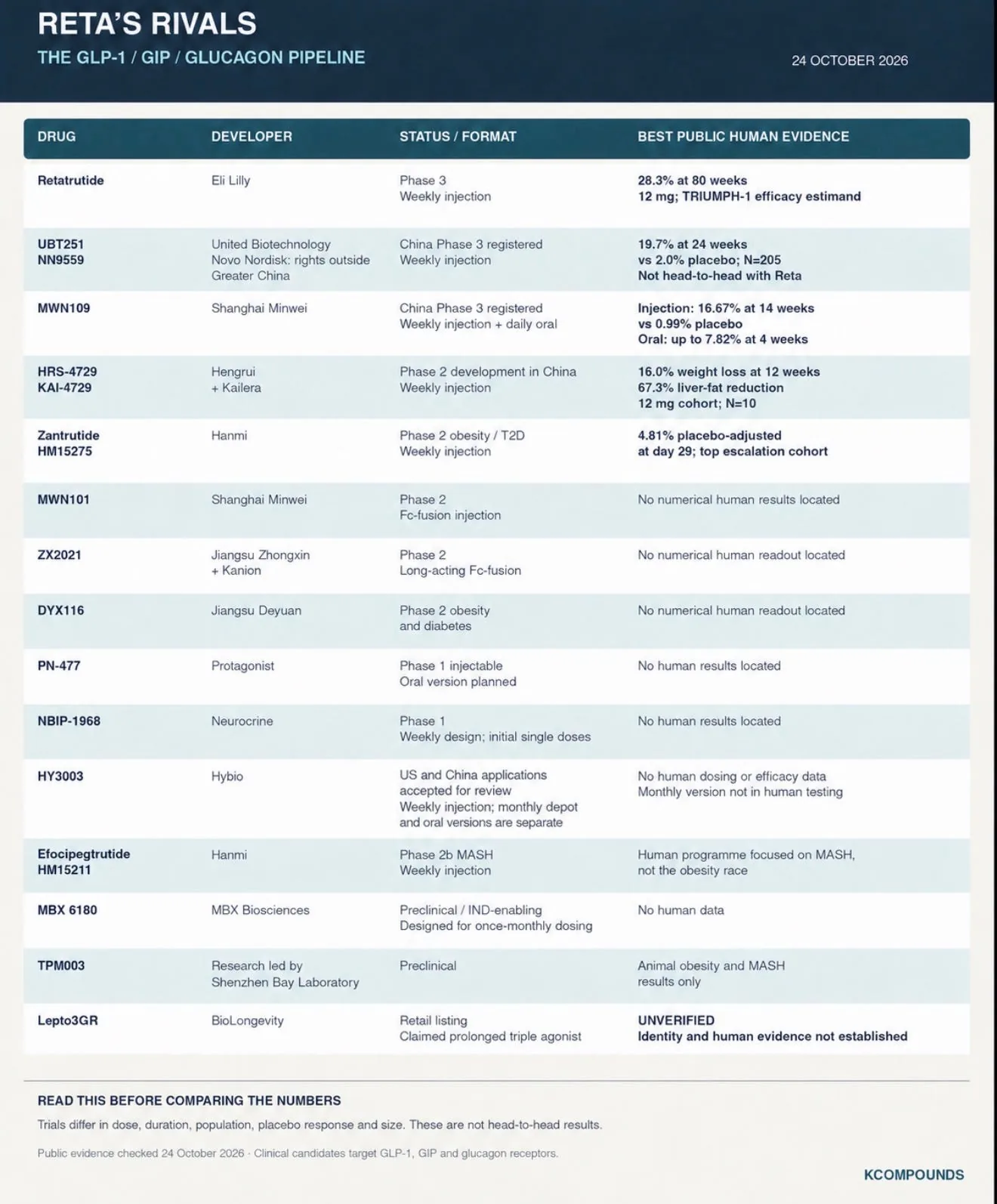
Lilly has reported 28.3% mean weight loss at 80 weeks with 12 mg retatrutide in the pivotal Phase 3 TRIUMPH-1 trial. That’s the benchmark its rivals are chasing, but a short Phase 1 trial involving ten people can’t be compared directly with a large Phase 3 study.
The front-runners
UBT251 is the closest established challenger
UBT251, also known as NN9559, is being developed by United Biotechnology and Novo Nordisk as a once-weekly injection. Its published Phase 2 trial involved 205 adults with overweight or obesity. After 24 weeks, the highest-dose group recorded 19.7% mean weight loss, compared with 2.0% for placebo. That was numerically higher than the 17.5% reported with retatrutide at 24 weeks in its Phase 2 trial, although the drugs were tested in separate studies and the result doesn’t establish that UBT251 is better. The most frequent adverse events were mild-to-moderate gastrointestinal symptoms.
UBT251 now has a registered Phase 3 obesity programme in China. Novo Nordisk is also running global studies examining its safety, tolerability, pharmacokinetics and effects on weight and blood glucose.
The mystery surrounding its structure has also been resolved. The structure and amino-acid sequence published with the Phase 2 paper match Patent Compound 3, identifying Compound 3 as the clinical molecule. The paper doesn’t use the patent label, but the molecular weight, sequence and lipid modification match.
Published Phase 2 trial · Novo Nordisk UBT251 disclosure
MWN109 is much further ahead than its profile suggests
MWN109, developed by Shanghai Minwei Biotechnology, is being tested as both a weekly injection and a daily tablet. Its injectable programme has a registered Phase 3 obesity study. Minwei said the programme was initiated on 10 September 2026, while the available registry entry still showed the trial as not yet recruiting.
In a 40-person Phase 1b study, 32 participants received MWN109. After 14 weeks, including dose escalation, the largest group recorded 16.67% mean weight loss, compared with 0.99% for placebo. One of the 32 active participants withdrew because of a drug-related adverse event. The commonly reported gastrointestinal events were described as mild or moderate.
The oral version was tested daily for four weeks. Mean weight reductions ranged from 4.18% at 7.5 mg to 7.82% at 45 mg, compared with 0.84% for placebo. One active participant withdrew because of an adverse event, and no serious adverse events were reported.
A 255-person oral Phase 2 obesity study was completed in July 2026, but results haven’t been posted yet. MWN109 therefore has striking early figures and an advanced programme, but no public Phase 2 or Phase 3 efficacy result yet.
MWN109 company results · Company chronology · Injectable Phase 3 registry · Oral Phase 2 registry
HRS-4729 produced the flashiest early result
HRS-4729, known outside China as KAI-4729, is being developed by Hengrui and Kailera. Its Phase 1 trial enrolled 102 participants overall, but the headline result came from only ten people who received the highest dose. After 12 weeks, the 12 mg group recorded 16.0% mean weight loss and a 67.3% mean reduction in liver-fat content. These are striking early results, but the group was too small and the trial too short to compare HRS-4729 reliably with retatrutide. The later poster reported 4.9% weight loss in the placebo group, while an earlier company announcement reported 5.4%. The reason for the difference hasn’t been explained.
HRS-4729 Phase 1 poster · Phase 1 registry
Zantrutide is promising, but 25% remains a target
Hanmi’s HM15275, now called zantrutide, is a once-weekly GLP-1/GIP/glucagon agonist in Phase 2 trials for obesity and type 2 diabetes in the United States. In a 50-person Phase 1 multiple-dose study, the highest escalation group received 0.5 mg followed by 2, 4 and 8 mg. After four weekly doses, it recorded 4.81% placebo-adjusted weight loss.
No grade 3 or serious treatment-emergent adverse events were reported. Two participants discontinued after grade 2 gout and atrial fibrillation, both judged unrelated to the drug. Gastrointestinal events were common. Hanmi’s target of at least 25% weight loss is an ambition, not a clinical result.
Zantrutide Phase 1 poster · Phase 2 obesity trial
The next Chinese group has trials but no usable results
Several additional Chinese triple agonists have entered clinical development. They belong in the race, but there’s not yet enough public human results to judge them against retatrutide.
MWN101 is Minwei’s injectable GLP-1/GIP/glucagon Fc-fusion protein. The company says obesity and type 2 diabetes entered Phase 2 development and that a Phase 2 study was completed in November 2024. No numerical weight-loss, safety or pharmacokinetic results were located. A separate Phase 2b obesity-with-sleep-apnoea study was terminated following a change in research plans. That doesn’t establish that the whole MWN101 programme was stopped or that a safety problem occurred.
ZX2021, from Jiangsu Zhongxin and Kanion, is another long-acting Fc-fusion triple agonist. The company reported that recruitment for its Phase 2 obesity study had been completed by August 2026, with higher-dose exploration planned. An indexed registry record still showed the study as recruiting, and no Phase 3 start had been verified.
DYX116, from Jiangsu Deyuan, completed Phase 1 in December 2025. The company’s 2026 interim report says Phase 2 studies for both diabetes and weight loss were underway. No numerical human efficacy results have been published.
They are genuine clinical candidates. They aren’t yet evidence that retatrutide has been matched.
MWN101 company chronology · ZX2021 company disclosure · DYX116 interim report
The American candidates have only just entered humans
PN-477, from Protagonist Therapeutics, is being developed as an injectable and an oral triple agonist. Protagonist announced on 5 August 2026 that the injectable Phase 1 study had begun with single ascending doses. Weekly injections and a daily tablet are development plans, not demonstrated repeat-dose performance. Oral Phase 1 testing was expected in the first half of 2027.
NBIP-1968, from Neurocrine, entered first-in-human Phase 1 testing on 7 August 2026. It is designed for weekly injection, but the initial study also uses single ascending doses. Neurocrine has discussed combining it with the CRF2 agonist NBIP-2118 in the future.
Neither programme had produced public human weight-loss, safety or pharmacokinetic results at the review cutoff.
PN-477 company disclosure · PN-477 Phase 1 registration · NBIP-1968 announcement
HY3003 is not a monthly human treatment yet
Hybio is developing HY3003 as a weekly injection, a monthly sustained-release injection and a daily tablet. The FDA accepted the company’s IND application for the weekly injection on 5 October 2026. Acceptance of the application shouldn’t be confused with proof of clinical dosing or FDA approval of the drug.
The monthly depot and oral tablet are separate development programmes. At present, there were no human pharmacokinetic data showing month-long release, no human efficacy results, no evidence that the depot was being tested in people and no first-in-human dosing announcement.
Hybio has reported favourable comparisons with tirzepatide and retatrutide in mice. But mouse results don’t establish that HY3003 will outperform either drug in humans.
Hybio’s FDA IND announcement
Other triples are taking different routes
Efocipegtrutide, also known as HM15211, is a genuine clinical GLP-1/GIP/glucagon agonist. Its main development programme has focused on MASH rather than competing directly for the obesity crown.
MBX 6180 is a long-acting triple-agonist prodrug selected by MBX Biosciences in August 2026. It’s designed to support monthly dosing, but remains preclinical. That monthly schedule hasn’t been demonstrated in people.
TPM003 has published encouraging obesity and MASH results in animals and also remains preclinical.
These compounds belong on the wider map, but they shouldn’t be placed beside late-stage obesity programmes as though they have equivalent evidence.
Efocipegtrutide pipeline · MBX 6180 announcement · TPM003 publication
Then there is Lepto3GR
BioLongevity advertises Lepto3GR 50 mcg for $249.97 as a prolonged-action GLP-1/GIP/glucagon agonist. That verifies the advertisement, not the identity of the product.
No independently authenticated sequence, tested retail material, registered human trial, clinical pharmacokinetic study or validated weight-loss result was located.
Lepto3GR belongs in a separate category: available to buy before the evidence is available to read.
BioLongevity Lepto3GR listing
The grey market has not authenticated the rest
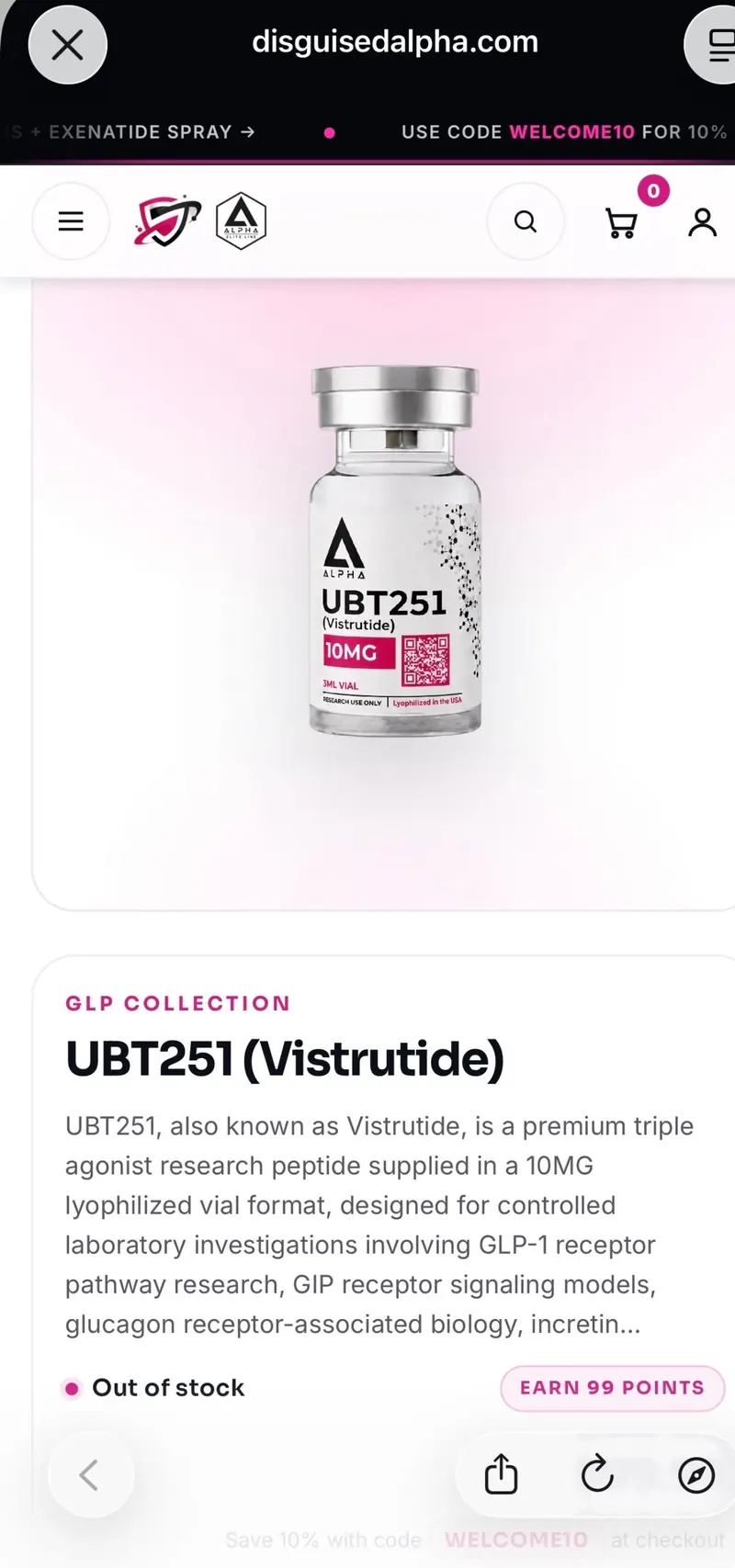
MedChemExpress lists zantrutide in its catalogue, and Sinopep mentions MWN109 on a development-services page. Neither is evidence that verified clinical material is being sold in retail vials.
I found no public listings for HRS-4729, MWN101, ZX2021, DYX116, PN-477 or NBIP-1968. They may be offered privately, but there is no public proof that sellers have the correct molecules or that the contents of any labelled vials have been independently confirmed.
MedChemExpress zantrutide listing · Sinopep MWN109 reference
Retatrutide still leads, but the queue is getting longer
UBT251 and MWN109 are the closest visible pursuers because both have progressed into Phase 3 development and both have meaningful human weight-loss data. Their evidence packages aren’t equal: UBT251 has a published randomized Phase 2 trial, while the MWN109 figures discussed here come from early-phase company disclosures.
HRS-4729 produced the most dramatic short-term result, but its leading figure came from ten people over 12 weeks. Zantrutide has reached Phase 2. MWN101, ZX2021 and DYX116 remain difficult to assess because detailed human results are missing. PN-477 and NBIP-1968 have only just entered first-in-human studies, while HY3003 has not yet produced evidence of human dosing.
Nobody can responsibly declare a winner by placing the largest percentages beside one another. Retatrutide remains the benchmark, but it’s no longer the only triple agonist worth watching.
Comments