
Who Is Cain?
Most people are familiar with Cain as the owner of the successful USA-based brand Nexaph, a company that lyophilises and distributes its own peptides within the United States.
Today, the business operates a website, a well-organised Telegram community with more than 22,000 members, organised third-party testing, and a fiercely loyal fan base that some have even described as a cult.
However, what may be less well known outside the OG peptide community is that the name Baba Cain has carried controversy for a long time.
Depending on who you ask, he’s either an entrepreneur willing to take risks and reinvent himself, or a vendor whose changing identities and business structure raise uncomfortable questions.
His supporters point to years of product testing, financial losses absorbed during crises, and continued customer support. His critics focus on aliases, company changes, forum investigations and what they see as a pattern of deception.
To understand why Cain became so divisive, you have to go back to the origins of the name, the creation of Shanghai Nexa Pharma, and the reason there is virtually no reference to either Cain or Nexaph within STG discussions.
This article is based primarily on a series of interviews I conducted with Cain, which were originally published in K Hole, together with information gathered from wider community discussions, public posts and conversations surrounding his history in the peptide industry.
My Connection to Cain
I’ve known Cain for quite some time. Our first contact dates back to 4 December 2024, when he messaged me offering to let me try his TIRZ. Since then, we’ve remained in intermittent contact.
But before I go into his back story, I want to address one of the most commonest questions people ask, which is whether Cain actually lyophilises his own products.
How do I know that he does since I’ve not visited his factory (but would be very happy to if invited)? I’ve asked him countless technical questions over the years, many that only someone directly involved in production would realistically be able to answer. Beyond that, I’ve spoken with other industry contacts who have independently confirmed that he performs his own lyophilisation.
That doesn’t mean every claim should be accepted without scrutiny, but it does provide context for the story you’re about to read.
Whether you see Cain as an innovative entrepreneur, a controversial vendor or something in between, one thing is certain: his story is far more complicated than most people realise.
The Origin of “Cain”
Below is a photo of the real Cain, the identity that Baba “borrowed” as his alias.

When Baba first entered the peptide space, he contracted Wuhan Marco Pharmaceutical Tech Co. Ltd. to finish peptides for him. The company reportedly had a history in vaccine manufacturing before shifting toward peptides. Notably even industry giant Merck utilised this same factory for their products.
The name “Cain” came from a representative at Wuhan Marco. Baba adopted the name for business purposes while the real Cain preferred to remain behind the scenes. During this period, Baba says his role focused on business-to-business operations rather than direct consumer sales, while Merck handled the direct to consumer operations.
The Evolution of a Brand: From EZ Peptides to EZ Pens
Initially, Baba’s vision for EZP was to focus solely on peptides. However, noticing a gap in the market, he pivoted to pens, an area with little competition. This decision quickly helped him build a significant following and expand his network internationally.
As his overseas contacts grew, Baba discovered he could buy his own API and then contract finishing facilities, gaining more control over the entire peptide production process. By cutting out the sales rep middleman, he could compete directly with major players like XCE and QSC. So he started buying API and had it finished by Marco Pharma to test out the process. Although his first batches were under-filled due to inexperience, this experimentation laid the ground work for future success.
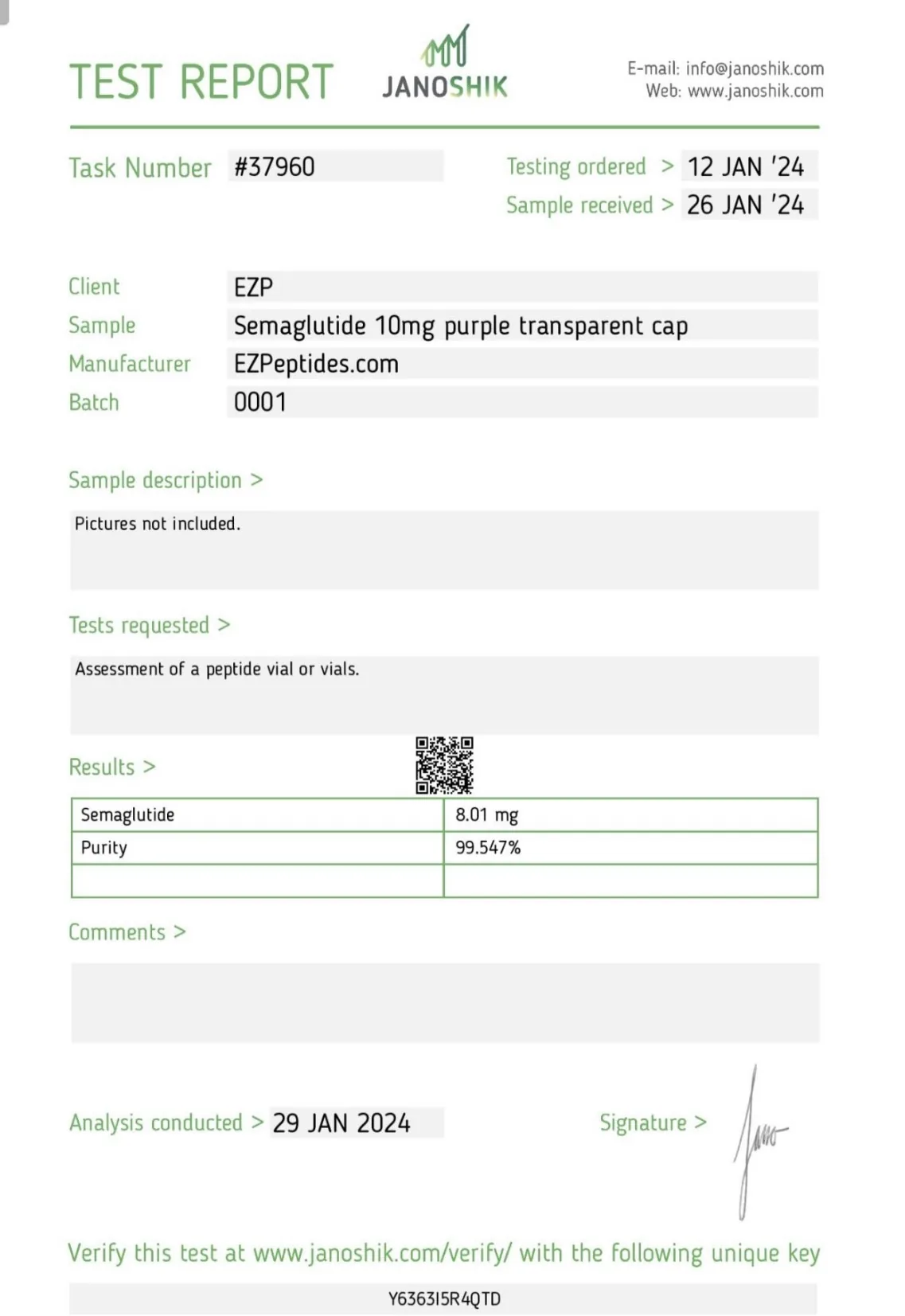
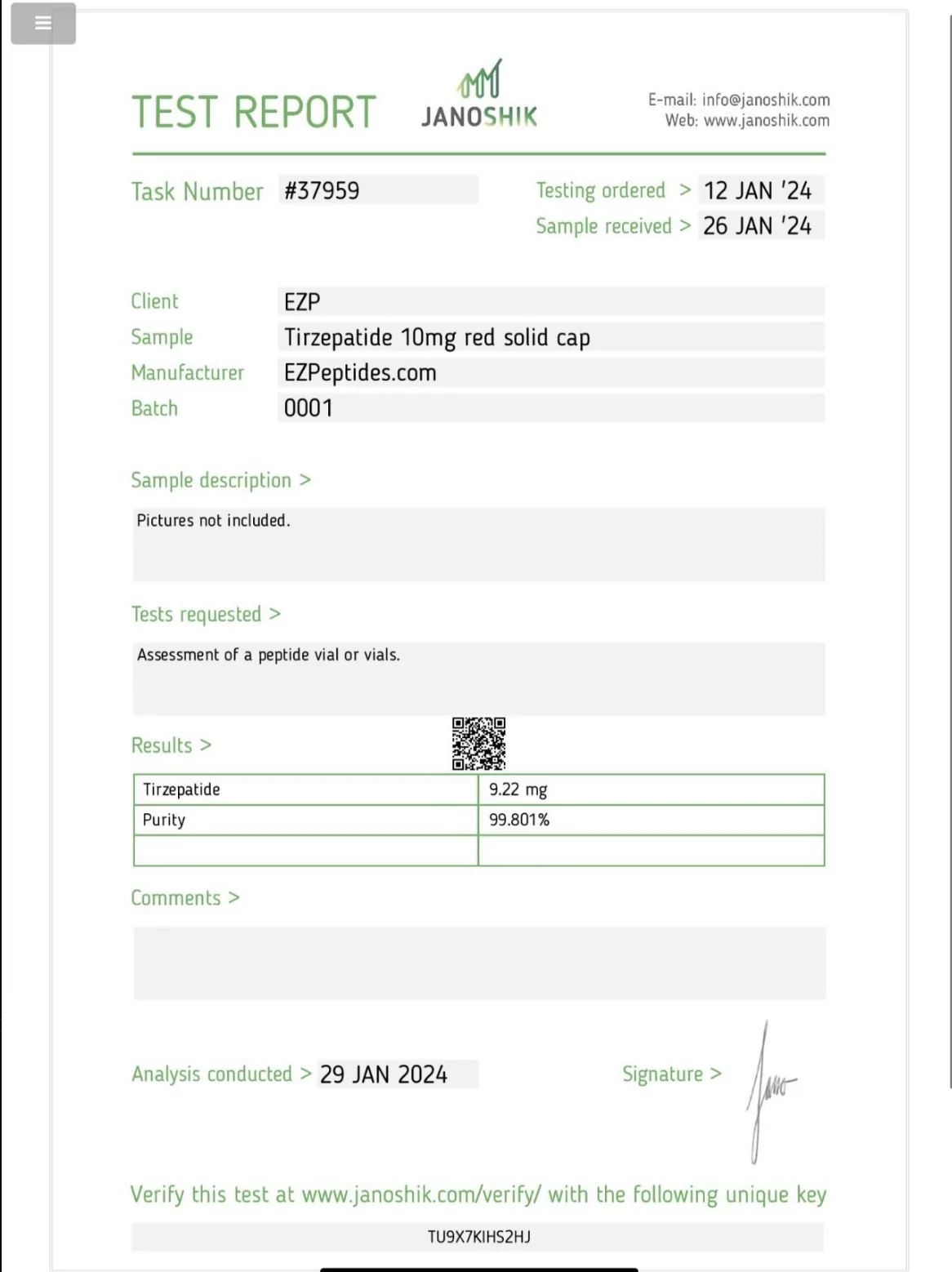
Below is the original testing that was still under the EZ peptides name via Janoshik.
The Triangle: Cain, Pri and Raven
One of the more interesting chapters involves the relationship between Cain, Pri and Raven.
Pri was described as a regular customer who purchased products not only for herself but also for friends and family. She also became a key connection between Cain and Raven, who at the time was running group buys through XCE.
Wanting to expand peptide sales without abandoning the pen business, Cain introduced a new company to do this and Shanghai Nexa Pharma became his separate peptide operation. According to Cain, the decision to use a separate company name stemmed from uncertainty about whether peptides should be sold under the EZP brand.
The arrangement quickly became controversial once Pri’s involvement became publicly known, since she’d built up a reputation from other communities. This generated criticism long before many people realised Cain and Baba were the same person.
The Merck raid and shutdown ( July 2024)
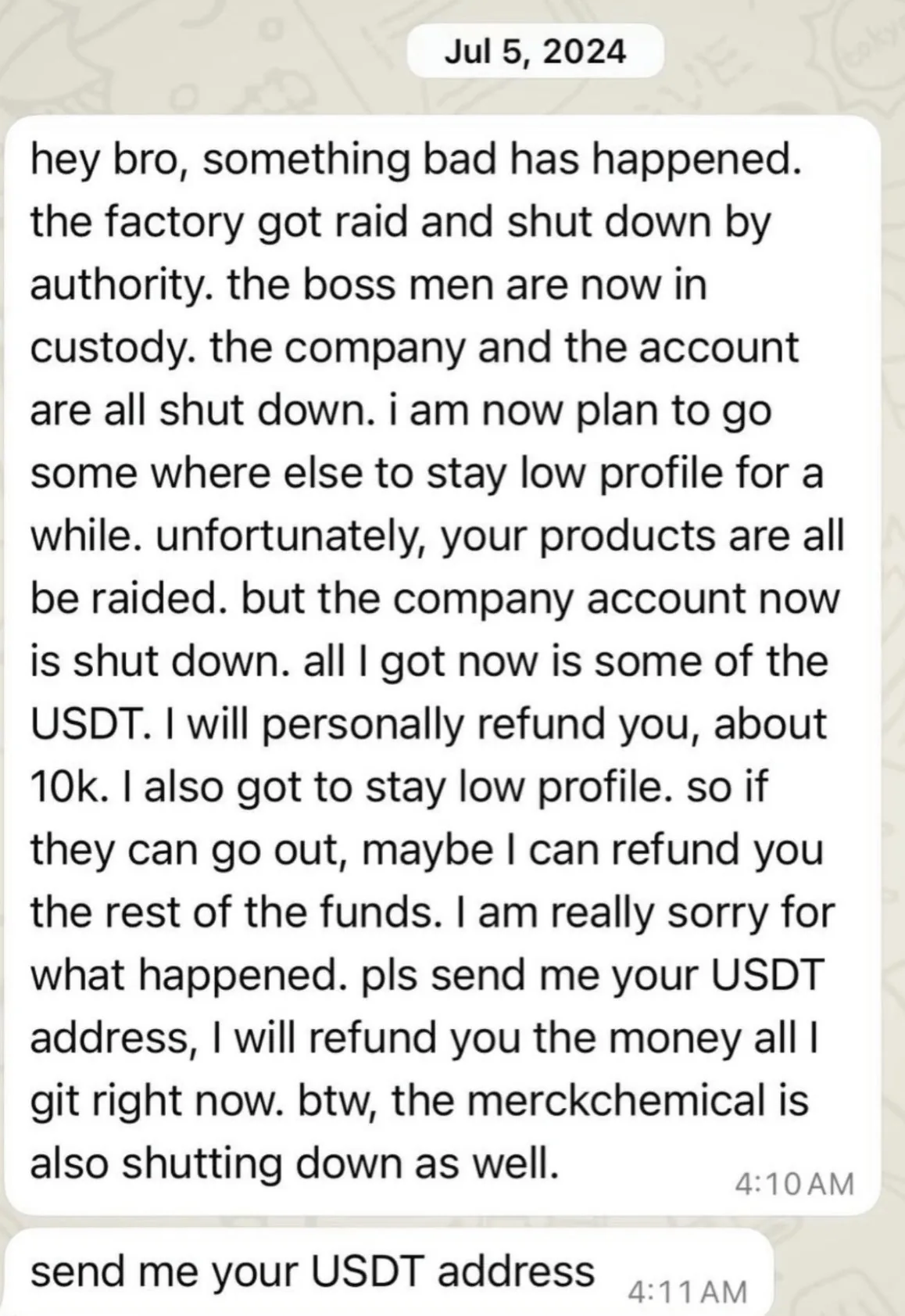
The message above is from Cain’s contact at the factory.
A turning point in Cain’s story was marked by the Merck raid during which the factory was raided by authorities, accounts frozen and products seized. At this time he had a group buy going with Ravens Nest.
According to Cain’s version of events, approximately 300 x T30 kits were seized, around $60,000 had been invested between API purchases and finishing costs, only roughly $10,000 was reportedly recovered and the remaining losses were absorbed and reinvested to reproduce products elsewhere.
Supporters point to this episode as evidence that Cain chose to continue fulfilling commitments despite suffering substantial financial losses, such that Raven wasn’t even made aware of the issues he was having. Raven’s group buy remained unaffected. Critics question how much of the story can be independently verified. Either way, the incident appears to have been a major turning point.
A New Chapter: Moving Production to the USA
Following the Merck shutdown, Cain made a strategic decision to move finishing operations to the United States. Profits from group buys were reinvested into a rented facility equipped with clean-room capabilities. Peptide filling and finishing now occur domestically, with tablets remaining the primary exception.
The stated goal was greater control over quality, excipients and manufacturing standards, ensuring top-notch quality with USP-grade excipients and water for injection (WFI) quality water.
Why the Controversy Never Goes Away
Several criticisms have followed Cain throughout his career, namely the use of aliases and operating multiple companies. Selling pens under one identity and peptides under another and questions surrounding vendor transparency.
Supporters counter with their own arguments that products generally test well, customers have received replacements when issues occurred and significant personal funds were allegedly used to cover losses.
Ultimately, the debate often became less about analytical testing and more about trust.
The GLP Forum IP Reveal
Another major controversy involved the GLP1 Forum. According to Cain, his EZP associate originally created an account on GLP to promote EZP pens. At that stage, Cain was not personally selling pens through EZP, while Nexaph was only just beginning to grow. Cain later asked the same associate to log into his Nexaph account on GLP to make some promotional posts and sales updates.
The problem came when the associate allegedly failed to switch VPNs between the EZP account and the Nexaph account. As a result, both accounts appeared to share the same IP address. While the forum’s owner was away, one of the admins was given access to the forum. He used his priveledges to search member’s IP addresses and matched the IP addresses to both companies. This was interpreted as evidence that Cain was operating under multiple identities.
That discovery was then used against Cain publicly and became another major part of the case against him. Cain’s version is that it was not proof of a fake identity network, but the result of one associate accessing two related accounts without changing VPNs.
More Than a Vendor Story
What makes the Cain saga interesting isn’t simply the products.
It’s the broader questions it raises, how much transparency should vendors provide?When does an alias become deception? How much weight should testing carry compared to reputation? Can a vendor recover from past mistakes? And where is the line between investigation and harassment?
Over the past year I’ve interviewed numerous Chinese sales representatives and vendors. Most use Western names that clearly aren’t their real names, some have provided false information about their role or company, and in several cases I’ve encountered claims that were difficult to believe. Yet these practices rarely seem to attract the same level of scrutiny or outrage.
So that raises an obvious question: why did Baba’s alias become such a focal point? Part of the answer may simply be timing. Many of the events described here took place during a period when the peptide community was smaller, personalities were more prominent and standards around transparency were still evolving. Actions that generated significant controversy then might attract far less attention today.
That doesn’t mean the criticism was necessarily unfair, nor does it mean the concerns were invalid. However, viewed through a modern lens, it’s difficult to ignore the fact that aliases, business pseudonyms and carefully constructed vendor identities have become commonplace throughout the industry.
Whether Cain was treated differently because he was an early example of those practices, because he was more visible than others, or because of the particular circumstances surrounding his businesses, what is clear is that Cain became the focal point for a level of scrutiny that many similar vendors have never faced.


Comments