
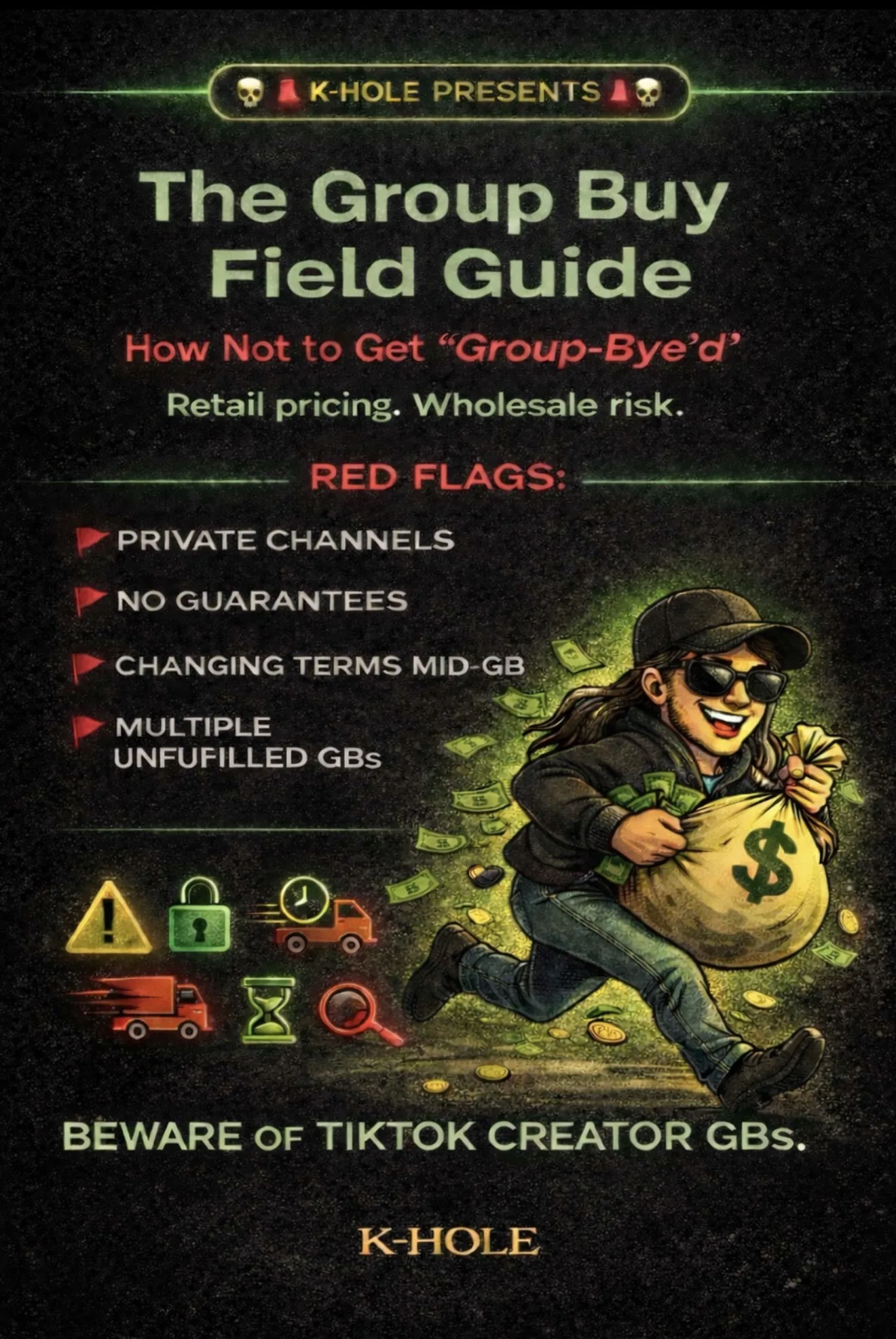
Group Buys (GBs) look so good on paper: lower prices, occasional “how is this even real?” deals, and the comforting promise of “testing included.”
The problem is that a GB can create a false sense of safety just because it’s a group thing, usually run by “someone from the community.” And after enough chaos across Facebook-style buys and Discord servers, one thing is painfully clear:
“Community-run” doesn’t automatically mean “community-protected.” ⚠️
So here’s a funny (but deadly serious) guide to what GBs actually are now, how they go wrong, and how to spot the exit signs before you’re standing in the dark refreshing tracking pages like it’s a religion.
What exactly is a GB?
1) A true third-party GB
A crowd funded buy (often a custom batch) where the organiser is not affiliated with the vendor and acts as a buyer rep, meaning your interests come first.
2) A vendor led GB
Same GB wrapper… but the vendor’s interests come first. (Because that’s the whole job description.)
3) Promos
Discounted existing/pre-sale stock. Often “pre-tested,” sometimes with additional third-party testing. Commonly used by new vendors to introduce themselves.
The big shift: what a GB used to mean vs what it often means now
A long time ago (in internet years), a GB was supposed to be simple:
Researchers pooling together to access good-quality, tested product at below market pricing.
But the definition has loosened so much that “GB” is now frequently just:
• one person buying in bulk
• getting a bulk discount
• not passing that discount on
• offering no testing
•. offering no guarantees
• and buyers still pay shipping to get it forwarded to them
So what are you actually getting?
Often: retail pricing + extra risk + fewer rights + less transparency…
…and sometimes a delivery timeline measured in geological eras.
Because some of these “GBs” take months to arrive, slow rolling updates, delayed batches, reshipper bottlenecks, customs limbo, and the classic “one last thing” that somehow lasts 8 weeks.
And if something happens to the stock, or the vendor ghosts, customers are left with nothing: no product, no refund, no leverage. Just a chat log and regret.
A good example of this “GB-shaped risk funnel” is the HK Peptides vs Peppytide story: the risk flowed downward and the protections didn’t.
Why GBs attract scammers (and why so many scams start here)
GBs aren’t just risky because logistics are hard. They’re risky because they’re a magnet for scammers and unscrupulous people looking to make a quick buck.
In fact, the vast majority of my scam investigations are GB organisers.
Not because every organiser is bad, but because the structure is perfect for manipulation.
The scammer’s favourite feature: isolation
A huge part of why these scams succeed is that they prey on newbies, then do the classic move:
“Participants only” private channels.
It sounds like organisation. Functionally, it’s isolation.
Once you’re inside, you’re cut off from:
• wider community scrutiny
• outside warnings and history
• people comparing notes publicly
• cross server accountability
It becomes a small bubble where the organiser controls the narrative, the updates, the rules… and sometimes who even gets to speak.
Why people stay quiet (even when it’s going wrong) 🤐
Two reasons:
1) The organiser often has personal details
Addresses, names, payment trails, enough real world info that people start worrying about being doxxed or targeted.
2) People have already paid
A lot of participants don’t speak up because they’re thinking:
“Let me get my goods first… then I’ll talk.”
Which buys bad organisers time, because a server full of people waiting for their parcel is a server full of people swallowing their concerns.
The usual suspects
“Notorious scammer” energy: Jewels + The Secret Stash
Even after “retiring,” this organiser has recently resurfaced to sell off “personal stock.”
Because nothing says trustworthy comeback like a surprise clearance sale from someone with a history.
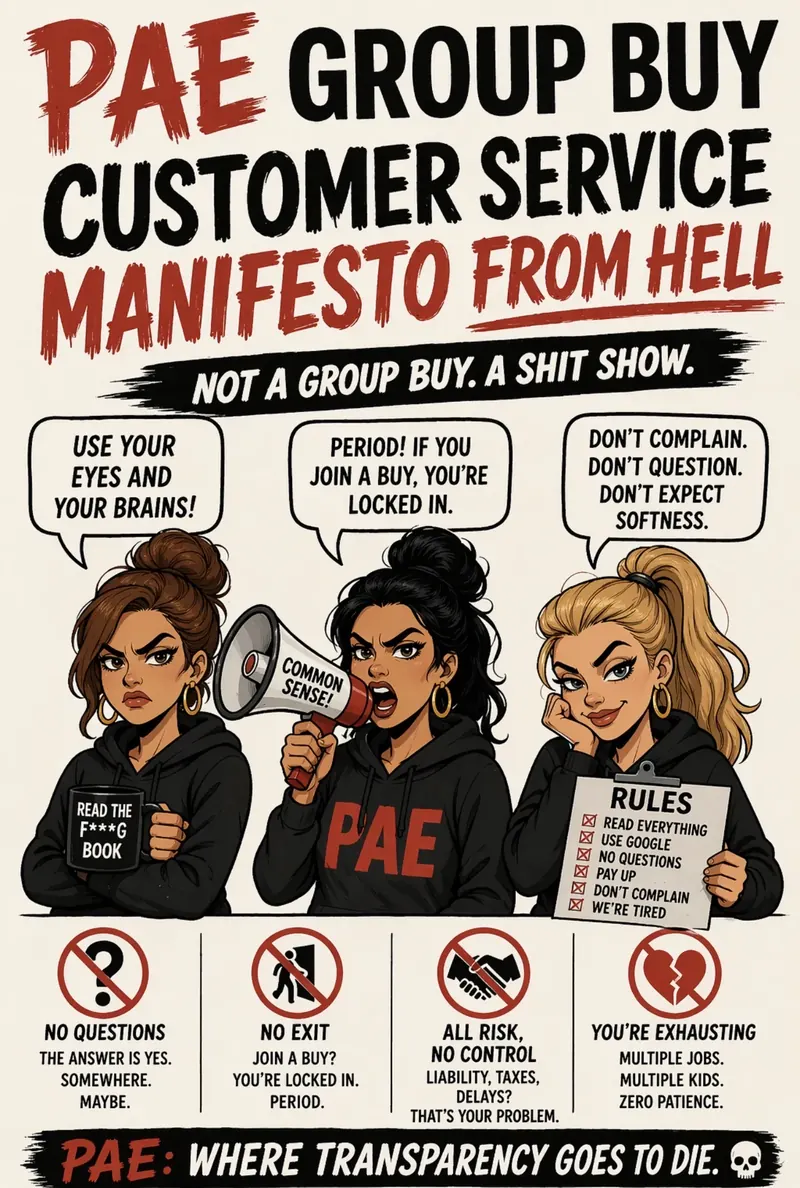
“Not always outright scam, but deeply unscrupulous” energy: PAE
Some GB ecosystems aren’t technically scams every time, but rely on tactics that discourage scrutiny and protect the organiser over participants:
• pressure + loyalty culture
• criticism suppression
• narrative control
• rules that appear when things go wrong
• accountability that evaporates on contact
Different label, same vibe: control the room, control the outcome.
The 10 Red Flags 🚩
(aka “Things That Should Make Your Eyebrow Leave Your Face”)
🚩 1) No guarantees / no refunds
Translation: “If it’s underfilled, impure, seized, missing, melted, or haunted… that’s a you problem.”
🚩 2) Consistent negative reviews
Patterns aren’t “bad luck.” They’re a business model.
🚩 3) Fear among participants
If people are scared to ask normal questions… you’re not in a GB, you’re in a hostage negotiation.
🚩 4) Demanding extra testing as a stall tactic
When issues arise and instead of honoring guarantees, the answer is:
“Let’s do more tests… paid by you.”
Classic delay seasoning.
🚩 5) Multiple open GBs at once
If someone is running a GB buffet simultaneously, expect logistics held together with duct tape and prayers.
🚩 6) Evidence of disorganisation
Conflicting updates, missed deadlines, timelines ignored, chaos is expensive. Guess who pays?
🚩 7) Changing terms mid-GB
Rules magically change after problems appear. That’s not policy. That’s improvisation.
🚩 8) No accountability
If the supplier fails and the organiser shrugs. no reship, no refund, no responsibility, you’re funding a shrug.
🚩 9) Affiliated or compensated organisers
If the organiser is paid/perked/linked to the vendor, they’re not your rep. They’re marketing with admin permissions.
🚩 10) Reduced communication + censorship
When updates dry up and comments start getting deleted… you’re in the pre-ghosting phase. 👻
Extra warning signs ❗ (the “Hmm” list)
• new GB/server appears out of nowhere
• vague process, vague answers, defensive energy
• niche offerings with zero evidence of proper research
• shaming/discrediting other organisers or disrespecting customers
• secrecy obsession: secret channels, “don’t show COAs outside the server,” etc.
• no clarity on volunteer donor/testing process or batch consistency
• reluctance to do third-party testing (or no testing at all)
• booting people for asking “too many questions”
• COAs don’t match batches, or excuses like “same raws used for both”
Plot twist: not every failed GB is an “outright scam”
Sometimes it’s an inexperienced coordinator who hasn’t yet experienced seizures/bad batches/reality… and then goes too big too fast.
But here’s the important part:
When they end up in arrears, some organisers start “floating money” or cutting corners, like skipping testing, removing guarantees, and refusing refunds.
That’s how “oops” becomes “pattern.”
Green Flags ✅ (what “good” actually looks like)
• super transparency (including leaving “bad buys” visible instead of burying them)
• not running dozens of GBs at once
• testing before the batch ships (especially when vendors do it proactively)
• organiser covers losses out of pocket (even when it’s the supplier’s fault)
• refunds available anytime (not “credit hostage coupons”)
• participants can discuss the GB outside the GB without punishment
• organiser is approachable and consistent
• organiser treats it like a responsibility, not a money-making opportunity
Copy/paste: questions to ask your GB organiser
1. Who provides the guarantee, vendor or organiser?
If vendor backed: do you have direct contact details? Are you paying the vendor directly? Do you even know who the vendor is?
2. What exactly happens if there’s a problem?
Total refund, replacement, or prorated? Cash refund or credit? If credit: does it sit with the organiser or the vendor?
3. Purity terms:
What result makes it unusable? What triggers refund/replacement vs “partial”?
4. Timeline (get it in writing):
What’s acceptable to you? Because some GBs languish for months while everyone is told to “be patient.”
The 20-second GB Smell Test
If you see three or more, walk:
• “No refunds.”
• private channels + secrecy rules
• term changes mid-stream
• testing used as delay
• fear of asking questions
• organiser won’t own outcomes
• censorship / comms drying up
• delivery timelines that keep moving like a mirage
That’s not a GB. That’s a slow motion disappearing act.
If you take ONE thing from this guide, take this
Never get involved with a GB organised by a TikTok creator.
Not “be cautious.” Not “do your research.”
Just don’t.
Because that setup combines the worst ingredients:
• Organiser is 9 times out of 10 affiliated with the vendor and is receiving “perks”
• an audience full of newbies
• hype driven buying
•. a “trust me” business model instead of a process
• private channels that isolate participants
• and a business model that rewards urgency over accountability
If a GB needs a ring light to function, it’s not a GB. It’s content.


Comments