
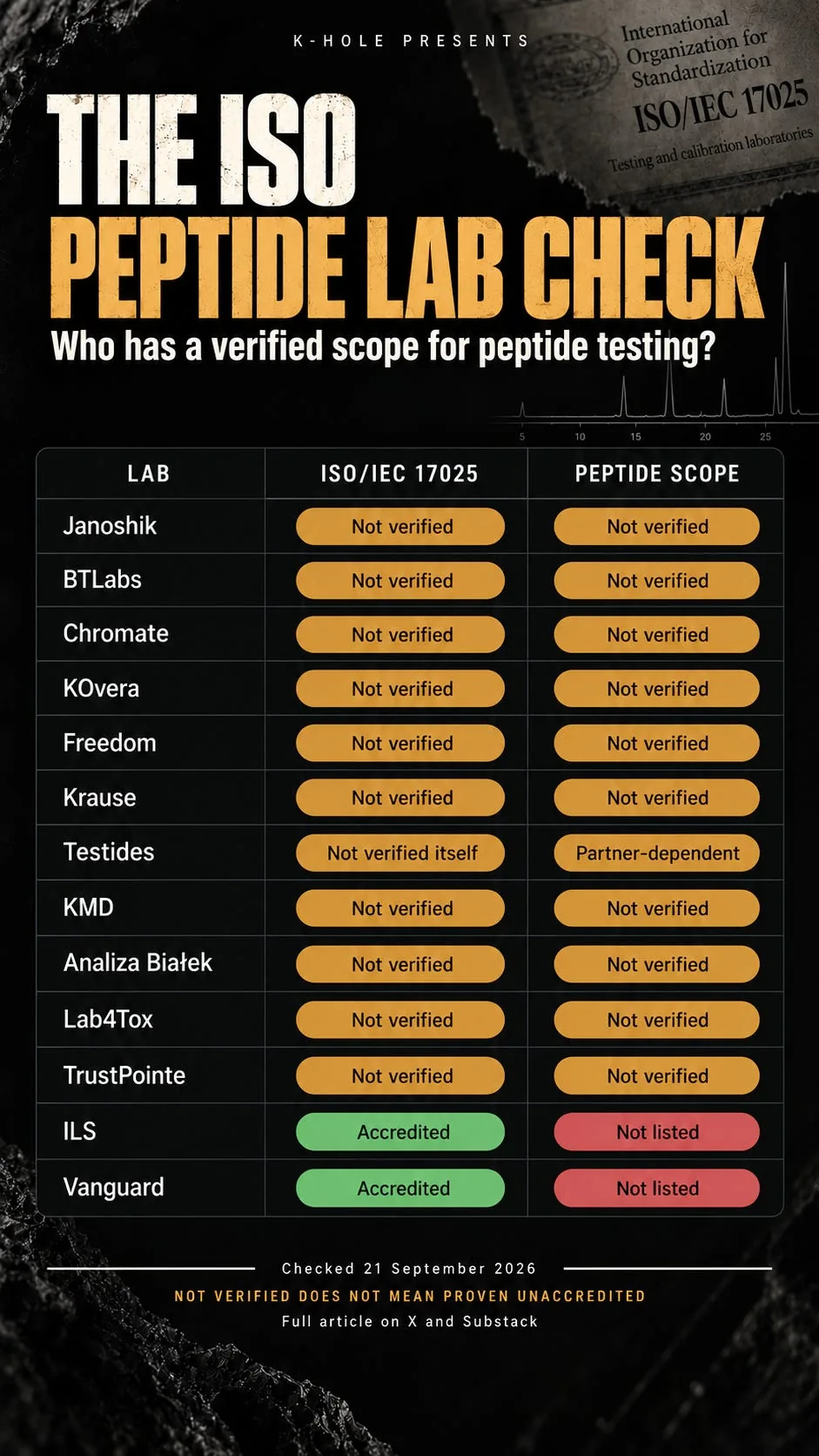
An ISO logo on a laboratory website looks reassuring. In the peptide community, it’s become an easy way to separate the supposedly professional labs from everyone else: accredited means trustworthy; unaccredited means amateur. It would be lovely if laboratory testing were that simple, but it isn’t.
Vanguard Laboratory supplied an extremely detailed explanation of accreditation, proficiency testing, method validation and what customers should examine before trusting a result. Its main argument wasn’t that accreditation is unimportant, accreditation provides valuable independent evidence about a laboratory. The problem begins when a COA is treated as a blanket endorsement of every result leaving the building.
First, ISO Does Not Accredit Laboratories
ISO/IEC 17025 is the principal international standard for testing and calibration laboratories. It sets requirements covering competence, impartiality and the consistent operation of laboratory activities. ISO writes and publishes the standard. It doesn’t visit labs, conduct assessments or issue accreditation certificates. That work is performed by accreditation bodies such as A2LA, ANAB, UKAS and PJLA.
Describing a laboratory as “approved by ISO” is therefore inaccurate. FDA registration, DEA registration, cGMP compliance, CLIA certification, CAP accreditation and claims of following USP methods all answer different questions. None automatically means that a peptide test is accredited under ISO/IEC 17025.
A Laboratory Is Not Accredited for Everything It Does
Accreditation applies to a defined scope. Depending on how the scope is written, it may identify particular fields, methods, analytes, matrices or groups of technically related activities. A lab could be accredited for one method and nothing else. It could then truthfully promote itself as an ISO/IEC 17025-accredited laboratory, even though almost every other test it sells remains outside its accredited scope. The certificate may be genuine but the conclusion drawn from it may still be wrong.
Accreditation for environmental contaminants, cannabis, food chemistry or microbiology doesn’t automatically extend to peptide identity, chromatographic purity, quantity or sequence confirmation. “Performed inside an accredited laboratory” and “an accredited test” are not interchangeable claims.
What the Current Scopes Actually Show
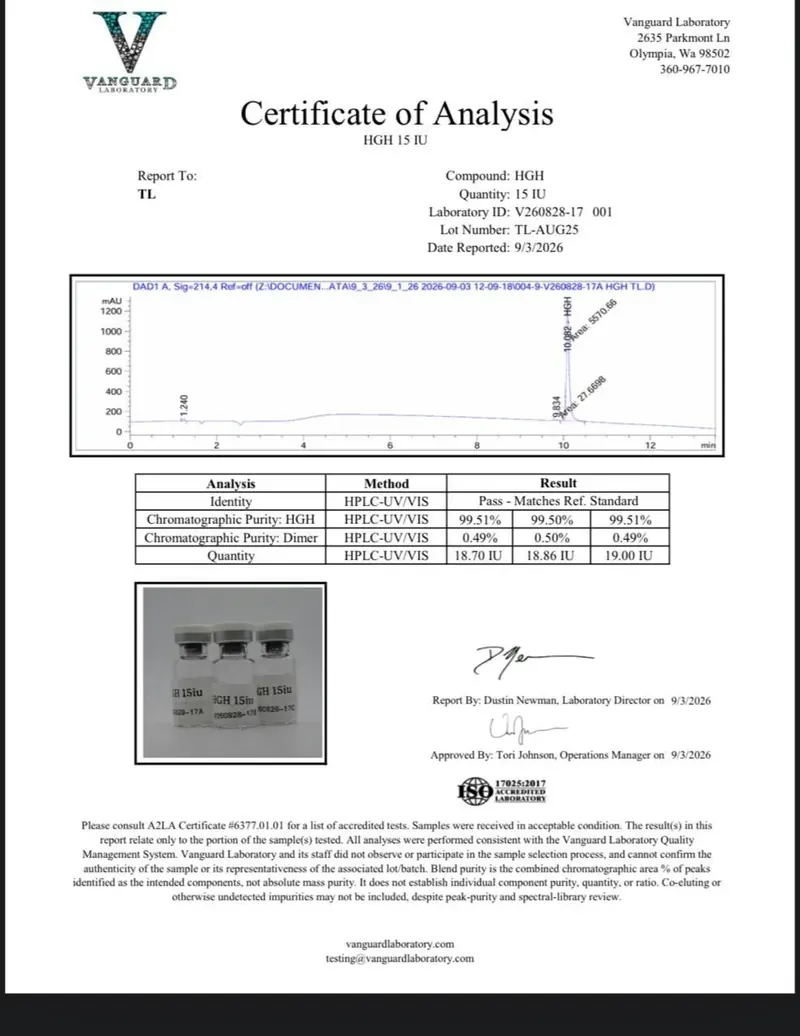
Vanguard’s current A2LA scope, valid until September 2027, includes microbiological tests, trace-element analysis by ICP-MS, preservatives by HPLC and residual-solvent analysis. It doesn’t currently list peptide identity, purity or quantity testing.
Vanguard says it’s working to add peptides as a matrix to its scope. It also says that, because it’s been unable to find a suitable peptide-matrix proficiency-testing programme, it’s completing pharmaceutical proficiency tests that A2LA will accept as alternative evidence. That may support a future expansion, but it doesn’t change the published scope today. Until A2LA issues a revised document containing the new activity, Vanguard’s peptide results remain outside its accredited scope.
ARL BioPharma provides a different example. Its current A2LA scope, issued in May 2026 and valid until April 2028, is genuinely pharmaceutical in character. It covers antimicrobial-effectiveness, bacterial-endotoxin, microbial-limits and sterility testing on active materials and finished drug products. It also covers HPLC, gas chromatography, UV and FTIR testing of active pharmaceutical ingredients using USP-NF monographs.
That’s much closer to pharmaceutical peptide testing than accreditation for cannabis or environmental samples. It still doesn’t provide blanket accreditation for every research peptide a lab might receive. The scope doesn’t name retatrutide, general peptide sequence confirmation or a universal non compendial method for peptide identity, purity and quantity. Whether an individual result falls within scope depends on the substance, matrix, method, applicable monograph and how the report is issued.
Accreditation Is Also Marketing
There’s also another reason the ISO logo often appears more prominently than the technical details behind it. A2LA’s own guide, “10 Steps Toward Achieving ISO/IEC 17025 Accreditation,” describes accreditation as recognition of competence to perform specific testing or calibration activities. Its final step is “Market your accreditation.” A2LA encourages accredited organisations to promote it through websites, social media, press releases, exhibitions, brochures, emails, letterheads, clothing and business cards.
There’s nothing improper about a lab promoting an accreditation it’s spent considerable time and money obtaining, customers simply need to recognise that the badge is also a marketing asset. The advertisement tells customers that the laboratory holds accreditation, it doesn’t tell them whether the peptide test being sold is included within it. So although the logo may appear everywhere, the accredited claim still ends at the published scope.
What Does the Wider Quality System Tell Us?
An ISO/IEC 17025 assessment looks beyond the individual tests named on the scope. Assessors also examine the quality system supporting the accredited work. This may include: Analyst training and competency, Equipment maintenance and calibration, Reference standards, Method validation, Document control, Data review, Internal audits, Corrective actions, Proficiency testing and Procedures for work that fails to meet requirements.
A laboratory may choose to apply the same systems to its unaccredited work. An off-scope peptide test could still be performed by trained analysts using calibrated equipment, controlled procedures and formal data review. That provides useful context, but it doesn’t turn the test into an accredited one. The accreditation body has formally recognised competence only for the activities covered by the published scope.
Scopes Can Change
Accredited scopes aren’t fixed forever. Laboratories can add methods and later remove them. Vanguard explained that it previously maintained an LC-MS/MS method covering roughly 80 pesticides while processing large numbers of samples under a state contract. When the contract ended and the testing volume disappeared, the method was removed from the scope. There was little reason to continue paying for the proficiency testing, auditing and scope maintenance associated with a method that was rarely being used. Removing a method doesn’t necessarily mean that the lab has lost its equipment or all previous experience. It means that the method is no longer covered by its current accreditation claim. This is why an old certificate or logo isn’t enough. The current scope must be checked.
Accreditation Is Not Simply Buying a Certificate
Vanguard estimated that the initial accreditation process for a small laboratory could cost between $10,000 and $20,000 once the assessment, assessor travel, equipment calibration, proficiency testing, reference materials, training and staff preparation were included. The expense continues after the certificate arrives. Labs face renewal assessments, annual fees, scope additions, staff training, reference standards, proficiency-testing samples and external calibration.
Vanguard has approximately 50 pipettes. Calibrating those several times a year creates a substantial cost before balances, thermometers, weights and more complex instruments are considered. There’s also the staff time spent writing procedures, validating methods, documenting competency, performing internal audits, investigating failures and controlling every revision of every document.
An older Association of Public Health Laboratories survey covering 18 mainly government food and feed laboratories demonstrates how quickly the costs can grow. The survey reported median initial and renewal assessment fees of $7,250 and $6,000. Its much larger median combined figure of $311,485 included staffing, software, monitoring systems, maintenance, training and some expenditure accumulated over several years.
That figure shouldn’t be presented as the normal annual cost for a small peptide laboratory. The participants were mostly government laboratories, several received federal funding, and respondents didn’t always separate accreditation expenses from the ordinary cost of operating a competent laboratory. What the survey does show is that genuine accreditation involves far more than paying for permission to display a logo.
Proficiency Testing Does Not Exist for Everything
Proficiency testing, usually shortened to PT, involves a provider sending a laboratory a sample whose result is unknown to the analysts. The laboratory tests it normally and submits its result, which is then compared with an assigned or consensus value. The provider may itself be accredited to ISO/IEC 17043. It shouldn’t be described as “ISO approved,” because ISO publishes the standard but does not directly approve the provider.
The difficulty is that an exact PT programme doesn’t exist for every analyte in every matrix. A laboratory may find a programme for a pesticide in drinking water but not for the same pesticide in cereal, oil or a lyophilised peptide. ILAC policy recognises this problem. Where appropriate PT is unavailable or unsuitable, a laboratory may use a justified alternative such as an interlaboratory comparison or a programme covering a technically related activity. The accreditation body then decides whether that evidence is adequate. This doesn’t mean that any remotely similar PT will do. The laboratory must explain why the alternative is technically relevant.
What Vanguard’s PT Records Show, and What They Do Not
Vanguard supplied a multi-year LIMS export, described by the laboratory as a partial list, documenting proficiency-testing participation across microbiology, food, water, environmental testing, pharmaceuticals and cannabis. It identifies providers, study or round numbers, methods and test areas, including microbiological organisms, gluten, preservatives, pharmaceutical active-ingredient assay, sterility, endotoxin, pesticides, mycotoxins, cannabinoids, trace metals and residual solvents. The listed platforms include HPLC, LC-MS/MS, GC-FID and ICP-MS.
This is useful evidence of an established laboratory quality programme, although some entries are historical and Vanguard explained that its principal schemes are alternated rather than completed every quarter. The export was supplied as an example of the proficiency testing it believes a competent laboratory should undertake.
Proficiency Testing and Method Validation Are Not the Same
Three separate questions are often treated as interchangeable:
Proficiency testing: How did the laboratory perform on a particular external challenge?
Method validation: Has the method been shown to work for its intended analyte, matrix and purpose?
Accreditation scope: Which activities has the accreditation body formally recognised?
Evidence in one category doesn’t automatically establish the other two. Proficiency testing can support confidence in a laboratory’s broader competence, but it doesn’t by itself validate a particular peptide method or place that method within the accredited scope. In-house methods and acceptance criteria can be legitimate, provided they are scientifically justified and appropriate for the claim being made.
Random Vials Do Not Make a Clean Laboratory Comparison
Cross-laboratory comparisons frequently appear within the peptide community, but many aren’t designed to separate laboratory variation from sample variation. If the purpose is to compare lab performance, each laboratory should receive a blind aliquot taken from the same sufficiently homogeneous and stable sample. The protocol, reporting rules and acceptance criteria should preferably be agreed in advance. Sending different vials carrying the same batch number introduces another variable. The vials themselves may contain different amounts or impurity profiles. If the labs return different results, it becomes difficult to determine whether the discrepancy came from the labs or the samples they received.
Testing random vials from one batch can provide useful information about batch consistency, but it’s not a clean test of lab accuracy alone. Vanguard has described an earlier comparison in which the same samples were sent to several laboratories without telling them they were participating. The results were reportedly close. Other comparisons have produced differences of 10 to 20%, with a few approaching twofold. Those differences may arise from lab performance, but vial variation, sample preparation, calibration, integration choices and differences between analytical methods can all contribute.
Vanguard also says it plans to work with TrustPointe on a laboratory-to-laboratory peptide comparison that may later be opened to other laboratories. That could provide directly relevant evidence, but it remains a plan rather than a completed study.
Does a Pharmaceutical Testing Laboratory Have to Register With the FDA?
Sometimes. It depends on what the laboratory is testing and why. Under 21 CFR Part 207, testing performed as part of manufacturing or controlling a commercial drug can count as drug manufacturing. A contract lab testing products for a registered drug manufacturer may therefore need to register with the FDA and comply with pharmaceutical cGMP requirements. That doesn’t apply to every laboratory. Exemptions may cover work performed solely for research, teaching or chemical analysis when the products are not intended for sale. The answer depends on: what is being tested; who commissioned the work; whether the product is commercial; and how the results will be used.
FDA can inspect contract laboratories working on commercial drugs. In a 2025 warning letter, it cited a laboratory testing commercial over-the-counter products for cGMP violations. Registration isn’t FDA approval. It doesn’t mean that FDA has approved the lab, its methods or its COAs, and it doesn’t prove that a particular peptide test is accredited or properly validated.
A Nonaccredited Laboratory Is Not Automatically Incompetent
Many academic, research, development and start-up labs aren’t accredited. Smaller laboratories may also delay accreditation because of the cost and work required to obtain and maintain it. Accreditation is strong independent evidence, but it’s scope-specific and doesn’t guarantee that every result will be correct. A laboratory can be accredited for unrelated work while conducting peptide analysis outside its recognised scope.
A nonaccredited laboratory can still provide meaningful evidence of competence through method validation, traceable standards and calibration, proficiency testing, quality controls and interlaboratory comparisons. In some cases, this evidence may be more relevant than an accreditation certificate that doesn’t cover the test being sold.
What Should a Credible Laboratory Be Willing to Show?
A laboratory claiming accreditation should provide its current certificate and complete scope, making clear whether the specific test is covered. If it is outside scope, the laboratory should be able to explain how the method was validated, how performance is monitored and how failed or unusual results are investigated.
This does not require publication of proprietary procedures or an unredacted quality manual, but enough information should be available through summaries or redacted records to support the reported result. Accreditation is valuable independent evidence, but it is not a guarantee that every result will be correct.

Comments