
The debate started with a fairly common explanation for why two laboratories can test apparently similar samples and report different results: the equipment. The suggestion was that grey-market testing may involve greater analytical variation because pharmaceutical companies can afford more extensive testing, more instruments and tighter quality systems. That quickly turned into a much bigger question.
If an independent peptide testing lab uses different equipment or a less extensive testing setup than a pharmaceutical company, does that automatically make its results “B-tier”?
The answer; No.
But using the same brand of equipment as Big Pharma doesn’t automatically make a lab pharmaceutical-grade either. The problem is that “pharmaceutical-grade equipment” isn’t really a regulatory quality category in the way people often use the phrase. What matters is what happens around the machine.
There is no magic pharma HPLC
The regulatory framework doesn’t divide chromatographs into ordinary HPLCs and special pharmaceutical HPLCs. Instead, analytical quality depends on whether the equipment is fit for its intended purpose, qualified, calibrated, maintained and operated within a controlled analytical system. And in Janoshik’s case, we no longer have to rely entirely on somebody else describing the equipment.
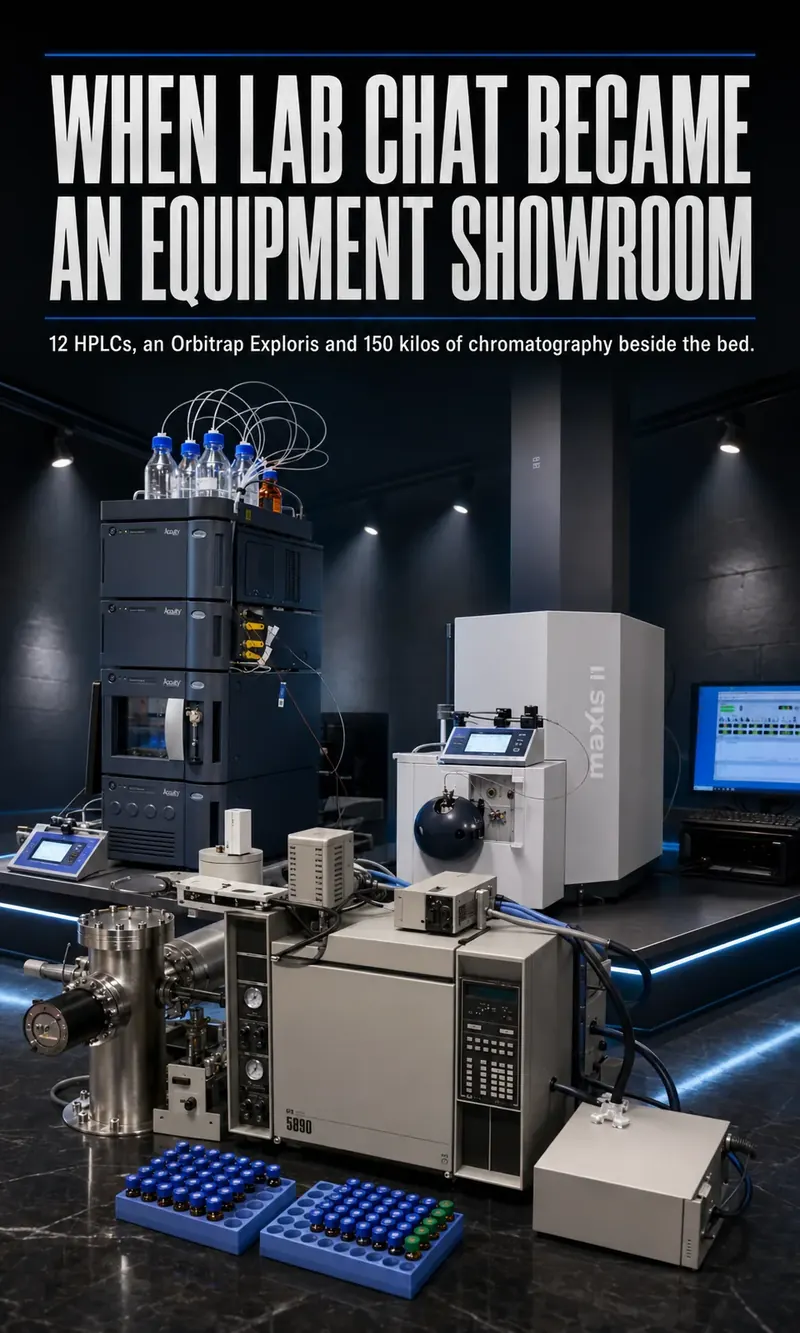
I visited Janoshik’s lab myself in May 2026, so I’ve seen the analytical setup firsthand. Janoshik uses Shimadzu systems, while Vanguard Laboratory says it uses Agilent equipment. Both manufacturers are widely used throughout pharmaceutical analysis. An independent lab can therefore own the same type or brand of analytical hardware found inside a pharmaceutical company. But that tells us much less than people sometimes think: the machine may be capable of pharmaceutical work without the laboratory itself operating under a pharmaceutical quality system.
Amino Metrics: old doesn’t automatically mean bad
Amino Metrics approached the argument from the opposite direction. He said much of his equipment is more than 15 years old, while claiming to benchmark his work against recognised standards and products produced in substantially better-funded laboratories. That performance claim hasn’t been independently verified, but the underlying point is sound: instrument age alone doesn’t determine analytical quality.
Instrument age alone does not determine the quality of the result.
An older HPLC that is properly maintained, qualified and demonstrably performing within a suitable method can still produce good analytical data. A brand-new HPLC running a poor method under weak controls can produce rubbish. That doesn’t mean age is completely irrelevant. Older instruments can create issues involving servicing, replacement parts, software compatibility, sensitivity or general performance. The sensible conclusion is therefore somewhere in the middle: old equipment isn’t automatically bad, new equipment isn’t automatically good, and equipment performance matters more than the date on the purchase invoice.
SDS-PAGE doesn’t make analytical variation disappear
SDS-PAGE is a general protein-analysis technique, which can be useful for recombinant proteins, including HGH, but its suitability depends on the size and nature of the analyte. It also came up as a possible way around the equipment-variation argument, with the suggestion that once you use SDS-PAGE, any remaining differences should essentially come from the individual vials rather than the laboratory equipment.
But that goes too far. SDS-PAGE is a different analytical technique, but it’s still an analytical technique. Its results can be influenced by sample preparation, voltage, temperature, gel and buffer conditions, staining, imaging, background subtraction and the detection and quantitative range of the method. Bio-Rad’s own technical material documents several of these sources of variability.
For suitable analytes, SDS-PAGE can be very useful alongside HPLC because it gives a different type of separation-based assessment. But a clean gel doesn’t automatically prove an HPLC result is wrong, and SDS-PAGE doesn’t magically remove laboratory or equipment-related variation. That actually reinforces the central point of this whole debate: There’s no analytical technique where the method suddenly stops mattering.
The machine and the method are not the same thing
This is where the original argument blurred two separate ideas: there’s the instrument, and then there’s the entire analytical system surrounding it. Two labs could own exactly the same model of HPLC and still operate under completely different levels of analytical control. One may have documented instrument qualification, calibration and maintenance, controlled reference materials, validated methods, predefined system-suitability limits, trained analysts, electronic audit trails and formal investigations when something goes wrong. Another could own the same machine without demonstrating any of those things. That’s why saying “we use the same equipment as pharmaceutical companies” doesn’t mean “our testing is equivalent to pharmaceutical QC.” The hardware may be identical. The confidence you can place in the reported result may not be.
Pharmaceutical-quality testing comes from the whole system: equipment, method, reference standards, analyst training, precision, QC, data integrity and review, not the brand printed on the front of the instrument.
Analyst variation is real; but it needs to be measured
Even highly automated testing doesn’t remove the human element completely. Janoshik has said that, despite extensive automation, human approval is still required. That means analyst review and judgement remain part of the process even when much of the data handling is automated. That isn’t automatically a problem, human review is normal in analytical work, but it does make the next question important: how much variation can different analysts introduce?
Vanguard said that around 2% RSD can be common in some pharmaceutical analyses involving different analysts, but my fact-check found no universal pharmaceutical rule saying 2% RSD is automatically acceptable across analytical testing. Appropriate precision depends on the method and what is being measured. And, crucially, 2% RSD isn’t the same thing as a two-percentage-point purity difference.
RSD ( relative standard deviation) describes the spread of a defined group of measurements relative to their mean. For example: 97% and 99% purity differ by two percentage points. But the sample RSD of those two numbers is approximately 1.44%, not 2%. Likewise, saying a method has 2% RSD doesn’t mean any individual purity result can simply wander around by ±2 percentage points and automatically be considered correct. You need to know what was measured, how many replicates were performed, whether different analysts and instruments were involved, and what performance the method has actually demonstrated. So when somebody explains a 96% versus 99% result by saying: “Lab variance.” the useful response is: How much lab variance? That should be measured, not guessed.
Different analysts and different machines are supposed to be tested
Pharmaceutical analytical frameworks already recognise these potential sources of variation. Changes between analysts, instruments, days and operating conditions fall under intermediate precision.
Comparisons between laboratories are a different issue again: reproducibility. That distinction matters because repeating one prepared sample several times on the same machine only answers one fairly narrow question. It doesn’t tell us what happens when somebody else prepares the sample, another analyst integrates the chromatogram, another instrument runs it, another column is used, or a second laboratory uses its own method.
If those variables are being invoked to explain differences between COAs, their effect should ideally be demonstrated rather than assumed. Despite searching specifically for one, I didn’t locate a strong public example where one homogeneous prepared sample had been split between the named laboratories with enough documentation to isolate laboratory-to-laboratory differences.
Reference standards matter too
Equipment is only one possible reason laboratories disagree. Reference material matters as well. The standard used for calibration needs to represent what the lab thinks it’s measuring, and calculations may need to take account of different salt forms or counterions. A perfectly functioning HPLC can’t rescue a calibration based on inappropriate reference material. Likewise, expensive hardware can’t fix a chromatographic method that fails to properly separate an impurity from the main peak. That’s why comparing labs purely by their equipment lists misses a large part of the analytical problem.
Accreditation isn’t a magic badge either
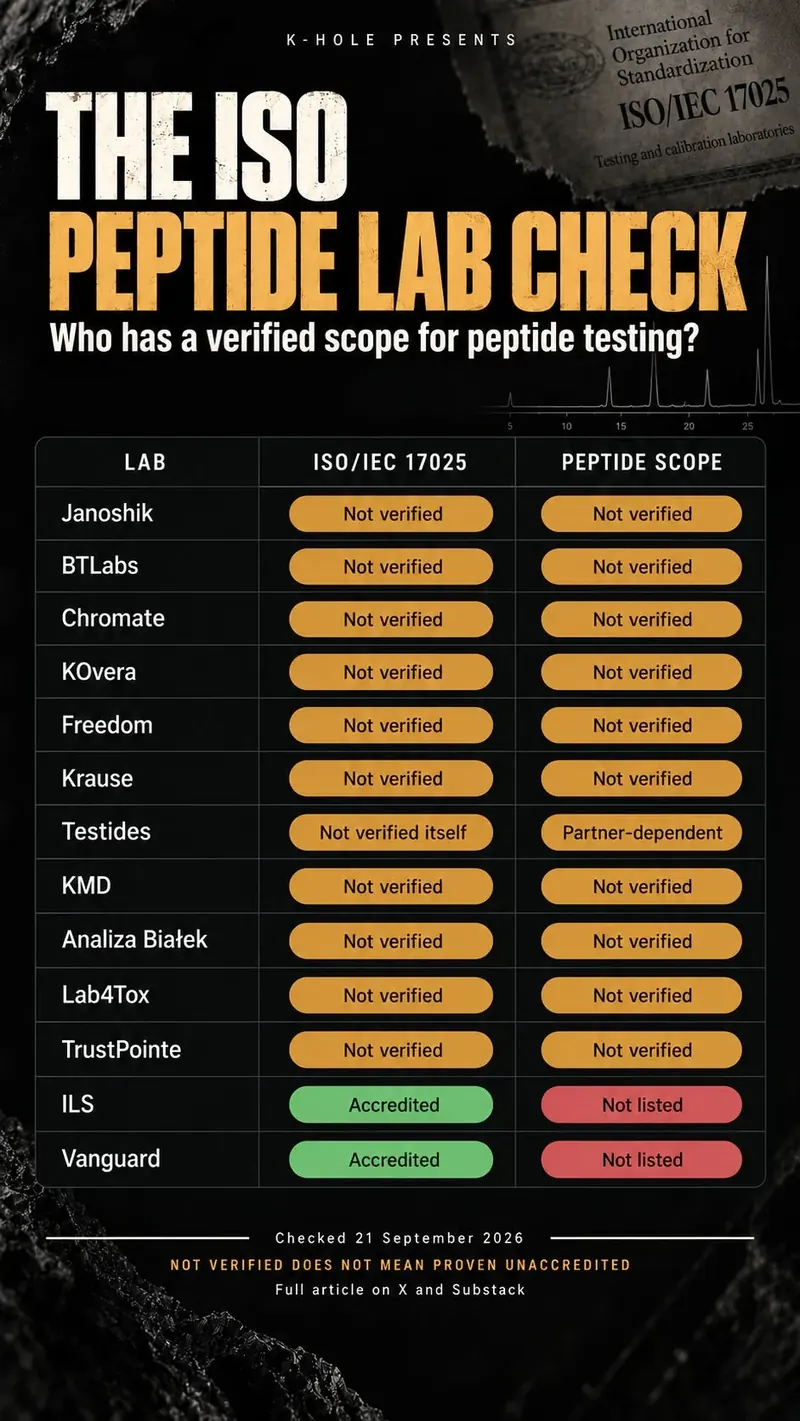
The same precision is needed when discussing lab accreditation. Vanguard Laboratory does hold ISO/IEC 17025 accreditation. But that accreditation is scope-specific, for particular microbiological and chemical tests. Peptide purity and peptide identity testing were not listed. So it would be wrong to say: “Vanguard is ISO accredited, therefore its peptide testing is ISO accredited.”
The public-page review also didn’t establish ISO/IEC 17025 accreditation or GMP status for Janoshik or Amino Metrics. Testides describes its quality system as ISO 17025-aligned, but being aligned with a standard isn’t the same thing as being formally accredited to it by an identified accreditation body. None of those facts prove that one lab produces better peptide testing results than another. They simply show why words such as GMP, ISO, accredited and pharmaceutical-grade need to be used carefully.
FDA provides a useful reality check
If sophisticated pharmaceutical equipment automatically guaranteed good analytical data, FDA warning letters would be considerably shorter. Recent enforcement actions have documented pharmaceutical facilities with problems including inadequate HPLC access controls, weak audit trails, missing system-validation records, failed calculations being discarded while passing results were reported, poor out-of-specification investigations, calibration-record problems and compromised chromatography-data backups.
One example involved Agilent OpenLab, a professional chromatography data system. The presence of sophisticated commercial analytical systems did not prevent failures in how the laboratory controlled its data and processes. That gets to the heart of the argument.
So what should customers actually ask?
Forget whether the HPLC is old, new or used by Big Pharma. The more useful questions are about repeatability, analyst-to-analyst variation, instrument qualification, reference standards, system suitability, integration rules, QC failures, audit trails and interlaboratory comparisons. Those answers tell us far more than a photograph of a brand-new machine.
The machine is important. The machine is not the laboratory.
What matters is whether the laboratory can demonstrate that its equipment, method, analysts and quality controls produce results that are accurate, precise and fit for purpose.
Pharma doesn’t come in the HPLC box.
For photos of Janoshik and Vanguard laboratory equipment, see the earlier equipment tour/article below.
When Lab Chat Became an Equipment Showroom
“fit for its intended purpose, qualified, calibrated, maintained…” → USP <1058>, Analytical Instrument Qualification
“intermediate precision” / “reproducibility” / the 2% RSD discussion → ICH Q2(R2), Validation of Analytical Procedures
SDS-PAGE variability → Bio-Rad, Performing Protein Electrophoresis
“Vanguard Laboratory does hold ISO/IEC 17025 accreditation” → A2LA, Vanguard Laboratory accreditation and scope
FDA reality-check paragraph about HPLC controls/audit trails → Westwood Laboratories FDA Warning Letter
The Agilent OpenLab example → Mentha & Allied Products FDA Warning Letter
Comments