
cGMP and What It Actually Means
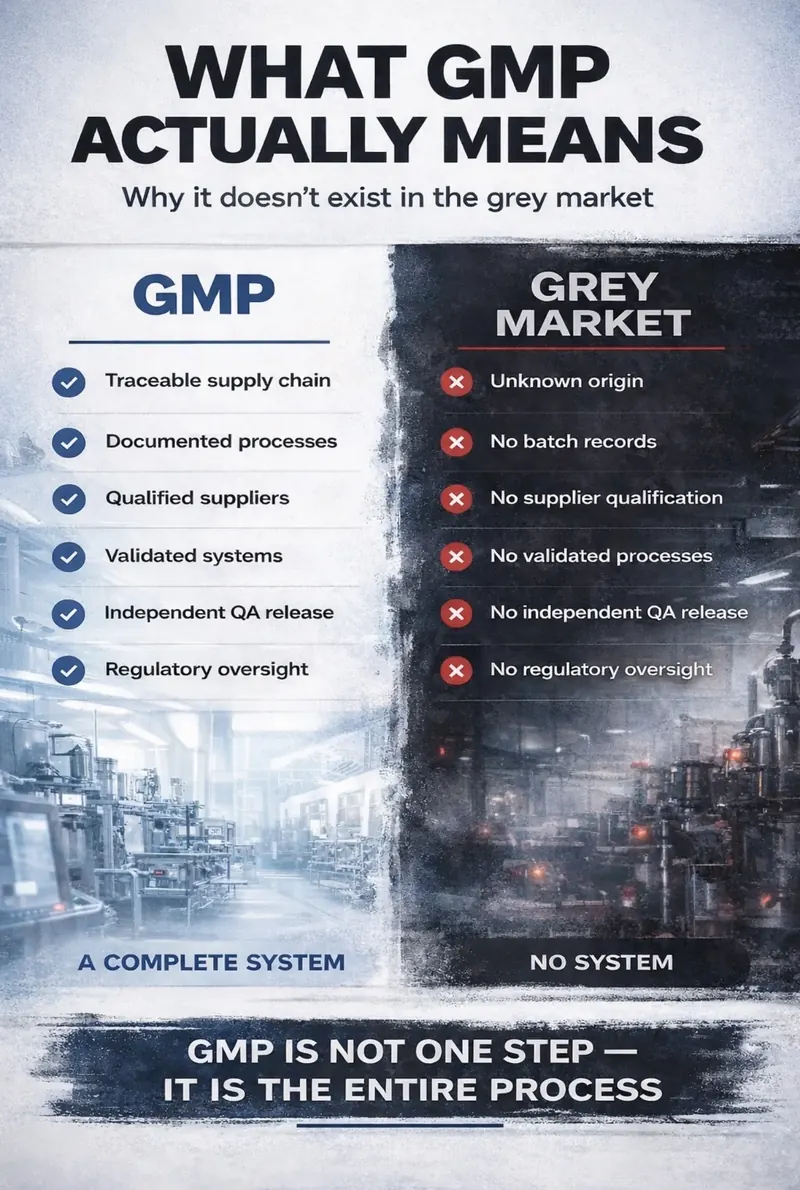
I’ve already written about what GMP means and why it’s unlikely to exist in the grey market, but that post was mainly focused on China vendors.
You can find that post here.
What GMP Means And Why It Doesn't Exist in the Grey Market
This post is focused more specifically on the US RUO market, since several RUO websites are now claiming cGMP compliance, so this is worth separating from the usual grey-market GMP claims.
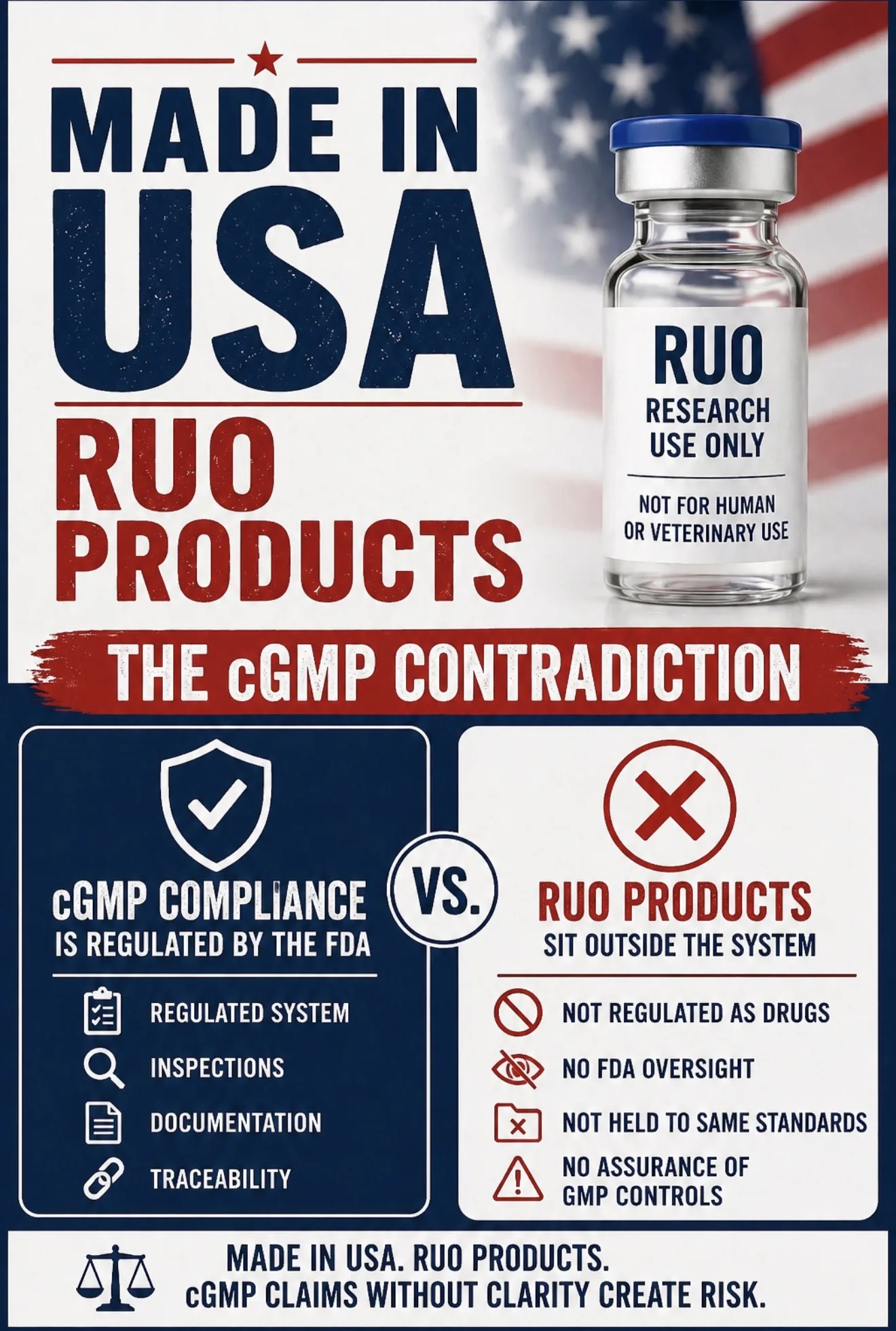
In the US, cGMP, current Good Manufacturing Practice, isn't a marketing term. It’s a regulated system overseen by the FDA.
It involves validated processes, controlled environments, batch records, QA/QC release, traceability, and inspections. That level of control applies to approved drugs and investigational products in clinical trials.
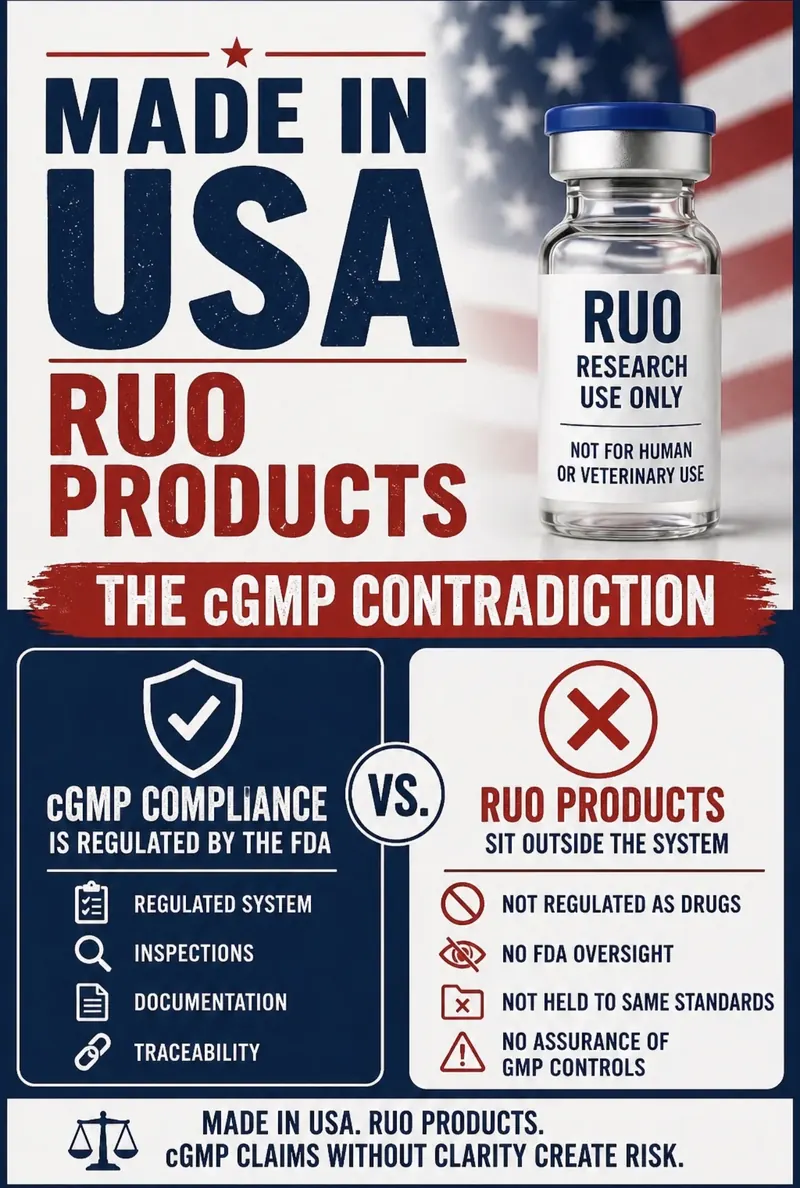
RUO products sit outside that system. They’re not regulated as drugs, not released under FDA oversight, and not held to the same documentation and inspection standards. So when a site selling RUO peptides uses broad cGMP claims, the obvious question is what exactly is cGMP referring to?
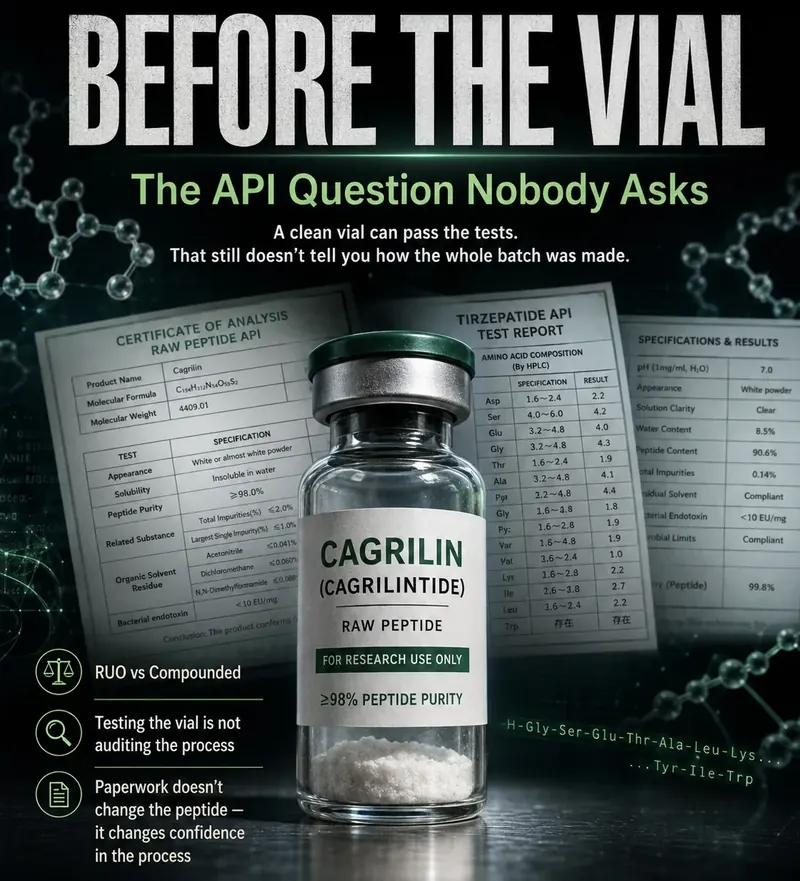
API vs Finished Product
There’s a key distinction here. The API is the raw peptide. It may be produced under GMP-style controls. The finished product is the vial buyers actually receive. That involves additional steps such as filling, lyophilisation, cleanroom controls, batch-level QA release, container closure integrity, and full traceability. So when a vendor uses an API GMP claim to imply finished-vial GMP, it doesn’t prove what buyers think it proves.
API GMP does not equal finished-product GMP.
And when the product is also labelled RUO, while the website simultaneously claims cGMP compliance, the contradiction becomes sharper.
RUO stays outside clinical/drug use.
cGMP implies regulated drug-style manufacturing controls.
Those two claims don’t sit neatly together without clear scope, facility details, and verification.
The “cGMP Facility” Claim
A company can say:
“Made in a cGMP facility”
But that can mean several things, only the API stage, a different product line, or simply that the company has GMP capability somewhere. It doesn’t automatically mean the specific RUO product is cGMP compliant, that the batch was produced under GMP controls, or that it’s being released within a regulated framework.
A facility can also run both GMP-regulated production and non-regulated work, including RUO. But when that’s done properly, the two are clearly separated with different production areas, SOPs, documentation, QA release systems, and batch traceability.
That distinction is critical.
GMP work is slow, audited, and tied to regulatory scrutiny. RUO work is less constrained. No serious GMP manufacturer wants to risk its regulated operations by blurring the two.
GMP status doesn't carry across everything produced in the same building.
So the question isn't whether a company has GMP capability somewhere. The question is was this specific RUO product made under GMP controls, and can that be verified?
Should There Be a Public Record?
If a company is making a real cGMP claim, there should usually be something traceable. That doesn’t always mean a neat public certificate page, but there should be information such as:
facility name and location
regulator involved
inspection history
scope of the GMP claim
and whether it applies to API or finished product
That scope is everything. A facility may be GMP-compliant for one product line, one stage of manufacturing, or one type of material. That doesn't automatically mean every product connected to that facility is produced under GMP.
So when a website simply says “cGMP compliant” without naming the facility, regulator, certification scope, or what part of the process is covered, the claim is not verifiable.
The FDA Verification Toolkit
If a vendor is making a serious US cGMP claim, the process is simple:
Identify → Verify Registration → Check Inspection History
First, ask for the facility name and FEI number.
The FDA Establishment Identifier (FEI) is the unique number used to identify a facility. Without it, the claim cannot be checked.
Second, check current registration status. A facility existing is not the same as being registered to manufacture drugs. The DECRS database shows whether a facility is registered and what it’s registered to do, such as manufacture, label, or pack.
Again, scope matters. A facility may be registered, but not for sterile injectable manufacturing or finished peptide vial production.
Third, check inspection history.
The FDA inspection database shows classifications such as:
NAI, No Action Indicated
VAI, Voluntary Action Indicated
OAI, Official Action Indicated
This shows whether a facility has been inspected and the outcome.
Why RUO Sites Often Fail This Test
When you apply this to a typical RUO peptide site, the process usually breaks down at step one. Typically there is:
no facility name
no FEI number
no named regulator
no inspection record
no defined scope
Sometimes a name is given, but it refers only to an API manufacturer. That may tell you something about the powder but it tells you nothing about the vial and that’s the bait-and-switch. A legitimate cGMP operation should know the facility, scope, and inspection history for the specific stage being claimed.
An RUO reseller will usually respond with vague language like “GMP facilities,” “clean rooms,” or API certificates, but that's not the same thing.
Why the Claim Needs Scope
This becomes even more important when RUO sites sell non-FDA-approved peptides such as retatrutide, or peptides that fall into FDA Category 2. These products sit outside normal pharmacy frameworks, while cGMP implies a regulated manufacturing system and that creates the contradiction:
RUO says outside drug regulation.
cGMP implies regulated drug-style controls.
So the issue isn’t whether cGMP exists, it's cGMP for what?
API? Finished vial? Lyophilisation? Fill-finish? Packaging?
If there's no named facility, no FEI number, no inspection record, and no defined scope, then the claim is not meaningful, it's just marketing.
A serious GMP manufacturer protects its status. It doesn’t blur regulated and non-regulated production just so an RUO website can sound more legitimate. If you can’t trace the facility, you can’t trust the claim.
Today’s FDA Guidance
https://www.fda.gov/news-events/press-announcements/fda-proposes-exclude-semaglutide-tirzepatide-and-liraglutide-503b-bulks-list
The FDA has just made its position even clearer.
In its latest announcement, the agency stated there is no clinical need for outsourcing facilities to compound semaglutide, tirzepatide, or liraglutide from bulk substances. It also reinforced a key rule:
When FDA-approved drugs are available, compounding from bulk substances is not allowed unless there is a clear clinical need.
And that “clinical need” has a very specific meaning. It's not convenience, cost, access or preference, it's medical necessity
Why This Matters Here
This sharpens the contradiction, because now you have non-approved peptides (including GLPs) sold as RUO products alongside broad cGMP language, while at the same time, the FDA is making clear that bulk compounding is limited, scale is restricted and “clinical need” is the only justification.
The Key Point
cGMP implies a regulated manufacturing pathway, oversight and a defined clinical use context, but RUO exists outside that system and FDA guidance is tightening the boundary between the two.
The more the FDA tightens what qualifies as regulated manufacturing, the less credible broad cGMP claims become without clear scope and verification.
Comments