
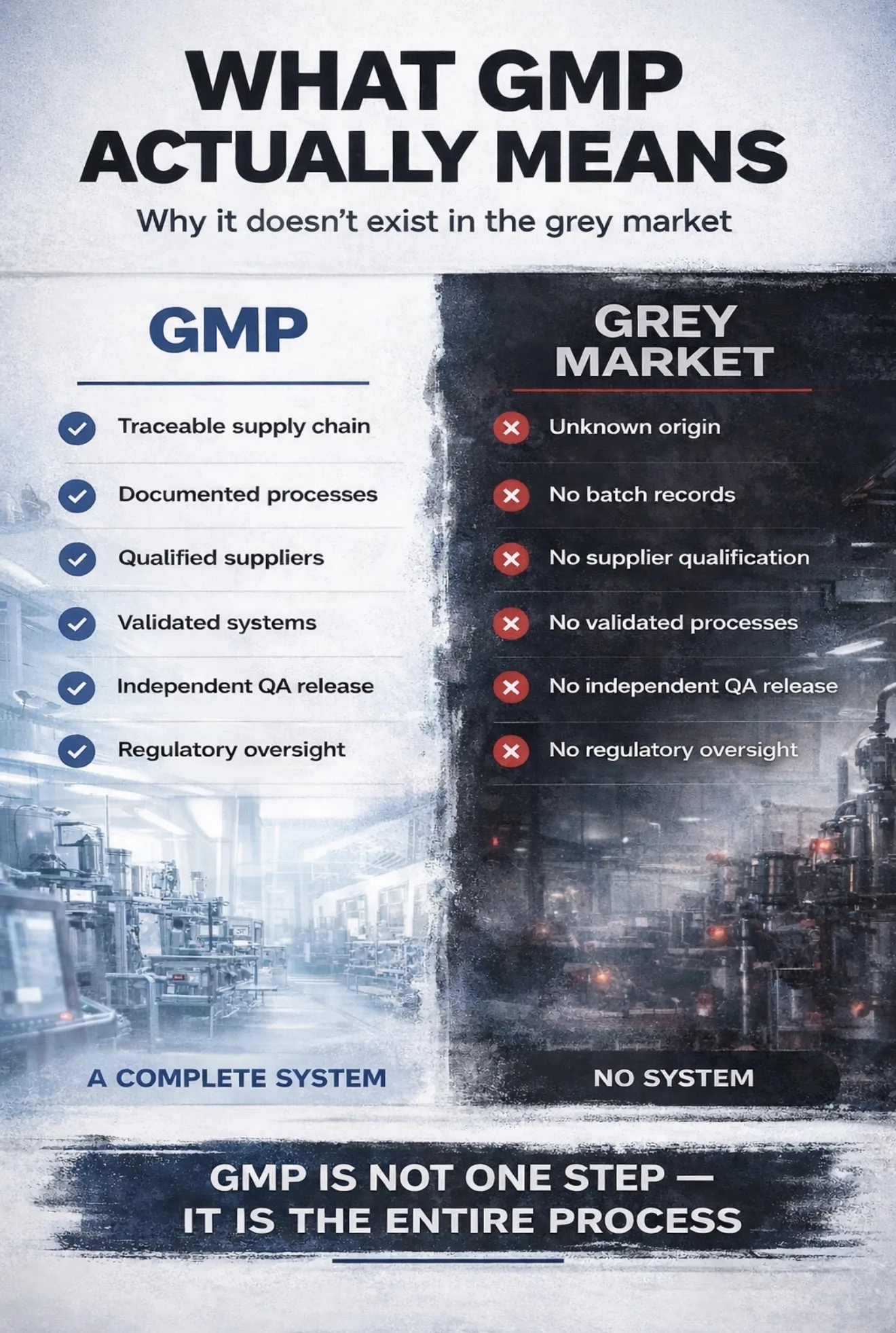
I’ve noticed that a number of grey market vendors and manufacturers claiming to be “GMP compliant”.
So I decided to investigate those claims.
In this article, I’ll explain what GMP compliance actually means, what is required to achieve it, and why it’s simply not feasible for any grey market manufacturer or vendor to be genuinely GMP compliant.
But to understand why, we first need to understand what GMP actually is.
GMP vs cGMP
GMP defines the framework.
cGMP means that framework is being followed using current, up to date methods, systems, and controls.
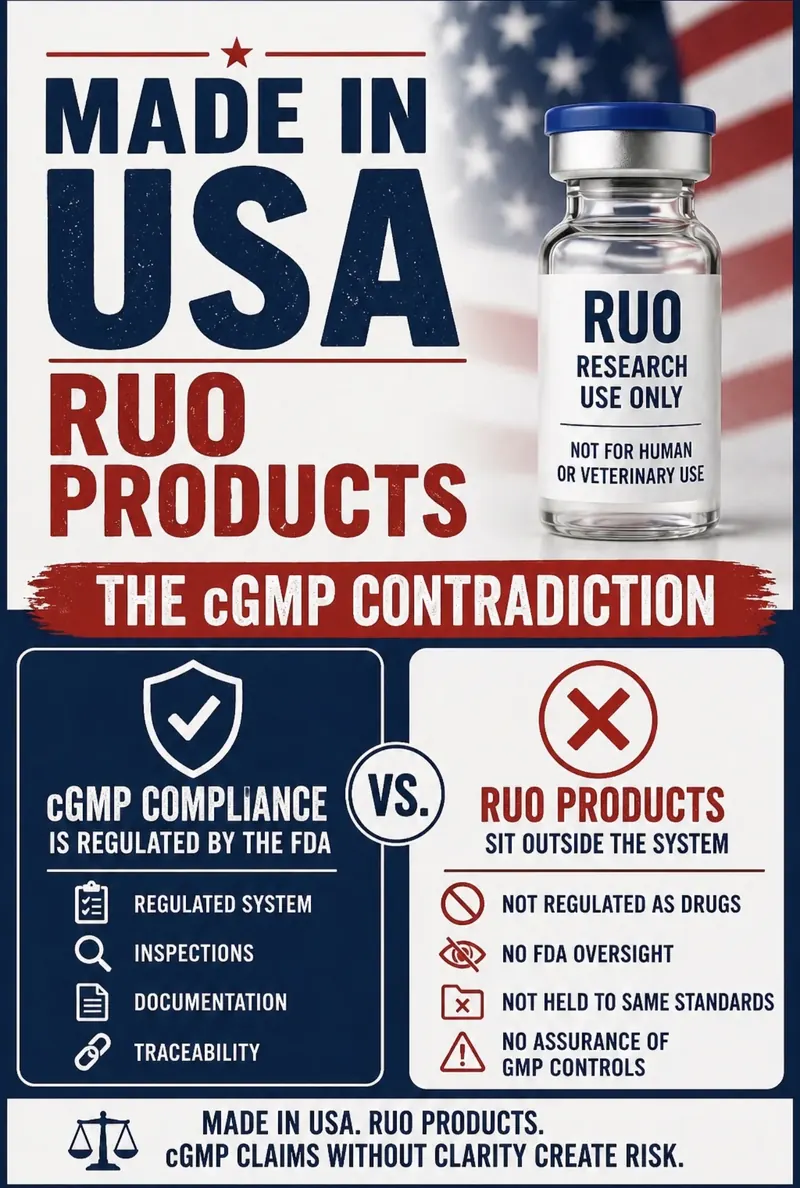
cGMP claims can’t be valid where GMP itself is absent, because cGMP depends on the presence of a real GMP system.
Where GMP comes from
GMP didn’t originate in pharmaceuticals. It evolved from industrial quality systems, particularly:
military manufacturing
aerospace
high reliability engineering
These were industries where failure was not an option. They relied on:
traceability
documentation
controlled processes
qualified suppliers
repeatability
Pharmaceutical manufacturing adopted these same principles because it carries the same requirement:
Zero tolerance for failure
What GMP actually is
GMP is an industrial level quality system designed for traceable, controlled high-risk production
GMP does not mean a manufacturer produces the “best” possible product. It means the product is produced consistently, within strictly defined limits, in a controlled, documented, and auditable environment. That distinction matters, because a product may appear good at the end and still not be GMP. GMP is not a claim about outcome alone, it is a claim about the system behind the outcome
Why traceability is everything
At the centre of GMP is one requirement
Traceability
Every raw material, component, supplier, process step, must be qualified, documented and auditable
If you don’t know where something came from, GMP fails immediately. GMP cannot be partially applied and if one part of the system breaks, the entire system fails.
What GMP actually requires
For a product to be manufactured under GMP, all of the following must exist:
1.Full supply chain traceability
known origin of all materials
qualified and audited suppliers
traceability of every component
2.Complete documentation system
full batch records
every step recorded
every parameter logged
every deviation investigated
If it isn’t written down, it didn’t happen
3.Qualified and audited facilities
approved manufacturing sites
regulatory inspection
controlled cleanroom environments
A cleanroom without oversight is not GMP, it’s just a clean room
4.Validated processes
proven, repeatable methods
no improvisation
GMP doesn’t allow “it worked once” it requires “it always works.”
5.Trained personnel
documented training
competency verification
6.Equipment qualification
installation, operational, and performance qualification
calibration and maintenance logs
7.Sterility assurance (for injectables)
WFI systems
depyrogenation
sterile filtration
environmental monitoring
Sterility is not assumed, it is continuously proven
8.In process controls
continuous monitoring during production
verification of critical parameters
9.Inspection and testing
automated visual inspection
sterility, endotoxin, and potency testing
10.QA release system
independent quality review
full data verification
If QA doesn’t sign off, the product does not exist
11.Post production traceability
Serialisation
supply chain tracking
GMP is not one of these things, it’s all of them, working together
API GMP vs Finished Product GMP
Pharmaceutical GMP is divided into two levels:
API GMP
API GMP is a quality system that ensures the active ingredient of a drug is consistently produced, controlled, and meets defined purity and quality standards. This covers synthesis and purification and chemical quality and consistency
This is the highest level grey market products could theoretically approach
Finished Product GMP
Finished Product GMP is a quality system that ensures the final drug product is consistently manufactured, sterile (if required), properly controlled, and safe for patient use. This covers sterile filling and injectables, aseptic processing, environmental control and full batch documentation
This is the standard required for hospitals, pharmacies and patient use
API GMP controls how the active ingredient is made. Finished Product GMP controls how it is formulated, filled and released as a medicine, to ensure it's safe and usable product.
The critical misunderstanding when vendors claim, “GMP product”, buyers hear, “Safe injectable pharmaceutical”
But the reality is at best, what might exist is API-level practices (maybe) but not finished sterile GMP
Where GMP fails in the grey market
Once the GMP requirements are understood, it doesn’t take a genius to realise that in the grey market
traceability is missing
documentation is missing
supplier qualification is missing
GMP is not a spectrum, it’s all or nothing
Even if a grey market manufacturer attempts to operate “as if GMP”, the system fails the moment any part of the supply chain lacks proper qualification or documentation.
Why this system does not exist in the grey market
Real GMP offers advantages in legal market circulation and export, but it also subjects a facility to inspection, accountability, and continued regulatory scrutiny. That is precisely why claims of genuine pharmaceutical GMP in the grey market are so difficult to take seriously: the very system that makes GMP meaningful is the same system grey market operators would have strong incentives to avoid.
GMP requires scrutiny. The grey market works by staying outside it.
GMP compliance doesn't automatically make a product more effective, and non GMP products can still be good if they are made to a high standard using quality materials.
References
World Health Organization, Good Manufacturing Practice guidelines
U.S. Food and Drug Administration, 21 CFR Parts 210 & 211 (cGMP)
European Medicines Agency, EudraLex Volume 4 (EU GMP Guide)
International Council for Harmonisation, ICH Q7 (API GMP)
European Commission, EU GMP Annex 1 (Sterile Manufacturing)
PIC/S, Guide to Good Manufacturing Practice

Comments