
Just because people use RUO products doesn’t mean they’re careless about their health. Quite the opposite in fact.
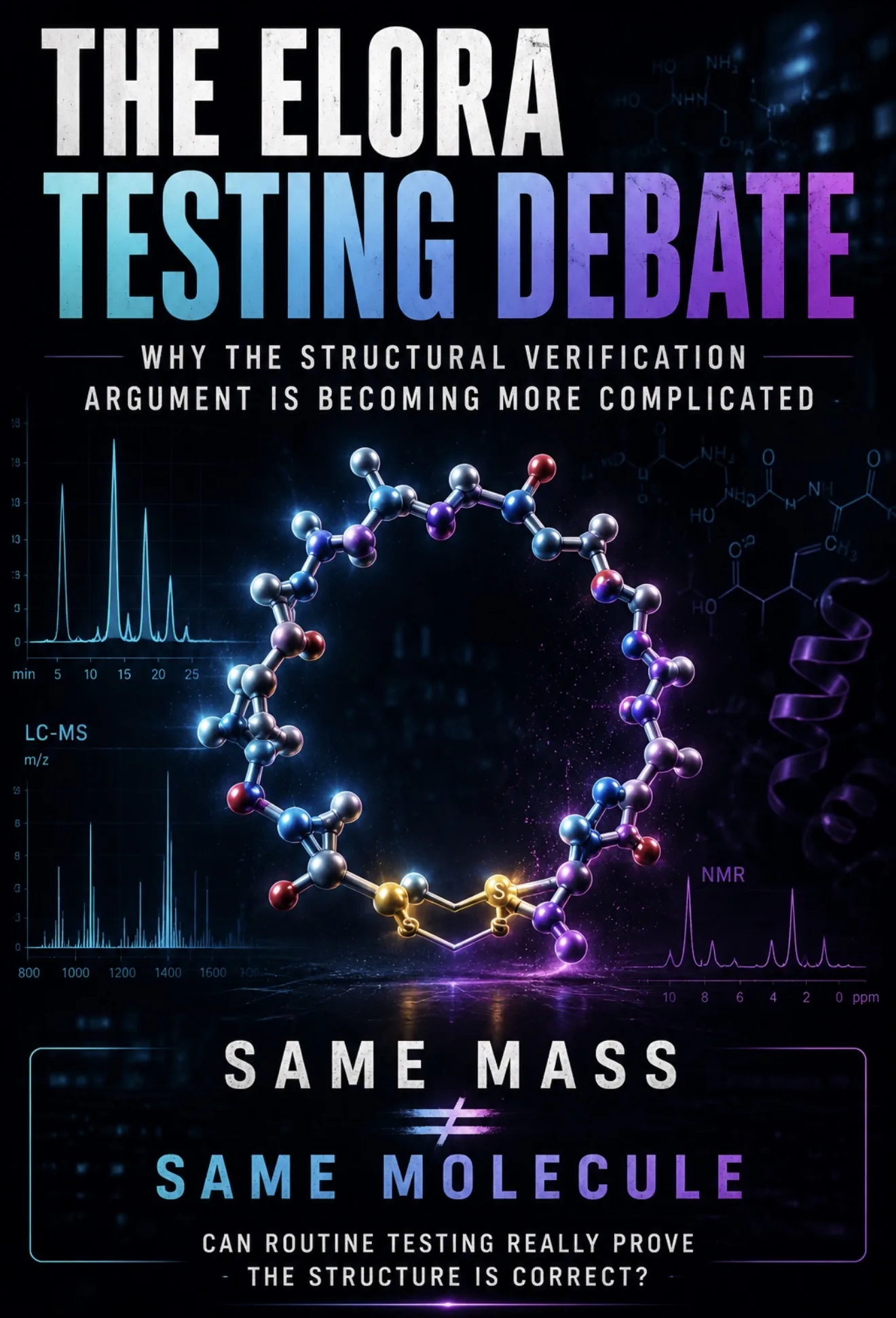
The ongoing Elora verification debate is a good example of this. Chemists, testing labs and potential users are still debating what standard testing can prove, where the limits are, and whether structural verification needs to go beyond routine “mass and purity.”
Can Elora actually be tested properly?
As I posted earlier, Janoshik confirmed that in his opinion RP-HPLC and LC-MS are probably more capable than people initially assumed, especially because many structural changes should alter polarity enough to separate chromatographically. But the other camp argued that standard LC-MS/MS is poor at confirming tertiary structure, biologically active conformation, folding state, aggregation, D vs L amino pairings and subtle structural variants.
The Mass Shift problem
A key point raised in the testing discussion is that a correct mass shift doesn’t automatically prove the intended ring formed correctly.
The intended Eloralintide bridge involves the loss of two hydrogens, creating a specific mass change. But that same 2 Da mass change can also be produced by other side reactions during synthesis, such as oxidation of a hydroxyl group to a carbonyl, or certain rearrangement reactions. In other words:
the expected mass change may suggest ring formation, but it does not prove the correct ring formed.
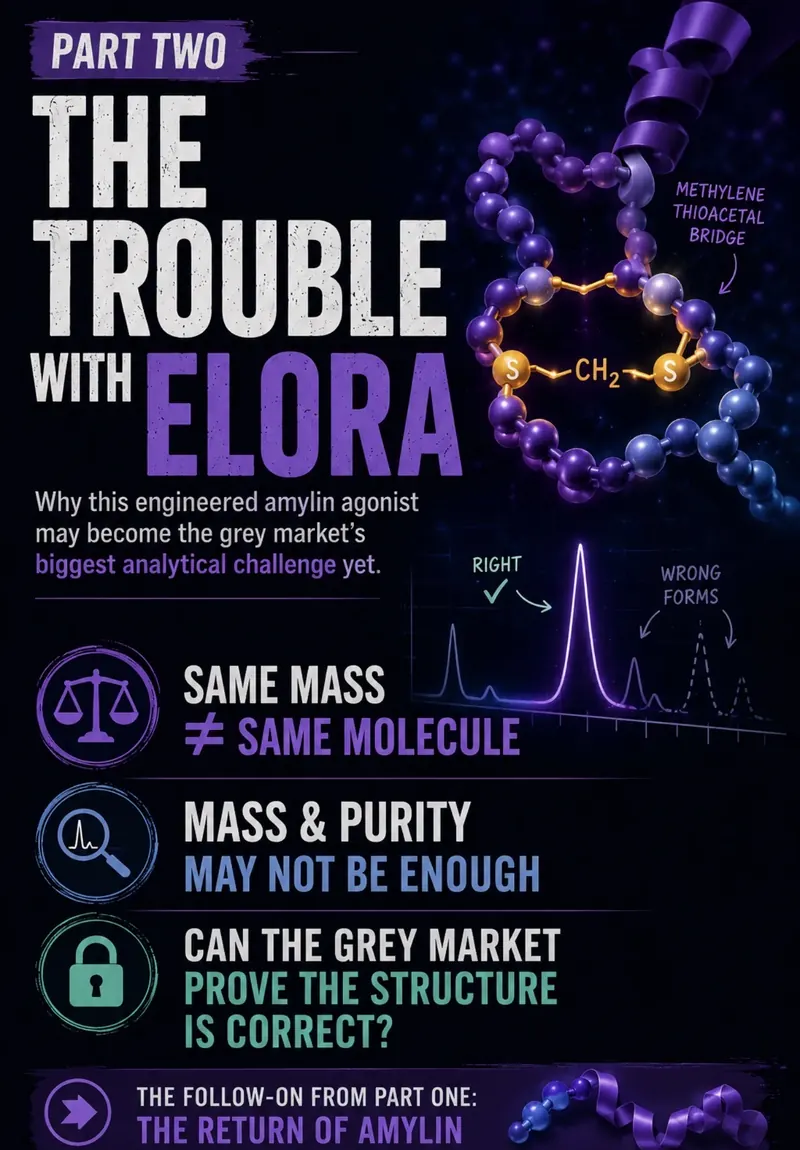
This is where Eloralintide becomes more awkward than simpler disulfide-containing peptides such as Cagrilintide. With a standard disulfide bridge, a lab can often run two samples, one untreated, and one treated with a reducing agent such as TCEP. If the disulfide bond is present, the reducing agent breaks it, and the comparison helps confirm the bond and estimate related purity. But Eloralintide is different. Its bridge is not a simple reducible disulfide bond. It uses the more stable methylene thioacetal linker -S-CH₂-S-. That linker is resistant to reductive degradation, meaning the usual “reduce it and compare” approach doesn’t work in the same way.
So the issue isn’t simply whether the mass looks right, but whether the intended bridge formed correctly and whether structurally similar side products are also present.
The key issue is whether these side products fully resolve during RP-HPLC analysis. Most incorrect linkages elsewhere in the peptide would likely separate chromatographically, but a misformed ring involving the nearby position 6 residue may behave very similarly to the intended structure and therefore be harder to distinguish or quantify properly.
The emerging consensus currently seems to be that obvious failures should be detectable, while subtle mixed populations may be harder and real-world testing will determine where the practical limits actually are.
The Misformed Ring Problem
The “missing ring” problem may not be the biggest concern. If the ring doesn’t form at all, that’s comparatively easier to detect or at least quantify. The larger concern is misformation of the ring. Elora contains a threonine at position 6 and a serine at position 5 directly adjacent to the cysteine at position 7. Because those nearby residues contain oxygen groups, the linker could potentially attach to oxygen instead of sulfur, forming an incorrect -S-CH₂-O- structure rather than the intended -S-CH₂-S-bridge.
The Resolution Problem
This type of side reaction may not be especially rare depending on the chemistry used, and in some synthesis methods could theoretically occur in more than 10% of linking reactions. The key issue isn’t simply whether these side products exist, but whether they fully resolve during RP-HPLC analysis.
The concern is that most incorrect linkages elsewhere in the peptide would likely separate chromatographically, but a misformed ring involving the nearby position 6 residue may behave very similarly to the intended structure and therefore be harder to distinguish or quantify properly. So the real analytical question becomes not “can RP-HPLC detect a bad Elora batch?” but, “can it reliably distinguish and quantify the most structurally similar misformed ring species?”
Yield Problem
There is also a manufacturing question. Even if these side products can be purified out, doing so reduces overall yield. The concern is whether large-scale API producers would be willing to sacrifice yield in order to aggressively remove low-level misformed species.
Formulation and pH may become another issue entirely
A separate debate emerged around Elora apparently being buffered around pH 8, for proper stability and solubility. That creates practical questions for the grey market because standard BAC water sits below that range. This led to concern around buffer composition, particularly sodium-containing buffers like PBS. At this stage, it’s still unknown whether Elora is fully compatible with sodium ions.
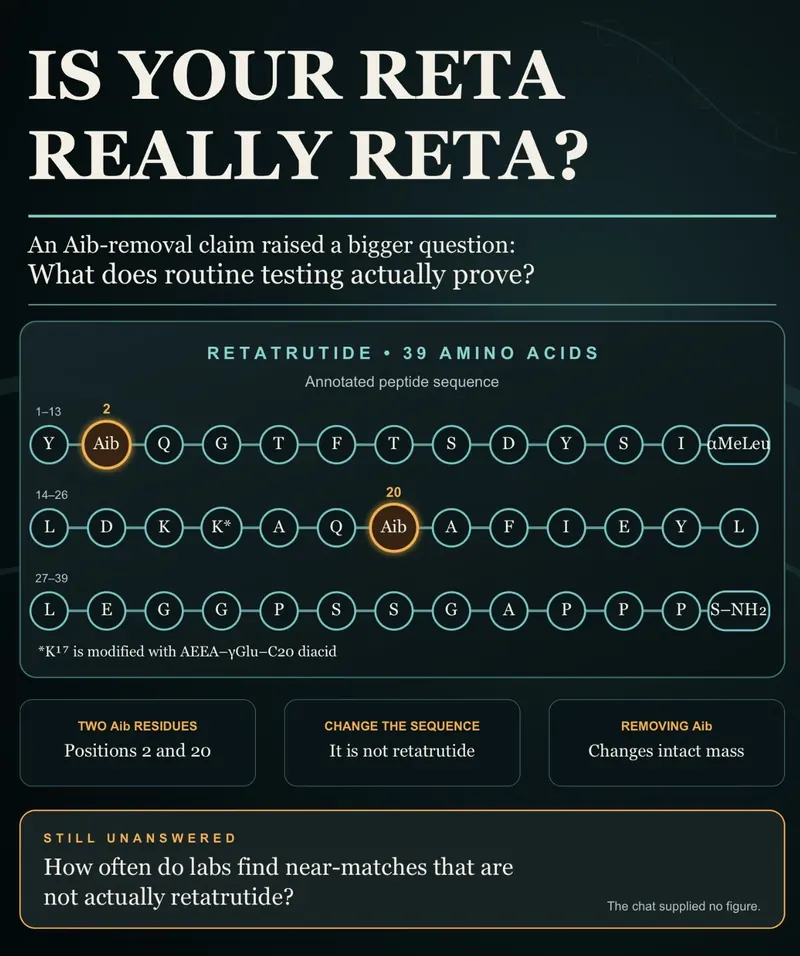
Other peptides such as Reta and Tesamorelin have already shown compatibility issues with certain ions and formulations, sometimes requiring significant trial and error to stabilize properly. The cautious recommendation was to use the lowest buffer concentration possible while carefully reaching the desired pH and minimizing unnecessary formulation stress…
So the conversation is now expanding beyond “is the peptide structurally correct?” into “can the formulation itself preserve the intended structure and stability?”
Final Thought For Today
Those about to place an Elora order may want to pause for a moment. The testing debate is still evolving, and the discussion has now moved beyond simple “mass and purity” into structural verification, possible misformed ring species, pH, buffer choice, sodium compatibility and formulation stability. None of this means Elora can’t be tested or used properly, but it does mean there are still open questions around what a grey-market COA can actually prove.
I’m sure Janoshik will have something to say about this tomorrow, and given his position as the usual gold standard in this space, that will probably shape where the discussion goes next.
To Be Continued…..
Comments