
Credit to Phil Finish (@lifeoflyo), whose first-hand account of visiting Chinese API manufacturers and cosmetics factories prompted this article. The regulatory differences were checked separately against NMPA, FDA and EU GMP sources.
TL;DR
Phil’s point isn’t that the factory videos are fake. Many may show genuine cosmetics factories doing real work.
These facilities can make freeze-dried topical products such as GHK-Cu, NAD+ and glutathione skincare kits, so they may have vials, filling lines, freeze dryers and workers in gowns, but that doesn’t make them sterile-injectable facilities.
Phil estimated that 95 to 98% of grey-market peptides come from cosmetics factories around Guangzhou.
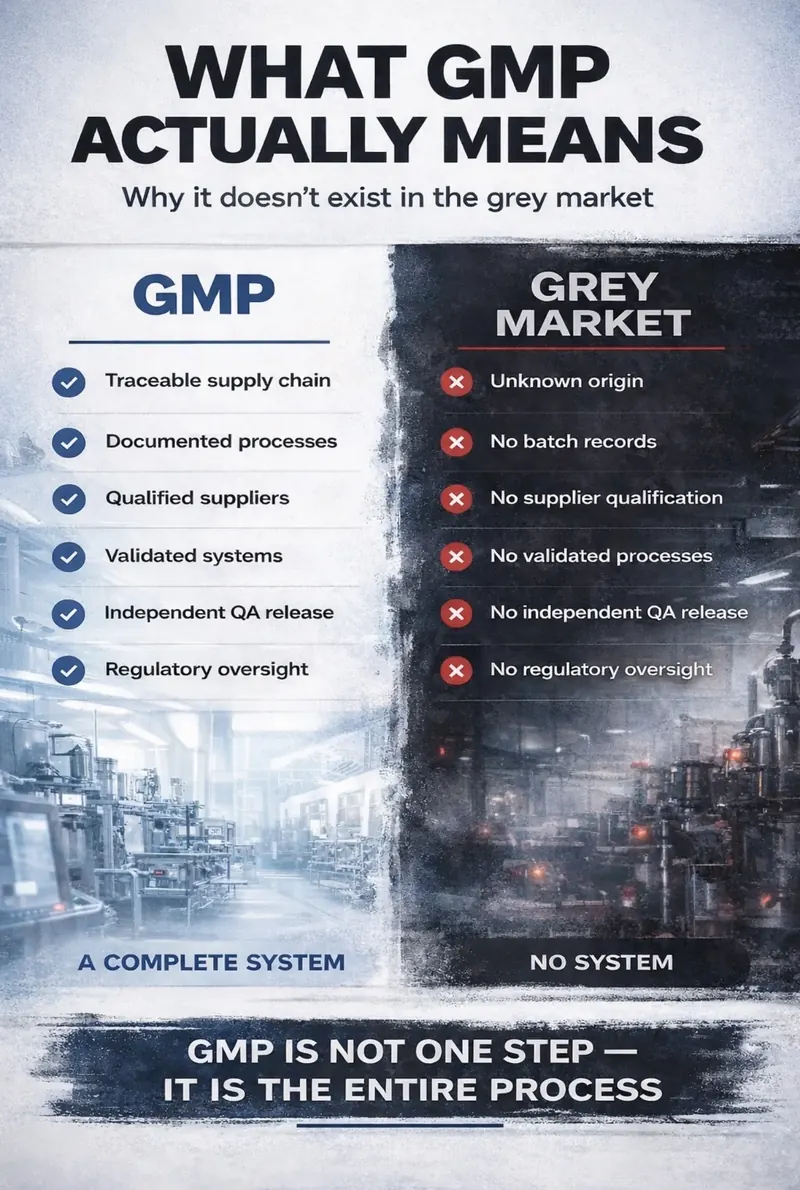
A cosmetics operation isn’t required to apply the complete system used for injectable manufacture: Grade A protection for exposed product, water for injection (WFI), depyrogenated vials, validated filtration, environmental monitoring, sterility and endotoxin controls, and documented batch release.
One factory may supply several trading companies and sales teams. The same rooms can appear in different videos while each seller describes the facility as its own.
API synthesis and vial filling are separate businesses. Phil said the API plants he’d visited were already running at or beyond capacity and generally had little incentive to risk filling grey-market vials themselves.
The missing middle
It’s often assumed that China’s peptide supply is divided between a handful of enormous pharmaceutical plants and small underground laboratories (UGL), doing everything from synthesis to vial filling. Both exist, but Phil’s point is that most grey-market vials come through a third type of operation: factories licensed to make cosmetics. That explains why so much of the factory footage that I’m sent looks convincing. The factory may be real. The filling line may be real. The freeze dryers, vials and workers may all be real. What the footage doesn’t establish is that the site is licensed or controlled to manufacture sterile injectable drugs.
Phil said there are dozens of these facilities around Guangzhou alone. In his description, they sit well above the image of a crude underground laboratory (UGL), but remain a long way below a properly controlled sterile-injectables suite. He said there were only a few smaller exceptions outside that model, ranging from fully underground laboratories to businesses connected to established medical manufacturing.
What these factories normally make
Phil described cosmetics-licensed factories producing lyophilised GHK-Cu, NAD+ and glutathione products for K-beauty-style kits. The freeze-dried material is mixed with a serum and applied to the skin. That work requires vials, filling equipment and lyophilisers, which is why the resulting footage can resemble pharmaceutical production. The intended use changes the manufacturing requirements. A topical cosmetics line isn’t required to operate as an aseptic injectable line. Phil said these factories commonly buy cosmetics-grade raw materials for products such as NAD+, GHK-Cu and glutathione. The gowning seen in their videos may therefore be appropriate for the work the site is licensed to perform.
The problem begins when the same room, equipment and clothing are presented as proof that an injectable peptide was made under pharmaceutical controls. Authentic footage of a cosmetics factory is still footage of a cosmetics factory.
Cosmetics production and injectable fill-finish
Phil’s comparison focused on the controls that are absent from the finished appearance of the vial. In the cosmetics operations he described, workers may hand-fill vials wearing a surgical mask, hair covering and lighter clothing, with facial skin or forearms exposed. Some footage even showed ordinary clothing or shorts inside the filling room. He described these rooms as roughly ISO 8 and said that, for topical products, sterile vials, low-endotoxin water and pharmaceutical-grade API aren’t required in the same way as they are for injectables. Some facilities may use a sterile filter, but that isn’t equivalent to a validated injectable process if filter integrity, room conditions and the batch are not checked.
Sterile pharmaceutical fill-finish requires a different system:
exposed sterile product and partially stoppered vials require Grade A or ISO 5 protection;
operators must be trained and qualified; Phil described the expected gowning as a sterile coverall, hood, goggles, mask and double gloves secured at the wrists, with no skin exposed and work conducted under laminar airflow;
vials and closures require validated preparation, including depyrogenation where applicable;
water for injection (WFI) and appropriately controlled raw materials must be used;
sterilising filters require validated use and integrity testing before and after use;
samples are taken throughout the run, and the room, process and operators are monitored, including personnel sampling such as glove-fingertip monitoring;
aseptic process simulations are used to challenge the process; and
each batch is tested against its sterility, endotoxin and other release requirements, with the results documented in the batch record before release.
The exact cleanroom background depends on the equipment and process design, so “ISO 5 inside ISO 7” isn’t universal. The central distinction remains: an open or partially stoppered injectable can’t be protected by appearances alone.
Two finished vials can look identical while only one is supported by evidence that it was manufactured as a sterile injectable.
This is particularly relevant to footage showing workers leaning over trays of partially stoppered vials. Those containers aren’t yet closed. If they contain a product intended for injection, they should remain under Grade A protection during transfer to and loading into the lyophiliser. Exposed faces, unsuitable gowning and an ordinary open bench would be a substantive contamination-control concern, not merely a cosmetic difference between factories.
Authentic does not mean pharmaceutical
Most of the videos are authentic and that’s the point: they show real factories, but not necessarily pharmaceutical ones. A genuine cosmetics facility can have filling lines, freeze dryers and rows of vials without being authorised or equipped for sterile injectable manufacture. The cosmetics factories often do a good job at the work they’re set up to perform. The sales representatives may also sincerely believe that the product is excellent. That doesn’t show that the facility checks sterility, endotoxin and the other attributes required for an injectable product. This is why gowning is one of the easiest visual distinctions. A hairnet, surgical mask and exposed skin may fit a cosmetics operation. A properly run open aseptic process requires far more extensive protection and controlled airflow. Full gowning isn’t proof of compliance, but visibly unsuitable gowning around partially stoppered vials is evidence worth taking seriously.
One factory, many sellers
According to Phil, these factories sell through several layers: foreign trading companies, their sales teams and sometimes additional in-house teams. When a seller wants footage, the factory may record it for them. The same rooms can therefore appear in several clips while each sales team thinks of the factory as its own. He called the barrier between the buyer and the real manufacturing operation the “Canton wall.” The person answering messages may be paid commission and working towards a monthly target. Their job is to move product; detailed knowledge of the production site may come second. They may claim that theirs is the best factory while having no direct way to know.
This doesn’t mean every representative is deliberately lying, but it explains how confident claims about factory ownership, exclusivity and quality can pass through the supply chain without records supporting them.
Where the API factories fit
The impressive API plant and the factory filling the vial aren’t necessarily the same company. Phil said the API factories he had visited were running double or triple shifts, operating around the clock and building additional capacity for peptide manufacture, with entire new compounds being constructed at some sites. Although some could also fill vials, he said they generally didn’t want grey-market vial filling to put the plant at risk of being shut down when their API capacity was already fully occupied. He identified Mol Changes as the only API manufacturer he personally knew was still making vials.
This also explains why the “handful of factories” story isn’t entirely wrong, but may be aimed at the wrong layer. Phil said protected amino-acid building blocks come from a much smaller group of Chinese suppliers, while a wider local industry provides glass, closures, filling equipment and lyophilisers. Many facilities can therefore fill similar-looking vials even when the upstream supply of starting materials is more concentrated.
The 95 to 98% estimate
Phil estimated that 95 to 98% of grey-market peptides come from cosmetics factories in Guangzhou, based on his first-hand experience of the supply chain.
What Finnrick has noticed
Finnrick CEO Raphaël Mazoyer raised a related possibility during my interview with him. He said the laboratory was seeing new types of failure, including zero-peptide results, severe underfilling and material that didn’t resemble an acceptable injectable formulation. Finnrick is also investigating unfamiliar buffers and other unexpected material that may not be covered adequately by the usual identity, quantity and chromatographic area tests. Mazoyer said one working theory is that suppliers experienced in cosmetics were moving into injectable products without equivalent manufacturing controls. However, he didn’t present that as a conclusion established by Finnrick’s testing, and the results don’t identify the factories that produced the samples.
What the videos can and cannot establish
A video can show real equipment, real workers and some form of production. It can also reveal visible concerns, particularly when open or partially stoppered vials are handled without appropriate protection.
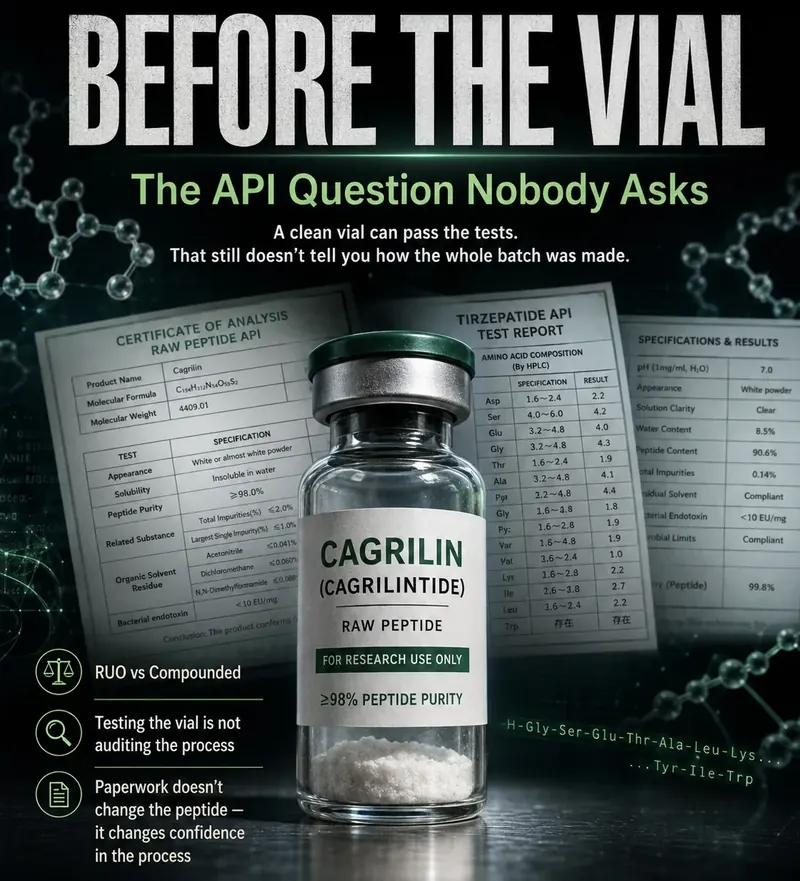
It can’t establish the site’s legal manufacturing scope, the grade of the materials, whether the process was validated, who supplied the API, whether the seller owns or contracts with the factory, or whether the footage relates to the batch being offered. A third-party HPLC report may provide useful evidence about the submitted vial, but it doesn’t reconstruct the conditions under which that vial was filled.
The point is not that every cosmetics factory is dirty or incompetent. It’s that a facility licensed and equipped for topical products shouldn’t be treated as a sterile-injectable manufacturer because its machinery looks familiar. People should know where their peptides are actually made, and what that factory is authorised and equipped to make.
The video below shows workers handling trays of partially stoppered vials in footage presented as peptide lyophilisation. This is likely filmed in a Cosmetics Factory. The vials aren’t yet closed, so if they’re intended for injection, the exposed facial skin and absence of visible Grade A protection raise serious contamination-control concerns.
For comparison, the video below was taken inside a pharmaceutical factory and shows operators working at a lyophiliser. Full cleanroom suits, hoods, masks, eye protection and gloves cover the operators, with no exposed skin over the trays. The difference from the cosmetics-factory footage is clear.
Primary sources
European Commission, EudraLex Volume 4, Annex 1: Manufacture of Sterile Medicinal Products, 2022.
US Food and Drug Administration, Sterile Drug Products Produced by Aseptic Processing, Current Good Manufacturing Practice.
US Food and Drug Administration / ICH, Q7 Good Manufacturing Practice Guidance for Active Pharmaceutical Ingredients.
National Medical Products Administration of China, Provisions for Supervision and Administration of Manufacturing and Marketing of Cosmetics.
National Medical Products Administration of China, NMPA Announcement on the Good Manufacturing Practice for Cosmetics.
National Medical Products Administration of China, Drug Administration Law of the People’s Republic of China.
Comments