
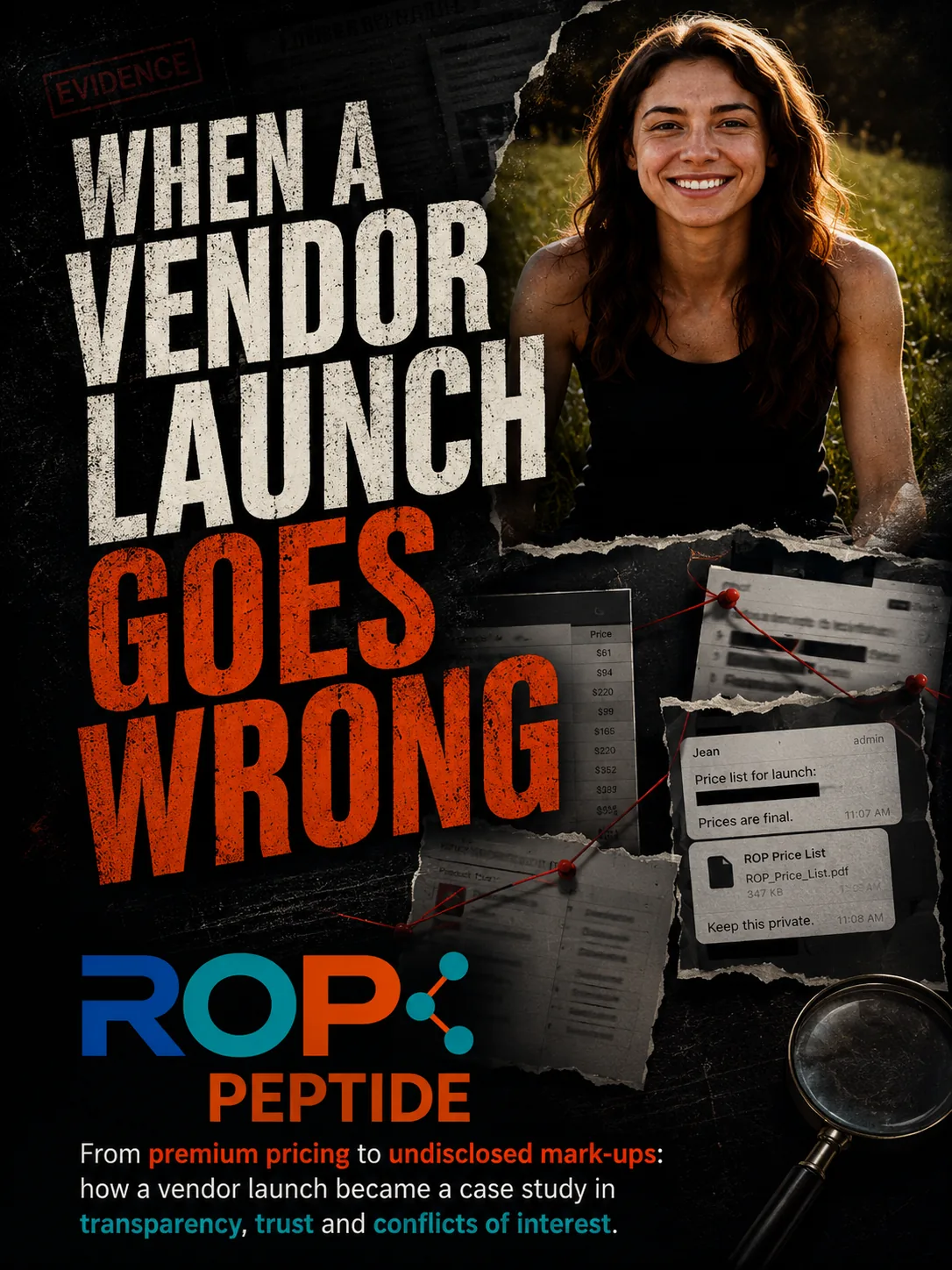
When I interview vendors, I don’t approach them as an investigator, I approach them as an opportunity.
Every vendor receives the same chance to introduce themselves, explain what makes them different, provide photos and videos, submit COAs, answer my interview questions and present their business to the community.
ROP was no different.
The initial contact came through a representative introducing herself as someone helping the company in Europe. She asked whether I’d interview the vendor, and shortly afterwards Jean contacted me directly.
From the outset, I encouraged her to make the most of it.
I asked for factory and warehouse videos, COAs, stock photos, customer reviews, price lists, contact details and detailed answers to my interview questions.
I even encouraged her to make the interview more personal by introducing herself and sharing details that would help buyers relate to the person behind the company.
My goal wasn’t simply to advertise a vendor. It was to help them stand out.
She thanked me repeatedly, sent the requested material and completed the interview.
The COA Overlap
Another detail also came up: ROP shared COAs with XH-Peptide, as well as the same stock video.
Shared COAs are quite common these days, as Janoshik, for a fee, will add a certain number of names to a COA as long as they are submitted prior to testing and by one person. It just means that the two companies are linked and selling the same stock.
The Conversation Changed Instantly
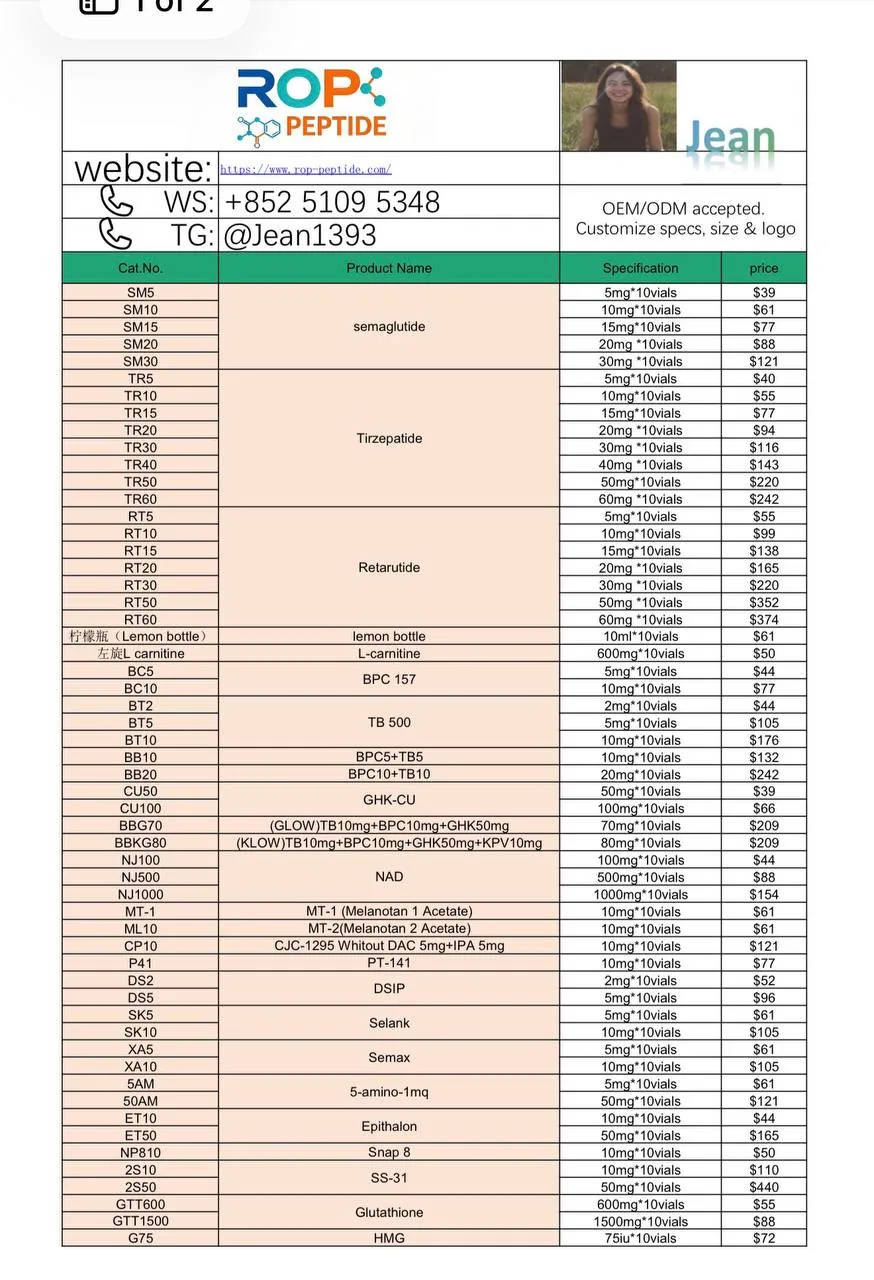
The moment the price list appeared publicly, experienced buyers started comparing it with competing suppliers. Most understand one thing.
If you put your business in front of experienced buyers, they’re going to ask questions.
ROP Peptide found that out very quickly. Within minutes, buyers noticed the prices were high. Not just a little high. High enough that people immediately started asking ordinary buyer questions:
“Why are your prices higher?”
“Do you test every batch?”
“Which products are independently tested?”
“What makes your products worth paying more for?”
“Are these COAs product-specific?”
These weren’t trolls, they weren’t people trying to catch her out. They were the same questions any business owner should expect from customers spending hundreds or thousands of dollars. Then things started going wrong.
Instead of simply saying, “Here’s why we charge more,” the responses became increasingly defensive. Questions about batch testing were answered with discussions about customer service. Questions about pricing became discussions about existing customers.
When buyers asked for specifics, they were repeatedly told to message privately.
Rather than recognising that people were asking legitimate commercial questions, Jean started saying people were mocking her.
At that point, the person who had arranged the interview decided to jump in. But instead of helping calm things down, she poured petrol on the fire. She began accusing members of being “keyboard warriors” and insisted people were attacking the vendor, rather than recognising that they were asking the same questions any sensible buyer would ask.
That changed the tone completely and the discussion stopped being only about pricing. It became about personalities. Ironically, several members kept repeating the same thing. Nobody was attacking her. People simply wanted answers. One member summed it up perfectly:
“I purchase many thousands in peptides… I like to ensure the vendor I work with is a good fit.”
Another wrote:
“People are asking them to justify the prices. Maybe there are batch tests or updated COAs? People have the right to ask these things.”
That was the point. Nobody said a vendor couldn’t charge more, people just wanted to know why. If the vendor had simply explained the value proposition, or even acknowledged the questions directly, the entire conversation might have lasted ten minutes. Instead, every unanswered question created another one.
The Conversation Took an Unexpected Turn
After the public discussion, Jean messaged me privately. Rather than discussing the questions buyers had raised, she asked me:
“If you felt our prices were on the high side, shouldn’t you have told me beforehand?”
She then asked:
“What do you think was the point of setting up a group chat and then confronting me?”
That caught me completely off guard. I hadn’t set her up. I hadn’t organised the questions. I hadn’t told members what to ask. I had simply given her the same opportunity I give every vendor: an interview, a platform and a chance to answer whatever questions the community had. My response was straightforward:
“It’s not for me to say.”
And later:
“I have no idea what you’re talking about. You’re making out I’ve known you before. I’ve done the same for you as all the other vendors.”
Looking back, I can’t help wondering whether she thought she was talking to someone else, possibly the person who had arranged the introduction or had been handling communications with her previously. That would explain why she thanked me “for all the help you’ve given me over the years,” despite us not having that kind of relationship. Whatever the reason, it reinforced the impression that she believed I had orchestrated what happened.
Jean then wrote:
“If you have advertising space available, we would be happy to make a donation… However, if there is anyone who disagrees with us, please feel free to contact me privately; if there is still a possibility for us to collaborate, please let me know.”
She even attached a screenshot of one of the admins comments from the discussion. Shortly afterwards, she sent one final message:
“Dear, please remove me from your channel. Thank you for your patience and communication all this time.”
I simply replied:
“OK.”
Throughout the launch, I had treated ROP exactly as I treat every other vendor. I provided an interview, asked them to submit supporting material and gave them a platform to present their business. The community’s reaction wasn’t something I orchestrated. It was something the vendor encountered by entering a marketplace where buyers compare prices, testing policies and value.
The Organiser Then Tried to Shut It Down
After the public thread went badly, the same person who had originally brought ROP to me messaged again. This time, she wasn’t asking for an interview, she was asking me to delete the post.
“Delete that ROP from K-Hole post please… keyboard warriors and little wan*ers are attacking her for nothing, her prices are not the only one here higher.”
That was telling.
Rather than acknowledging that buyers had asked fair questions about pricing, batch testing and COAs, the response was to blame the community and label them “keyboard warriors.”
But the screenshots show something different. People were asking basic buyer questions. That isn’t an attack, that’s due diligence. And the person who organised the introduction made the situation worse by treating scrutiny as hostility.
Afterwards, More Information Surfaced
Following the discussion, I came across additional information that added another layer to the story. This included different versions of ROP’s price lists, claims that reseller groups were using marked-up pricing, and allegations that intermediaries kept the difference between the vendor’s standard price and the publicly advertised price.
Customer’s Regular Price
Price List Published
Increase
Semaglutide 10 mg
$55
$61
+10.9%
Tirzepatide 20 mg
$85
$94
+10.6%
Tirzepatide 50 mg
$200
$220
+10.0%
Retatrutide 10 mg
$90
$99
+10.0%
Retatrutide 20 mg
$150
$165
+10.0%
Retatrutide 30 mg
$200
$220
+10.0%
Retatrutide 50 mg
$320
$352
+10.0%
NAD 500 mg
$80
$88
+10.0%
BPC-157 10 mg
$70
$77
+10.0%
Across the examples I checked, the published list was consistently around 10% higher than the customer’s version.
The Undisclosed Commission Issue
This is the part that matters most. The issue wasn’t simply that there were different price lists. The issue was that the person who organised the interview was allegedly operating as an undisclosed commission-based intermediary. That same person is also acting as a moderator in ROP’s PepChat and Telegram spaces. That creates an obvious conflict of interest. If someone is presenting themselves as a helpful community member, moderator or vendor contact, but is also financially benefiting from sales through a marked-up price list, that should be disclosed clearly.
Buyers have a right to know whether the person defending a vendor is doing so as an independent supporter or as someone with a financial interest in the outcome.
Without that disclosure, the whole launch looks very different. It means the public price list wasn’t just “high.” It may have been high because it included an undisclosed commission. And that’s why the controversy matters.
Jean’s Explanation
After I discovered there were multiple price lists, I asked Jean directly about them. I specifically asked why there appeared to be a “regular” price list and another that included a higher price through the admins group. Jean explained that there were different prices depending on sales volume, dealer status and sales channels.
She described one list as the dealer price and another as the China warehouse price, adding that “there are also differences in channels.”
Where the conversation became more interesting was when I asked about disclosure.
My issue wasn’t that distributors make money. That is normal. The issue was whether buyers knew they were being shown a higher-priced list by someone who may have been keeping the difference.
When I asked how much the admin made from the arrangement, Jean didn’t answer directly. Instead, she replied:
“What are you talking about? Can’t you make money in business?”
and later:
“Go ask how much money I’ve earned.”
She then said she couldn’t decide the prices herself and suggested I contact her boss.
But that wasn’t the point.
The point was whether buyers should have been told that the person introducing the vendor, moderating the Telegram and PepChat groups, and defending the pricing may also have had a financial interest in those sales.
That is the transparency issue at the heart of this story.
Why I’m Leaving the Channel Up (for now)
For now, I’m keeping her channel up. Not as promotion but as evidence. If buyers come across ROP, Jean, or any of the related Telegram and PepChat groups, they can see the discussion for themselves and make up their own minds.
They can see the price list that was posted. They can see the questions buyers asked. They can see how those questions were answered. And they can also see who stepped in to defend the vendor while allegedly having a financial interest in the inflated pricing.
That’s why I’m not deleting it. Transparency protects buyers.


Comments