
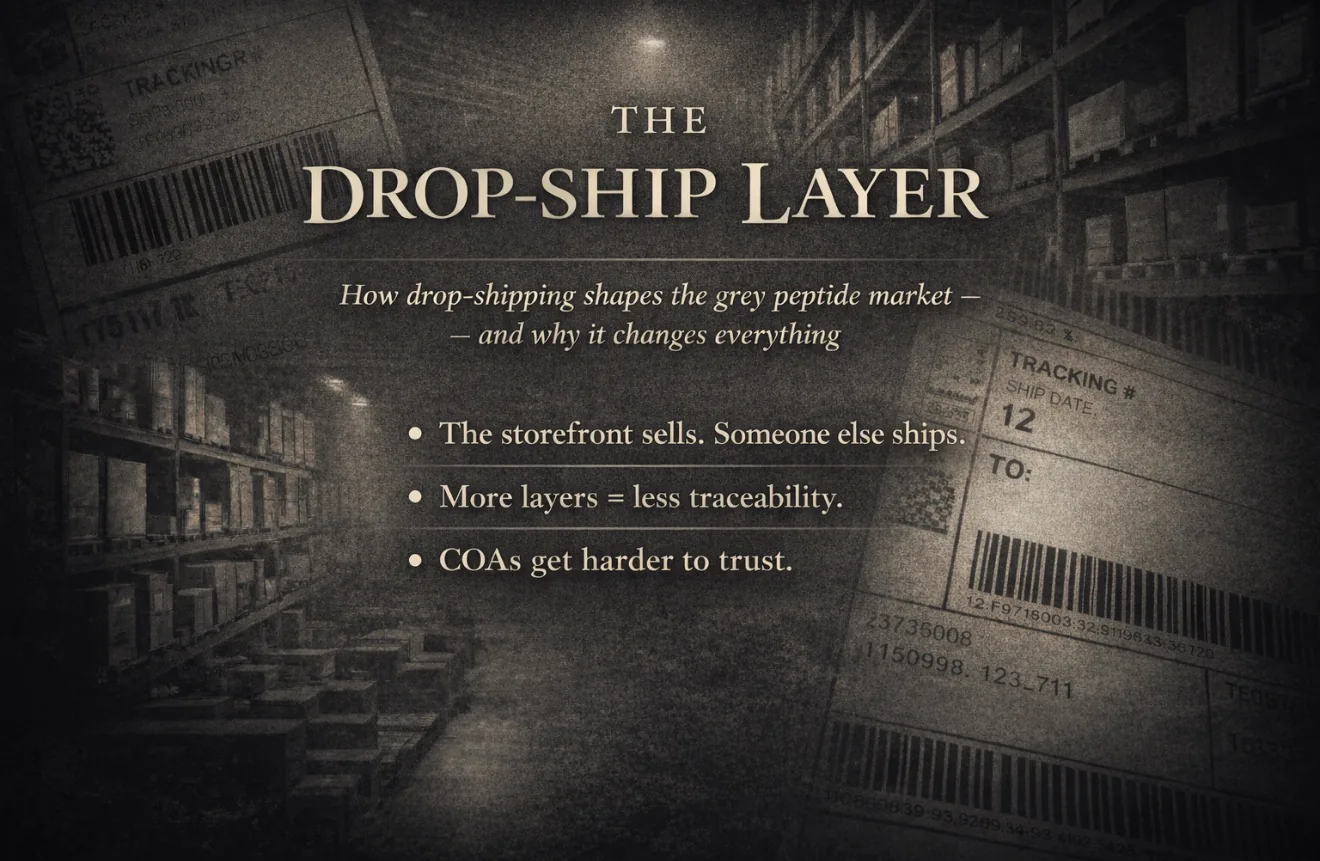
While working on my next piece, The Newbie Tax, I’ve realised something important.
Before I publish that, I need to define a term that keeps coming up in grey market discussions but rarely gets properly explained:
Drop shipping.
So I’ve decided to write a separate article first:
What drop shipping actually means.
How it works in grey peptide markets.
Why it’s not automatically a scam.
And why it changes how buyers should think about batches, COAs, and “warehouses.”
Because if we don’t understand the structure, we can’t understand the funnel.
And if we don’t understand the funnel, we won’t understand the “Newbie Tax”
In most industries, drop shipping is simple.
A seller takes your order.
They don’t hold inventory.
They forward the order to a supplier.
The supplier ships directly to you.
The storefront never physically handles the product.
That’s it.
On its own, drop shipping is not illegal.
It’s not inherently unethical.
It’s a fulfillment model.
But in the grey peptide market, the implications are different.
How Drop Shipping Works in Grey Peptide Markets
In this grey zone, the model often looks like this:
You order from a clean, professional looking website.
You pay via credit card, PayPal, or another “newbie friendly” method.
The storefront converts that payment into crypto.
The order is placed with an upstream supplier.
The product is shipped from wherever that supplier or fulfillment partner holds stock.
The storefront handles:
Branding
Customer service
Website design
Payment processing
Public facing reputation
The upstream supplier typically controls:
Production or bulk sourcing
Primary inventory custody
Batch allocation
Fulfilment and physical dispatch
This is brokerage layered on top of fulfillment.
And brokerage is not automatically wrongdoing.
But it changes what buyers think they’re buying.
A Related Pattern: Group Buys as Drop Shipping Infrastructure
In grey peptide markets, drop shipping isn’t limited to storefronts.
Some vendors (and resellers) have also been known to use group buys (GBs) as an informal drop shipping layer.
The structure looks like this:
1.A GB organiser advertises a deal (often framed as MOQ-based pricing).
2.Buyers send funds to the organiser.
3.The organiser forwards the consolidated order upstream.
4.Fulfilment may then happen in one of two ways:
Central reship: product is sent to the organiser, then redistributed locally, or
Direct drop ship: upstream supplier ships directly to individual buyers using the GB list.
In the direct drop ship version, the GB organiser functions less like a warehouse and more like a transaction coordinator, collecting payments, consolidating details, and triggering fulfillment without ever holding the inventory.
Again: this isn’t automatically unethical. It can reduce costs and speed things up.
But it carries the same structural implications:
Buyers may assume the organiser controls inventory when they don’t.
Batch uniformity can vary if sourcing shifts between suppliers.
COAs may be “representative” of a batch tested previously rather than the specific batch allocated to each buyer.
Accountability becomes blurred because the buyer is dealing with an organiser, while the product originates elsewhere.
Group Buys Can Become Fulfilment Hubs
This “reverse drop-ship” model which is also known to exist, introduces another layer of opacity:
In some cases, a reseller doesn’t hold stock at all.
Instead:
1.The reseller takes payment from customers.
2.They place a bulk order through a Group Buy (GB) organiser.
3.The GB organiser arranges shipment directly to the reseller’s customers.
So the chain becomes:
Reseller → Group Buy Organiser → Original Supplier → Customer
The reseller never touches inventory.
The group buy becomes the logistical layer.
Why This Matters
This “reverse drop ship” model introduces another layer of opacity:
Customers may believe they’re buying from a standalone vendor.
In reality, the product may be sourced via a GB they never see.
Batch control now depends on the GB’s allocation process.
COAs may originate from the original supplier, not the reseller.
And if the GB itself is sourcing from rotating upstream suppliers, variability increases again
This is why understanding drop shipping matters even if you never shop on a website.
In grey markets, purchasing is often mediated by communities and intermediaries, not just a single storefront.
Why Drop Shipping Appeals to New Buyers
For someone entering the grey market for the first time, drop ship storefronts feel safe.
They often:
Accept familiar payment methods
Present structured support channels
Provide visible reviews
Look more stable than Telegram only sellers
If you’ve just been hit with:
A $1,000 pharmacy quote
Insurance rejection
Compounding waitlists
Scarcity
You are not looking for complexity.
You’re looking for the simplest path forward.
Drop ship models sell simplicity.
That convenience has value
Convenience can feel like safety, but it isn’t control. It’s a service, and it comes with a markup.
The Supply Chain Reality
Here’s where things get structurally important.
When a storefront does not control manufacturing or inventory, several things can happen:
1. Multi Supplier Sourcing
If the storefront sources from multiple upstream vendors:
Different customers may receive different batches.
Same seller. Same listing. Different batch or even sometimes different source.
Batch consistency is no longer guaranteed by default.
Brand identity becomes separate from production identity.
2. COA Complexity
Certificates of Analysis (COAs) in drop ship models can become:
Sample based rather than batch specific.
Representative of a tested lot, not necessarily every fulfilled lot.
Disconnected from what a specific customer receives.
If batch numbers are not tightly matched to COAs, traceability becomes buyer dependent.
And most newcomers don’t know to verify that.
3. Group Testing Distortion
In communities where users organise third party testing, drop shipping can create confusion:
If 10 customers order the “same product” but receive inventory from different upstream suppliers, then;
Test results may conflict.
Purity variance may appear inconsistent.
Users may argue over whether the product “works.”
The storefront reputation absorbs the variation.
Without full sourcing transparency, batch uniformity becomes guesswork.
What Drop Shipping Is, And What It Isn’t
Drop shipping is not automatically:
A scam.
Counterfeit distribution.
Intentional fraud.
Many industries operate on brokerage.
But in grey peptide markets, where:
Products are injectable.
Storage matters.
Batch traceability matters.
COA integrity matters.
Supply chain opacity carries higher stakes.
The Transparency Standard
Drop shipping becomes problematic when:
The sourcing layer is not disclosed.
Warehouse claims imply ownership.
Batch matching is unclear.
Buyers assume a single, controlled supply chain when the structure is layered.
The issue is not the model itself
The issue is whether the buyer understands the model.
If a buyer thinks they’re purchasing from a seller who controls the supply chain, but the order is actually routed through intermediaries, their assumptions about batch consistency and COA traceability can be wrong.
Buyers need clear disclosure of how orders are sourced and fulfilled to make informed decisions.
Why This Matters Before We Talk About “The Newbie Tax”
If you don’t understand drop shipping, you focus on the wrong issue. This isn’t only about price or markup, it’s about visibility. Once you see the layers, the question changes from “is this vendor legit?” to “who controls the batch?” That’s the bridge to my next article; The Newbie Tax.
Comments