
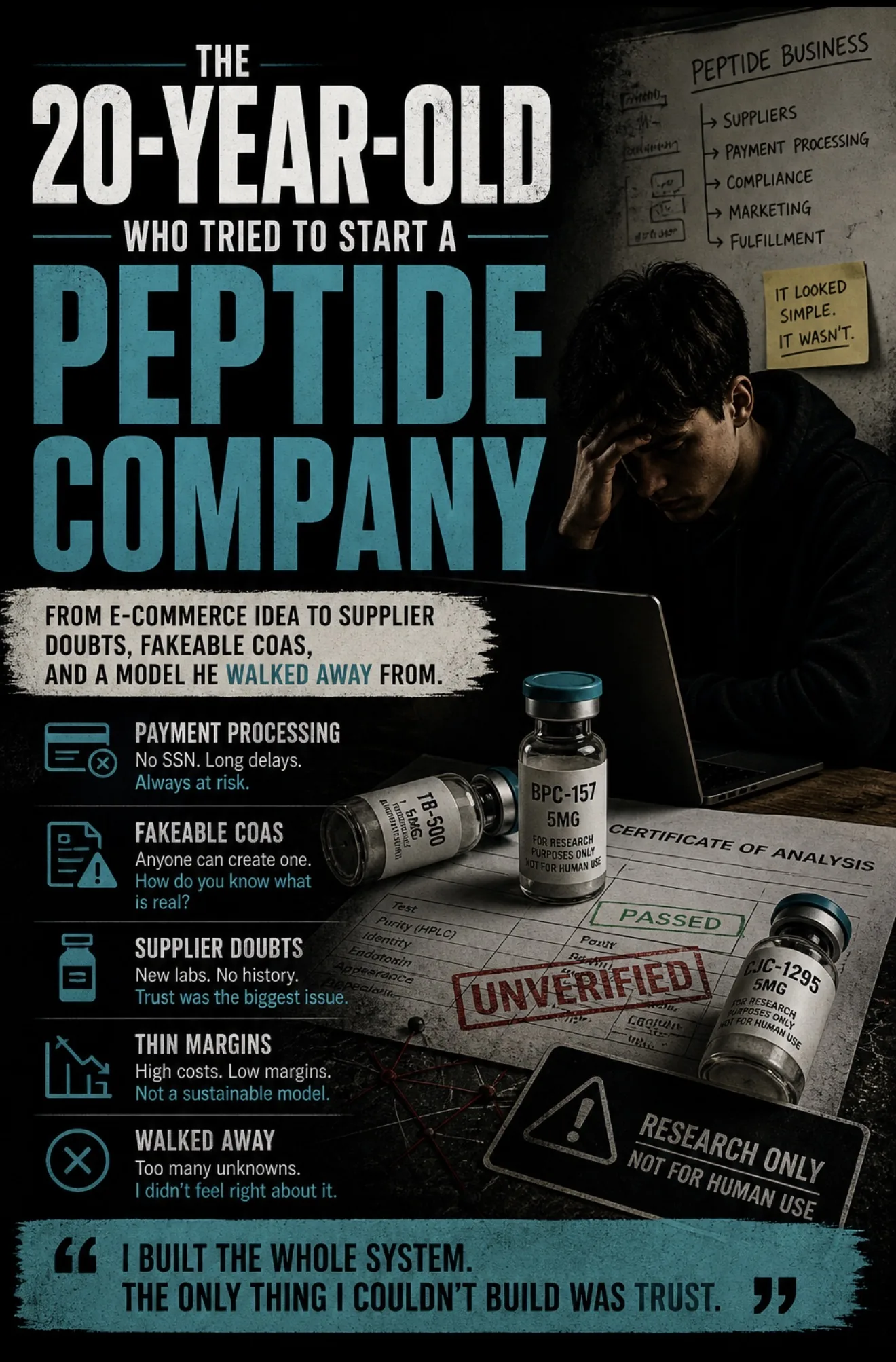
He first became interested in peptides around December 2025 or January 2026 after repeatedly seeing videos about them in his social media feed. At the time, he hadn’t even heard of peptides before, but the market immediately stood out to him because it felt early. Coming from an e-commerce background, he saw what looked like an opportunity.
The more he searched for information on how to actually start a peptide company, the more interested he became, partly because there was so little real information available compared to other business models.
He was already working in e-commerce and eventually decided to shift toward trying to build a peptide business aimed at the U.S. market, despite not being American himself.
He joined a Discord group run by someone teaching people how to start peptide companies. According to him, the server had around 100 members paying roughly $250 a month, all trying to launch peptide brands of their own. But he quickly realised the information being sold there was extremely basic. He left after about a month because he felt he was able to figure most of it out himself.
From there, he began building the infrastructure, the website, the backend, account systems, product pages, labels, vial mock ups, branding and overall storefront structure. By his own admission, he originally treated the entire thing like a normal e-commerce business. That assumption eventually became one of the reasons he walked away.
The First Problem: Payment Processing
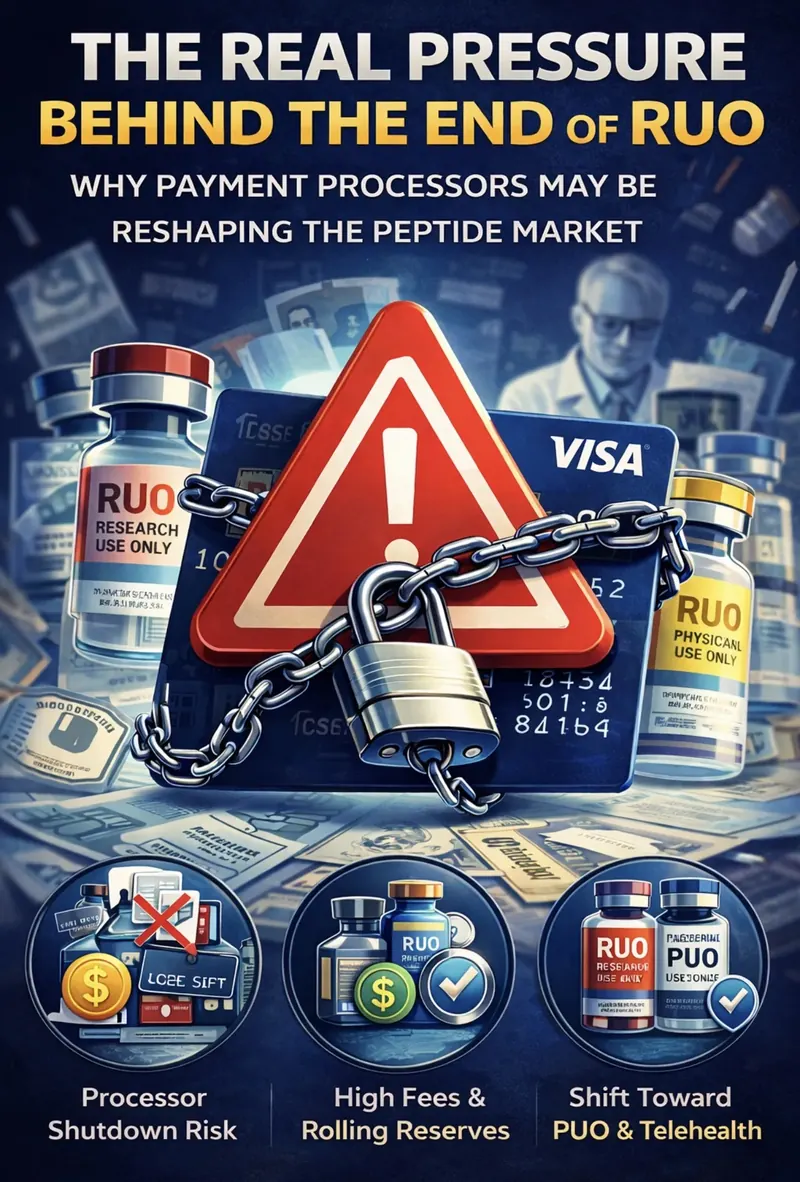
One of the first major issues was payment processing. Because he was not based in the U.S., he didn’t have a Social Security number, which many processors require. He applied for an ITIN, but the process would take several months. But even beyond that, he realised processor instability was simply part of the RUO business model itself.
According to him, even large peptide websites pulling hundreds of thousands of monthly visits regularly end up having to switch merchant processors after accounts are shut down. He described it as an ongoing issue in the space rather than an isolated problem.
He also admitted he should have entered the business with a marketing partner because his strengths were operational and technical rather than promotional.
The Bigger Problem: Trust
Eventually, however, he realised payment processing was not the biggest issue. Trust was. He was introduced to multiple suppliers, vendors and drop shipping systems, but he kept running into the same problem, he had no real way to verify what was actually inside the vial. In his own words, he couldn’t confidently know whether a product contained peptides or “baking powder.” That became the turning point. Because according to him, professional-looking COAs are not difficult to fake.
He openly admitted that he personally could create convincing-looking Certificates of Analysis himself using Photoshop and most people would never notice unless they investigated deeply. That realisation fundamentally changed how he viewed the industry. If he could do it, suppliers could too. And once that thought entered his mind, the business stopped feeling like simple e-commerce and started feeling ethically dangerous.
He specifically said he didn’t want to participate in selling products to people if he couldn’t confidently verify what they were. That concern became one of the primary reasons he decided to exit entirely.
Supplier Red Flags
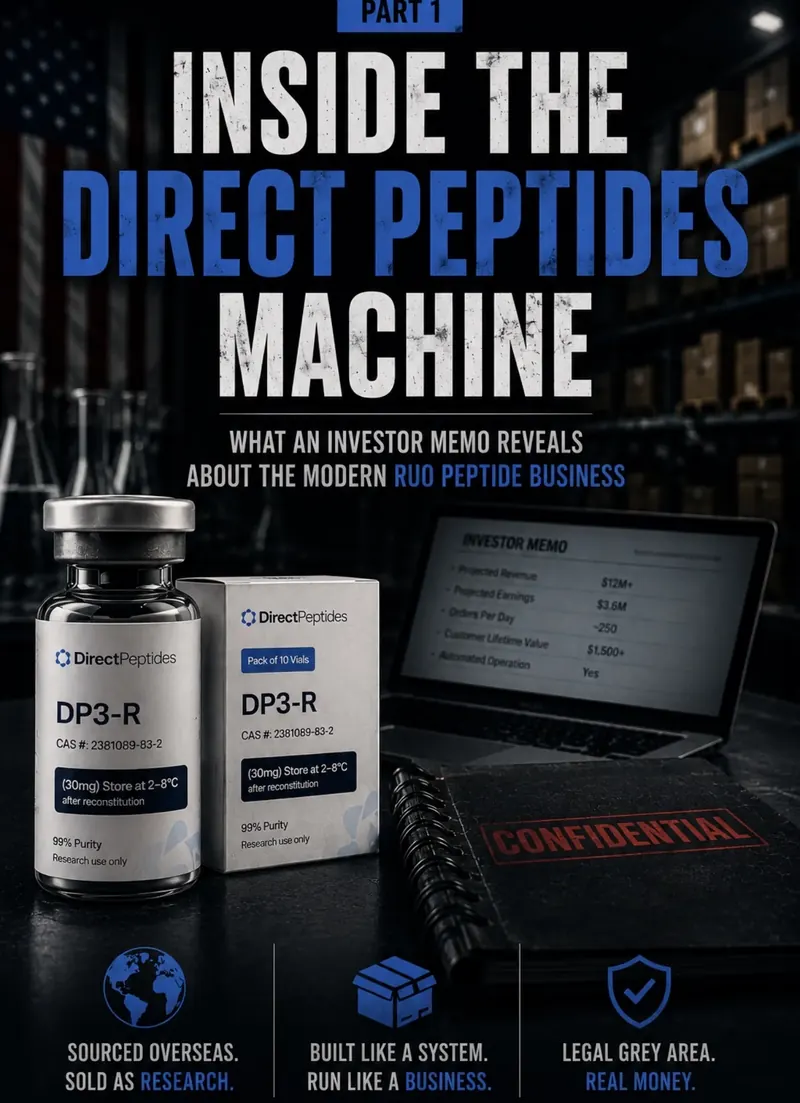
One supplier he investigated particularly concerned him. He described looking into a company called Direct Peptides and their associated testing partner, Horizon Analytics. After running deeper checks using AI research tools, he allegedly discovered that the supplier registration appeared one day and the associated testing lab appeared to be registered the following day. That immediately raised concerns for him about whether the lab itself was genuine. He also questioned how sellers or customers could realistically verify claims surrounding purity, endotoxins, batch quality and analytical testing, especially when independent testing is expensive.
The Cost of Testing
According to him, proper peptide testing was far more expensive than he originally realised. He estimated around $300 per test minimum, with some peptides costing $500 to 600 or more to analyse properly. For small or newly launched brands trying to scale quickly with minimal start up capital, he believed many simply would not perform independent testing at all. That created another major issue for him psychologically. The more he learned, the less comfortable he became.
China vs Middlemen
He also looked into sourcing directly from China.
In his view, this is likely how many existing peptide sites actually operate, direct bulk purchasing, low per-vial costs, independent testing after import and then reselling at large margins. He acknowledged that buying directly from China can reduce costs enough that proper testing still leaves room for profit. However, he personally lacked the capital, the customs knowledge, the logistics understanding and the operational confidence to navigate that route himself.
He described that side of the industry as even “sketchier” because of the uncertainty surrounding what is actually being purchased.
The Drop shipping Route
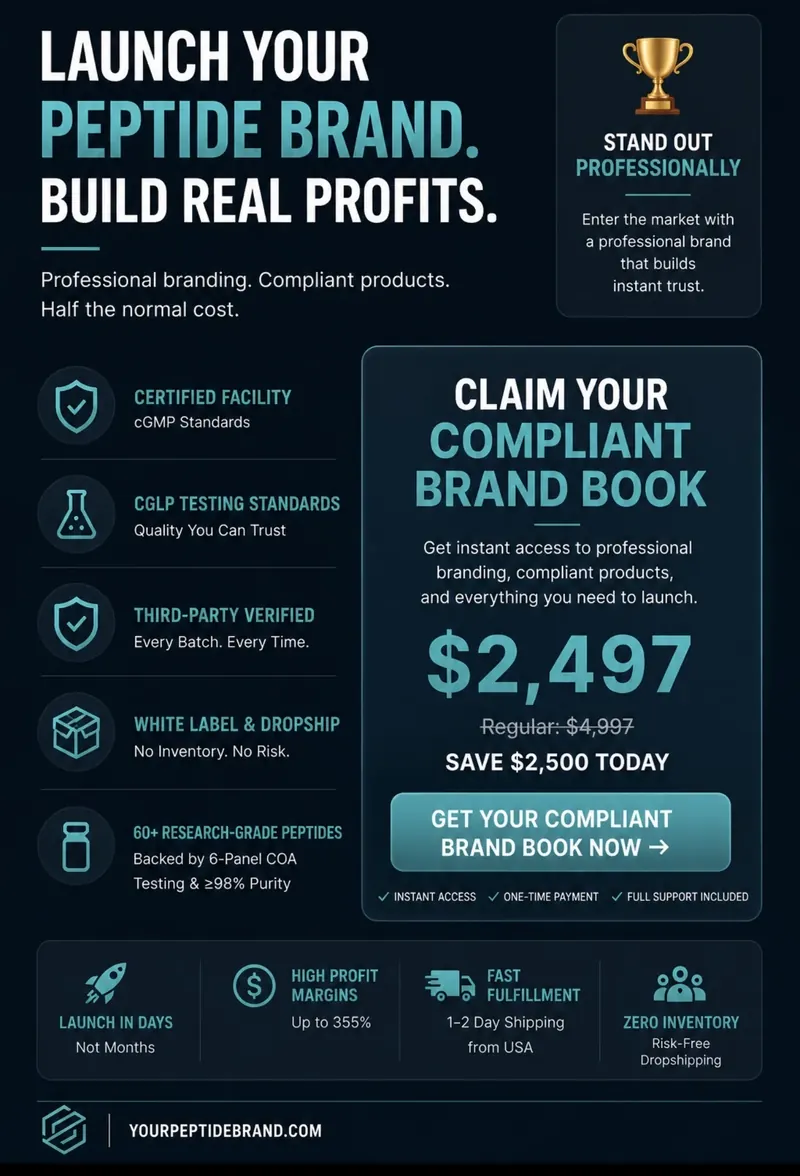
Instead, he initially explored a white-label drop shipping system called yourpeptidebrand.com. The attraction was obvious. There was no inventory needed, no fulfilment handling, no direct shipping management and a prebuilt infrastructure. The system effectively allowed someone to launch a peptide storefront without handling physical stock themselves. But once he ran the numbers, he felt the economics made little sense for smaller operators. He specifically pointed to products like BPC-157 which are around $26 per vial through the platform, compared to roughly $6 per vial from direct suppliers. Once affiliate commissions, discounts, advertising costs and customer incentives were added, he believed many sellers would struggle to maintain meaningful profit margins.
He also described the monthly subscription pricing as expensive, mentioning fees around $500 a month before product costs.
His conclusion was blunt. The platforms themselves appeared to be making more reliable money than many of the actual storefront operators using them.
RUO Marketing & Enforcement
He also became increasingly aware of the legal and marketing contradictions inside the RUO space. He understood that even if a product is labelled “Research Use Only,” companies can still face problems if they imply weight loss, anti-aging, energy enhancement or other human outcomes. He specifically pointed out what he saw as a common loophole, the websites remain technically “clean” while affiliates openly discuss dosing, human effects and applications on social media. He believed that disconnect was one of the major vulnerabilities in the current model.
Final Decision
By the end of the process, he had built almost everything, the storefront, the backend, the systems, the product structure, the branding and the operational framework. Payment processing was one of the final missing pieces. But by then, his perspective had completely changed.
What began as a simple e-commerce opportunity eventually turned into something he viewed as operationally unstable, legally uncertain, ethically uncomfortable and dependent on trust structures he no longer fully believed in.
His final conclusion was simple, the peptide business looked far easier from the outside than it actually was.
RUO Website Checklist; Dos & Don’ts (from this account)
DO:
Understand what you are actually selling before launching
Research suppliers independently
Verify labs, domains, and COAs properly
Budget for real third-party testing
Understand payment processor risk from the start
Learn the difference between RUO wording and implied human use
Treat fulfilment, sourcing, and batch verification as core business functions
Expect account shutdowns, processor instability, and platform bans
Read the backend structure behind white-label systems carefully
Understand that a polished storefront does not equal a trustworthy supply chain
Accept that low barrier-to-entry businesses usually shift risk somewhere else
Be realistic about margins once affiliates, discounts, ads, and fees are included
Understand that scaling fast and verifying properly are often competing priorities
Realise that COAs are only useful if the underlying system is trustworthy
Understand who actually controls the product, fulfilment, and infrastructure
DON’T:
Treat peptides like normal e-commerce products
Assume a professional website means a professional operation
Assume “third-party tested” automatically means independent
Trust a COA without verifying the lab behind it
Enter the space purely because it “feels early”
Rely entirely on drop shipping platforms without understanding the backend
Assume RUO wording alone protects you legally
Allow affiliates to openly imply human use while pretending the storefront is compliant
Ignore payment processing realities
Assume high MSRP equals high real-world profit
Launch without understanding sourcing and logistics
Confuse branding with quality
Assume convenience removes responsibility
Sell products you cannot confidently verify
Forget that the parts you don’t control are often the most important parts of the business
ADDENDUM
When I checked the WHOIS records myself, I didn’t find exactly the same pattern he described.
DirectPeptides.com appears to be an older domain, registered in 2012 and updated in 2024. HorizonAnalytical.com, however, appears much newer, with a registration date of October 2025.
So I cannot confirm his exact claim that the supplier and lab were registered one day apart. But what I can say is that his broader concern still stands and a testing lab connected to a supplier needs to be independently checked, not simply accepted because it appears on a COA.
Comments