
It began with another dispute over “stolen” COAs. One company, HK Qiangtai (Niki) claimed another TC Peptides (Eira), had stolen its COAs and was using them to sell counterfeit products. TC Peptides insisted the reports belonged to them as they got the COAS from the factory. Similar arguments have become increasingly common, with vendors accusing each other of copying reports, stealing documentation and passing laboratory certificates off as their own.
At first glance it looked like just another disagreement between competing sellers. But the more these disputes appeared, the more I began to suspect they were symptoms of something much bigger.
Rather than asking who owned one particular COA, I started asking how the entire system actually worked. Luckily I had Eira from TC Peptides and Robert from Quangzhou Wuyou Biotech, to answer my questions and slowly a picture began to emerge. Not necessarily of one industry operating one way, but of at least two different business models existing side by side.
Not manufacturers
One of the first things I discovered was that most of the sales people customers deal with aren’t manufacturers at all. This isn’t news to us at all by now. Most sales reps work for distributors and behind them sits a boss or business owner who controls sourcing, production and the wider supply chain.
Rather than each vendor owning a factory, the people speaking to customers appear to represent only the sales side of a much larger operation. That also immediately confirmed what we all have suspected by now, that the answers the reps give to my interview questions of whether they are a manufacturer are false.
Two different business models
As the conversations continued it became clear that there are at least two very different types of peptide businesses operating in China.
Model One, The supply-chain operator
This was the model described by Eira. According to her, the business owner attends trade shows such as Shanghai Pharmaceutical Exhibition, where they purchase raw materials directly from suppliers before identifying pharmaceutical factories willing to undertake private production. The exhibitions she was probably referring to include CPHI China and API China, both legitimate pharmaceutical trade events bringing together raw-material suppliers, manufacturers, contract manufacturers and buyers.
Official websites:
CPHI China https://www.cphi-china.cn/en/ and https://www.cphi.com/china/
API China; https://en.apichina.com.cn/
If true, these exhibitions represent the beginning of the supply chain rather than the end. The factories which are owned by pharmaceutical companies, take private orders to make the finished peptide kits. The products are then sold through one or more sales teams operating under different business names. The boss provides the platform she sold from. The boss, not the sales representatives, located the factories and the factories themselves are not owned by the distributors.
Robert, the business owner, explained that he personally purchases the raw materials before entrusting factories to fill the finished vials. He also revealed that he operates six separate sales teams, together with a dedicated supply-chain department responsible for overseeing production and quality control.
If true, that completely changes the way many people think about Chinese peptide vendors. Instead of dozens of independent factories competing against each other, there may instead be business owners commissioning production from existing pharmaceutical facilities before distributing the finished products through multiple sales teams.
The supply chain described above looks something like this:
Business owner >Attends pharmaceutical trade shows >Purchases raw materials >Finds pharmaceutical factories >Places private manufacturing orders > Supply-chain team oversees production > Multiple sales teams sell the finished products.
Model Two, The reseller
The second business model is very different. According to Robert, more than 85% of suppliers just buy finished peptides from the open market and resell them. He estimated that building a genuine supply chain requires an investment of more than one million US dollars, making it impossible for most new businesses.
Instead, many simply buy finished products before advertising them under their own brands. They copy product photographs and documentation online before sending them to customers. According to him, many new suppliers have no inventory, no production facilities, no manufacturing expertise and no supply chain. He also claimed many have never even met the people supplying their products. Instead they communicate entirely online. He alleged that many operate using unregistered Hong Kong phone numbers, while flooding the market with advertisements for products they didn’t manufacture.
Below is an example of such advertisements;
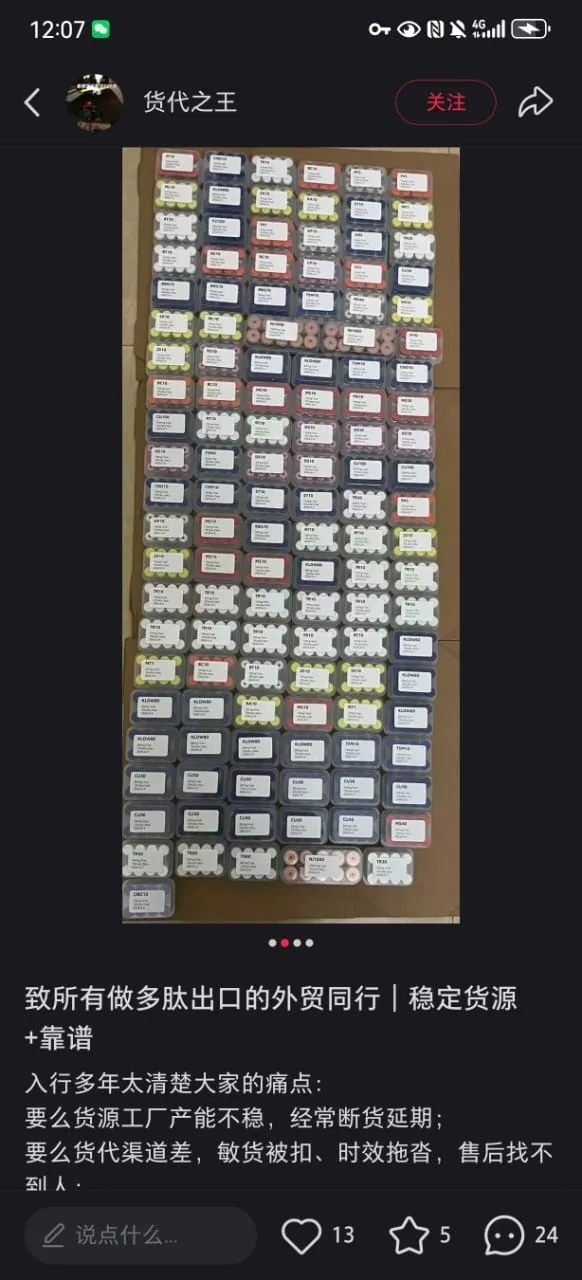
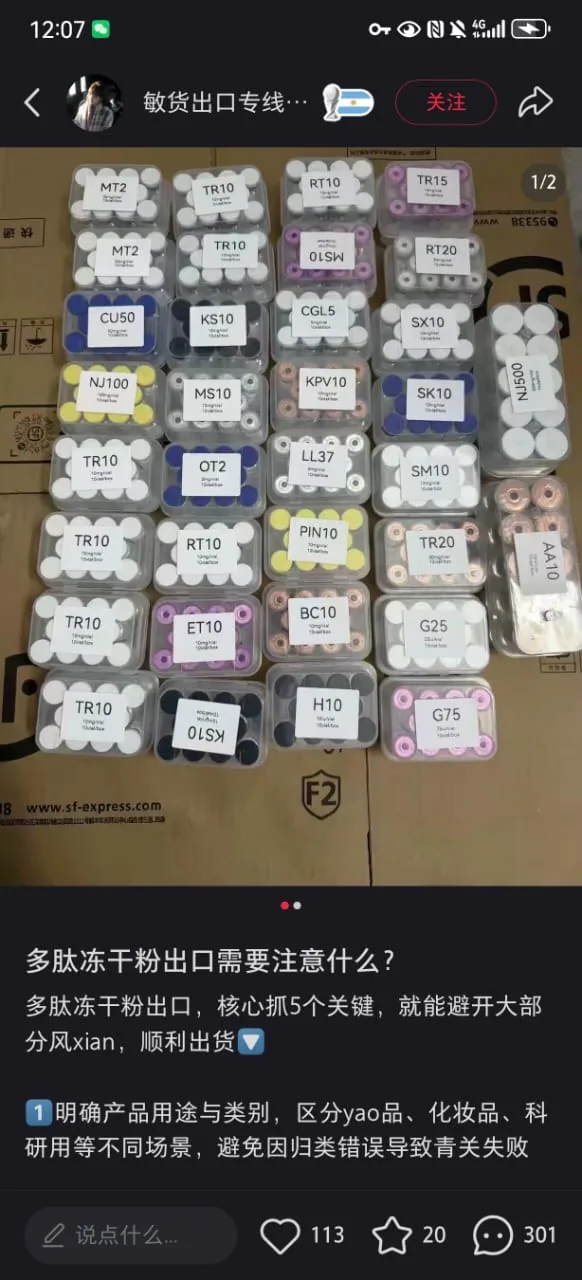
Image 1
Username:
货代之王, King of Freight Forwarding
Headline: To everyone engaged in peptide exports: Stable supply + reliable logistics.
After many years in this industry, I understand everyone’s biggest pain points:
Either the supply factory is unreliable, with frequent shortages and shipping delays;
Or the freight forwarding channel is poor, shipments are frequently seized, delivery is delayed, and after-sales support cannot be found.
Image 2
Username:
敏货出口专线, Minhuo Export Special Line (literally “Sensitive Goods Export Dedicated Line”)
What should you pay attention to when exporting lyophilised peptide powder?
For exporting lyophilised peptide powder, focus on five key points, and you can avoid most risks and ship successfully.
Point 1
1. Clearly define the product’s intended use and category.
Distinguish whether it is for pharmaceuticals, cosmetics, research use, etc., to avoid customs clearance problems caused by incorrect classification.
(The remaining four points are cut off in the screenshot.)
What the ads are really selling
These aren’t peptide advertisements in the normal sense. They’re advertising export logistics/freight forwarding services aimed at Chinese peptide exporters. The first ad says, we have reliable factories, we have reliable shipping channels, we can avoid seizures, we provide after-sales support.
The second ad is essentially a guide to exporting lyophilised peptide powder, focusing on customs classification and successful international shipping.
These ads are interesting because they’re aimed at people selling peptides overseas, not end users. They fit with the supply-chain model, where businesses source products and rely on specialist freight channels to export them.
How cheap is too cheap?
Robert estimated that around 80% of the products being advertised through these channels were poor quality. According to him, many of these products are also sold at extremely low prices. He even claimed that some finished peptide kits sell for less than the cost of the raw material itself.
If that’s true, it raises an obvious question. How can a finished, filled, labelled and packaged peptide kit cost less than the peptide powder required to manufacture it?
His explanation was consistent with everything he’d already described. Many businesses, he believes, don’t manufacture products themselves. Instead they buy the cheapest finished kits they can find, advertise aggressively online and compete almost entirely on price.
In his opinion, this race to the bottom has flooded the market with low-quality products and made it increasingly difficult for buyers to distinguish genuine supply-chain operators from simple resellers.
The ecosystem is advertised in plain sight
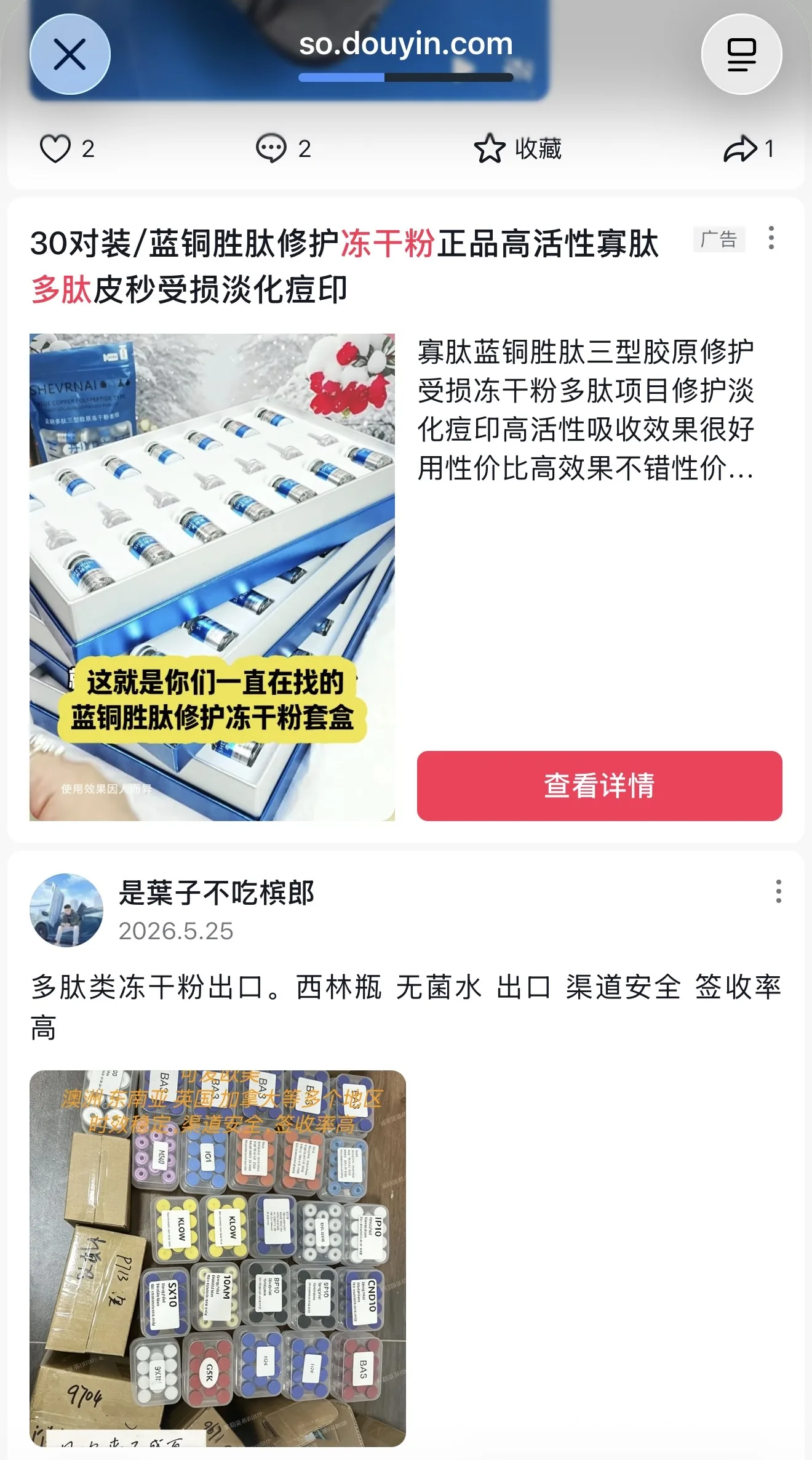
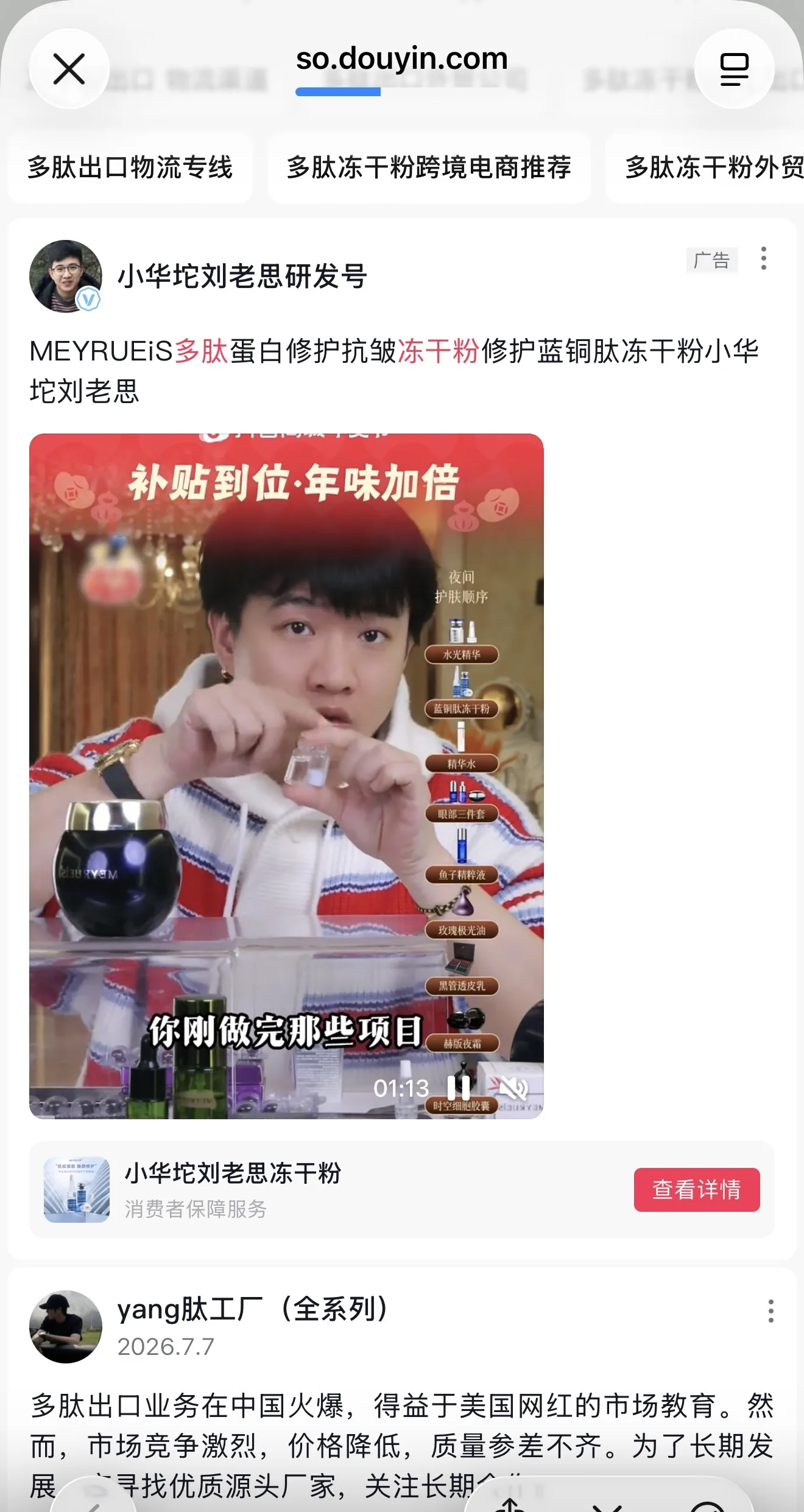
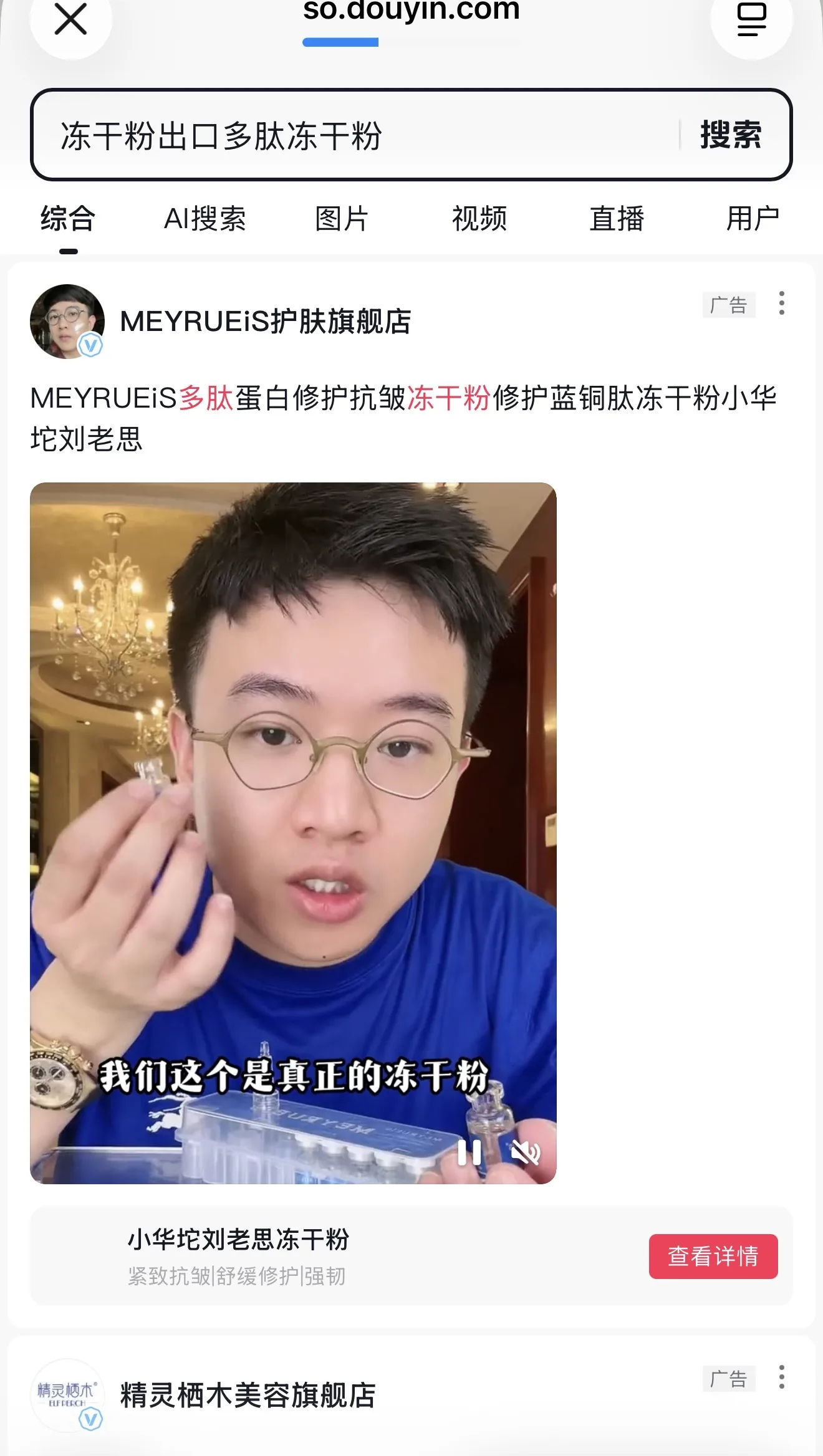
The more I searched, the more evidence appeared that this isn’t simply a market made up of individual vendors selling directly to customers. Across Chinese platforms such as Douyin (the Chinese version of Tik Tok), businesses openly advertise the wider infrastructure surrounding peptide exports. Some promote themselves as source factories. Others sell complete supply-chain services, export logistics, customs clearance and specialist shipping routes for lyophilised peptide products.
One account described itself as:
“Peptide source factory, supply chain.”
Another advertised:
“Peptide biological exports, complete supply chain.”
A separate post stated that the peptide export business was booming in China, driven partly by demand from the American online market. It also acknowledged that competition had intensified, prices had fallen and product quality varied considerably.
Another account used the name PeptideFactory and advertised:
“Export of peptide lyophilised powder for foreign trade.”
The video itself promoted “stable quality.”
Other adverts focused less on the product and more on moving it overseas. They offered dedicated routes for peptide lyophilised powder, customs clearance, tax-paid delivery, drop shipping and specialist handling for goods described as sensitive cargo.
One freight company advertised a Europe and America small-parcel service for lyophilised powder and peptides, promising delivery within around ten days. The service included packaging, export declarations, import clearance, taxes and door-to-door delivery.
Another post promoted peptide exports alongside sterile water and insulin syringes, claiming safe shipping routes and high delivery rates.
Not all of the search results related to grey-market research peptides. Some promoted legitimate cosmetic peptide products such as copper peptide and oligopeptide skincare. Those belong to a separate cosmetics market and shouldn’t be treated as evidence of the same trade.
One article was titled:
“Global Peptide Import & Export Solutions and Guide to Avoiding Pitfalls.”
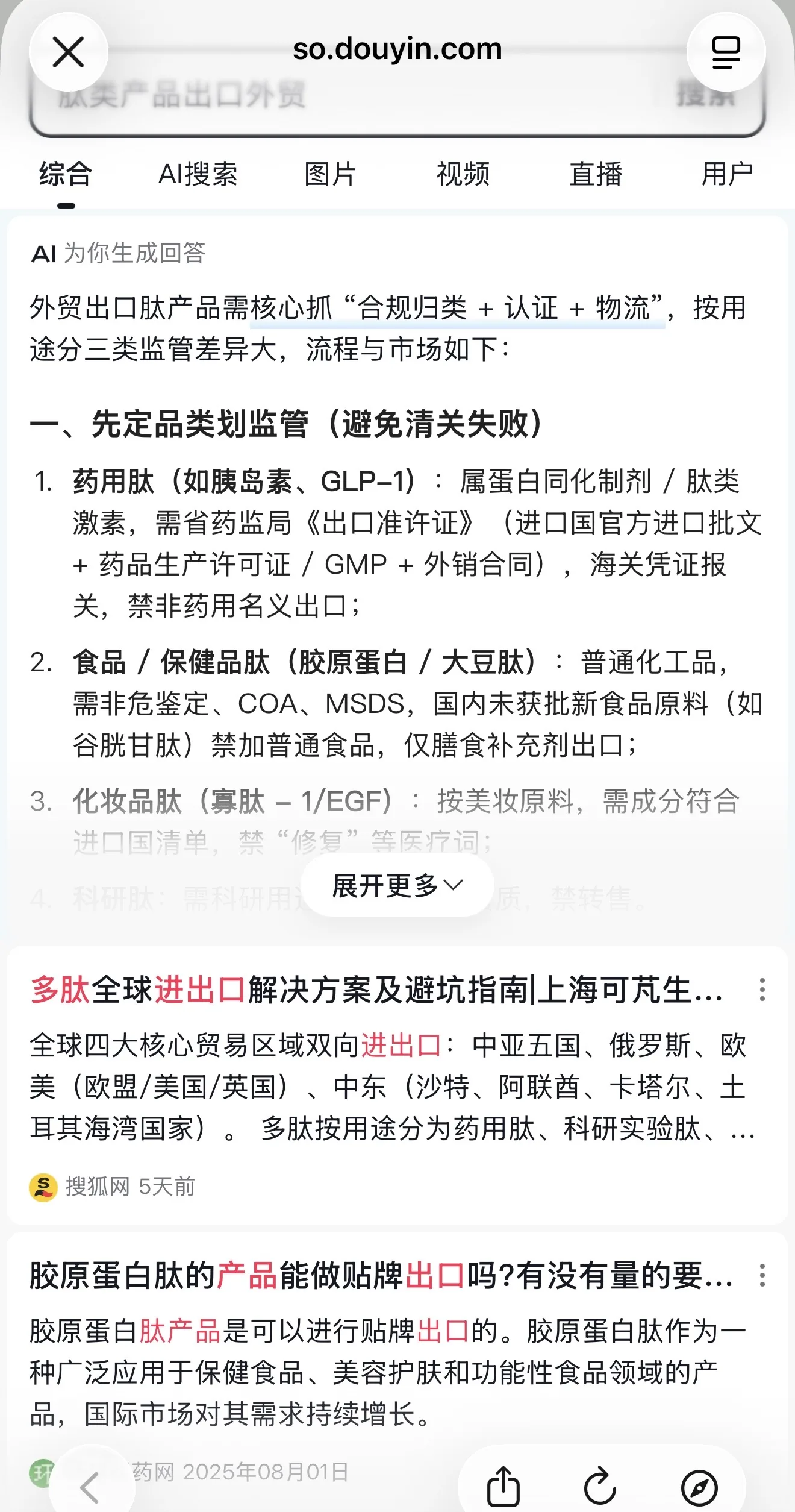
Rather than discussing peptides themselves, it focused on how companies should successfully export them. According to the guide, peptide exports revolve around three key areas:
Compliance classification
Certification
Logistics
The guide explains that peptides should first be classified according to their intended use before export. It separates them into pharmaceutical peptides, research peptides, cosmetic peptides and food or health supplement peptides, with each category requiring different documentation and regulatory requirements.
For pharmaceutical peptides such as insulin or GLP-1 products, the guide lists export licences, pharmaceutical manufacturing licences, GMP certification, export contracts and customs declarations as examples of the documentation required.
Research peptides, cosmetic peptides and food supplement peptides are each described as requiring different classifications and supporting documents. The article is clearly aimed at exporters.
The COA Mystery; Why the names on COAs can be misleading
According to Eria, the COAs belong to the factory, but the name on the COA may not be the actual factory name since producing vialed peptides is illegal in China, and so the factory makes up a name which isn’t the registered company name. This could explain why tracing a report back to the actual manufacturer is so difficult.
It could also explain why several businesses use the same name. If the name isn’t legally protected, another seller may adopt it because customers already associate it with the COAs. In that situation, the name on the report doesn’t necessarily prove that the seller displaying it is the factory, owns the factory or has exclusive rights to the document.
How several companies can have matching Janoshik COAs
There is another possible reason several companies may hold almost identical Janoshik reports. Janoshik allows a customer to request multiple versions of a COA under different names, provided those names are supplied before the testing takes place. This means one sample can produce several versions of the same report.
For example:
One sample is submitted for testing. One analysis is carried out. Several versions of the report are issued, each carrying a different company name.
A business owner operating several brands or sales teams could therefore give each one a report bearing its own name. All of the reports could be genuine and verify correctly, but they would still come from the same sample and the same test. This is clearly different from a report being stolen after publication.
Some while some matching COAs may have been copied without permission, others may have been issued in several names from the beginning or several distributors may be selling stock from the same factory.
The important point is that a genuine COA carrying a vendor’s name doesn’t automatically prove that the vendor submitted its own sample or commissioned an independent test.
After knowing this, people should probably be less suspicious about different vendors producing the same COAs.
The bunk peptide theory
Perhaps the most interesting discussions concerned declining product quality. Eria blamed knockoffs. She claimed counterfeit products were entering the market through unscrupulous merchants motivated by greed. According to her boss, they come from the Baiyun District in Guangzhou.
However, she didn’t believe poor-quality peptides were caused by bad raw materials. Instead she insisted the ingredients themselves were legitimate. The problem, according to her, occurred later. She believed genuine raw materials were deliberately stretched across too many finished products. She gave the example of how it might take 10 boxes of raw materials to produce one box of purified product, but criminals could make 20 boxes instead, which would result in non compliance.
Robert independently described something remarkably similar. He said raw peptide powder is expensive, and for his production, he always overfeeds at 1.1 or 1.2 times the labelled dosage. There will be losses during production, heating and testing. No raw material can reach 100% purity, so the acceptable test range normally falls between 0.95 and 1.15. But according to him, many competitors only add 1.0 times, or even just 0.8 times the required amount of raw material. This lets them undercut prices and grab more orders.
He also believed the reseller model had made matters worse. Businesses competing solely on price frequently purchase the cheapest finished products available before selling them under their own brands.
Both accounts blame commercial incentives rather than malice.
When no one knows who made the product
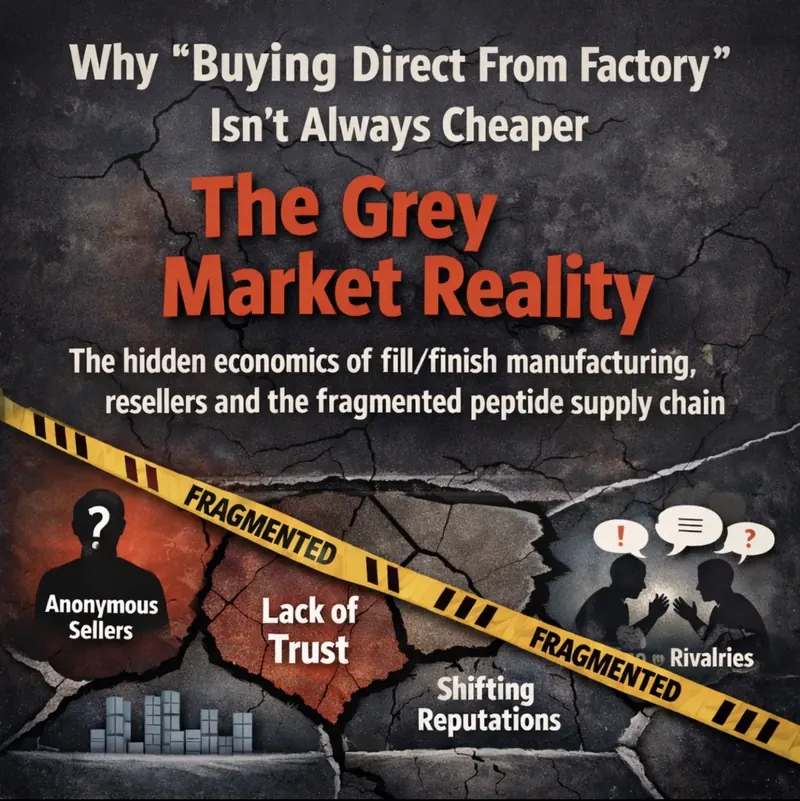
What this investigation ultimately shows is that sourcing in this market is often a mess.
Products pass through bosses, supply-chain operators, factories, sales teams, resellers, freight forwarders and overseas vendors. Some businesses buy raw materials and commission production. Others simply buy finished kits from the open market. Several sellers may use the same factory, the same photographs, the same COAs and sometimes even the same company names.
By the time a kit reaches the customer, the visible vendor may have no direct relationship with the factory that made it. In some cases, the vendor may not even know who manufactured it.
That creates a serious problem when bunk products are identified. There is often no reliable chain of custody from the raw material to the finished vial. When something goes wrong, everyone can point to someone else, and the person who actually made the product may never be identified. So when a bad product appears, demanding to reveal, “Which vendor sold this?” is not as helpful as people think.
And so by now it should be clear to everyone that naming the person who sold the kit doesn’t necessarily identify who made it, who underfilled it, who substituted the contents or at what point in the chain the problem was introduced.
The vendor may have bought the finished kits from another seller, who bought them from another intermediary, who obtained them from a factory operating under an unofficial name.

Comments