
TLDR;
Federal agents searched 503 Prosperity Way in North Sioux City on 23 September 2026. Local reports identified the premises as Apex Waste Management, but the live Apex Peptides website also lists the same address. Corporate filings show that the waste company and the peptide business shared the same two managers and formed part of a cluster of 20 Apex-branded South Dakota LLCs. What the authorities were investigating hasn’t been disclosed.
The search that led back to Apex Peptides
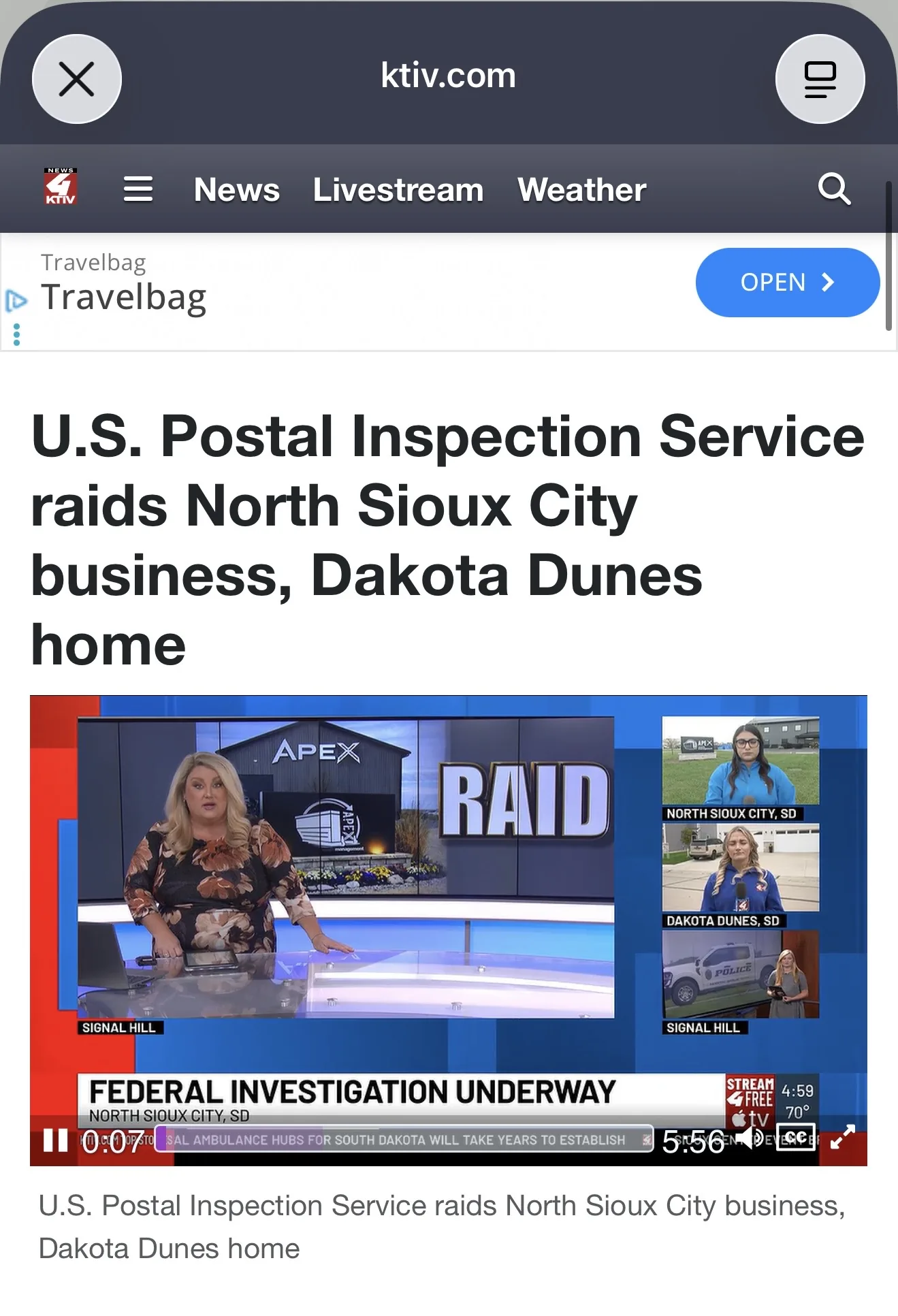
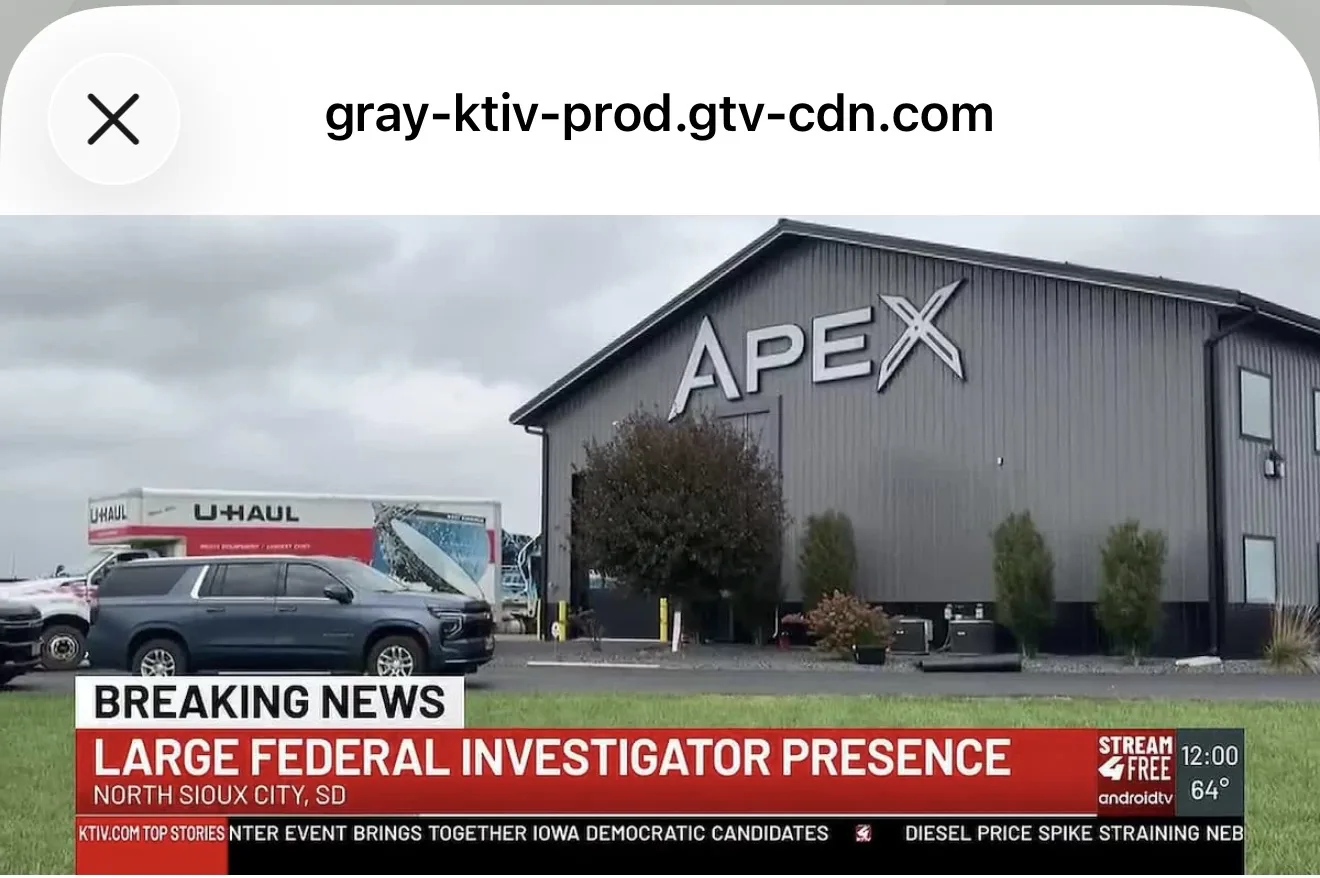
Shortly after 10am on 23 September, more than a dozen marked and unmarked law-enforcement vehicles gathered outside a warehouse at 503 Prosperity Way in North Sioux City, South Dakota.
The US Postal Inspection Service was leading the operation. The FBI, IRS Criminal Investigation, the Union County Sheriff’s Office and North Sioux City Police were also there. KTIV filmed investigators carrying evidence bags and collection equipment into the building before a U-Haul was brought in. Papers, boxes and a tote containing small packaged items were later loaded into it.
One detail made the scene particularly unusual. When a UPS driver arrived with a delivery, agents directed him behind the warehouse and transferred the packages straight into the U-Haul. KSCJ and KCAU/KELOLAND also reported that two unidentified people were led away in handcuffs, although neither their identities nor their legal status was disclosed.
At roughly the same time, postal inspectors were searching a home at 661 Prairie Boulevard in nearby Dakota Dunes. Property records cited by KTIV identify the owner as Ryan Isaacson, twin brother of Riley Isaacson. The station filmed agents removing bags and boxes from the house and examining boxes in its garage.
On the surface, none of this looked like a raid on a peptide seller. The searched warehouse was identified in local reports as Apex Waste Management. The name Apex Peptides was nowhere on the building.
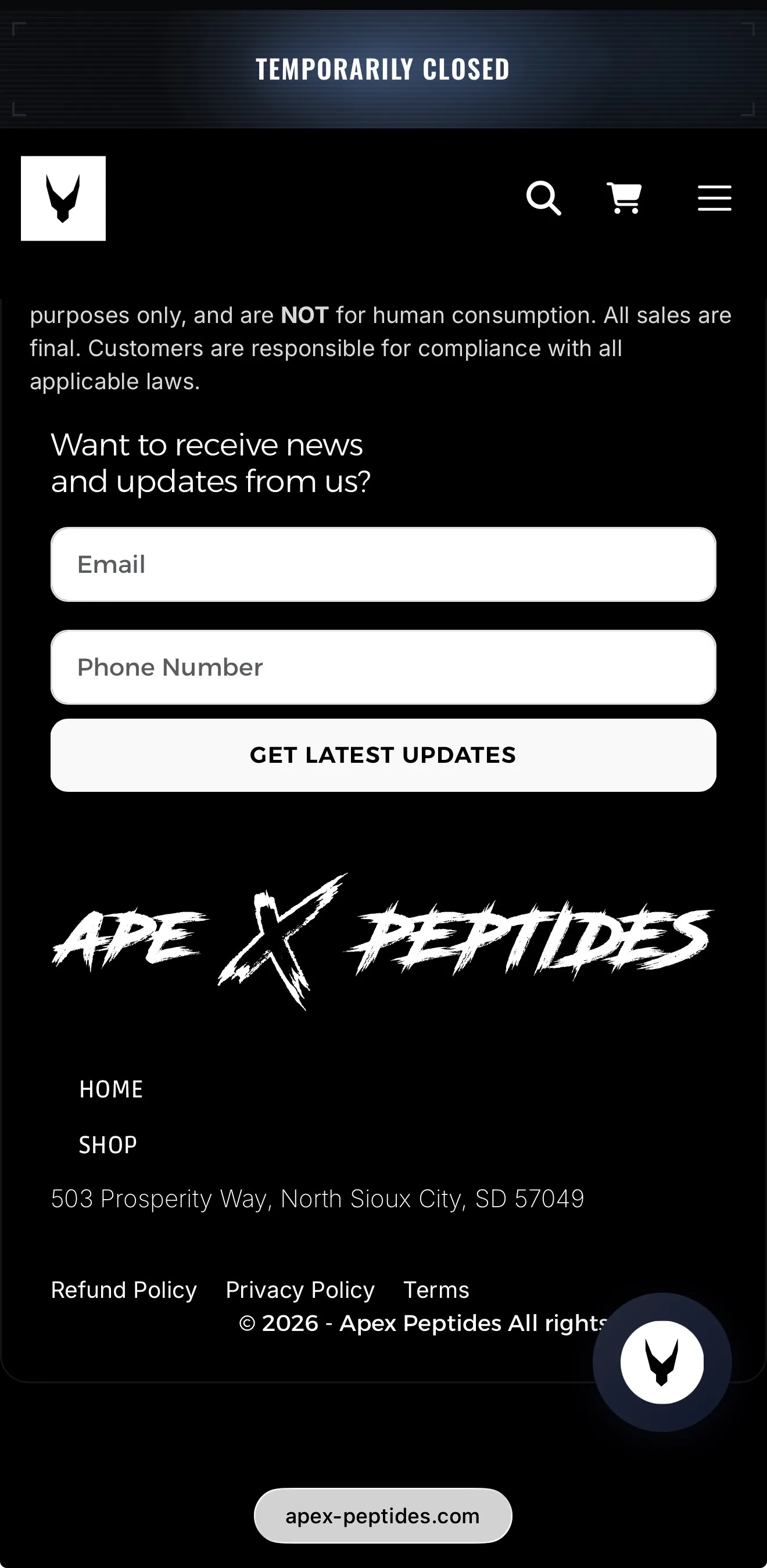
Five days later, however, the peptide company’s own website supplied the clearest connection. When checked on 28 September, the footer of apex-peptides.com listed its address as 503 Prosperity Way, the exact warehouse searched by federal agents. The site carried a large “Temporarily Closed” banner. Its Peptides and Pills categories showed zero products, but the rest of the commercial infrastructure remained: customer accounts, Google and Facebook sign-in, a shopping cart, a support function and a laboratory-results page. Nothing on the site explained the closure, and there’s no public evidence that authorities ordered it. The timing is notable, but the reason remains unknown.
The website address transformed what first looked like a search of an unrelated waste company. The corporate records explain the rest.
Three names, one peptide business
The paper trail begins in Iowa in November 2024 with ApexSupps LLC. In spring 2025, the company moved into South Dakota under a new name: Apex Peptides LLC. The change became effective on 1 May.
Less than two weeks later, restated articles renamed the same company Apex Research LLC. The documents describe it as “formerly Apex Peptides” and retain the same South Dakota business ID, DL299126. ApexSupps, Apex Peptides and Apex Research were not three loosely connected businesses, they were successive names for the same legal entity.
The consumer-facing brand didn’t disappear with the legal name change. Archived software files still contained the ApexSupps name, indexed marketing used Apex Research, and the live store continued to trade under the Apex Peptides branding.
The link to the waste company is also direct. Apex Research’s 2026 annual report names Riley Isaacson and Jared Miller as managers. When Apex Waste Management was formed in December 2025, its articles named the same two men as managers and gave the same original principal address: 617 1st Street, Suite A, Sergeant Bluff, Iowa. Jared Miller was also listed as the waste company’s organizer.
The companies remained legally separate. The records don’t show that one owned the other or that money moved between them. They do show that the peptide operation and the waste-management company had the same two named managers and began with the same principal address.
That connection matters because the waste company was only one part of a much larger expansion.
The business behind the storefront
Public filings connect 20 South Dakota LLCs through Riley Isaacson, Jared Miller and Ryan Isaacson, along with four recurring addresses. Sixteen filings name Riley and Jared as managers. Four newer companies name Ryan.
The registrations ranged far beyond peptides and waste. They included processing companies, capital businesses, outdoor services, printing and clothing, cosmetics, health clubs, insurance and prescription-branded ventures. Four short-lived companies called Apex Processing 1 through 4 were terminated in September 2025. The other sixteen were recorded as being in good standing when the registry was checked on 27 September 2026.
The addresses make the expansion easier to see. The original Sergeant Bluff address connected the peptide business, Apex Brands, the four processing companies and Apex Waste Management. The Dakota Dunes home searched by postal inspectors appeared in early Apex Capital filings and in the waste company’s federal motor-carrier record.
The two Prosperity Way properties became the centre of the newer registrations. In addition to its association with Apex Waste Management, 503 Prosperity Way appeared in filings for Apex Brands, Apex Capital, Apex Outdoor Pros, ApexRx, Apex Threadhaus & Ink, ApexAssure and Apex Cosmetics. During the search, a customer arrived to collect an order of 100 sweatshirts and was turned away because no one was allowed inside. Whatever the internal arrangement, the warehouse was serving more than a conventional waste-management operation.
Another six companies used 498 Prosperity Way, a nearby property that KTIV found still under construction and apparently non-operational. One of the Isaacson brothers was filmed there the following morning carrying a suitcase and duffel bag. The registrations show that the address was being used on company paperwork; they don’t establish that six businesses were actively operating from the unfinished building.
There is one other name that is easy to misread. Apex Research Holdings LLC was the fictitious name used when the South Dakota Apex Research company registered in Iowa, not a newly discovered holding company. A separate Iowa company called Apex Research LLC also used the Sergeant Bluff address, although the records recovered for this investigation didn’t establish who managed or owned it.
The filings don’t prove that all 20 companies shared finances, staff or beneficial ownership. What they reveal is a rapid proliferation of Apex-branded entities around the same people and a small group of addresses. That’s a very different picture from the narrow laboratory supplier presented by the words “research use only.”
A research supplier built like a retail brand
Before the closure, Apex’s indexed marketing promoted more than 50 products across categories such as metabolism, recovery, sleep and cognition. It promised US dispatch, delivery in two to four business days, third-party testing and several payment options. Customers were offered a calculator for bacteriostatic-water quantities and reconstitution instructions, while the company referred to the trust of large fitness influencers.
Although marked “Temporarily Closed,” the Apex website still displays its previous marketing: research-only peptides, purity above 99 per cent, same-day dispatch and delivery from the United States within two to four business days. Its laboratory-results page shows a July 2026 Freedom Diagnostics report for an Apex Peptides Retatrutide 30 mg sample. The report records confirmed identity and purity above 99 per cent in all 12 vials tested.
Apex also stated that its products were not intended for human use. That disclaimer sat alongside a consumer storefront built around fitness-related products, rapid shipping, reconstitution guidance and promotional codes. Archived pages referred to GLP and BPC products, bacteriostatic water, insulin needles and a reconstitution calculator.
The affiliate marketing is documented. PeptideBenchmark and Prof. Peptide advertised 20 per cent discounts, while Apex promoted its own 10 per cent code. Together, the material shows a business formally presented as a laboratory supplier but marketed in ways familiar to the bodybuilding and weight-loss peptide market.
What “research use only” does, and does not, protect
Calling a product “research use only” doesn’t automatically settle how regulators will view it. The FDA can look beyond the disclaimer to the surrounding claims, sales tools and intended audience.
The raid still has no public allegation
The agencies involved have fuelled speculation. Postal inspectors have worked on previous cases involving misbranded drugs moving through the mail. IRS Criminal Investigation regularly handles financial evidence, fraud, tax offences and money laundering. The FBI can assist in all of those areas and many more.
Their presence is not a charge sheet.
Nor do the objects seen leaving the properties provide an answer. Reporters saw papers, boxes, bags, small packaged items and a UPS delivery being transferred into the U-Haul. Authorities haven’t identified any of them as peptides, illegal drugs or evidence of a particular offence.
As of 27 September, no public criminal complaint, indictment or search-warrant affidavit had been identified in the searches conducted for this article. The two people seen in handcuffs weren’t named, and the reports didn’t establish that they had been arrested or charged. An authenticated PACER search wasn’t performed, so sealed, unindexed or newly filed records may exist.
What can be said is narrower, but still significant: federal agents searched two properties connected to the people behind Apex Waste Management and Apex Research. The company formerly called Apex Peptides shared managers with the waste business, and its live website listed the searched warehouse as its own address.
The suspected offence remains undisclosed.
The story behind the raid
It would be easy to reduce this to another peptide company being “busted.” The available evidence supports a more complicated story.
ApexSupps became Apex Peptides and then Apex Research under one legal identity. A separate waste-management company appeared later with the same managers and the same original address. Around them grew 18 more South Dakota LLCs covering businesses as varied as processing, capital, clothing, cosmetics, outdoor work and health clubs. The searched warehouse was tied not only to waste management but to the peptide storefront itself, which now sits temporarily closed with no products available.
That doesn’t prove what federal investigators believe happened but it does show that Apex Peptides wasn’t an isolated online seller. It was part of a fast-growing collection of companies connected by the same people and addresses, operating behind a consumer storefront that paired research-only disclaimers with the language and machinery of the fitness peptide market.
The search is confirmed. The corporate connections are documented. The website now ties Apex Peptides directly to the searched property. What the government found there, and which part of the wider business operation it was examining, has yet to be made public.
Sources and reporting note
The search account is drawn from KTIV’s original scene report, its follow-up on the additional companies, KSCJ’s continuing-investigation report and KCAU/KELOLAND’s report. The descriptions of the search are journalistic observations, not an official inventory of evidence.
The corporate history is based on the South Dakota Apex Research domestication packet, restated articles, 2026 annual report and Apex Waste Management articles, together with the original filings for the other connected entities. Filed roles and addresses do not necessarily reveal beneficial ownership or actual operations.
Storefront evidence includes the live Apex Peptides website, preserved archive responses, the indexed seller landing, PeptideBenchmark’s offer and the Prof. Peptide offer. Archived pages were incomplete, and indexed wording is not treated as a full capture of the historical website.
The regulatory comparison uses the FDA’s Peak Performance Peptides warning letter. Earlier cases involving Osta-Gain and Spectrum Peptides, Ronald DeFranco and Paradigm Peptides provide legal context only. None establishes an allegation against Apex.

Comments