
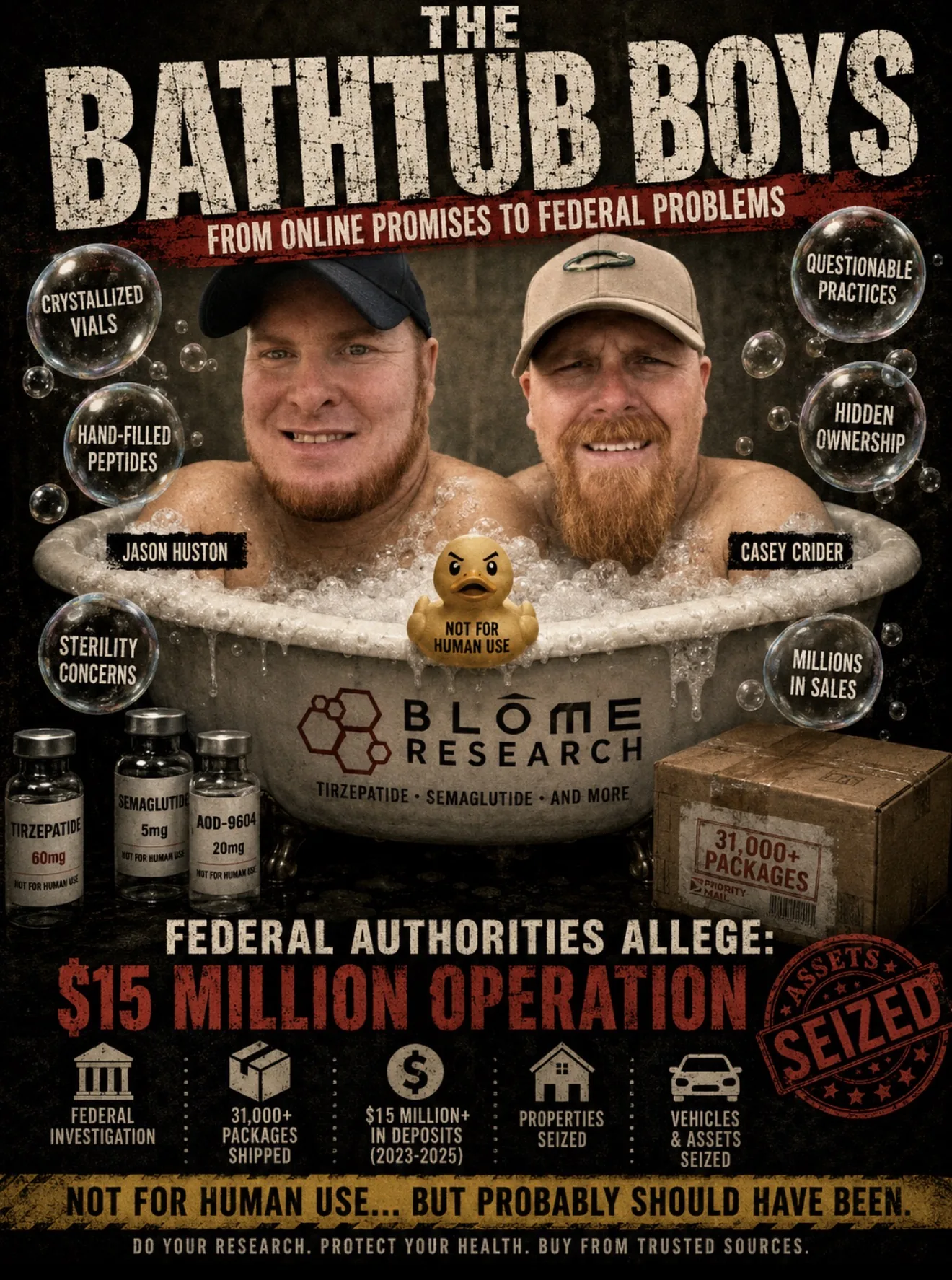
For years, Blome Research occupied a strange place in the peptide world.
To some customers, it was simply another American peptide vendor selling tirzepatide, semaglutide, NAD+, AOD-9604 and a growing list of other compounds at prices far below prescription alternatives. To others, it was something entirely different.
The Bathtub Boys.
The nickname predates the recent federal seizure action. It appears throughout discussions dating back more than two years, long before federal agents arrived in Missouri and before forfeiture notices were taped to properties linked to the business.
Now, with federal authorities alleging a $15 million operation involving illegal misbranded weight-loss drugs, those old discussions are being revisited in a very different light.
The Federal Seizure and the Investigation Behind It
https://www.fourstateshomepage.com/news/local/usps-seizure-newton-county-missouri/
On June 4, 2026, local news outlets reported that federal authorities had seized assets connected to Blome Research owners Jason Huston and Casey Crider.
The complaint itself gives a more detailed account of how the case developed.
According to the filing, federal agents began investigating Huston, Crider and Blome Research in June 2025 over the alleged sale of unlicensed weight-loss drugs, including semaglutide, tirzepatide and retatrutide.
The complaint states that in September 2024, the Missouri Board of Pharmacy had been provided with screenshots from Crider’s Facebook page and a Facebook Messenger exchange in which Crider allegedly offered to sell tirzepatide for weight loss to a pharmacist, so long as the pharmacist was “not the FDA.”
Later that month, an undercover Missouri Board of Pharmacy employee emailed Blome Research to ask where the products came from. According to the complaint, the response was that they came from China, were third-party tested at a laboratory in California, and were “100% pure.”
In October 2024, the Missouri Board of Pharmacy allegedly placed undercover orders for semaglutide and bacteriostatic water. The filing states that both were shipped through USPS using a return address connected to Blome Research.
On November 1, 2024, the Missouri Board of Pharmacy issued a cease-and-desist letter requesting that Blome Research stop the unlicensed practice of pharmacy and drug distribution in Missouri. According to the complaint, Blome Research acknowledged receipt and agreed to stop all business as of that date.
Federal investigators allege the business continued.
By July 2025, agents found the website had been changed. Products were reportedly listed under altered names including “GLP-Tir = Tirz,” “GLP-Sem = Sema,” and “GLP-Ret = Reta.” The site also required visitors to click an “I understand” button beneath a disclaimer stating the products were not dietary supplements or medications and that buyers were responsible for knowing how to use them legally.
Despite those disclaimers, the complaint alleges the website still displayed vials labelled with names including semaglutide, retatrutide, tirz and reconstitution solution, next to sale prices. Investigators also allege that the phone numbers listed on the site belonged to Huston and Crider, and that the return-label address was Huston’s residence.
The complaint states that Blome Research had no approved new drug applications and was not permitted to offer retatrutide or other new drugs. It also alleges that neither Huston nor Crider was a licensed medical doctor or pharmacist, and that no known Blome Research employee held those qualifications.
Investigators later reviewed shipping records and alleged that between January 4, 2024 and September 8, 2025, Huston, Crider and Blome Research shipped approximately 31,776 parcels from Carl Junction, Joplin and Seneca, Missouri.
The filing also describes further undercover activity. In one recorded call, an undercover officer allegedly told Crider he was trying to lose weight and asked for suggestions. Crider allegedly recommended retatrutide, discussed his own weight loss, and provided dosing information and instructions regarding needles, while also saying he was “not supposed to give this information because we’re not pharmacists or doctors.”
In February 2026, another undercover order was allegedly placed for one vial of “TIRZ 20” for $80 plus shipping, without a prescription. The package allegedly contained one vial labelled “TIRZ 20” and a packing slip, but no use instructions or warnings.
The complaint also describes a March 2026 call in which Huston allegedly said he could not legally give advice on how to use the product, but then stated it was “perfectly clear” for personal use and provided instructions for weight-loss use. Huston also allegedly said Blome Research was on a “watch list,” discussed international shipping limitations, and said local “porch pick ups” could be arranged for people willing to drive to Seneca, Missouri.
The financial allegations are just as significant. Investigators allegedly identified at least 50 bank accounts owned or controlled by Huston, Crider and/or Blome Research. The complaint alleges that more than $1 million was spent purchasing peptide materials from chemical companies advertised as being located in China.
According to the filing, deposits into accounts controlled by Huston, Crider and Blome Research frequently referenced terms such as “blome,” “order,” “research,” “tirzepatide,” “tirz,” “peptides,” “meds,” “sema” and “semaglutide.” The complaint also alleges that the business maintained around 12 intake accounts, including PayPal, Cash App, Zelle, MetaPay and Bluevine accounts.
Between July 2023 and December 2025, investigators allege that approximately $15 million entered accounts controlled by Huston, Crider and Blome Research, primarily from the sale of illegal misbranded peptides.
The government’s case doesn’t appear to rest on the “Bathtub Boys” nickname or the old forum arguments about crystallized vials. The complaint focuses on something more direct, whether products labelled as research-use only were actually being sold, discussed and used as weight-loss drugs for human use.
At the time of writing, these remain allegations and the legal process is ongoing.
For many in the peptide community, however, the reaction was less shock than recognition. After years of warnings, arguments and unanswered questions surrounding Blome Research, the federal action felt like the long-delayed ending to a story that had been playing out in public for years.
Before The Raid Came The Rumours
Long before federal authorities became involved, Blome Research was already one of the most controversial names in peptide forums. Reddit threads discussing the company stretch back years and contain recurring themes: questions about manufacturing practices, allegations of hand-filled vials, reports of crystallized peptide material, concerns about sterility, questions around website transparency, debates over product sourcing and allegations regarding company ownership and behaviour.
The most persistent claim was that Blome was purchasing peptide raw material and filling vials themselves in unsanitary conditions. This is where the nickname “Bathtub Boys” came from.
The Crystallized Vial and Sterility Controversy
Crystallized vials and sterility concerns were among the most common criticisms attached to the company. Customers reported receiving products that looked different from what many peptide users expected. Instead of the familiar lyophilized white peptide puck found in many research peptide vials, some buyers described seeing crystalline material, powder-like deposits, minimal visible product and a lack of vacuum seals.
The theory circulating in peptide communities was that raw peptide material was being packaged directly into vials rather than being conventionally lyophilized. Sterility then became a major concern, with allegations that products were being hand-filled, hand-crimped and packaged outside sterile laboratory environments.
This distinction mattered because raw tirzepatide is not the same thing as a finished sterile injectable product and the concern was that inexperienced GLP-1 users may not understand the difference between raw peptide material and a properly prepared injectable product. Cheap tirzepatide may look appealing, but if the product requires sterile handling, filtration, accurate reconstitution and dosing knowledge, it’s not something first-time weight-loss users should be casually injecting.
The Name Behind The Name
The controversy around Blome Research was not limited to the products.
It’s claimed that “Blome” appeared to reference Kurt Blome, a Nazi-era biological warfare figure. There were discussions across Reddit and other peptide forums linking the name to those allegations, alongside wider claims about racist, homophobic and extremist content connected to the people behind the company.
Those claims became part of why the company attracted such hostility online. For many people in the peptide community, the name itself was not just strange branding. It was treated as another warning sign.
As with much of the early Blome discussion, these were allegations circulating in online communities rather than findings from the federal complaint. But they help explain why the reaction to the seizure was so blunt. The anger was never only about peptide quality. It was also about who people believed they were buying from.
The Website Mystery
Another recurring theme involved the company’s public presentation. Reviewers frequently noted how difficult it was to determine basic information about Blome Research. One review in muscleandbrawn.com, highlighted that the company provided little information about itself, its “About Us” section discussed peptides rather than the company, corporate information was difficult to locate, and the company presented itself as a U.S.-based supplier while providing limited detail regarding operations.
The same review noted that despite the lack of transparency, the company was actively selling a wide range of research compounds. For critics, this lack of information was a red flag. Supporters viewed it as fairly typical behaviour for businesses operating in the peptide grey market.
The Mixed Reviews
Blome Research was not universally condemned by customers. That is part of what made the story so messy.
On review platforms, the company appeared to have many positive ratings. Some customers claimed the products worked, reported significant weight loss and described the pricing as far more affordable than clinic or prescription alternatives.
Several reviews described repeat purchases. Some customers said they had lost 20, 50 or even 60 pounds. Others praised the speed of shipping, communication or customer service.
But the reviews were not all glowing.
Some customers complained about inconsistency, saying the products felt strong one month and weak the next. Others questioned whether they had received the dose they ordered. One reviewer said cheaper pricing was not worth the inconsistency and returned to a pharmacy source because they felt safer there.
Another review described hair loss after using GLP-1 products and questioned whether it was connected to the medication, rapid weight loss or the product itself. The reviewer also noted that Blome Research was not FDA approved and appeared to be “only for testing,” expressing regret over using it despite losing weight.
That ambiguity sat at the heart of the Blome Research story.
The company had customers who believed the products worked and who were happy with the price. But even among customer reviews, there were signs of uncertainty around consistency, dosing, safety and the difference between a cheap online GLP-1 product and a regulated pharmacy product.
In other words, Blome didn’t survive for years because everyone thought it was obviously bad. It survived because enough people believed it worked.
The Fake Team Photos

The company’s website eventually became the subject of another controversy. Team photographs appearing on the website appeared to be stock images rather than actual company personnel. Screenshots circulated showing website profiles that allegedly matched stock images available through website-building platforms. Critics argued this damaged the company’s credibility even more.
The website was not the only part of the company’s online presence that attracted scrutiny.
Forum users also accused Blome Research of operating fake or alternate accounts on Facebook and discussion forums to promote the company, defend it against criticism and create the appearance of independent support. Some posters went as far as alleging that supposed experts or satisfied customers were actually connected to the business itself.
No evidence of these allegations appears in the federal complaint, and the claims were never independently verified. However, the accusations became another recurring theme in discussions about the company and contributed to growing skepticism surrounding its public image.
The Laboratory Reports
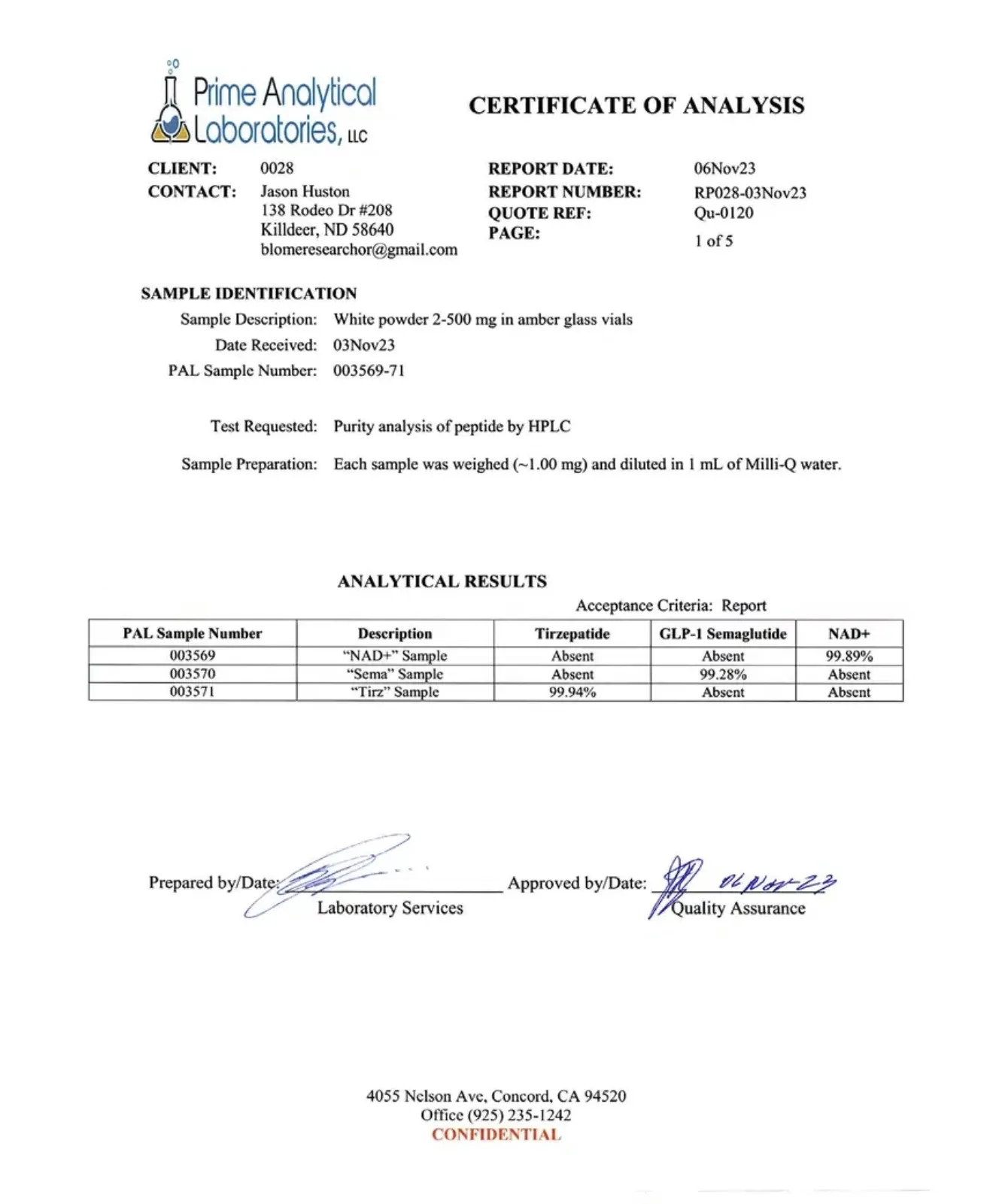
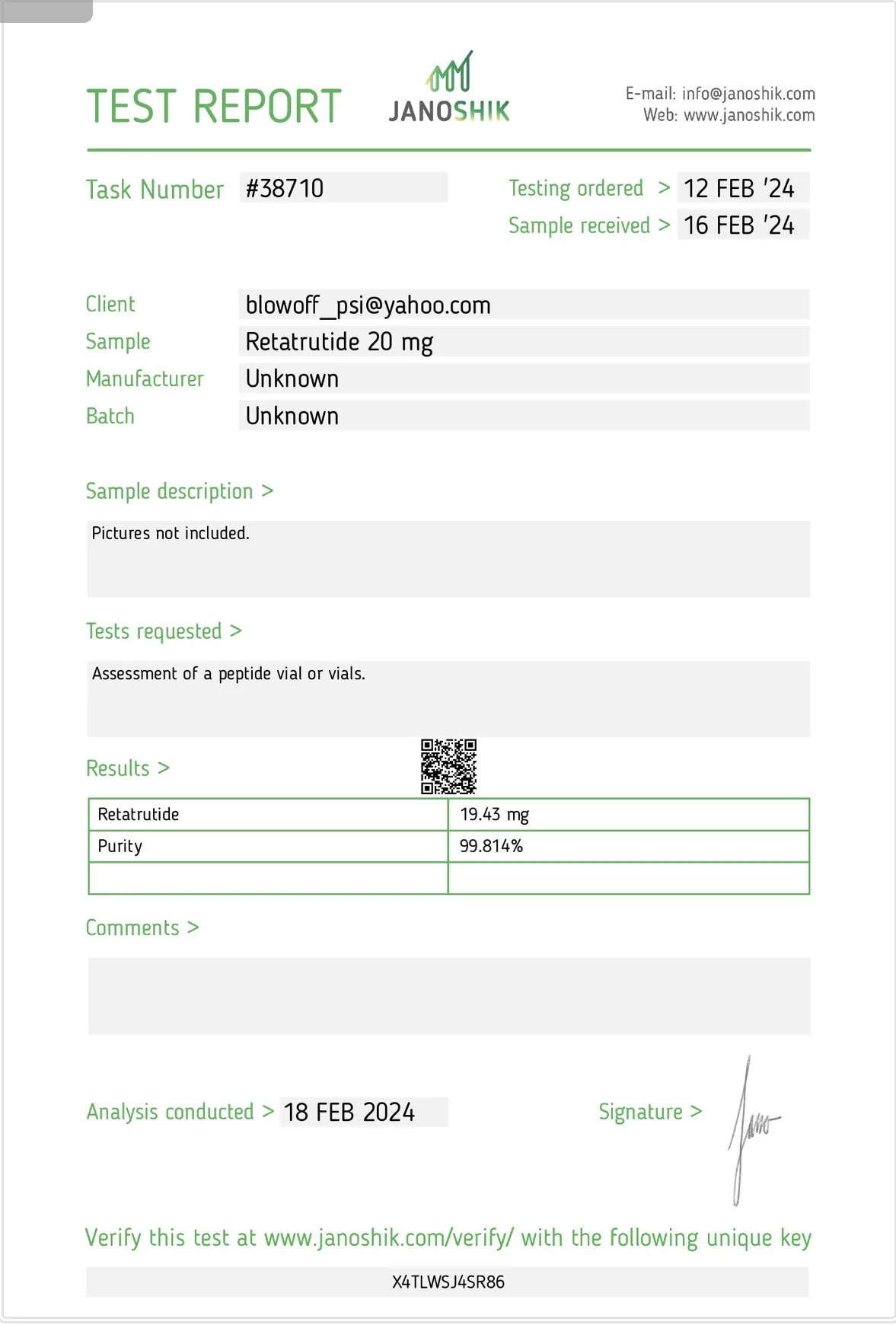
One reason the company retained customers despite ongoing controversy was that it didn’t operate without testing. The company displayed laboratory reports from Prime Analytical Laboratories. Additional reports from Janoshik were later circulated, complete with visible verification codes.
Many customers viewed these reports as evidence that the products contained the compounds being advertised.
The Biggest Irony
One of the strongest narrative points in the entire article is that for years, critics argued about crystallized vials, sterility, stock photos and “bathtub” manufacturing. The federal government largely ignored those debates.
Instead, the complaint focuses on something much simpler, whether products labelled “Not For Human Use” were actually being sold, marketed and discussed as weight-loss drugs for human use.
That is arguably the real story emerging from the court filing. The Reddit controversies may have made the company famous, but the government’s case appears to focus primarily on alleged misbranding, human-use marketing, mail fraud, wire fraud, interstate sales and financial proceeds rather than the “bathtub” allegations themselves.


Comments