
XTP R30 Tests in Date Order
4 June 2026; Freedom Diagnostics, Mid Mo Peptides
Lot: RET30-2606-1
Quantity: 31.76 mg
Purity: 93.77%
Result: Failed purity
15 June 2026; Janoshik, Obvious Reel Tests
Batch: R30-003
Quantities: 4.48 mg / 4.29 mg / 34.47 mg
Purities: 99.254% / 99.489% / 99.901%
Result: Two severely underfilled vials and one overfilled vial
17 June 2026; Janoshik, IDUN Peptides
Reported batch: RT30-260527, later described as IDUN’s internal tracking number
Quantities: 33.26 mg / 35.29 mg
Purities: 99.524% / 99.564%
Result: Passed, but its connection to XTP batch R30-003 couldn’t be established
22 June 2026; Freedom Diagnostics, Amino Annex
Lot: RT30-0619AB-3
Quantities: 27.79 mg / 27.18 mg / 28.22 mg
Purities: 89.59% / 89.54% / 89.58%
Result: All three failed purity and were under the labelled 30 mg
23 June 2026; Freedom Diagnostics, RJB
Lot: 01497
Quantity: 31.47 mg
Purity: 89.07%
Result: Failed purity
27 June 2026; Vanguard Laboratory, Alpha Tides
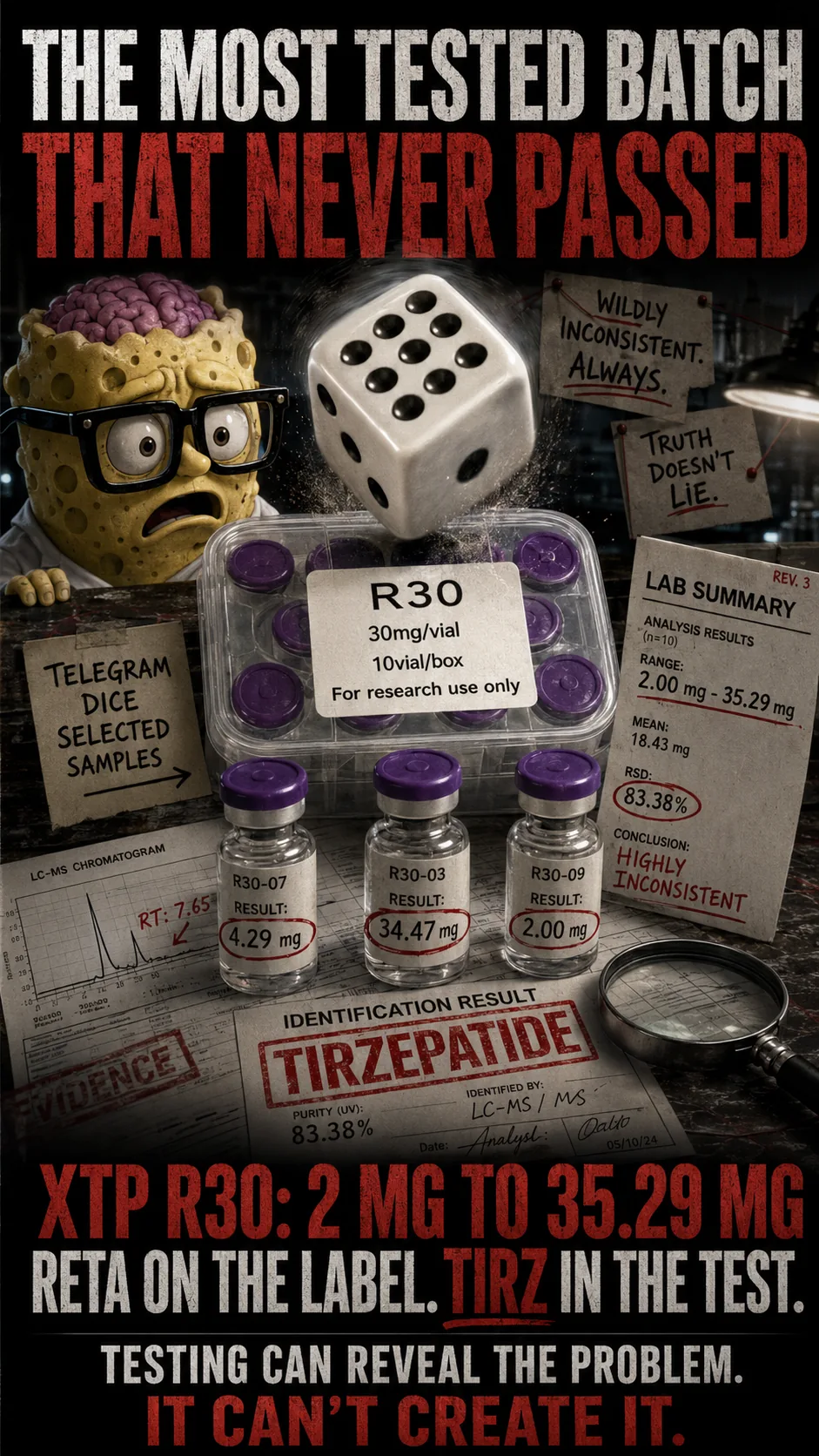
Batch: R30-003
Quantity: 27.62 mg
Purity: 83.38%
Result: Failed purity and under the labelled 30 mg
3 July 2026; ILS Labs, Crowned Life Sciences, vial one
Batch: RT30-20260616
Quantity: 28.36 mg
Purity: 88.45%
Result: Failed purity and under the labelled 30 mg
3 July 2026; ILS Labs, Crowned Life Sciences, vial two
Batch: RT30-20260616
Quantity: 27.95 mg
Purity: 88.17%
Result: Failed purity and under the labelled 30 mg
23 July 2026; Janoshik, XTP-organised R30 retest
Batch: XTP-R30-003
Identity: Tirzepatide, not retatrutide
Reported measurements: 2.11 mg / 2.00 mg / 2.07 mg
Purities: 90.573% / 90.547% / 89.824%
Result: Wrong peptide, severely underfilled and failed purity,
The Retest Group That XTP Wanted to Control
After the first failed R30 tests, XTP created a dedicated group to arrange another round of testing. Three customer vials would be selected, donors would provide proof of purchase and film themselves packing the samples to show they’d not been tampered with. Members also wanted a mixture of the different stopper styles circulating within the supposed batch.
XTP agreed to cover the testing costs, but arguments began almost immediately over who would control the process. Bella said the group’s “organisational authority” needed to remain in XTP’s hands, while the XTP testing account insisted that it must lead the group. Customers argued that a third-party test shouldn’t be controlled by the vendor whose product was being investigated.
XTP said it would only organise the process and wouldn’t participate in selecting the samples. Bella said everything would be random, but members repeatedly asked how the random selection would work and insisted that neither customers nor XTP should be allowed to hand-pick the donors.
The next argument was over what XTP would do if the product failed again. Bella initially said that if there was a quality issue, XTP “can offer a refund or send a replacement.” Customers wanted the exact purity and fill standards confirmed before donating vials and putting more time into another test.
XTP then posted a new sliding compensation policy:
• Below 90% of the stated quantity: 20% refund
• Below 80%: 30% refund
• Below 70%: 40% refund
• Below 60%: 50% refund
• Below 50%: 60% refund
• Below 40%: 70% refund
• Below 30%: 80% refund
• Below 20%: 90% refund
• Below 10%: full refund
• Purity below 98.5%: full refund
Customers immediately rejected it. They produced XTP’s previously published guarantee, which said that purity below 98.5% or fill below 90% would qualify for either a refund or replacement shipment. In other words, the sliding scale appeared to replace the guarantee that had been advertised when the product was purchased.
After the backlash, Bella said she’d submitted the issue to her supervisor and published a final policy: purity below 98.5% or active ingredient content below 90% of the agreed specification would receive a full refund.
XTP also refused to recognise the original testing group’s results, citing its dispute with the organiser and questioning the group’s objectivity and credibility. It claimed its own tests used random samples without special selection or pre-prepared vials, then offered to fund this new retest because it had “full confidence” in the product.
That’s important now that XTP is suggesting human interference or malicious competition. The company didn’t simply reject the first results and walk away. It created a dedicated retest group, insisted on organisational control, restricted participation to verified customers, required packing videos, paid for the tests and negotiated the refund conditions before the samples were sent.
The process was designed specifically to eliminate accusations of fake customers, substituted vials and tampering. Yet when the results continued to expose problems, XTP’s explanation returned to interference and hostile competitors.
A Good Test Appears; but Which Batch Was It?
XTP eventually proposed that three randomly selected customers would each supply one vial. One customer would consolidate the samples and send them to Janoshik, while XTP reimbursed the internal shipping and paid for one final shipment to the laboratory. The selection was later conducted using a virtual dice roll.
During the discussion, another customer posted a Janoshik report showing good results:
33.26 mg and 35.29 mg
99.524% and 99.564% purity
Reported batch: RT30-260527
Client: IDUN Peptides
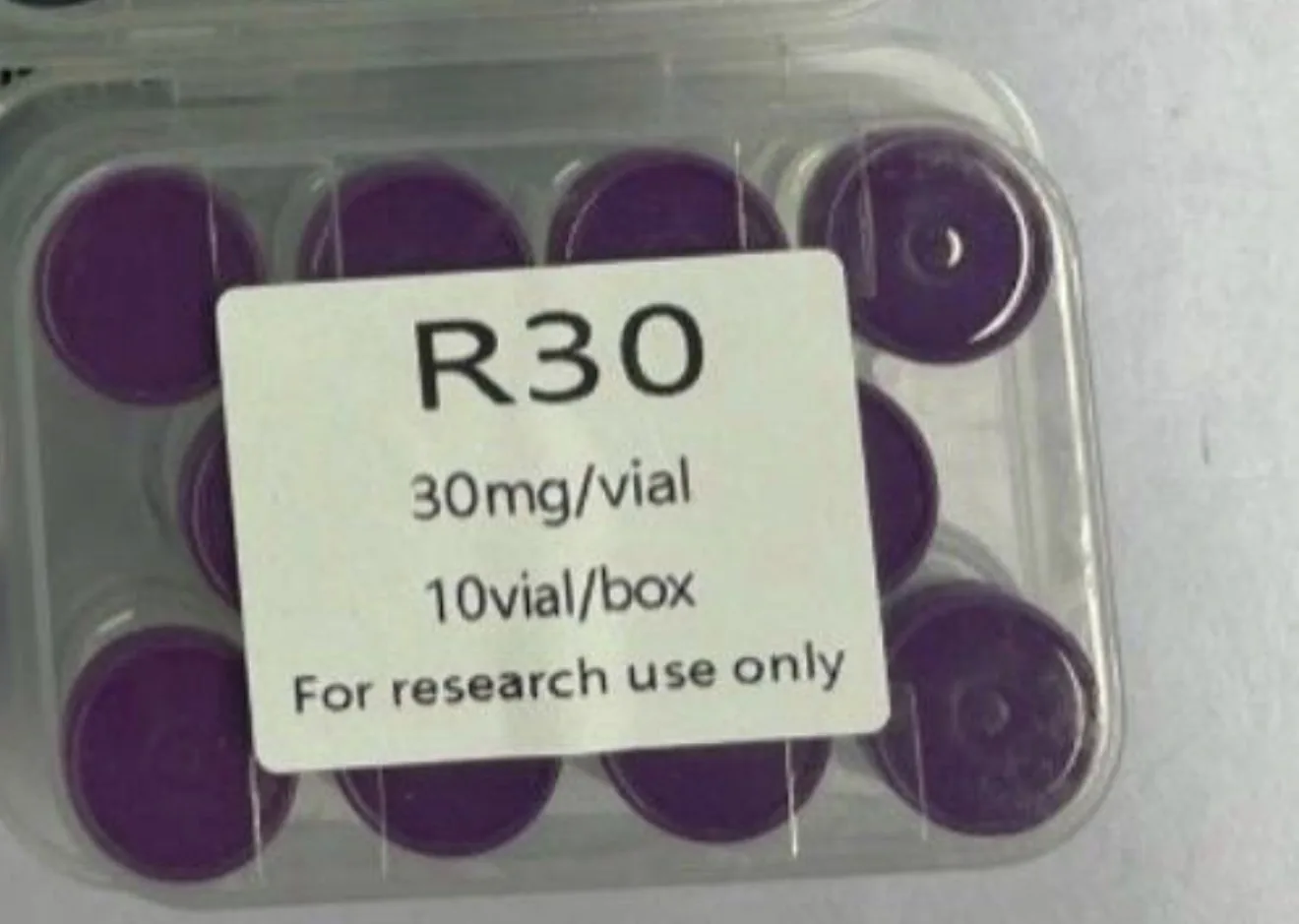
The customer said the R30 had been purchased from Bella and provided payment evidence. However, he also explained that RT30-260527 was an internal IDUN tracking code used to identify the vendor order, not an XTP batch number. His boxes had no batch number printed on them. Other customers said their visually similar R30 had been sold as batch R30-003 and produced failed results. When someone suggested the good IDUN report might make further testing unnecessary, members pushed back. One good result from stock with no confirmed XTP batch number couldn’t resolve the failures affecting customers who had specifically been told they held R30-003.
Bella nevertheless insisted:
“These products are all from the same batch and there is no distinction between high-quality and low-quality ones.”
That statement creates another problem. If the good IDUN vials, the low-purity vials, the severely underfilled vials and the later tirzepatide samples were genuinely all from one batch, then the batch was extraordinarily inconsistent. If they weren’t, then different products were being passed off as the same batch without reliable traceability. Either explanation undermines the claim that the good test cleared R30-003. The report proved that those particular IDUN samples tested well. It didn’t prove that they came from the same stock as every other vial being disputed.
The Donors Were Chosen by Dice
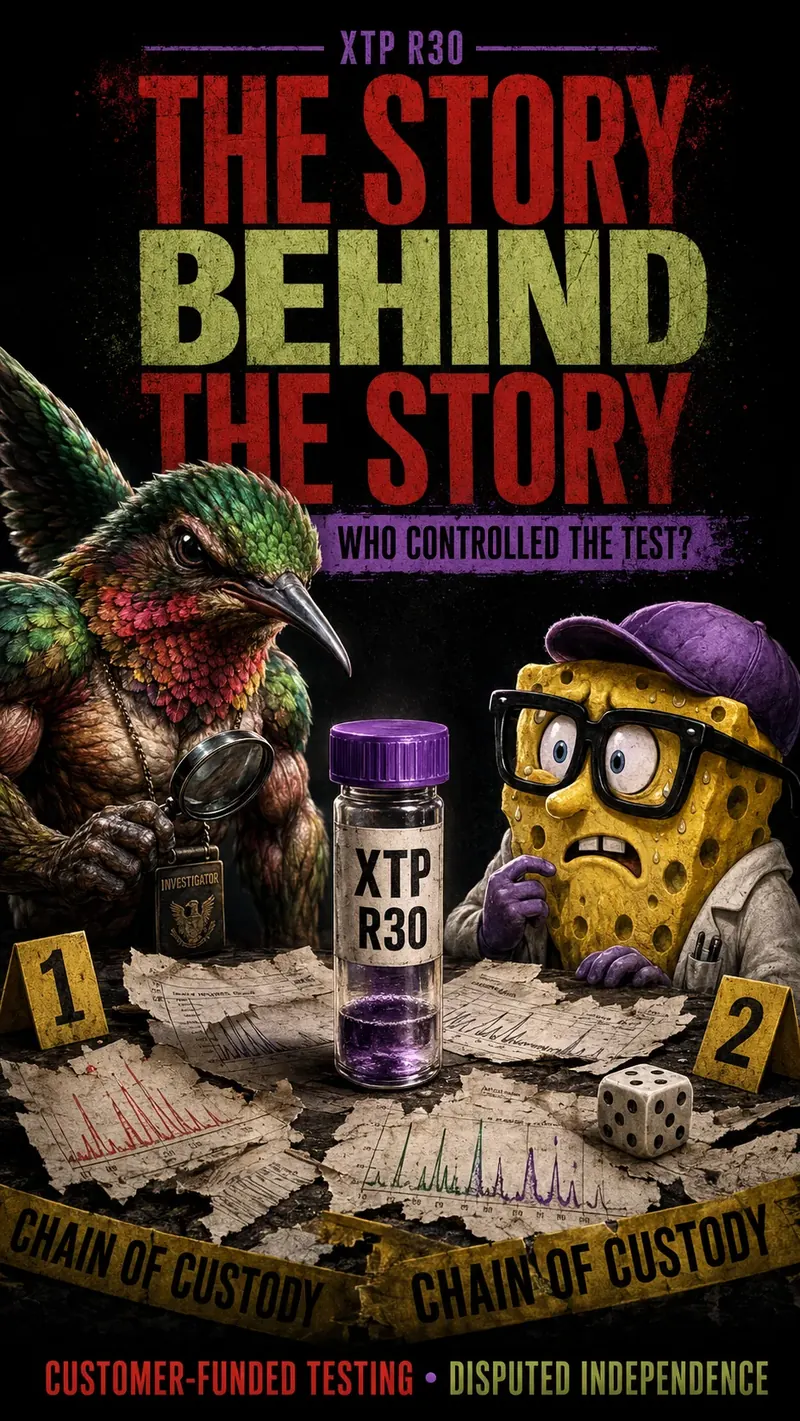
On 22 June, XTP carried out the promised random selection inside the group. Members were asked to be online and roll Telegram’s virtual dice. Bella initially paused the process because only 14 people were present and many US customers were asleep, then waited for more members before continuing.
The first qualifying rolls were used to select three vial donors. XTP then checked their payment records to confirm that all three had purchased the R30 from the company. This is important because it documents the chain of events behind the retest:
XTP created and controlled the group
XTP restricted participation to verified customers
The donors were selected publicly using dice
XTP checked their payment records
Donors were required to film the packing process
XTP funded the testing and shipping
Three customer vials were sent for testing
Those three vials later produced the Janoshik report identifying approximately 2 mg of tirzepatide per vial, rather than 30 mg of retatrutide.
The Anti-Tampering Rules
Once the three donors had been selected and verified, XTP published mandatory shipping rules intended to “completely eliminate” the possibility of sample dilution, replacement or alteration.
Each donor was required to use a brand-new, unopened vial with its original seal intact. They were then expected to make one continuous, unedited video showing the vial and cap colour, the entire packing process, the journey to the courier and the handover of the parcel in exchange for a shipping receipt. Any cut, interruption, blurry footage or failure to follow the instructions could disqualify the sample.
Customers quickly pointed out that this wasn’t practical. Filming an uninterrupted journey from home through to the courier could produce an extremely long video, and many US courier locations don’t permit customers to record inside. They questioned why XTP was demanding such an elaborate process without first putting its refund commitment clearly in writing.
Emma from XTP then admitted this was XTP’s first group test and that the company had no previous experience organising one. Members proposed a more workable chain of custody: each donor would film the vial being packed, seal the parcel with a tamper-evident sticker and send it to the person consolidating the samples. That person could then confirm that every seal remained intact before filming the final package sent to Janoshik.
The importance of this goes beyond whether XTP’s original instructions were realistic. The entire process was openly discussed with XTP, the donors were selected inside its own group, their purchases were checked, and multiple safeguards were created specifically to prevent substitution or interference.
XTP can’t reasonably present the eventual tirzepatide result as an unexplained hostile test while ignoring the elaborate chain-of-custody process it demanded before the samples were accepted.
From Selection to Result
The timeline inside XTP’s own group establishes how the final Janoshik retest was handled.
22 June: Three donors were selected using Telegram’s virtual dice and their payment records were checked by XTP.
23 June: XTP published its mandatory anti-tampering rules. Donors were required to send unopened vials, document their seals and cap colours, and film the packing process. Members proposed tamper-evident stickers when XTP’s demand for continuous filming through to courier handover proved impractical.
11 July: The person consolidating the samples reported that the package had reached the Czech Republic and was expected to arrive at Janoshik by 14 July.
13 July: Tracking showed that the package had been delivered. The group was told, “Janoshik has possession of our samples.”
23 July: Janoshik conducted the analysis.
27 July: The report was posted directly inside the XTP testing group.
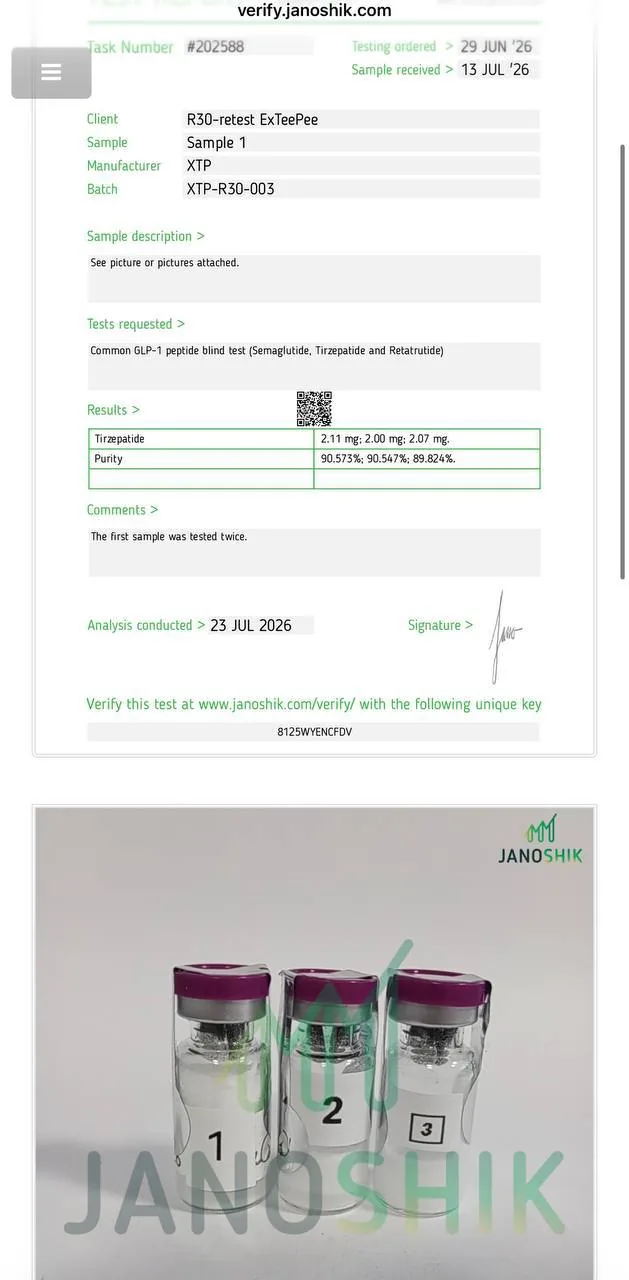
The report, task #202588, identified tirzepatide rather than retatrutide. It recorded measurements of 2.11 mg, 2.00 mg and 2.07 mg, with purity results of 90.573%, 90.547% and 89.824%. It also stated that the first sample was tested twice.
This wasn’t an anonymous report appearing without context. The entire journey, from selecting verified XTP customers to confirming delivery and publishing the result, was documented inside the group established and supervised by XTP.
From Retest to Denial
When the report was posted on 27 July, members were stunned. None of the tests identified retatrutide. All three results showed approximately 2 mg of tirzepatide. The group organiser reminded everyone that the samples had been tamper-proofed and photographed. Others also questioned what anyone would gain by substituting the vials with 2 mg of tirzepatide, a product strength that isn’t ordinarily sold. That doesn’t independently prove where the contents originated, but it makes deliberate substitution a particularly strange explanation.
The following day, Bella posted XTP’s official response inside the same testing group. It claimed that there had “not been a single testing report” showing tirzepatide and suggested that conflicting information might involve human interference or malicious commercial competition. That statement was made in the very group where the Janoshik report identifying tirzepatide had been posted less than 24 hours earlier.
XTP had created the group, controlled its membership, verified the donors, watched them being selected by dice, imposed anti-tampering rules, funded the testing and followed the shipment to Janoshik. When the result arrived, the company didn’t explain how interference could have occurred within that process. It simply claimed that no tirzepatide result existed.
XTP ended its statement by welcoming testing from customers and third-party laboratories “such as Janoshik.” Apparently, Janoshik is welcome when its results support XTP, but when an XTP-organised Janoshik test identifies the wrong peptide, the report suddenly becomes something that never happened.
The Customers Ask for Refunds
XTP’s announcement didn’t address the question its customers were actually asking: would the company honour the refund guarantee agreed before the retest?
Members asked whether XTP no longer trusted Janoshik, how three randomly selected samples could contain almost identical quantities of the same wrong peptide and what solution would be offered to customers. They also pointed out that the tamper labels remained visible in Janoshik’s photographs.
The three results were remarkably close:
2.11 mg tirzepatide, 2.00 mg tirzepatide, 2.07 mg tirzepatide
Customers argued that deliberate interference was difficult to reconcile with three independently selected vials producing virtually the same unusual result. They asked XTP to identify if any of their manufacturers produced 2 mg tirzepatide kits, which is not a normal quantity of tirz to produce, which therefore suggests that a critical supply or packaging error was more plausible.
The mood inside XTP’s own group turned openly hostile. Customers accused the company of rewriting its rules, dismissing every unfavourable test and blaming the people who had followed the process XTP designed. Several said that an honest acknowledgement, refunds and an investigation into the supplier might have preserved their trust. Instead, they were left with accusations of malicious competition and no clear answer about compensation. The test exposed a serious product failure. XTP’s response turned it into a crisis of trust.
Janoshik Confirms the Identification
The group organiser contacted Janoshik after XTP questioned the result. Janoshik replied that it could confirm “with certainty” that the identification was correct. The laboratory said there was no indication that the samples had been mishandled inside the lab. It asked whether anything could have happened during packing or transport because of the difference between the earlier results and the retest, but its recommendation pointed back to production:
“We recommend verifying their manufacturing and filling process, as the inconsistencies you described strongly suggest an issue at that stage.”
That leaves XTP with a problem its statement doesn’t address. Janoshik stands behind the tirzepatide identification, found no evidence of laboratory mishandling and believes the reported inconsistencies strongly suggest a manufacturing or filling issue. XTP, meanwhile, says no tirzepatide report exists and raises the possibility of malicious competition without explaining how three verified customer vials arrived at essentially the same unusual result.
Refund Requests Were Already Being Ignored
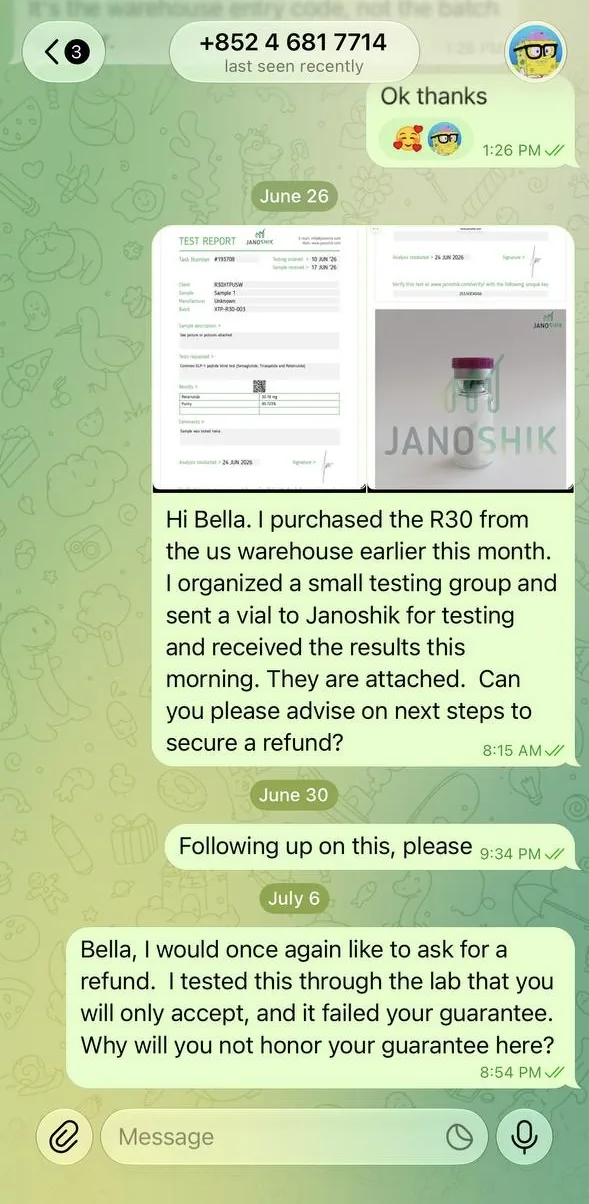
The refund dispute also began before the latest retest. One customer sent Bella a failed Janoshik result on 26 June and asked how to obtain a refund. After receiving no answer, the customer followed up on 30 June and again on 6 July, pointing out that the product had been tested by the only laboratory XTP said it would recognise and had failed XTP’s guarantee. The messages shown received no response.
Another customer said three different products purchased from XTP since February, MOTS-c, tesamorelin and retatrutide, had all failed Janoshik testing. He said he’d been removed from one group after raising the issue and that repeated emails and Telegram messages to Bella had gone unanswered.
So the latest refusal isn’t an isolated disagreement over one strange result. Customers say they’d already been asking XTP to honour failed Janoshik tests before the company organised its own retest. When that retest also failed, and Janoshik confirmed the identification, XTP moved from silence to blaming possible interference.
The tests created the refund obligation. XTP’s response created the wider scandal.
What the Customers Actually Wanted
Despite XTP’s repeated references to malicious competition, customers continued to make a much simpler request: honour the guarantee and refund the failed product.
They pointed out that the R30 had now failed more than once, including in the retest XTP helped create and control. The donors were randomly selected, their purchases verified, the vials documented, tamper-proofed and sent under rules approved by XTP. Janoshik confirmed the identity result and suggested examining the manufacturing and filling process.
Customers weren’t asking XTP to accept every allegation circulating online. They were asking it to accept the test conducted under its own conditions. One member summed it up:
“We are just asking for a refund on the product that didn’t test to your standards on more than one test, including the test that you were in control of.”
XTP could refund its customers and pursue its own supplier separately. Any dispute between XTP and the manufacturer shouldn’t leave customers carrying the cost of a product that failed the company’s published guarantee.
The longer XTP focuses on competitors, interference and its reputation, the more it avoids the only question customers still need answered: Where are the refunds?
This is another example of how past performance is not a guarantee of future performance. I remember months ago, last year, when members in my discord were being so positive about XTP and asked me to interview Bella. Bella seemed very receptive to the idea of the interview, but it never got past the answering my questions stage and she ended up ghosting me.
Let’s hope for the sake of the customers who are left with bunk products, that XTP does the right thing and sticks by their refund promises.


Comments