
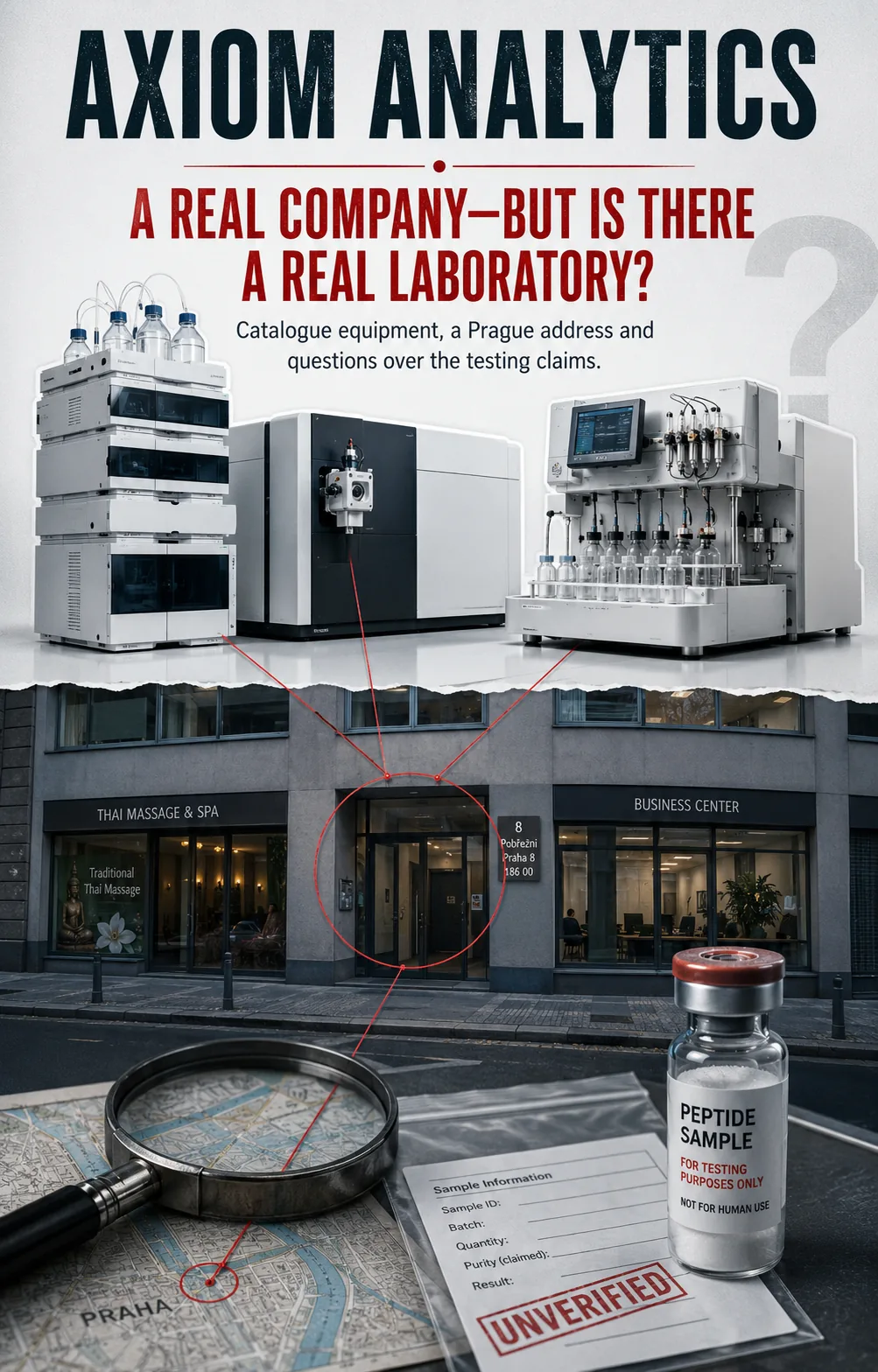
Its website presents Axiom CZ s.r.o. as an independent analytical laboratory offering quantitative peptide analysis and identity verification. Customers are invited to submit samples and receive publicly verifiable results within five to seven business days.
However, according to Janoshik,
“It’s fake company, doesn’t test anything”
So I decided to take a closer look and what i found does uncover several issues that Axiom needs to explain.
The company is real
Despite the claim that Axiom is a fake company, AXIOM CZ s.r.o. is a real Czech legal entity. Czech records show that the company was incorporated on 19 October 2012 under company number 24233935. Its registered office is listed as Záhřebská 148/50, Vinohrady, Prague. What can’t currently be found is any public history connecting that company to peptide testing, HPLC or LC-MS analysis before 2026. Its recorded activities are broad professional, scientific and technical services. That isn’t evidence that it’s operated an analytical laboratory since 2012.
The legal company may be genuine, but the relevant question is whether it owns and operates the laboratory described on its recently created website.
The website appeared in 2026
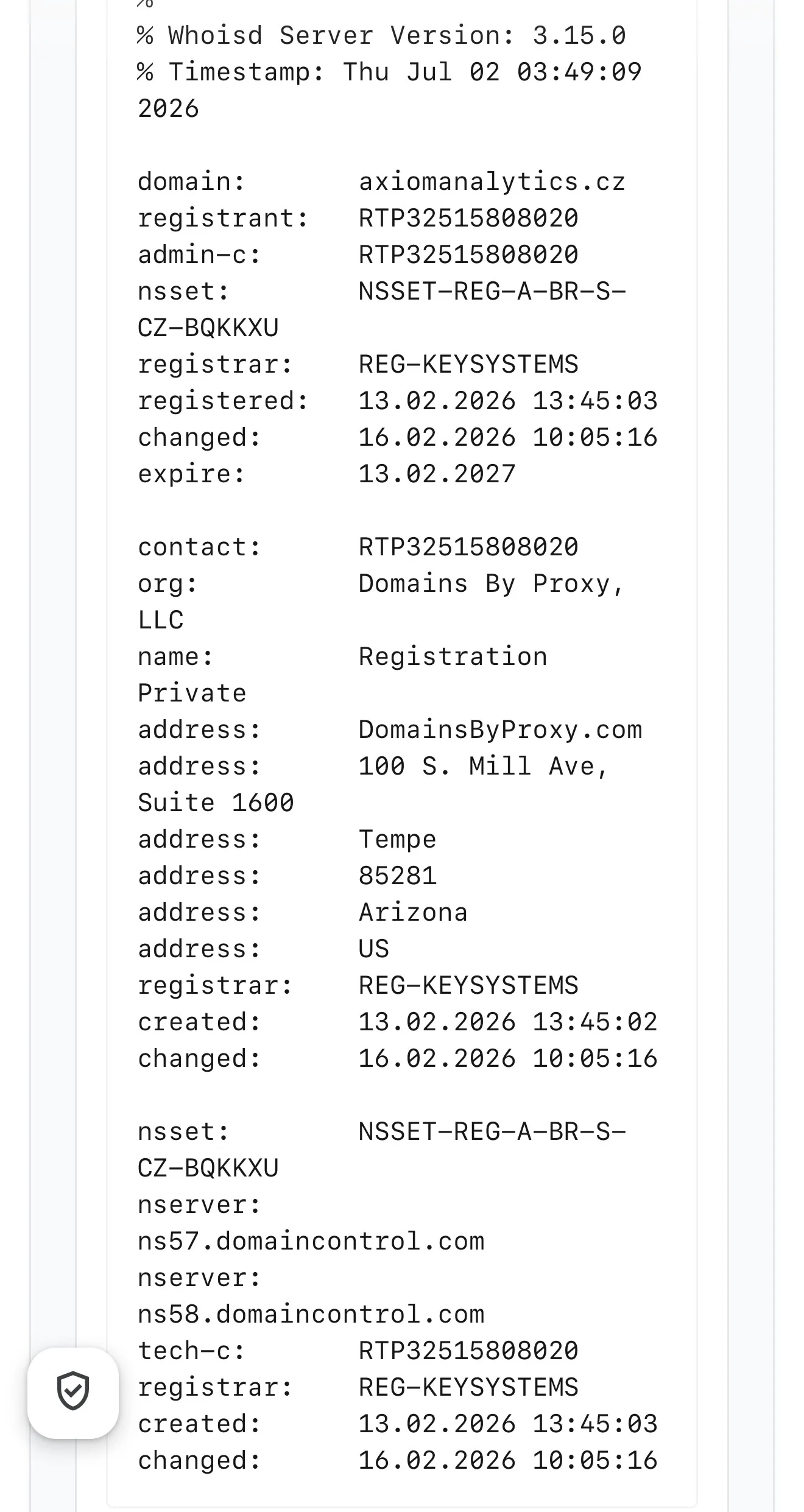
Official WHOIS information shows that axiomanalytics.cz was registered on 13 February 2026. That means the company’s 2012 incorporation date shouldn’t be confused with the beginning of Axiom Analytics as an online peptide-testing service. So far, no earlier laboratory website has been identified. Axiom’s demonstration report contains dates from November 2025 and uses task number #00421. However, the page clearly states that it’s an example created for demonstration purposes.
The dates and task number may therefore be entirely fictional. They can’t be treated as evidence that Axiom completed 421 assignments or performed peptide testing before its domain existed.
Is the registered office also the laboratory?
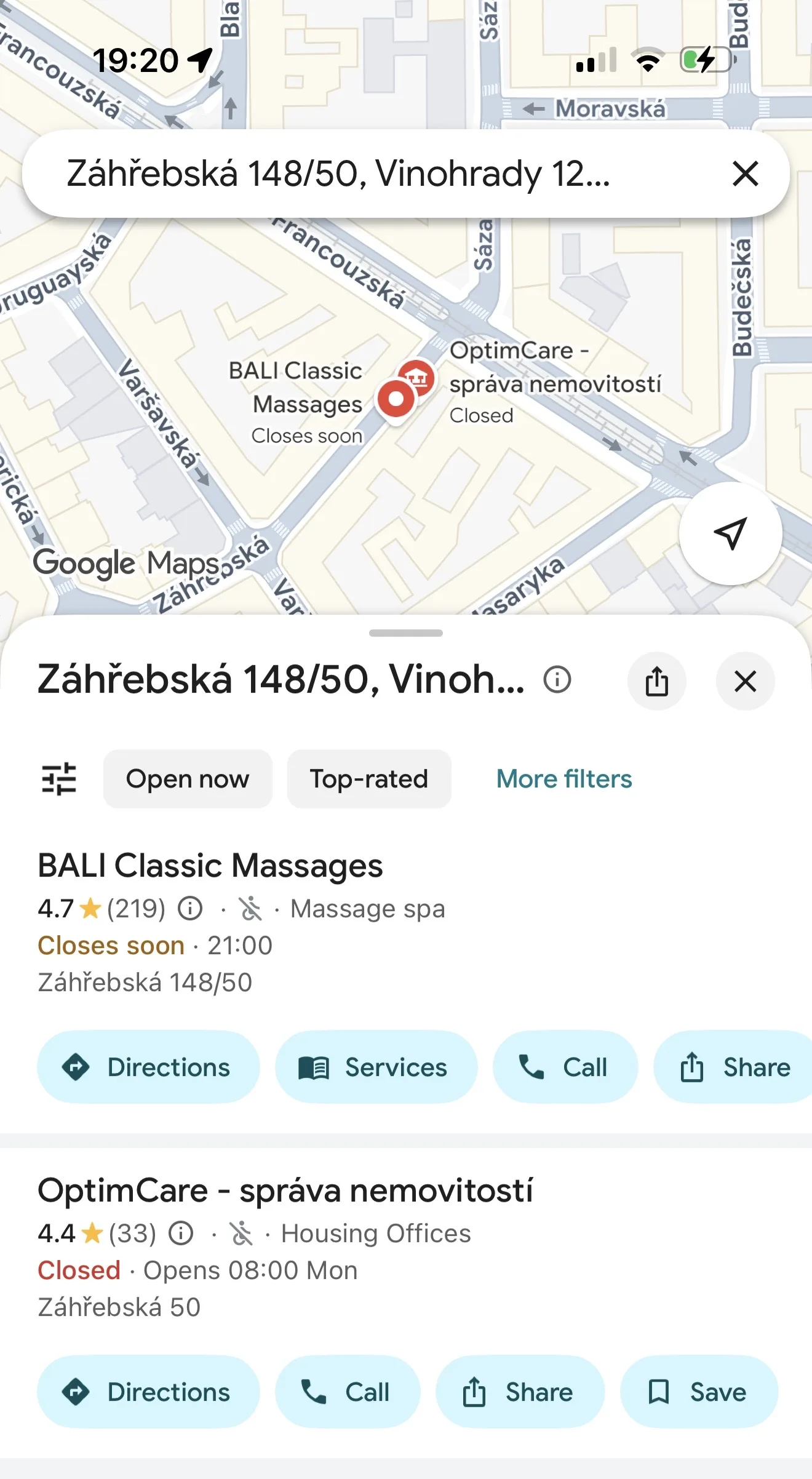
Axiom’s website tells customers to “send your sample to our laboratory,” before displaying the Záhřebská 148/50 address in its footer. Public searches of that address show a mixed-use Prague building associated with several unrelated businesses, including BALI Classic Massages, OptimCare property management and legal services. No analytical laboratory is publicly listed there.
A laboratory could operate from an unlisted unit, and Axiom may provide customers with a different delivery address after they submit the request form. However, no unit number, laboratory photographs or independently confirmed operational address appears on the website.
“Our Equipment” but not photographs of Axiom’s equipment
Axiom includes a section titled “Our Equipment,” featuring images of two expensive laboratory systems. Reverse-image searches confirm that both are catalogue photographs taken from manufacturers’ promotional material. They’re not photographs of machines installed at Axiom’s premises.
The first is a Gilson purification system. The second is a Biotage Syro II automated peptide synthesizer.
Using stock photographs isn’t automatically deceptive, particularly when a company is illustrating the type of technology it uses. But placing catalogue photographs beneath the heading “Our Equipment” naturally creates the impression that Axiom owns those systems. The website provides no photographs of its laboratory, equipment serial numbers, installation records, calibration documents or operators standing beside the machines.
A purification system described as high-resolution LC-MS
Axiom labels the first image:
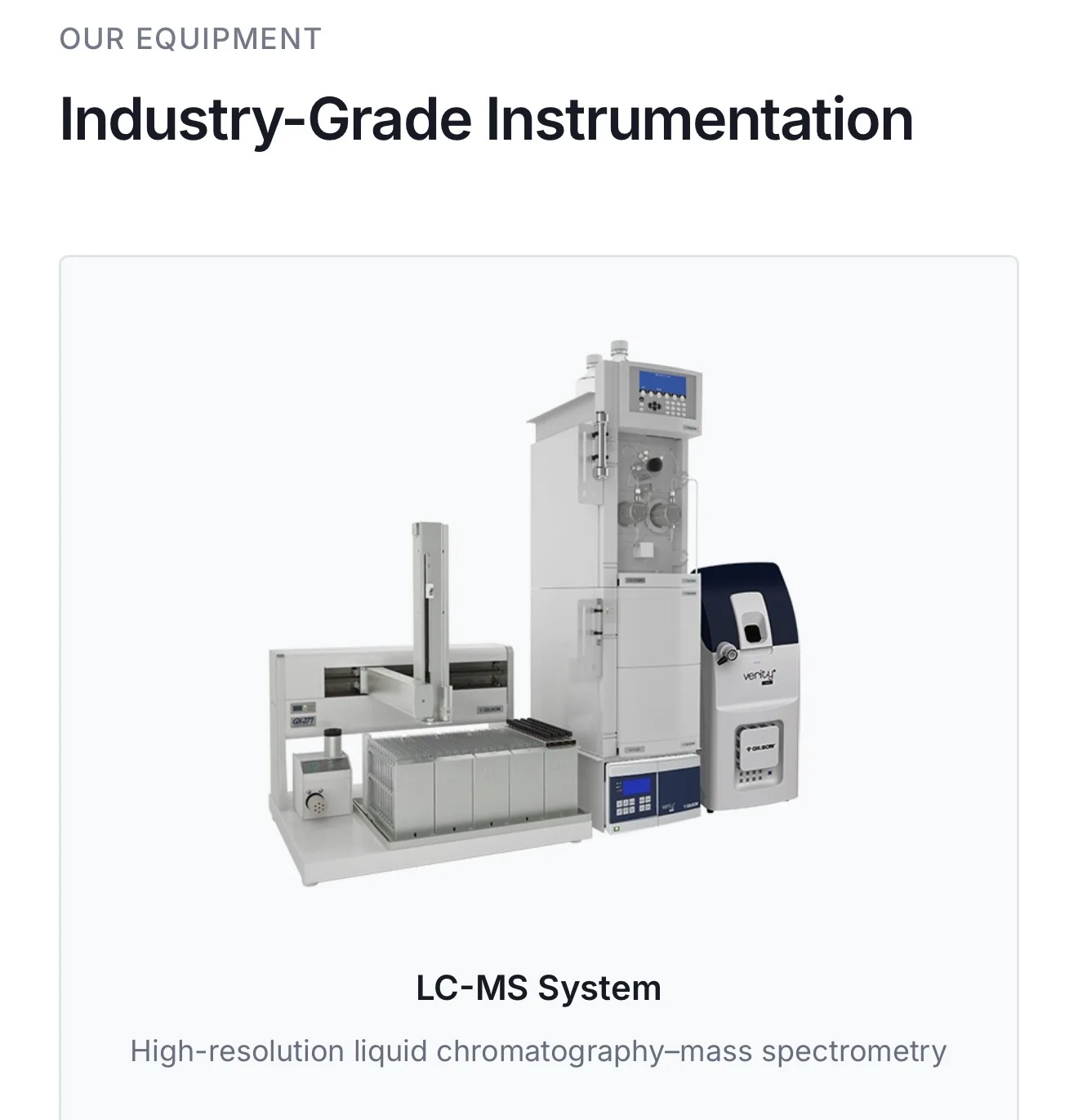
“LC-MS System, High-resolution liquid chromatography-mass spectrometry.”
Calling it LC-MS is broadly correct because the pictured configuration combines liquid chromatography with mass detection. The problem is the claim that it’s high resolution. The image is associated with Gilson’s VERITY and PLC product range, marketed principally for semi-preparative and preparative purification. Gilson describes the VERITY 271 LC-MS as a system designed to isolate compounds and perform mass-directed peptide purification.
Its mass detector is a single-quadrupole system. Manufacturer specifications list resolution around ±1 m/z. That isn’t what analytical laboratories normally mean when they refer to high-resolution mass spectrometry, which generally involves accurate-mass instruments such as Q-TOF or Orbitrap systems.
The Gilson system can produce UV and mass data. It can help identify the target mass and determine which fraction should be collected during purification. That doesn’t make it useless for analytical observations, but it’s not accurately represented by the description “high-resolution LC-MS.”
The pictured configuration is primarily associated with peptide purification rather than the type of high-resolution analytical identity testing claimed underneath it.
Why does a testing laboratory need a peptide synthesizer?
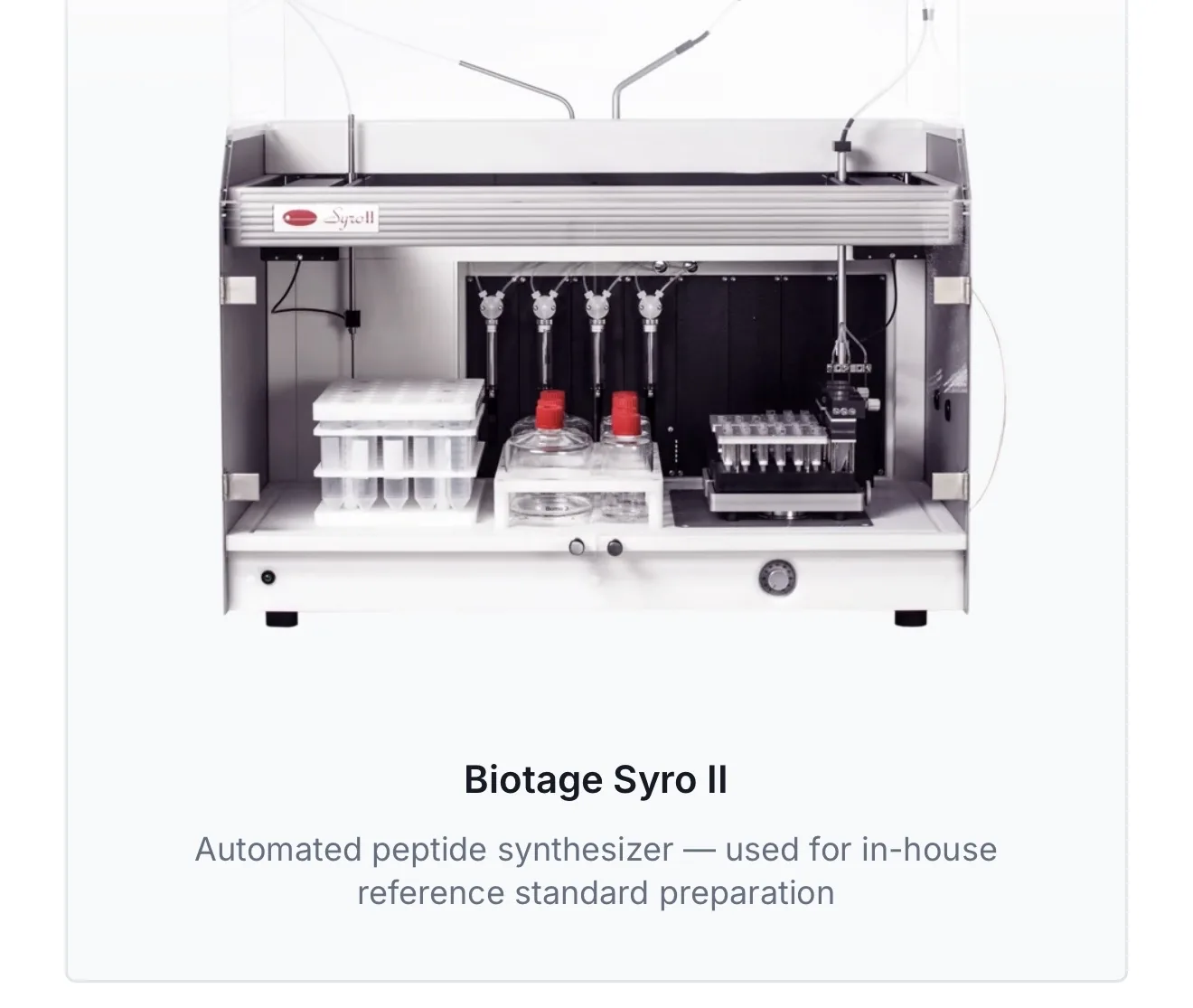
The second catalogue image shows a Biotage Syro II. This isn’t a testing instrument. It’s an automated system used to synthesise peptides in parallel. Axiom says it uses the machine for “in-house reference standard preparation.”
This is something more commonly found in an R&D laboratory working on peptide synthesis and appears to be an unlikely choice for a newly established peptide-testing service.
In addition, synthesising a peptide doesn’t automatically produce an authenticated reference standard. The synthesizer produces candidate material, not a certified reference standard at the press of a button. The resulting material would still need to be purified, structurally characterised and assigned an accurate purity and peptide content. Depending upon how it was intended to be used, that could require accurate-mass analysis, amino-acid analysis, quantitative NMR or other independent and orthogonal methods.
The two machines shown together make more sense as a peptide synthesis-and-purification workflow than as the complete equipment list of an independent analytical testing laboratory.
Questions over the demonstration report
Axiom’s example report also raises methodological questions.
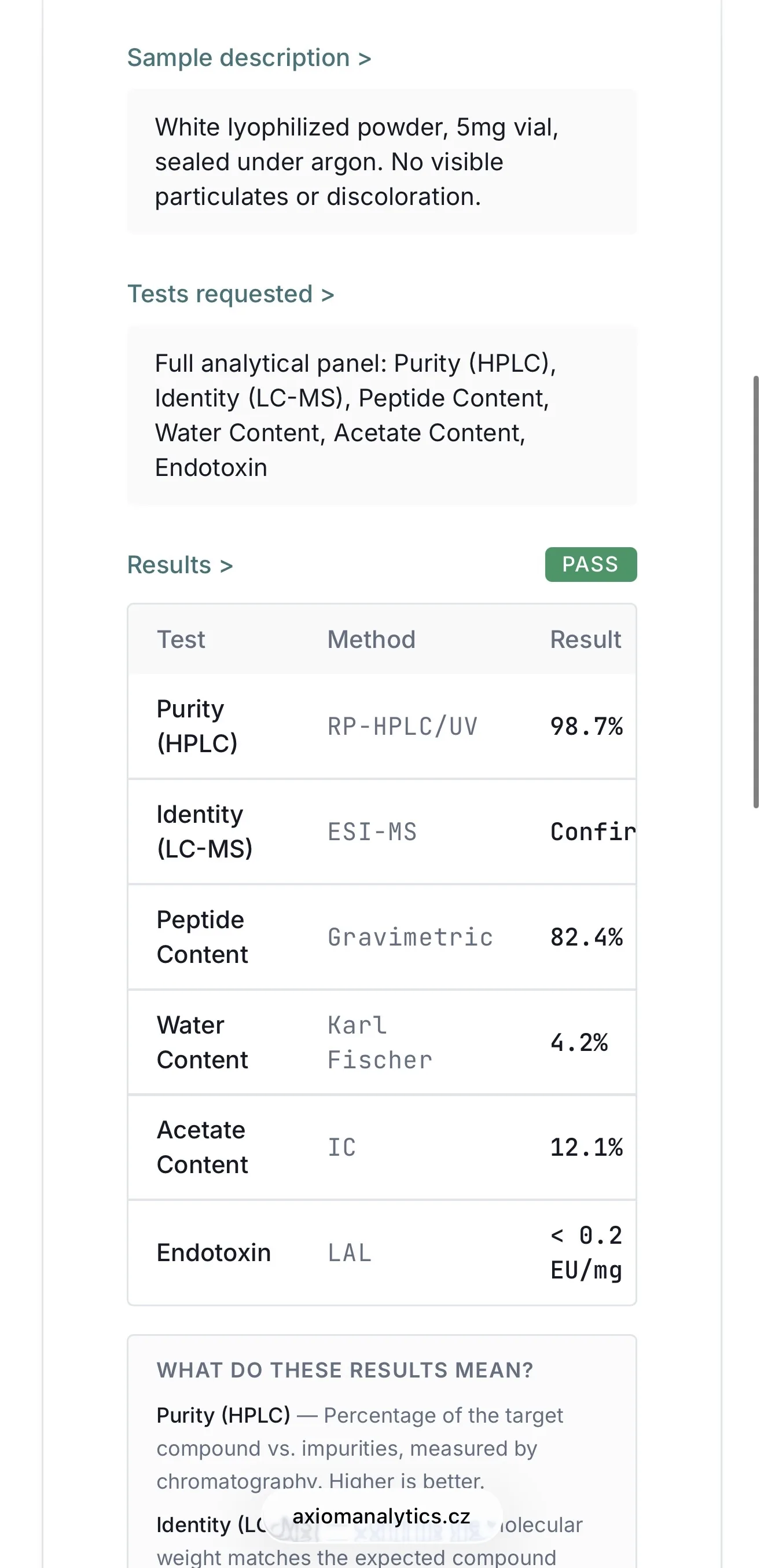
It lists BPC-157 as a 5 mg vial, but the results give “Peptide Content” as 82.4% rather than reporting the measured quantity in milligrams. The method is described as “Gravimetric.” Gravimetric analysis measures weight. By itself, it can’t establish which portion of a vial’s contents consists of peptide rather than water, acetate, excipients or other material.
The report declares the sample a PASS but doesn’t state the specification or acceptance limits used. Identity is marked “Confirmed” without providing the expected mass, observed mass, tolerance or mass spectrum.
No chromatogram, peak table, integration data, calibration information, instrument metadata or named analyst is included in the example.
It’s only a demonstration report, so it shouldn’t be examined as though it represents a genuine sample. However, Axiom created it to demonstrate what customers can expect. Its omissions therefore remain relevant.
What would resolve this?
None of these findings independently proves that Axiom fabricates results. A real laboratory can operate from an unlisted unit. It can own the same machines shown in catalogue photographs. It can use preparative equipment for more than one purpose and prepare internal working standards when properly characterised.
But Axiom’s public presentation currently asks customers to accept all of those possibilities without supplying the evidence needed to verify them.
Axiom could answer the questions relatively easily by providing:
Its physical laboratory address and unit number
Dated photographs or a live tour of the laboratory
Exact instrument models and serial-number plates
Evidence that the displayed systems belong to Axiom
The qualifications of its analysts
Raw chromatograms and mass spectra
Validation information for its methods
An explanation of its gravimetric peptide-content calculation
The origin and characterisation of its in-house standards
Confirmation of which tests are performed internally and which are outsourced
For now, the evidence supports AXIOM CZ s.r.o. being a real registered company. What remains unverified is whether Axiom Analytics operates the laboratory it presents online and whether its equipment and methods can support the results it claims to provide.
A catalogue photograph isn’t a laboratory. A synthesised peptide isn’t automatically a reference standard. And a preparative purification system doesn’t become high-resolution LC-MS simply because a website describes it that way.
Axiom Analytics is on Telegram and I’ve reached out to them, so let’s wait and see what the response (if any) is.

Comments