
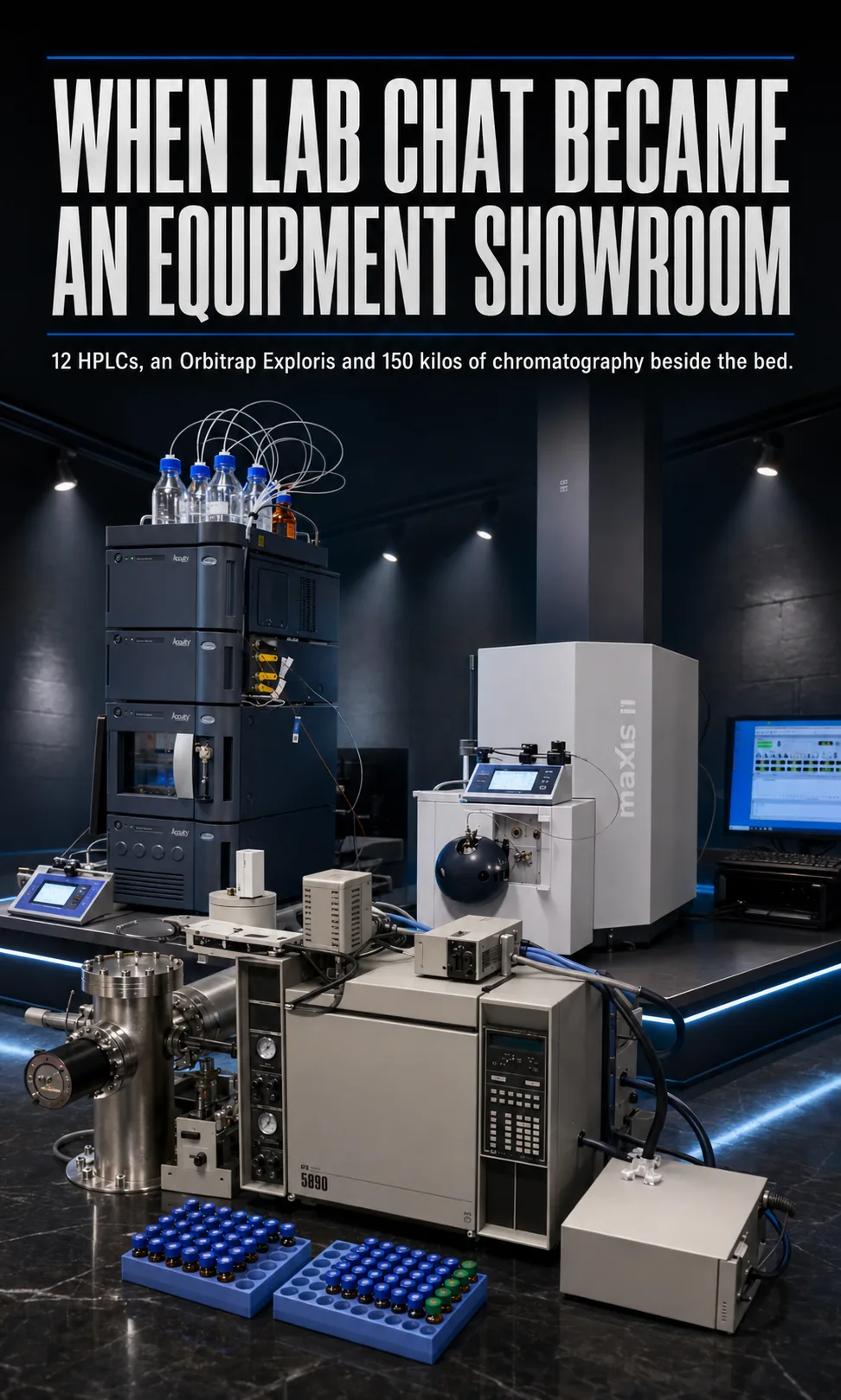
It’s great to see the boys getting along for once and showing off their toys together in the K-Hole Lab Chat. After all the recent laboratory battles, they appear to have bonded over their shared love of extremely expensive equipment and machines old enough to qualify for museum admission.
The following is a slightly humorous summary of the conversation between the new friends.
The conversation began with a discussion about laboratory capacity, and before long everyone was comparing machines.
Pacific Coast Biologics said peptide testing takes time because an HPLC cannot ordinarily run multiple peptide analyses simultaneously. If a laboratory wants ten HPLC analyses performed at once, it needs ten HPLC machines.
He questioned how a US laboratory could operate at that scale while charging only $150 to $250 per analysis once the cost of the equipment and the annual calibration required by ISO 17025 and GMP-style laboratories were taken into account.
Janoshik responded with a fairly direct laboratory flex:
“We have 12 HPLCs.”
Pacific Coast Biologics asked whether newer Q-TOF or DAD detector modes could handle multiple injections simultaneously. Janoshik said gas chromatography had offered multicolumn analysis for some time, although it was no good for peptides, and that more advanced LC-MS modes could do something similar.
According to Janoshik, it’s largely a software and methodology issue. With a simple sample matrix, a continuous isocratic method can be used, allowing samples to be injected as quickly as the autosampler can cycle. However, he said this only works for certain analyses, such as screening thousands of batches containing the same analyte in microplates.
Pacific Coast Biologics joked that he might need to update his methods because he was still operating with 2008 methodology. He had used microplates before, but the HPLC analyses were still performed one at a time. They could be programmed to run overnight, but each produced an individual report.
Janoshik said his laboratory now tends to steer away from the “fancy stuff”:
“It’s all fun and games until you troubleshoot with 4,000 samples in the row.”
He said the laboratory had dealt that day with a completely blocked desolvation line on an LC-MS because of material in the peptide samples. He also said UHPLC systems clog more easily than conventional HPLCs, despite the laboratory filtering everything through 0.22-micron filters.
Pacific Coast Biologics had recently experienced his own clogging problem in the needle seat. The increased back pressure disrupted his retention times and took several days to fix.
Then the equipment nostalgia began.
Pacific Coast Biologics identified his current system as an Agilent 1100, describing it as “a dinosaur.” He said it still worked well for purification and had met his needs until he began examining peptides.
Janoshik said he ran his first tests on a Gilson semi-preparative system and posted a photograph of the machine.
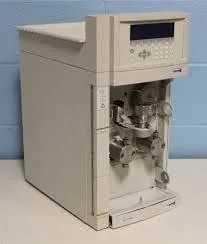
It wasn’t exactly a discreet little benchtop unit.
Janoshik described it as “150 kilos worth of HPLC” and revealed that he had kept the Gilson setup in his student dormitory, next to his bed, while its enormous pump heads went “bump, bump, bump” throughout the day and night.
Some students keep a mini-fridge beside the bed. Janoshik apparently went with 150 kilograms of chromatography equipment.
Pacific Coast Biologics remembered using old Beckman Gold systems for method development before transferring proteins to an Agilent Prep 1200 system. The Beckman produced an HPLC trace that he said was accurate to within 1 to 2% when larger columns were subsequently run on the preparative system.
Janoshik described the old Gilson machines as preparative systems masquerading as analytical or semi-preparative equipment, but said they were “insanely robust.” He switched completely to Shimadzu after 2015 and said his current Shimadzu systems are heavily automated, including live online updates.
He also shared a dashboard displaying the status, latest analysis, errors and maintenance logs for several instruments.
Pacific Coast Biologics said he might need to investigate Shimadzu because Agilent prices had become “insane,” with even a refurbished unit costing around $25,000 to $30,000.
Janoshik said it would be difficult to find a ready-to-run HPLC for less unless the buyer could service it themselves. Because he has experience servicing Shimadzu equipment, he said he can obtain unusually good deals, but he wouldn’t attempt the same thing with Agilent.
Pacific Coast Biologics said he performs most Agilent servicing himself but occasionally encounters faults he cannot repair. Janoshik advised him to stay with Agilent because the time spent learning an unfamiliar system could wipe out any money saved.
They then moved on to Waters equipment.
Pacific Coast Biologics described his experience with a Waters preparative system as a nightmare and said his former company had spent around $75,000 on it. Janoshik said Waters had once offered his laboratory discounts of up to 80%, but it still refused because, in his words:
“The software is hell.”
Apparently, even an 80% discount couldn’t make the software more lovable.
Janoshik ultimately described Shimadzu as his favourite. He acknowledged that its software is very different from other systems but said it’s highly customisable and well suited to automated processing.
The conversation had now progressed naturally into 12 HPLCs, automated instrument dashboards, $30,000 refurbished machines, an 80% discount that still could not make Waters appealing and a 150-kilogram Gilson sleeping beside Janoshik’s student bed.
And the laboratory show-and-tell was only getting started.
Vanguard Brings in Reinforcements
Vanguard Laboratory entered the conversation while advertising for a method-development chemist and a molecular biologist.
The chemist role required experience with TOF-MS, Orbitrap, HPLC-MS/MS, GC-MS/MS and ICP-MS, along with five to ten years of industry experience and knowledge of EPA, AOAC, USP and FDA methodologies.
Later, when the discussion moved to detecting unknown substances, Janoshik asked whether Vanguard had high-resolution mass spectrometry.
Vanguard confirmed that it operates an Orbitrap Exploris HRMS and uses LC-MS/MS for targeted screening. The laboratory said it already has targeted methods for some analytes and shared a photograph of its collection of certified reference materials.
These included fentanyl, methamphetamine, lorazepam, LSD, phenibut, oxycodone, phenobarbital, cocaine, heroin, dextromethorphan, amphetamine, melatonin and several others.
Janoshik said lateral-flow immunoassays can sometimes detect much lower concentrations than untargeted GC-MS or LC-MS screening, particularly when quadrupole instruments are used.
He also listed substances his laboratory had tested, including DMAA, PDE5 inhibitors, diclofenac and dexamethasone.
Vanguard then shared images from its own mass-spectrometry work and said it performs targeted LC-MS/MS screening alongside high-resolution analysis using the Orbitrap Exploris.
By this point, Janoshik had revealed that his laboratory has 12 HPLCs, shown its automated Shimadzu systems with live online monitoring and discussed LC-MS equipment processing thousands of samples. Vanguard had responded by producing an Orbitrap Exploris HRMS and a catalogue of certified drug reference standards.
Several laboratories were now comparing their machines, methods and software as if someone had accidentally turned the chat into an analytical-chemistry motor show.
Or, as one member put it after Vanguard arrived:
“Lab Chat got some reinforcements.”
What began as a discussion about laboratory capacity had become the analytical-chemistry equivalent of everyone opening their garage doors and showing what they had parked inside.
When the Laboratory Dinosaurs Came Out
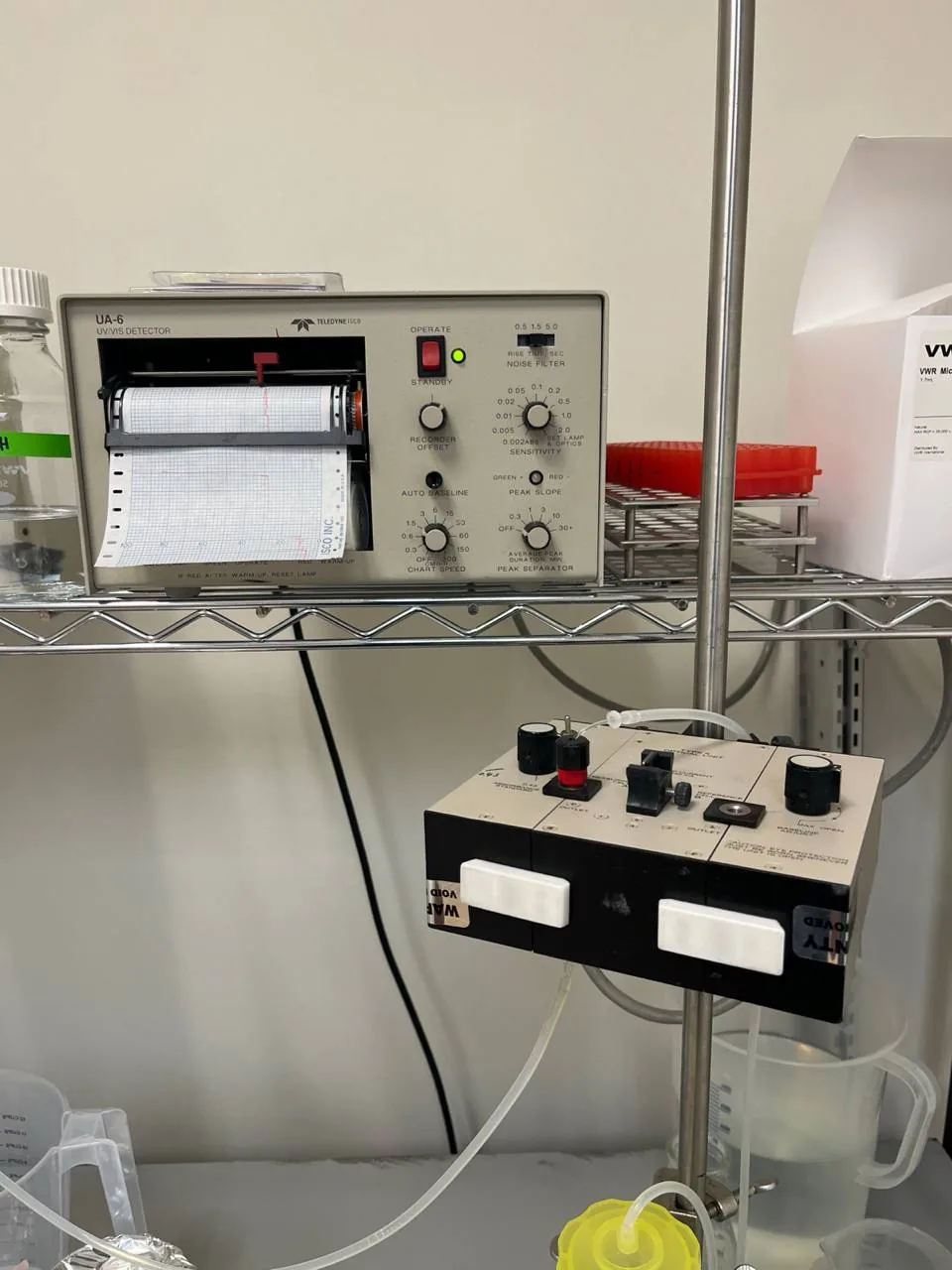
Pacific Coast Biologics then showed a homemade purification system, explaining:
“When you can’t afford an IKA, we build our own purification system. Check this out. Retro tech.”
The system used analogue equipment that had taken some time to calibrate. Pacific Coast Biologics said he verified the units using a DeNovix spectrophotometer and later mentioned that the founder of DeNovix had invented the NanoDrop.
He had also been lent a newer digital system by the founder of Q Biotech Corp, although he’d not yet found time to optimise it.
One member described working on the old analogue equipment as being:
“Like being a chiropractor for a dinosaur.”
Vanguard Laboratory then joined in with some vintage machinery of its own.
He said he’d recently dismantled an old HP 5890 gas chromatograph that had been connected directly to an FTIR system for continuous gas monitoring, describing the setup as “a beast.”
Vanguard also said he still had an HP 1080 equipped with RID and ELSD detectors lying around, although its autosampler requires a compressor.
Pacific Coast Biologics replied that the amount of old laboratory equipment still in circulation could be a gold mine for someone starting out. He also offered the details of an engineer in San Diego who services older systems.
Another member, then answered the call of the laboratory dinosaurs by posting photographs of an HP 5890 gas chromatograph.
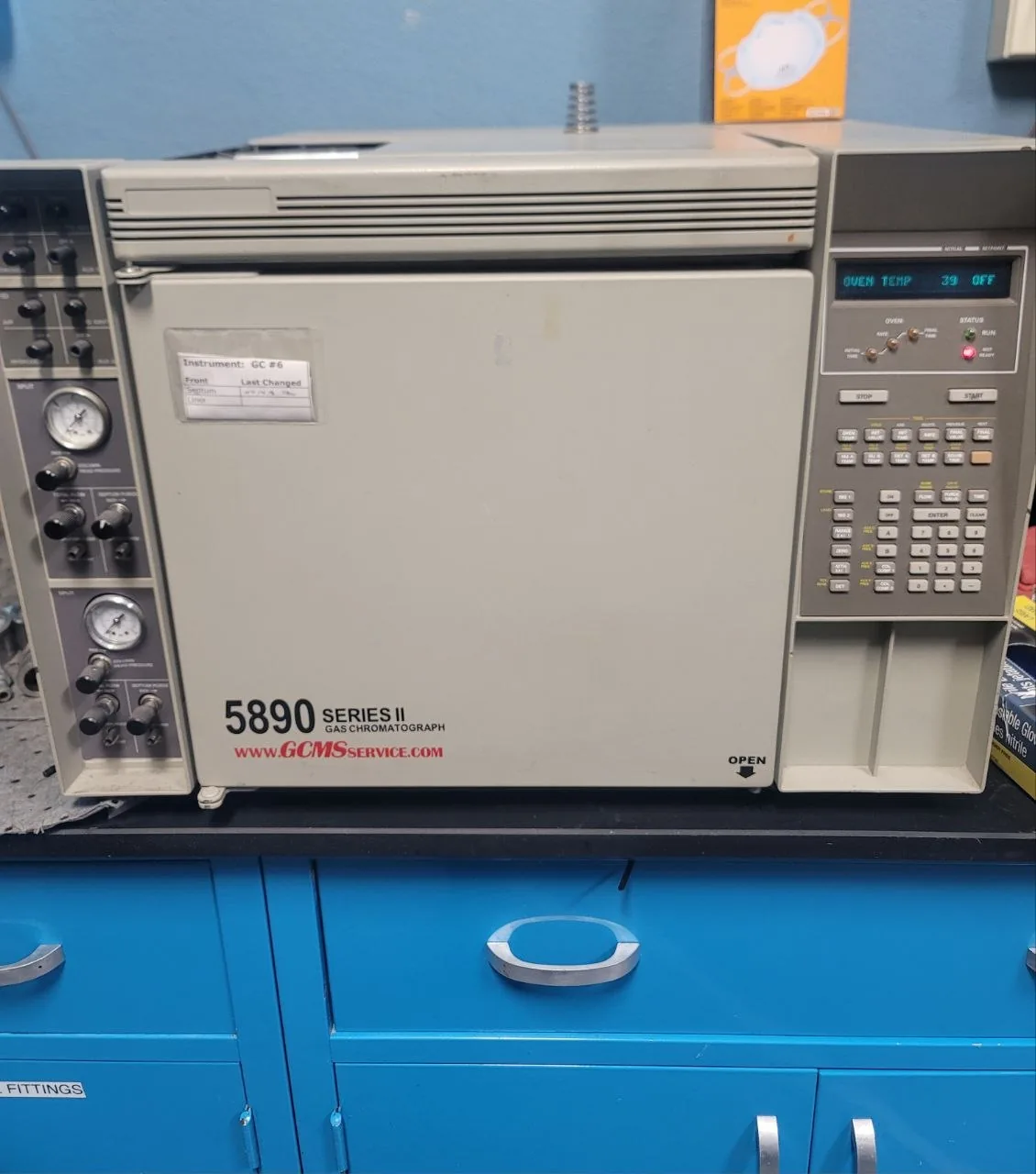
Vanguard Laboratory responded by saying he had “a couple of those lying around” and described the machines as “built like tanks” and posted a picture of them.
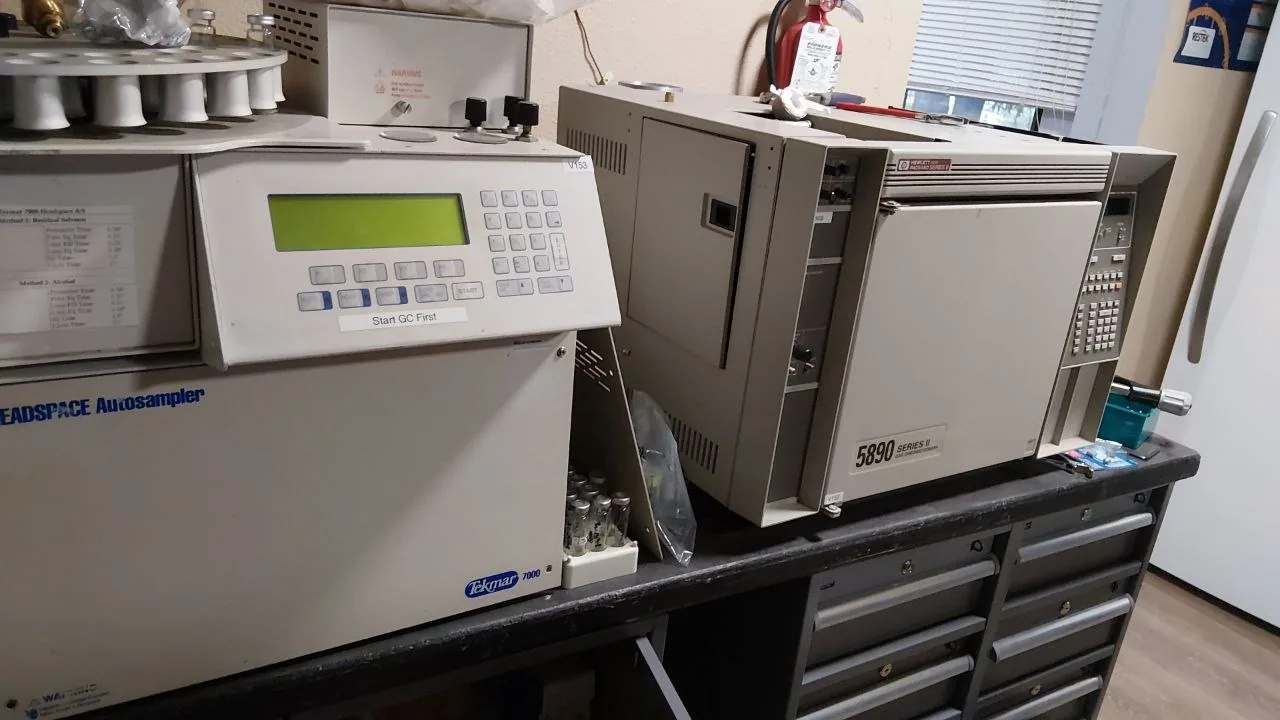
The member said its HP 5890 was used for analysing LPG samples, while Vanguard said its own 5890 systems were set up mainly for fuel analysis.
Not to be outdone, Vanguard shared a photograph of a newer Agilent system, describing it as “a bit more fun to play with.”
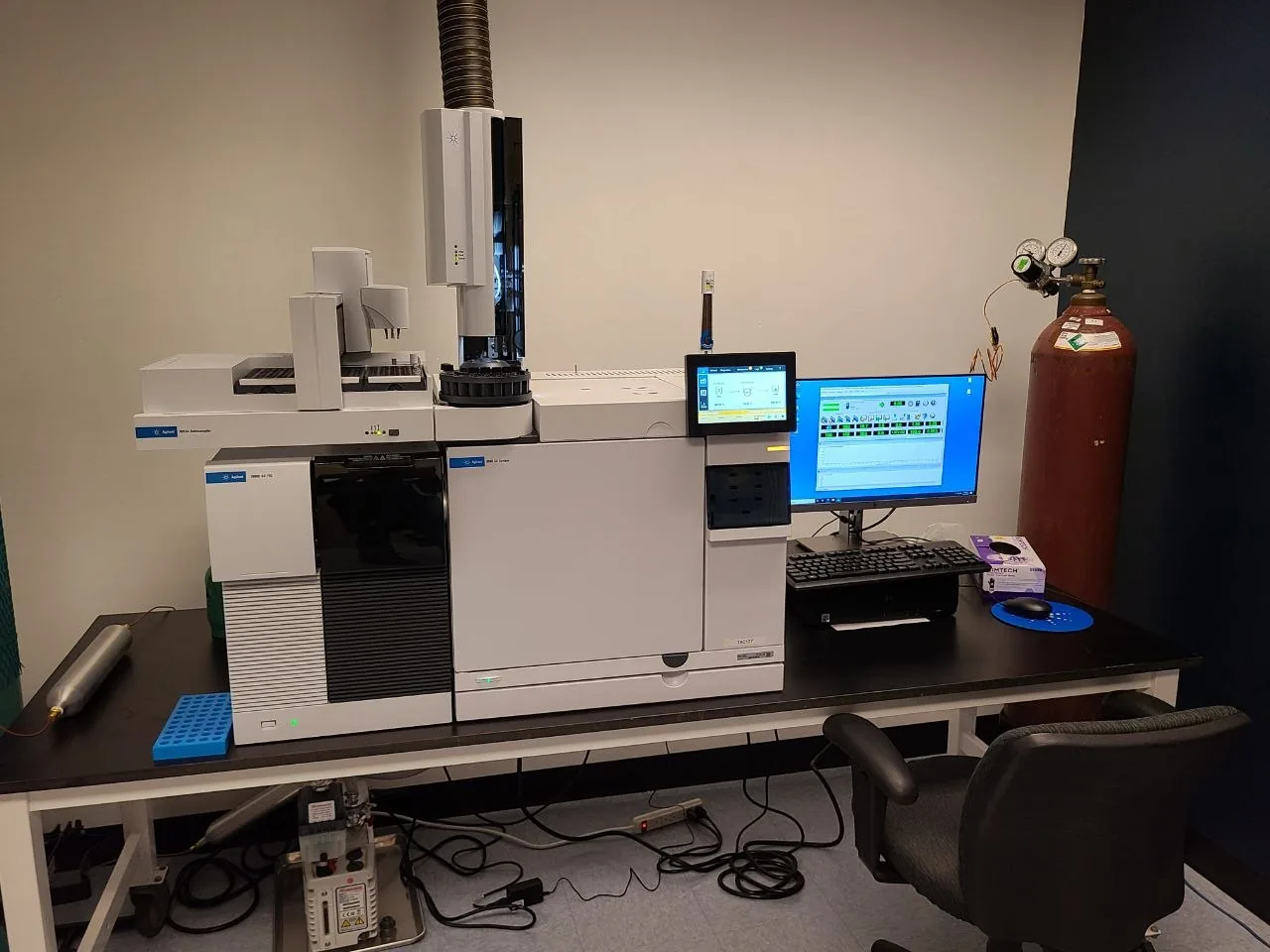
Pacific Coast Biologics then declared his love for Agilent systems, saying they were expensive but could last 30 years with proper maintenance.
Vanguard then posted a photograph of another old HP 5890 setup. He’d had finally got rid of the machine the previous year because he was running out of space, although the system was still working.
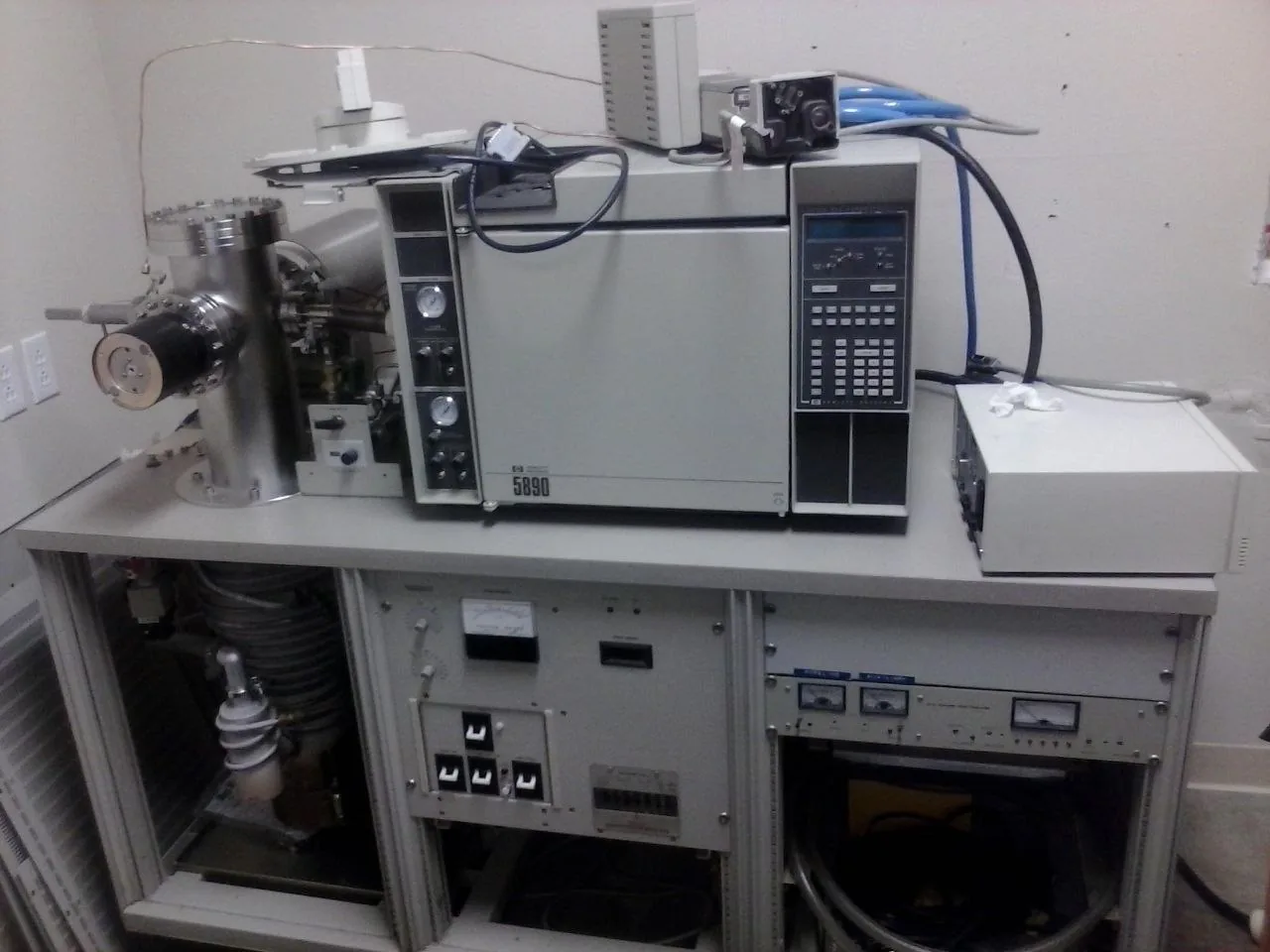
Vanguard joked that he probably should have donated the machine to a museum, before explaining that he’d acquired it from the DEA around 20 years earlier. The laboratory’s representative had been doing consultancy work when the agency was preparing to throw it away, so he was allowed to take it home.
Pacific Coast Biologics admitted that the system was from before his time and asked what it was.
Vanguard identified it as an ancient single-quadrupole GC-MS made by HP before Agilent was spun off from the company. It apparently occupied half a room, prompting Pacific Coast Biologics to wish him good luck finding anyone capable of servicing it.
The machinery continued into the night when Vanguard shared another photograph, this time showing equipment used for pulsed-field gel electrophoresis, or PFGE.
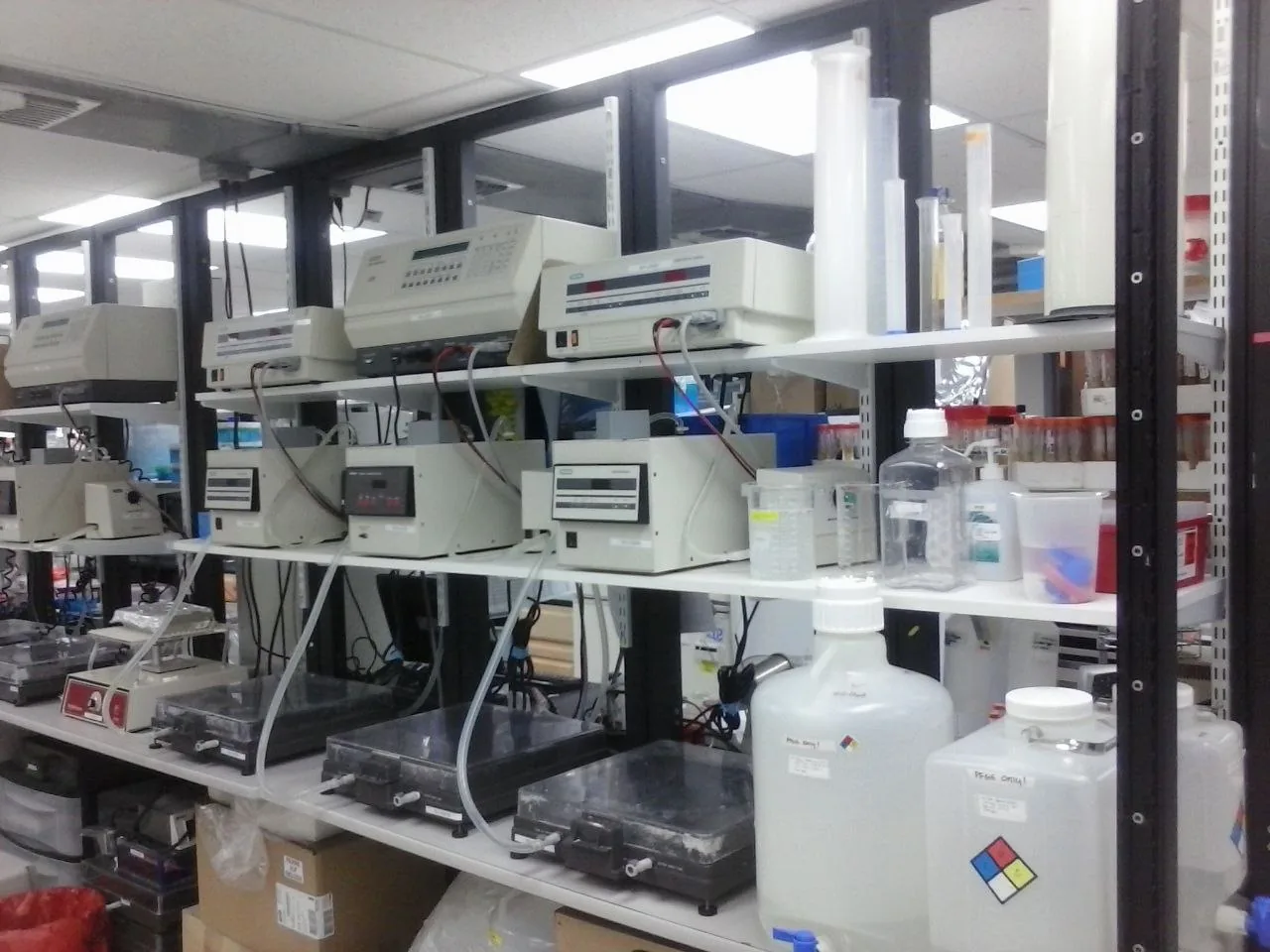
Vanguard said PFGE wasn’t particularly useful for peptides but was valuable for tracking down microbial contaminants in raw materials and environmental samples.
By this point, the equipment showroom had expanded beyond peptide analysis, mass spectrometry and gas chromatography into microbial contamination investigations as well. Apparently, once the laboratory doors were open, everyone was seeing how many machines they could wheel through them.
Then Kimera Chems Opened the Doors to MZ Labs
Just as the equipment show-and-tell appeared to be running out of machinery, Kimera Chems joined in with photographs taken during a visit to MZ Labs.
Kimera Chems said that when they met Ken at MZ Labs, he told them the laboratory receives roughly 300 to 900 samples per day. He showed them the equipment and explained that each of his Bruker systems could run 300 samples at a time. According to Kimera Chems, MZ Labs has three of them.
Kimera Chems was impressed by the testing capacity but said one part of the operation remained a mystery:
“I wondered how the COAs are handled though. Didn’t show us that part haha.”
Another member joked that producing the COA was the part that took forever, the test could be finished, but the certificate might appear four days later, “if they are lucky.”
Kimera Chems then shared a collection of photographs from inside MZ Labs. The images showed part of the laboratory’s testing setup, including equipment visibly labelled Bruker maXis II and Waters ACQUITY, along with an autosampler containing vials.
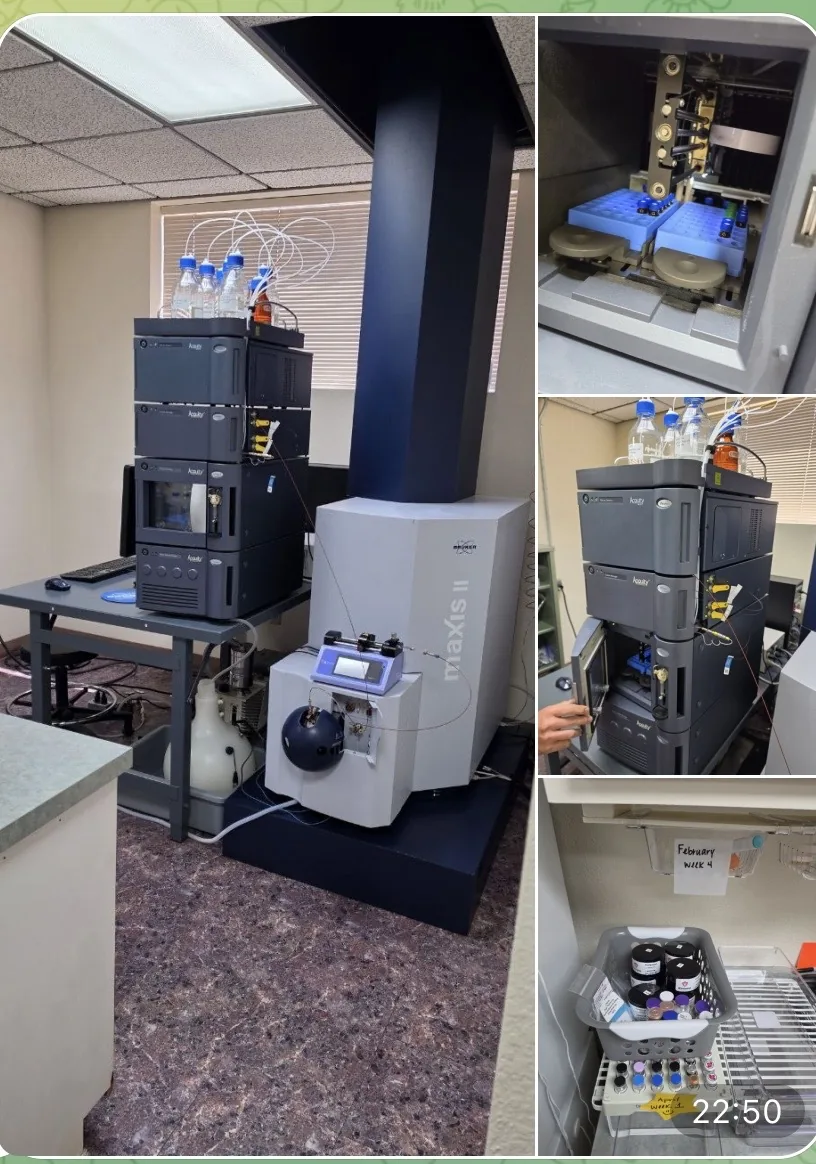
At this point, Lab Chat had moved beyond the boys showing off the equipment in their own laboratories. They were now bringing holiday photographs from other laboratories into it as well.
Meanwhile, Pacific Coast Biologics offered a glimpse of the workload behind operating all these impressive machines. He said he was at the laboratory almost every day for a minimum of 15 hours and joked that his wife was ready to leave him.
He warned anyone interested in starting a biotechnology company to proceed with caution because it involved a considerable amount of work. His manufacturing workflows were almost fully automated, but he still needed to optimise the testing side of the operation.
Apparently, owning the toys is the easy part. Keeping them running, processing the samples and eventually producing the COAs is where the fun begins.
By the end, the laboratory equipment parade had expanded from Janoshik’s 12 HPLCs and Vanguard’s Orbitrap Exploris to homemade purification equipment, automated Bruker systems at MZ Labs, PFGE equipment, analogue recorders, retired HP systems, gas chromatographs built like armoured vehicles and enough vintage machinery to open a small analytical-chemistry museum.
What began as a discussion about how laboratories process large numbers of samples soon had Janoshik, Pacific Coast Biologics and Vanguard comparing their machines, before Kimera Chems joined in with photographs from MZ Labs.
It ended with everyone effectively saying:
“That’s a nice machine. Now look what I’ve got.”

Comments