
TLDR
A buyer seeking peptide testing was asked to supply reference standards because the local laboratory didn’t hold them. Vanguard objected to unverified customer material, but said purchasing from established suppliers and sending it directly to the lab might be an option.
Alan described the use of high-purity commercial peptides as working standards where certified materials are difficult to obtain. His response covered peptide-content corrections, matching salt forms, the limitations of HPLC-UV and additional testing used to characterise in-house standards. He considered the 10 mg request reasonable because material could also be used for validation, repeat testing and retention.
HPLC purity and peptide content are different measurements: a MedChemExpress retatrutide certificate reports 99.96% purity and 93.04% peptide content. Properly characterised working standards can support quantitative testing without necessarily being certified reference materials.
How the Reference Standard Question Began
A buyer in Venezuela wanted independent testing of tirzepatide, retatrutide and GHK-Cu for identity, purity and actual content per vial. A local lab could run HPLC-UV, but didn’t hold reference standards for those compounds. Its proposed solution was for the customer to obtain them. The lab would accept material from a reputable supplier with more than 99% purity and a COA. It requested around 10 mg of each compound and planned to inject the reference before analysing the samples. A certified reference material (CRM) wasn’t considered essential.
The buyer’s concern was sensible: would that purchase provide a suitable analytical standard, or just another high-purity peptide with paperwork? Difficulties obtaining specialised testing and importing materials made this a practical question about how to arrange a meaningful test with the resources available.
Should the customer be sourcing it?
The proposal drew objections in Lab Chat. Dustin from Vanguard Labs said he wouldn’t normally accept a customer’s material as the reference standard for testing that same customer’s samples because the provenance of the material couldn’t be independently established. A customer could, in theory, provide the same unverified material as both the sample and the reference.
Dustin later clarified that purchasing material from established suppliers such as Sigma, Cayman or MedChemExpress and having it sent directly to the laboratory might be an option. He also explained that when Vanguard requires a standard for a test it performs infrequently or that falls outside its normal scope, it can source that material through an approved supplier and charge the customer for the cost. The discussion therefore centred on the difference between a customer supplying an unknown material and a laboratory sourcing or accepting a recognised analytical standard.
Why commercial peptides are used as working standards
Alan described high demand for GLP-1 peptides alongside limited availability of certified reference materials. He said genuine retatrutide CRMs were particularly difficult to obtain and tirzepatide CRMs expensive. In his account, labs commonly use high-purity commercial peptides as in-house working standards, with some asking customers to supply the material. He distinguished those working standards from formally certified materials. Commercial batches with more than 99% purity and supporting analytical documentation could, he said, provide a practical alternative for internal testing. His response also stressed that the material’s composition matters when it’s used to calculate milligrams per vial.
Does it have to be certified?
Alan distinguished commercial working standards from certified reference materials and said a potency-assigned CRM was required for regulatory submissions. However, ICH Q2(R2) recognises suitably characterised materials, including in-house primary and secondary references. Certification is therefore not a universal requirement under that guideline.
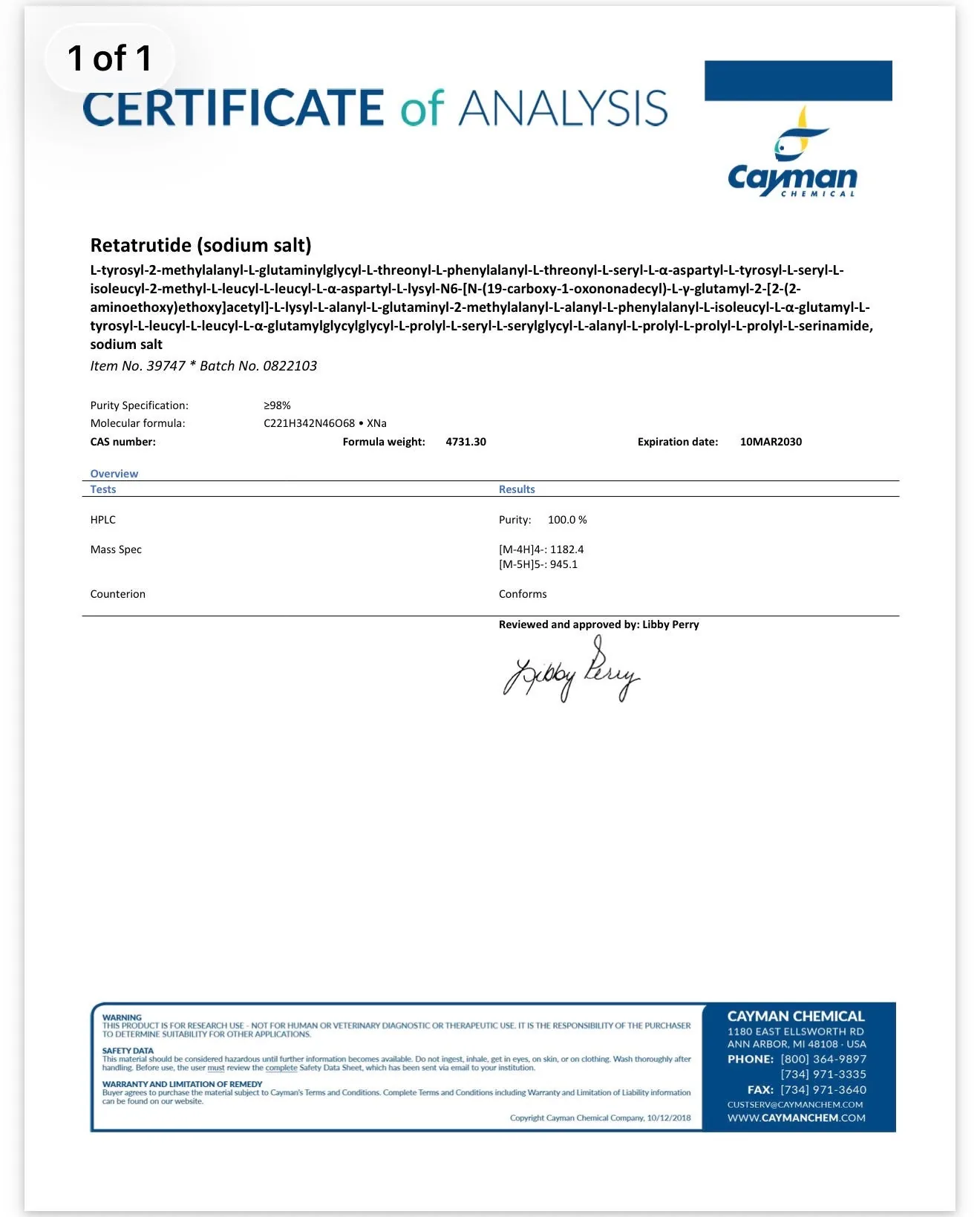
Retatrutide material is commercially available. Cayman’s certificate for retatrutide sodium salt, lot 0822103, reports 100.0% HPLC purity, intact-mass results and a conforming counterion result.
Purity is only part of the calculation
Alan said water, residual solvents and counterions such as TFA or acetate must be accounted for when assigning peptide content. He described suppliers issuing certificates that report HPLC area purity without separately stating peptide content, and warned against treating the weight of a peptide salt as though it were entirely peptide.
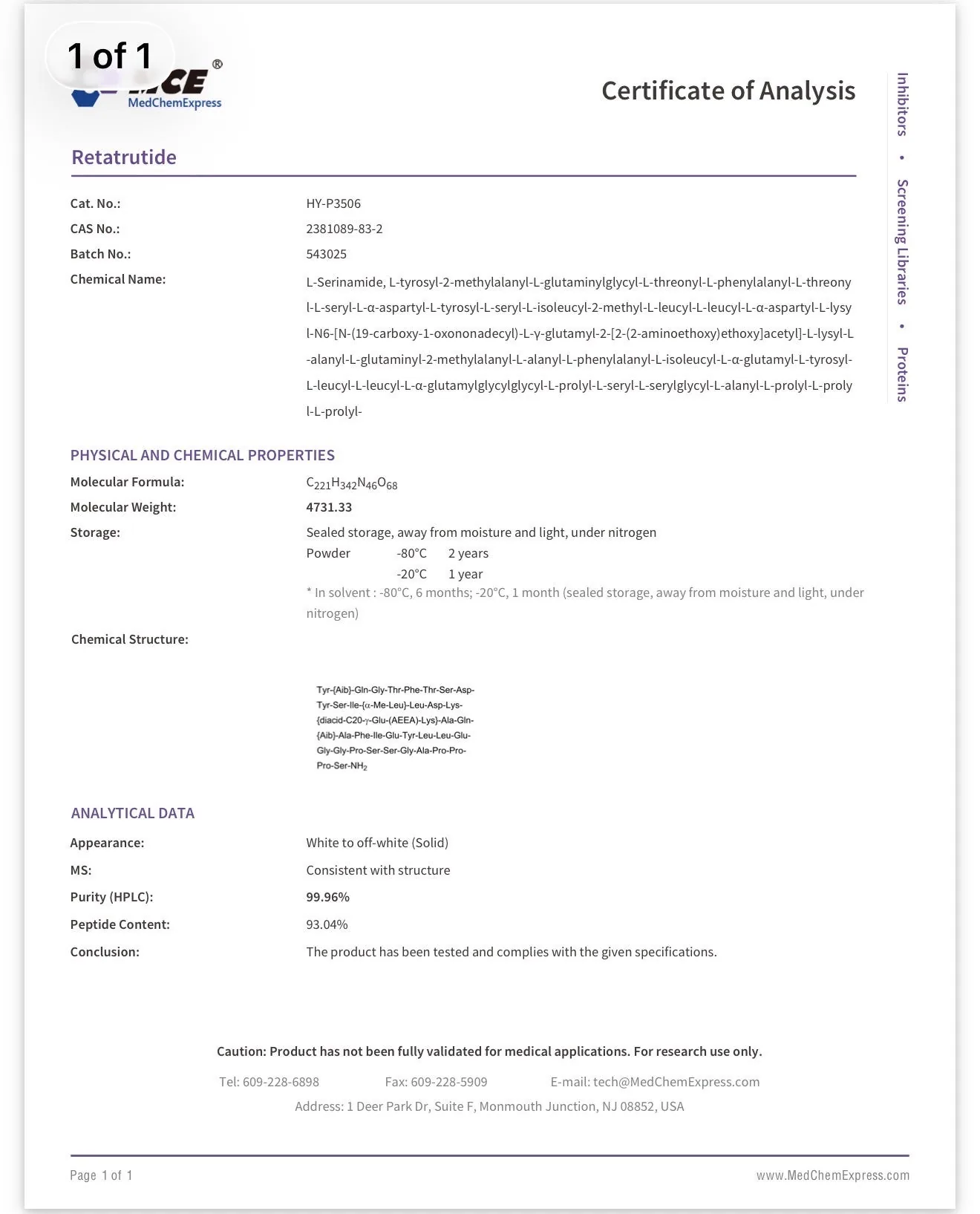
That distinction appears directly in MedChemExpress’s retatrutide certificate for lot 543025, which reports 99.96% HPLC purity and 93.04% peptide content. The certificate lists both values separately, showing that chromatographic purity and peptide content are different measurements. Alan described overlooking these components as a recurring problem in sample submissions, with consequences for the final quantity calculation.
Matching the chemical form
The buyer had also asked whether the reference needed to match the sample’s salt form. Alan favoured using the same form, noting that commercial peptides may be supplied as TFA or acetate salts. He warned that differences in chemical form could affect chromatographic behaviour and introduce quantitative bias. Where a matching form couldn’t be obtained, he argued for complementary LC-MS confirmation. His preference was therefore for a reference that matched the sample chemically, rather than selecting material on purity alone.
Why the laboratory requested 10 mg
The laboratory requested around 10 mg of reference material for each peptide, prompting the buyer to ask whether that was a normal amount. Alan said HPLC testing itself could consume 1 to 3 mg, but that additional material could be used for method validation, repeat injections and retaining a portion for future reference. He also said many medium-sized laboratories didn’t maintain extensive reference-material collections. In that context, he considered a request for 10 mg reasonable and described such requests as fairly common.
What HPLC-UV can miss
Alan’s response went beyond the choice of reference. He warned that truncated peptides and deletion impurities could co-elute with the main peak, leaving them unresolved by an HPLC-UV method. He described HPLC-UV as the method used for purity and quantity, while arguing strongly for LC-MS to confirm molecular weight and screen for impurities. His concern was that a convincing main peak could conceal related material that hadn’t been adequately separated.
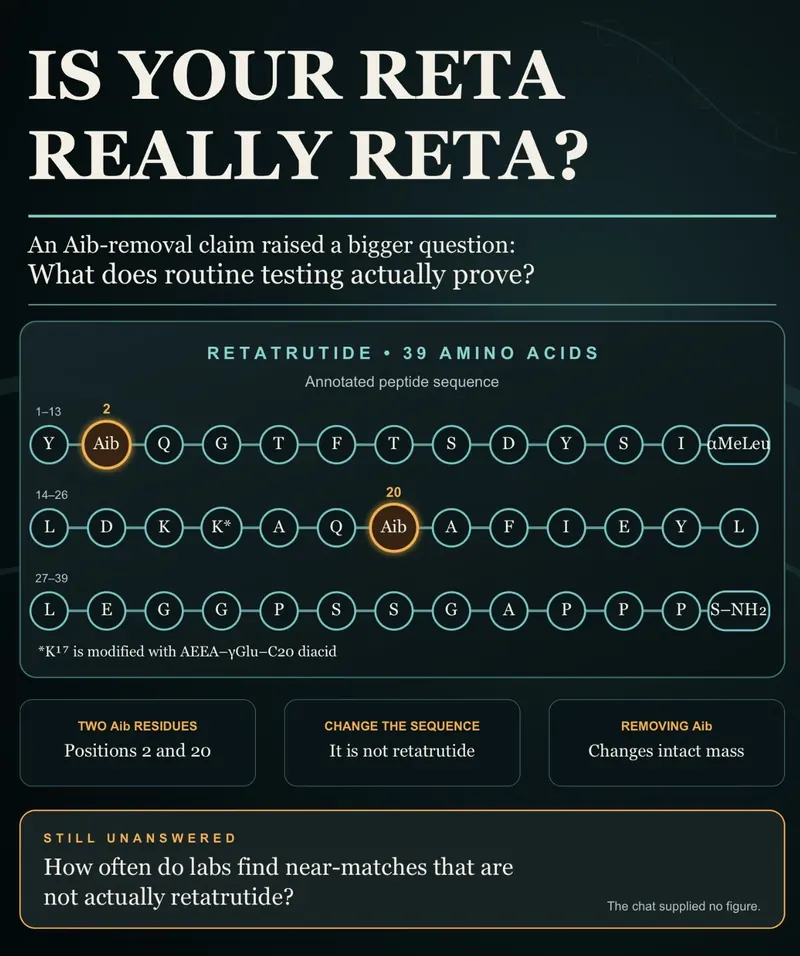
The distinction between routine purity and deeper characterisation also appeared elsewhere in the discussion. Another reply distinguished consistent purity from correct amino-acid sequence and biological potency, supporting routine screening alongside targeted deeper testing.
How in-house standards are characterised
For compounds such as retatrutide, Alan described laboratories selecting a high-purity batch and building an in-house working standard through additional testing. His account included HPLC-UV, LC-MS molecular-weight verification, and measurements of water, residual solvents and counterions. The resulting data would be used to assign a working value for quantitative analysis.
He contrasted that process with simply taking a high-purity commercial batch and using it as the reference without further characterisation. He warned that the latter approach could undermine the reliability of comparisons between batches.
Sources
MedChemExpress, Retatrutide certificate, lot 543025
ICH, Q2(R2) Validation of Analytical Procedures, corrected 2025 version
Cayman, Retatrutide sodium salt certificate, lot 0822103
Comments