
TL;DR
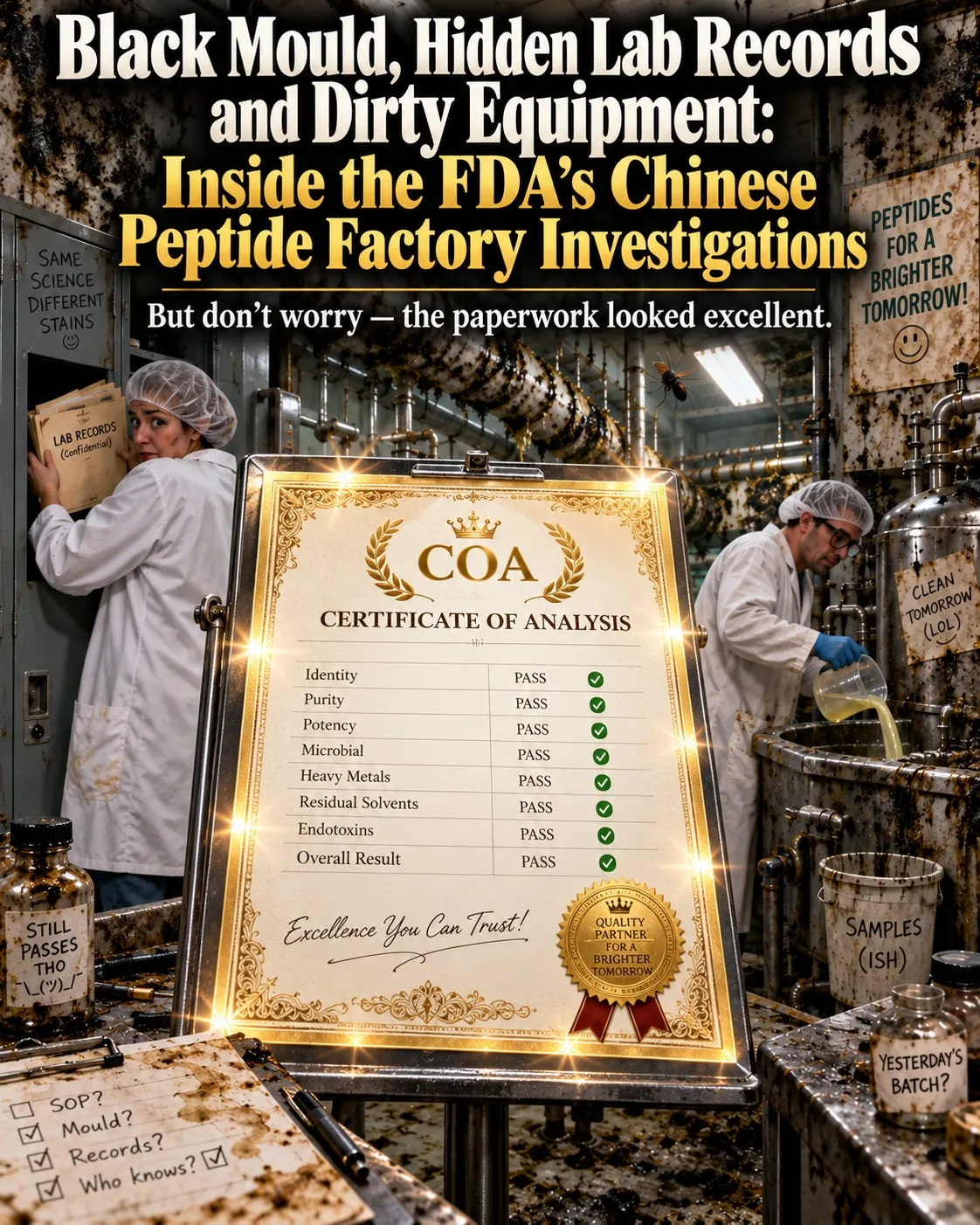
FDA inspections of two Chinese peptide manufacturers revealed serious concerns, including black mould, dirty equipment, hidden laboratory records and questionable testing practices. Earlier FDA records show that both companies had already been cited for quality-control deficiencies, and both now face US import restrictions.
Both manufacturers also have documented US business connections. Chengdu Shengnuo has been linked to American API distributor ChemWerth, while Nanjing Chengong’s parent company, Hanxin, is 11.5% owned by US pharmaceutical company Amphastar. Shengnuo also has FDA product listings for semaglutide and tirzepatide ingredients intended for the US compounding market.
The findings reach beyond China’s grey-market peptide industry, raising important questions about the sourcing and quality of ingredients entering the regulated US pharmaceutical supply chain.
What FDA Inspectors Found at Two Chinese Peptide Manufacturers
Black mould on manufacturing equipment. Insects in ceiling areas. Laboratory records hidden in lockers. Samples poured down sinks. These are among the findings reported by Bloomberg on 15 October 2026, following FDA inspections of two Chinese pharmaceutical suppliers: Chengdu Shengnuo Biopharm and Nanjing Chengong Pharmaceutical. Both companies supply pharmaceutical ingredients and have connections to the growing GLP-1 market. Both now face US import restrictions.
But there’s another interesting part to this story. Earlier FDA inspection records show that both manufacturers had already been cited for quality-control problems, years before the latest investigation. Some of those earlier findings are particularly revealing.
Chengdu Shengnuo: Black mould and hidden records
FDA inspectors visited Chengdu Shengnuo in August 2026. According to Bloomberg’s investigation, inspectors encountered black mould on equipment, contamination on floors and insects in ceiling areas. The reporting also describes laboratory employees hiding records inside lockers while other workers poured product samples down sinks. These findings raise serious questions about the reliability of the company’s quality-control procedures. After all, laboratory records are supposed to provide an accurate account of what was tested, how it was tested and whether the results meet the required standards.
Shengnuo’s parent company subsequently confirmed that FDA had issued a Form 483 containing eight observations on 27 August. The company submitted a response and proposed corrective measures on 17 September. On 19 September 2026, Shengnuo was added to FDA Import Alert 66-40. It also announced that it would stop supplying peptide APIs to the United States until the restrictions were lifted.
FDA had already raised concerns in 2023
An earlier FDA inspection from September 2023 identified problems with Shengnuo’s manufacturing and laboratory records. Inspectors found several issues:
A stability record confused the microbiological standards for domestic and export products.
Water-system records failed to explain why additional cleaning had been carried out.
Laboratory equipment logs were missing important information, including who performed certain tests and when.
Information relating to a known impurity was incomplete.
These might sound like administrative problems, but pharmaceutical testing depends on accurate and traceable records. If the laboratory can’t reconstruct a test properly, establishing the reliability of the reported result becomes much harder.
The 2023 inspection documented weaknesses in recordkeeping. Bloomberg’s 2026 investigation describes more serious concerns involving the concealment of records and disposal of samples. Whether the underlying problems are connected remains to be established, but the earlier inspection provides important context.
Original Shengnuo FDA inspection report, 2023
Nanjing Chengong: Dirty equipment and questionable certification
The second manufacturer, Nanjing Chengong Pharmaceutical, faced a different set of concerns. According to Bloomberg, FDA inspectors found that Chengong had approved pharmaceutical ingredients manufactured by other companies without adequately examining the original manufacturers’ testing records. This is particularly relevant to a market where ingredients may pass through several businesses before reaching the final seller. A company issuing or approving a certificate must have an adequate basis for its quality decisions, including the testing information behind them. And Chengong had already attracted FDA attention.
Dirty equipment found in March 2025
An FDA Form 483 from March 2025, issued to Nanjing Cuccess at the facility associated with Chengong, makes interesting reading. Inspectors documented equipment that had been designated clean despite having visible residue and dirt. Among the findings were a damaged and soiled seal on a manufacturing vessel, residue on a sight glass and a gasket protruding approximately one centimetre, creating an area difficult to clean. The same inspection raised concerns about stability testing.
FDA found that three validation batches had been assigned shelf lives without completing the required six-month accelerated stability study. In other words, there were questions about both the cleanliness of equipment and the evidence supporting how long certain products would remain within specification. The affected product names were redacted from the public report.
Another interesting detail is that the 2025 FDA report was addressed to Henry Zhang, General Manager of Nanjing Cuccess. Amphastar Pharmaceuticals’ corporate filings also identify Henry Zhang as chairman and general manager of Nanjing Hanxin, Chengong’s parent company.
Original Nanjing FDA inspection report, March 2025
Both manufacturers now face US import restrictions
The FDA has added both companies to Import Alert 66-40.
Chengdu Shengnuo Biopharm: 19 September 2026
Nanjing Chengong Pharmaceutical: 1 October 2026
This allows FDA to detain covered pharmaceutical shipments without physically examining every consignment. The restrictions concern whether the manufacturers meet required production and quality standards. They don’t mean that every batch manufactured by either company has been found contaminated. Both facilities remained listed when the records were checked for this article.
Official FDA Import Alert 66-40
Where do these ingredients end up?
This is where things become especially interesting for the peptide community. Chinese pharmaceutical ingredients can pass through manufacturers, distributors and other intermediaries before reaching the company selling them to the final customer. FDA product listings connect Shengnuo to semaglutide and tirzepatide ingredients, including material listed for human prescription compounding.
There’s also a documented historical business relationship between Shengnuo and pharmaceutical API distributor ChemWerth. At Chengong, the corporate connections extend to US pharmaceutical company Amphastar, which holds an 11.5% stake in Nanjing Hanxin and has board representation. Chengong is wholly owned by Hanxin.
The more interesting question is which American companies actually purchase APIs from Shengnuo and Chengong. That includes compounding pharmacies, pharmaceutical manufacturers and US fill-finish operations that turn imported ingredients into finished products. The documented business relationships establish connections to the US pharmaceutical industry, but the available records don’t identify specific customers or batches affected by the inspection findings.
Tracing those customers would establish how far the ingredients travelled through the American pharmaceutical supply chain, including whether they reached businesses beyond the compounding market.
And what about all those lovely COAs?
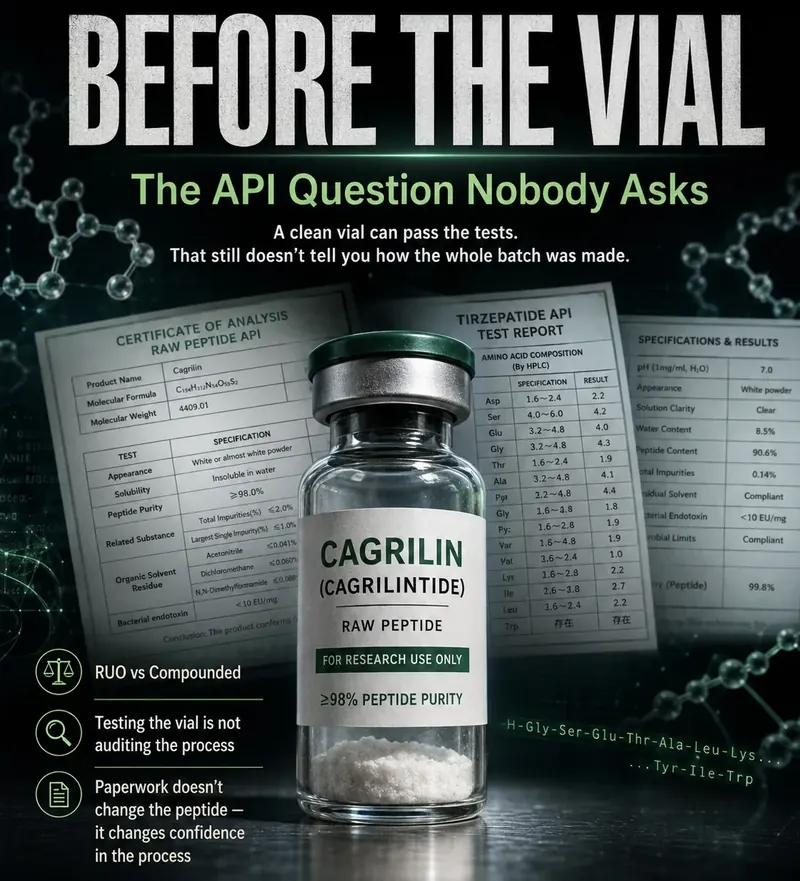
This is probably the most relevant part for research-peptide buyers. A COA is frequently presented as reassurance that a product has been tested and meets its stated specifications. But a COA depends on the reliability of the records, sampling and laboratory procedures behind it. A manufacturer’s COA, a distributor’s certificate and an independent laboratory report can represent very different types of evidence. And even a legitimate result showing 99% purity says little about sterility, endotoxins, the actual amount of peptide present or whether the tested sample represents every vial in a batch.
Bloomberg’s findings at Chengong raise questions about the certification of material originating from other factories. At Shengnuo, the reported concealment of records and disposal of samples raises questions about how reliably testing could be reconstructed. The earlier FDA inspections add another layer, documenting problems with laboratory records at Shengnuo and manufacturing cleanliness and stability testing at Chengong.
A lovely-looking COA is only useful when the testing behind it is reliable and the results can be traced to the material being sold.
The Bigger Picture: Made in the USA?
The wider issue is how heavily the peptide industry relies on Chinese API manufacturers. China is a major source of peptide ingredients used by US compounding pharmacies, American fill-finish companies and research-peptide vendors.
This makes the frequent boasting about “Made in the USA” peptides particularly interesting. A product can begin as an API manufactured in China, be shipped to America for filling and packaging, and then be advertised with an emphasis on its US manufacturing or finishing.
There’s a similar contradiction among those who champion US compounding pharmacies while dismissing RUO products simply because they originate in China. Both markets can source their ingredients from the same country, and potentially the same manufacturers.
Compounding pharmacies operate under different regulatory requirements and may provide safeguards absent from the grey market. But those safeguards don’t change where the original ingredient was produced.
The FDA findings raise an important question for everyone involved, regardless of which market they support: how thoroughly are the ingredients being checked before they reach the final customer?
Before celebrating a peptide because it’s “Made in the USA” or dismissing another because it’s Chinese, perhaps it’s worth finding out who actually manufactured the API in the first place.
Sources
Original investigation
Bloomberg, FDA findings at Chinese GLP-1 ingredient suppliers, 15 October 2026
FDA inspection records
Chengdu Shengnuo, September 2023 Form 483
Nanjing Chengong/Cuccess, March 2025 Form 483
Company and supply-chain records
Shengnuo, September 2026 disclosure
ChemWerth, Shengnuo relationship
Amphastar, Form 10-Q for quarter ended 30 June 2026, filed 6 August
Comments