
After the Biuret experiment, the customer came back with another home test being used in Brazil. This one is aimed specifically at GHK-Cu and blends containing it, such as Glow and KLOW. Instead of looking for peptide bonds, this test uses EDTA to go after the copper.
The idea is simple: GHK-Cu is blue because copper is bound to the peptide. Add a powerful copper-binding agent, pull that copper away, and the colour should change. The customer sent me a video demonstrating the test on a Glow-type blend.
His explanation was that if the copper is genuinely associated with the peptide, EDTA should strip it away and the turquoise-blue colour should disappear or change rapidly. He also said that dye-adulterated products would remain blue and that copper sulfate adulteration would react much more slowly.
The chemistry behind the first part is real. The question, again, is how much the colour change actually proves.
Why is GHK-Cu blue in the first place?
GHK itself isn’t blue. GHK is the three-amino-acid peptide glycine-histidine-lysine. The familiar blue colour appears when GHK binds copper in its Cu²⁺ form, creating the GHK-Cu complex. This is worth understanding because the colour isn’t simply there because “copper is blue.” When Cu²⁺ is coordinated by atoms in the GHK peptide, the copper sits in a particular chemical environment. That changes the energy levels available to electrons around the copper ion. When visible light hits the complex, some wavelengths are absorbed and others are reflected back towards us. What we see is that characteristic blue/turquoise colour. Change what is bound to the copper and you can change the colour too. That’s the entire basis of the EDTA test.
What is EDTA?
EDTA is a chelating agent. In simple terms, it’s extremely good at grabbing metal ions. It has several potential binding sites which can wrap around a metal such as copper and form a very stable complex. So when EDTA is added to GHK-Cu, you effectively introduce a competitor for the copper.
You start with:
GHK, Cu²⁺
Add enough EDTA under suitable conditions and the copper can instead become associated with:
EDTA, Cu²⁺
leaving the GHK peptide without its original copper. That changes the copper’s chemical environment and therefore its colour. This is why a deep blue GHK-Cu solution can become much paler, turquoise, blue-green or otherwise visibly different after EDTA is added.
The video
In the video, the test is performed on two products: Left is fake/ dyed GHK-Cu and right is a product containing GHK-Cu. The explanation given is essentially:
EDTA sequesters the copper from the peptide.
As the reaction proceeds, the original turquoise-blue colour fades quite quickly. The demonstrator says that, in his experience, genuine GHK-Cu-containing products should show a rapid change, ideally within around 30 seconds. He also makes two further claims:
a product coloured with artificial blue dye ( on the left) should stay blue because EDTA can’t remove the dye;
a product adulterated with copper sulfate may also change colour, but supposedly much more slowly.
The first observation makes chemical sense in principle, but the second needs much more caution. A colour change supports the presence of copper, but doesn’t by itself prove GHK-Cu. EDTA can strip copper from genuine GHK-Cu, changing or reducing its characteristic blue colour. But EDTA will also bind Cu²⁺ from other copper compounds, including copper sulfate. The useful distinction may therefore be between a copper-based colour and a simple blue dye, not between genuine GHK-Cu and every possible copper adulterant.
The suggestion that genuine GHK-Cu must react within 30 seconds while copper sulfate necessarily takes much longer would need proper experimental validation before it can be relied on.
Reaction speed can depend on: EDTA concentration; copper concentration; pH; temperature; mixing; other compounds in the vial; and exactly which form of EDTA reagent is being used.
What about blue dye?
This part is more intuitive. If a product is simply being made blue using a dye that has nothing to do with copper, then adding EDTA shouldn’t magically remove that dye. EDTA binds metal ions. It’s not a general-purpose colour remover. So if a blue product stayed exactly the same colour after EDTA was added, that might raise an interesting question. But even here, the result wouldn’t tell you exactly what’s in the vial. A manufacturer could potentially use both copper and colouring. Different dyes could behave differently at different pH values and some formulations are already complicated mixtures. So once again: useful clue, not proof.
Why Glow and KLOW are blue
This also explains why products such as Glow and KLOW can have such a strong blue appearance. The other peptides in those blends generally aren’t responsible for that colour. The visually dominant component is usually GHK-Cu. You can have several colourless peptides in the same vial, but one strongly coloured copper complex can determine what the entire vial looks like. That means a blue Glow vial can tell you something very basic: there is a strongly coloured component consistent with a copper complex present. It doesn’t tell you whether every other ingredient listed on the vial is there. And it certainly doesn’t tell you whether they’re present at the correct doses.
EDTA and Biuret together
The customer has also been using the EDTA test alongside the Biuret test. That combination is more interesting than either one on its own. A Biuret reaction can indicate material capable of reacting like peptide bonds. An EDTA reaction can indicate accessible copper. So if a GHK-Cu-containing product: turns Biuret purple and changes colour when EDTA is added, you potentially have two separate pieces of screening information: peptide-reactive material appears to be present and copper appears to be present
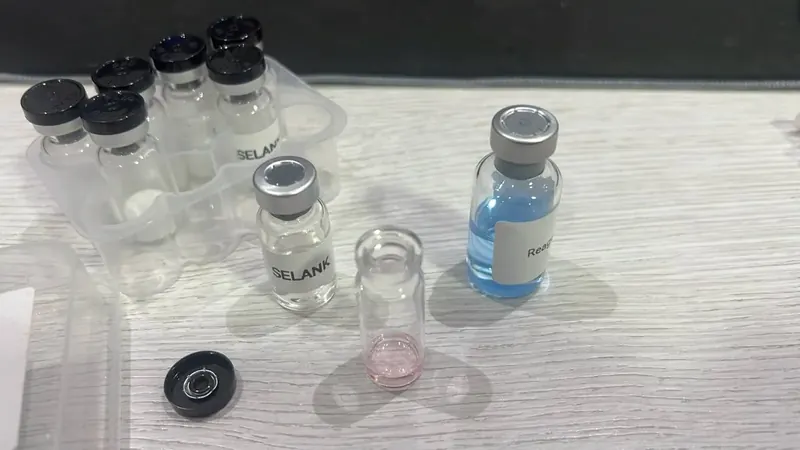
KLOW: On the left is the positive EDTA test and on the right is the positive Biuret test
But even together, those results still don’t establish authentic GHK-Cu. A mixture containing some other peptide plus a copper compound could potentially satisfy both tests.
GHK-Cu is actually awkward for Biuret
There’s another problem here. GHK itself is only a tripeptide. That means it contains just three amino acids and two peptide bonds. As we found during the Selank investigation, very short peptides sit at the difficult end of the Biuret test, especially when you’re trying to interpret colour by eye rather than with laboratory instrumentation. GHK-Cu also already contains copper and has a strong colour of its own. You’re therefore trying to interpret a copper-based colour test using a sample which already contains a coloured copper complex. That isn’t exactly ideal.
A blend may produce a much clearer Biuret reaction because additional peptides contribute more peptide bonds, but then you have another problem: a positive blend tells you nothing about whether every individual peptide in that blend is actually present.
So what does a positive EDTA test tell you?
Used carefully, I think it tells you something. If an intensely blue product changes appearance when excess EDTA is added, that’s consistent with the colour being connected to a metal complex that EDTA can disturb. For a product advertised as GHK-Cu, that’s certainly more interesting than nothing happening at all.
Why this still has some value
As with the Biuret test, it’s easy to dismiss this from somewhere where formal peptide analysis is readily available. But that misses the reality that the customer keeps describing in Brazil. People there are buying grey-market peptides without easy access to the analytical laboratories many of us take for granted. So they improvise.
A reagent costing only a small amount in Brazilian currency, can at least give them another piece of information about what’s inside the vial.
Comments