
Chimera Peptides once invited customers to message anytime, ask questions and join a community offering real-time support. A statement posted by co-owner Mark delivered a rather different proposition: keep placing orders, but don’t expect answers about them.
Alongside an account of a serious accident involving co-founder John, the announcement attacked customers, alleged sabotage and declared Telegram a place where “WE talk and you read.” For customers trying to establish what happened to their orders, it offered plenty of anger and little practical reassurance.
What Chimera claimed to be
In an earlier interview, John described Chimera as a business founded by three people who had joined forces after working in the peptide market. He said the company had moved beyond reselling by purchasing a minority stake in a factory it had worked with for several years. According to John, that investment gave the founders influence over how the factory operated and helped them improve product consistency. He described the production chain directly:
“The current chain is that our lab buys the raw materials from an external source. This goes through testing multiple times before we settle on it. The lyophilization and packing are done on site in our lab.”
Its public messaging emphasised accessibility. In June 2025, customers were invited to message anytime. Discord was promoted as a hub for questions, shared experiences and “real-time support.” Referral discounts and sales promotions encouraged the community to grow.
Then came the order complaints
By spring 2026, public customer accounts described delayed orders, tracking that remained at label-created status and unanswered messages. One April review described an order exceeding $600 placed on March 17, followed by a dispatch notification without corresponding movement in tracking. Another customer reported paying for an April 9 order that remained at warehouse status.
In an April 22, 2026 website notice, Chimera said US shipments from its international catalogue were on hold, blaming customs and regulatory changes. Customers with outstanding US orders were offered three options: wait, switch to a US warehouse equivalent if available, or request a refund. “Your payment isn’t lost. We’ll communicate with you directly,” the notice promised.
Customers challenged that explanation. One reported that another supplier’s shipment had cleared customs and questioned why unrelated vendor closures were being presented as evidence of a universal shipping shutdown. He also said he’d paid for express shipping while orders placed after his received tracking.
Discord messages showed similar frustration. One customer described a March 20 order with an April 8 USPS label still awaiting the item. Another said they’d ordered weeks earlier and were directed to the website when requesting an update. Others reported unanswered refund requests.
The outcomes were mixed. Some customers subsequently reported deliveries in late April and May. One acknowledged a refund and later received part of his order. Others continued reporting unresolved purchases. On September 3, one customer alleged that a $1,200 order remained undelivered and a promised refund unpaid.
A supplier was looking for him too
A contact called TopXPeptide was also trying to reach John. “I am his supplier, and he has disappeared for two months,” they wrote, asking for help getting in touch and providing shipping information naming “Chimera US”. The contact said orders from 26 people remained unshipped because John hadn’t paid for them. Asked whether they could send the outstanding products, they replied: “Yes, because he didn’t pay, I can’t ship the item.” A direct question about whether John had ever paid for those orders received a one-word answer: “No”.
“I last contacted him when he was on vacation and suddenly there was no news,” they added. The supplier’s account puts Chimera’s factory claims under further scrutiny: why were these orders dependent on payment to TopXPeptide, and where did that supplier fit into the factory operation Chimera had described? Minority ownership wouldn’t rule out buying elsewhere, but it leaves a question about who was actually producing the kits.
The factory claim was already being challenged
Chimera’s production claims had attracted questions in K-HOLE last year. Members noticed that its kits looked the same as those sold by other vendors, including HYB. Matching labels, cap colours and packaging across several products led them to question whether Chimera was reselling finished kits rather than carrying out its own lyophilisation.
When challenged in the community on November 25, 2025, Chimera said the labels were a standard printer preset used by many manufacturers. Members weren’t convinced. One said at least ten suppliers sold the same R10 cap and label combination, posting photographs of their own stock. Others pointed to matching pink-capped R30 kits sold by JEEP, APS Andy and TFC.
One member asked directly: “Can you show us some factory proof.” Chimera maintained that “you can’t distinguish the manufacturing lab via a label or the cap.”
Matching packaging doesn’t settle who manufactured the contents. But the question went beyond cap colours: what supported Chimera’s claim that it carried out its own production? Explaining why other vendors could use the same packaging still left that question unanswered.
Mark’s account
A statement dated September 23 appeared on Chimera’s Telegram announcement channel from someone calling himself Mark, who introduced himself as one of the company’s three owners. He hadn’t previously introduced himself there, prompting suspicion that “Mark” might actually be John writing under another name. however, that suspicion remains unconfirmed. With only administrators able to post, customers couldn’t challenge his account in the channel.
Mark said the three owners had travelled to Greece, where John proposed to his girlfriend. A few days later, according to his account, John was encouraged to go out on a water scooter and waves dragged him into cliffs. He said John spent three weeks in a coma and was now in a minimally conscious state, adding that he “has not woken up” and wasn’t running the business. The statement gave no date for the accident.
But much of the announcement was devoted to attacking the community. Mark called members “pepmoms, know it alls and trolls”, criticised customers for switching between vendors and complained about repeated requests for tracking updates. He maintained that Chimera had warned customers two months in advance about disruption around Chinese New Year and problems at the US border.
He also said that some posts attributed to John had actually been written by the other partners. Customers who thought they’d been speaking to John may have been dealing with someone else.
Mark then alleged that imposters had created a fake Chimera website and that someone previously on the company’s payroll, receiving $300 to 400 a month, had hijacked its Telegram community. He referred to reimbursement following a failed group buy and claimed John had helped “Mr Caveman” start his own brand. These accusations sat alongside praise for Chimera’s former customer-service staff and US packing team.
Throughout the announcement, Mark repeatedly praised John’s character and generosity, presenting him as someone who had gone out of his way to help customers and others in the business. That defence sat awkwardly alongside the insults aimed at customers asking about missing orders: there was plenty about what an admirable person John was, but little about what would happen to the money people had paid.
Taken as a whole, the statement was aggressive and defensive. Customers waiting for products or refunds were met with insults, accusations and complaints about their demands for updates. Mark devoted far more space to defending Chimera and attacking its critics than explaining how outstanding orders would be resolved.
The testing dispute
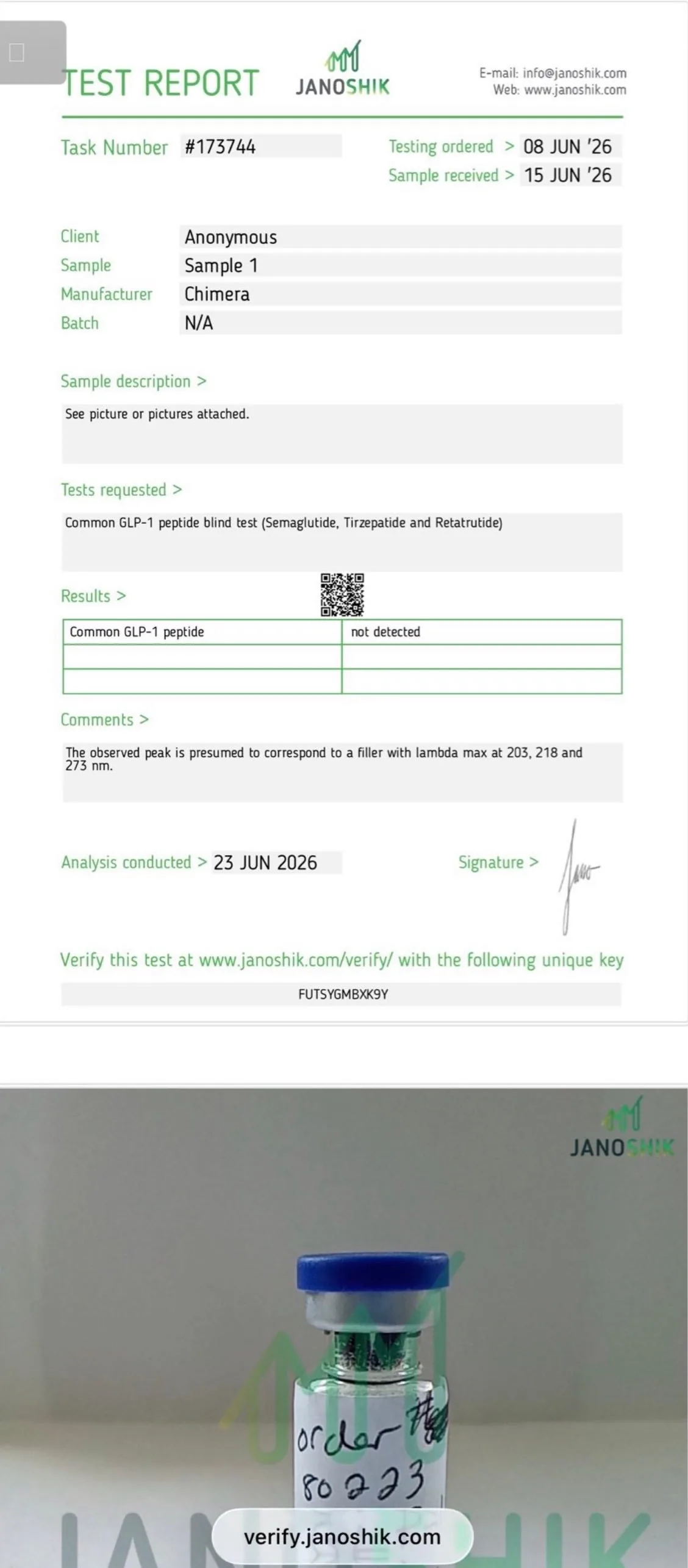
A Janoshik report numbered 173744, dated June 23, 2026, records a blind test for semaglutide, tirzepatide and retatrutide on a sample listing Chimera as the manufacturer. The result was “not detected”, and the observed peak was described as presumed filler.
Mark alleged that someone had submitted fake vials to Janoshik to damage the company, however, his statement supplied no evidence demonstrating that substitution.
The customer-service policy
The clearest part of the announcement concerned how customers would be treated: “Contacting us via DM or email regarding your order will not be responded.” Customers would receive a payment confirmation and a tracking ID. “Nothing more, nothing less.”
Meanwhile, orders were declared “greenlit”. Customers were encouraged to buy, with assurances of the same products, quality and packing team.
A serious injury deserves compassion. Customers with outstanding purchases also deserve answers. The statement did not provide a specific plan for resolving earlier unfulfilled orders or unpaid refunds.
Chimera had promoted a community where customers could ask questions. Mark’s announcement offered a business where customers could “pay, and read”

Comments