
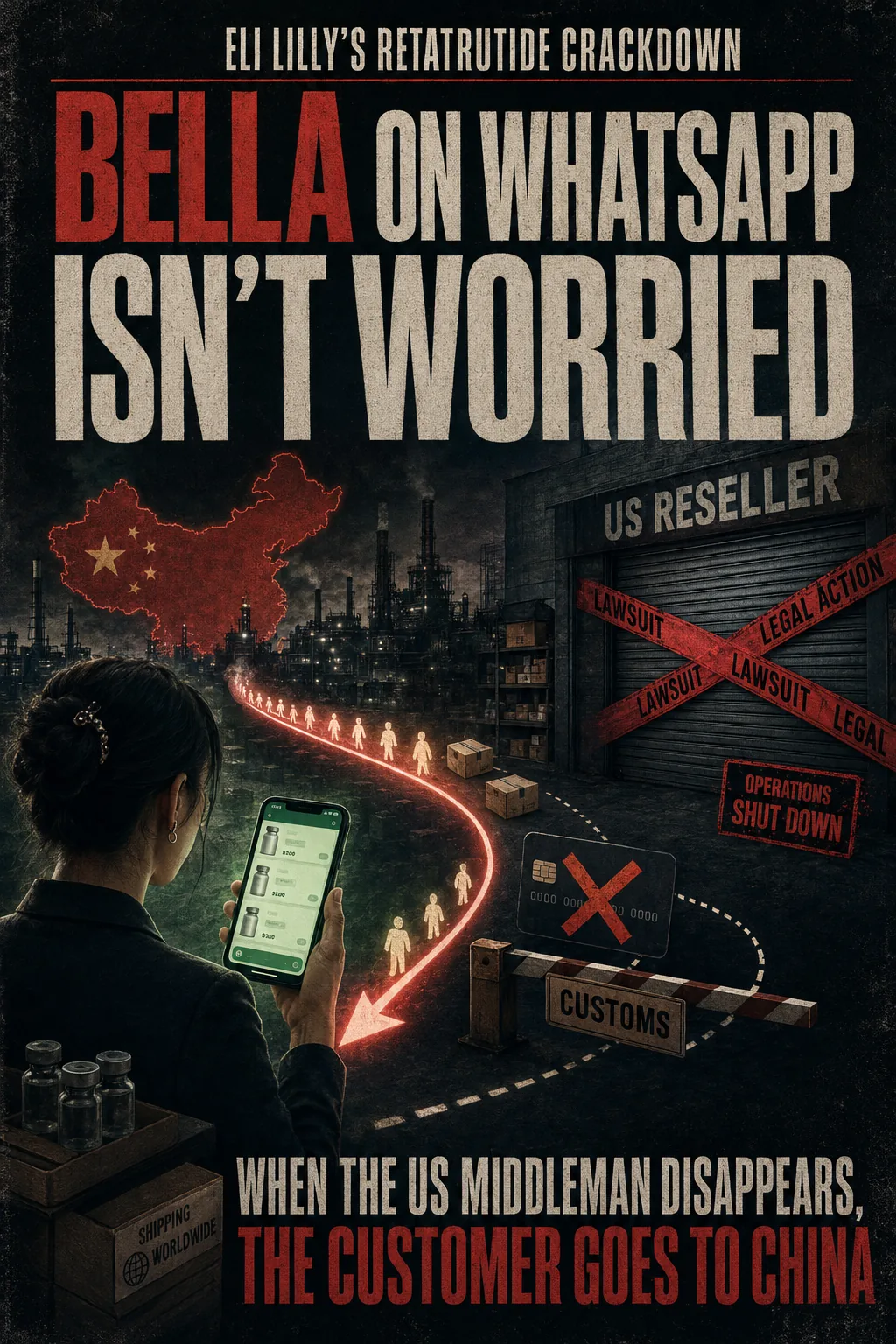
Most social-media coverage of Eli Lilly’s retatrutide crackdown has stopped at the six American businesses being sued. None of them is a Chinese manufacturer or our “Bella” selling peptides through WhatsApp.
For anyone unfamiliar with Bella, she’s a running joke I started about the generic English names used by Chinese peptide sales reps. She isn’t one particular vendor. She’s the familiar WhatsApp profile with a catalogue and a factory, or perhaps just another distributor, somewhere behind it.
That distinction matters as Lilly has sued businesses with company names, public websites, domestic addresses, licences, payment accounts, premises and stock inside the United States. Bella may be little more than a contact name, a profile photo and a number that can be replaced by tomorrow.
That’s why she probably isn’t particularly worried.
The mood is visible in one response circulating within the peptide market. It opened with a link to an overstock sale before arguing that Lilly was protecting a future blockbuster and frightening smaller sellers into submission. It was seller advocacy, not independent legal analysis, but it didn’t read like a market preparing to disappear. It read like a sales pitch.
Removing the Middleman May Help China
The first effect of Lilly’s lawsuits could be to send more business to China. American resellers make the grey market easier to use. They provide searchable websites, card payments, domestic stock, fast delivery and the appearance of ordinary online retail. They also add a margin between the Chinese supplier and the customer.
If those resellers remove retatrutide, committed buyers may not abandon it. They may ask where the product came from and order directly. Removing the American middleman isn’t the same as removing demand; it can transfer the customer relationship, and more of the sale price, to the Chinese vendor.
Some buyers will walk away when the convenient domestic option disappears. Others will go straight to Bella. In the short term, the China-facing market could therefore gain customers even as the visible US market contracts.
The question isn’t whether Lilly can find and sue every Bella. It’s whether buying from her can be made difficult enough that the customer gives up.
Lilly Is Targeting the Infrastructure
Lilly’s own announcement makes the broader ambition explicit. Beyond the six lawsuits, it called on regulators, social-media and e-commerce platforms, card companies, payment processors, and shipping and logistics businesses to “cut off the infrastructure enabling this illegal trade.”
That sentence matters more to the China grey market than the names of the six defendants. Lilly isn’t suggesting that six American lawsuits will close an international supply chain. It’s asking the businesses connecting sellers to customers to stop providing the services that make the trade feel easy and dependable.
Lilly may not need to win every case for that pressure to work. Federal litigation is expensive, especially for a small peptide seller. A business may remove retatrutide rather than spend months defending a case, while a processor, warehouse or carrier can decide that the account is no longer worth the risk without waiting for a judgment.
But the immediate result is still not necessarily fewer customers for Bella. If the American layer retreats, it removes the middleman and can send buyers directly to China. The pressure reaches Bella only when it follows those customers into the direct transaction, by disrupting how they find her, pay her and receive her parcels.
Payments May Bite First
Payments may be the most fragile part of that route because mainstream providers already have policies that can be used against unlawfully marketed products.
PayPal and Square prohibit unlawful commerce. Wise goes further and expressly lists peptides among the transactions it doesn’t support. Stripe’s policy is more nuanced: it permits some genuine research-peptide businesses when safeguards prevent non-research access. A seller presenting an unapproved product for self-injection would struggle to fit that model.
This won’t make payment impossible overnight. Chinese vendors may continue obtaining access to cards, wallets or transfer services until an account is identified and closed. But payment access can become unstable: processing can be suspended, payouts can be delayed or held, and buyers can be pushed towards crypto or international bank transfers that offer less protection.
That changes the transaction psychologically as well as practically. Paying by card on a recognisable American website feels like shopping. Sending an irreversible payment to a changing name on WhatsApp feels like the grey market it actually is. Bella may still receive the money. The problem is persuading enough customers to send it.
The US Warehouse Becomes a Liability
A domestic warehouse has been one of the grey market’s biggest selling points. It shortens delivery times, removes the uncertainty of an individual international parcel and lets a vendor advertise “US stock.”
It also creates a fixed point in the supply chain.
A warehouse means inventory, shipping records, a consignee, a landlord and people physically handling the product. Those connections are easier to identify than an overseas WhatsApp profile. Fulfilment companies, insurers and property owners may decide that storing an unapproved experimental drug isn’t worth the trouble.
If domestic stock becomes harder to hold, more orders will travel directly from China. Once again, that may increase Bella’s direct sales rather than reduce them. What disappears is the convenience: delivery takes longer, customs becomes the buyer’s problem and there may be no realistic remedy when a parcel is detained or never arrives.
The grey market already jokes that buyers can’t expect Amazon delivery. Losing the American warehouse would make that much less of a joke.
The Border May Matter More Than the Lawsuits
The day after Lilly announced the six cases, the FDA’s page for Import Alert 66-80 was published with a major revision covering foreign GLP-1 bulk drug substances and active pharmaceutical ingredients.
There is no evidence that the revision was caused by or coordinated with Lilly’s lawsuits. The alert itself says the revision followed an FDA memo from March. The timing is still revealing because the two developments place pressure on opposite ends of the same supply chain: Lilly’s cases target the visible American sellers, while the FDA alert tightens scrutiny of foreign GLP-1 ingredients entering the country.
Under the alert, covered GLP-1 API shipments may be detained without physical examination unless the particular manufacturer-and-product combination appears on the FDA’s Green List. The agency says it evaluated 48 GLP-1 API sites and found 21% non-compliant or unresponsive to its requests.
Manufacturers seeking Green List treatment may be asked for physical manufacturing locations, batch records, certificates of analysis, stability data, specifications, testing methods, customer and consignee details, and complaint or recall histories. That level of traceability is the opposite of the anonymous WhatsApp trade.
There’s an important complication. The Green List includes some Chinese manufacturer-and-product combinations whose importer descriptions mention retatrutide. Inclusion only excludes that particular supply route from detention under this manufacturing-quality alert; it doesn’t approve retatrutide, make it legal for human sale or permit compounding. The FDA separately states that retatrutide is unapproved and cannot be used in compounding under federal law.
The American “Factory” May Still Depend on China
Import Alert 66-80 may affect American finishing facilities more directly than individual Chinese vendors. A company may fill, lyophilise and package its vials in the United States, but if the API originated in China, production still depends on that material clearing the border.
If the foreign manufacturer-and-product combination isn’t on the Green List, the API may be detained before reaching the American facility. The FDA can also request details of US customers, importers and consignees when assessing a foreign manufacturer, potentially identifying the domestic businesses receiving and finishing the material.
Those facilities may have to change suppliers, accept delays and higher costs, or lose access to the ingredient. Rather than ending Chinese supply, the alert could concentrate more business among the Chinese manufacturers whose products already appear on the Green List.
Import Alert 66-80 covers bulk ingredients and APIs rather than every finished lyophilised vial sent by a Chinese vendor. Finished vials can still be detained or refused under the FDA’s wider authority if they appear to be unapproved, misbranded or adulterated.
Bella’s individual parcel may therefore fall outside the precise scope of this alert, while a US operation importing Chinese API sits directly within it. A vial labelled “made in the USA” may still depend entirely on Chinese raw material, and leave a much clearer trail than Bella’s WhatsApp account.
Going Underground Costs Customers
Public websites may remove retatrutide while sales move further into WhatsApp, Telegram and private groups. For Bella, that isn’t a dramatic change. She was already there. For the market, it matters. Public listings, search results, reviews and card checkouts attract new customers. Private groups and disposable accounts are harder to discover and harder to trust. They also make impersonation, payment disputes and exit scams easier.
Public marketing can create evidence too. A “research use only” label becomes less persuasive when the same seller discusses appetite, weight loss, weekly dosing or provides an injection calculator. Moving those conversations into private chats may reduce the public trail, but it also reduces the market’s reach.
Committed users may follow vendors wherever they go. Casual buyers are less likely to send crypto to a changing WhatsApp name and wait for an international parcel without a chargeback, refund guarantee or reliable customer service.
That loss of ordinary retail convenience may shrink demand more effectively than the remote possibility of Lilly suing a factory in China.
Bella Is Still Not Worried
The six lawsuits won’t close China’s peptide factories. Their immediate targets are American sellers with names, property, websites and accounts that can be found.
In the short term, removing those sellers may increase direct orders from China. The first-order effect is fewer American middlemen; the second is more customers asking Bella for a catalogue.
The longer-term effect depends on whether Lilly and regulators can make those direct transactions sufficiently awkward and risky. Pressure on payments, domestic warehouses, public advertising and import routes could make the trade smaller, less visible and less reliable. Much of that burden will fall on the buyer, who assumes more financial and delivery risk once the American reseller disappears.
Bella can change her name, replace her WhatsApp account and continue offering the same products. What she cannot control is whether the customer can pay, whether the parcel arrives and whether new buyers remain willing to take the risk.
For now, Lilly is not at Bella’s door. It may be removing the American middleman and introducing her to more customers. The crackdown becomes a serious threat to China only if it can make the direct road between Bella and the buyer too difficult to use.
Comments