
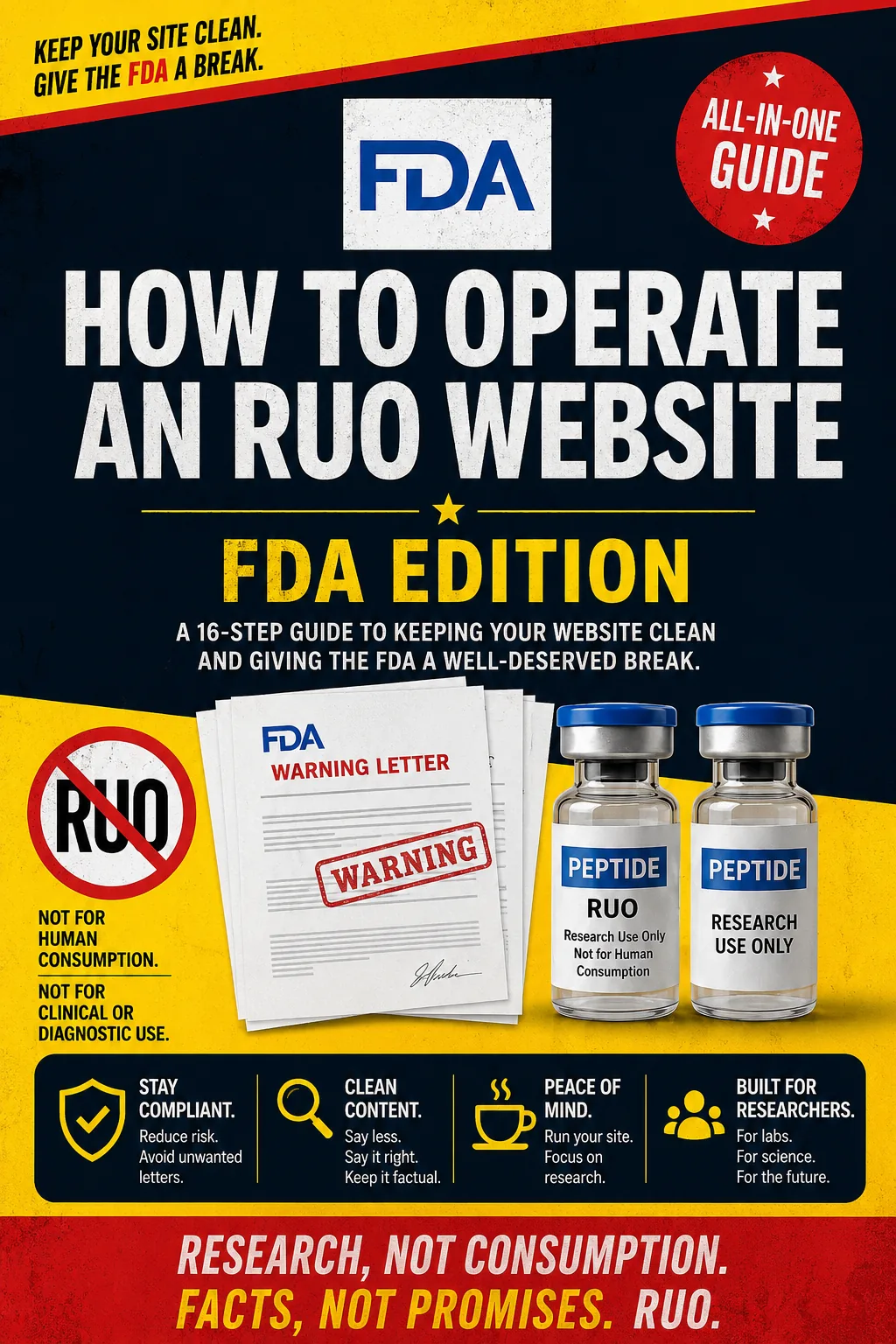
Most people with half a brain are probably quite familiar by now with the sort of things FDA will go after an RUO website for. But there are still plenty of sites out there that either don’t care, haven’t been paying attention, or apparently just want a bit of attention from the FDA.
So this guide is for them. Yes, you can thank the FDA for this
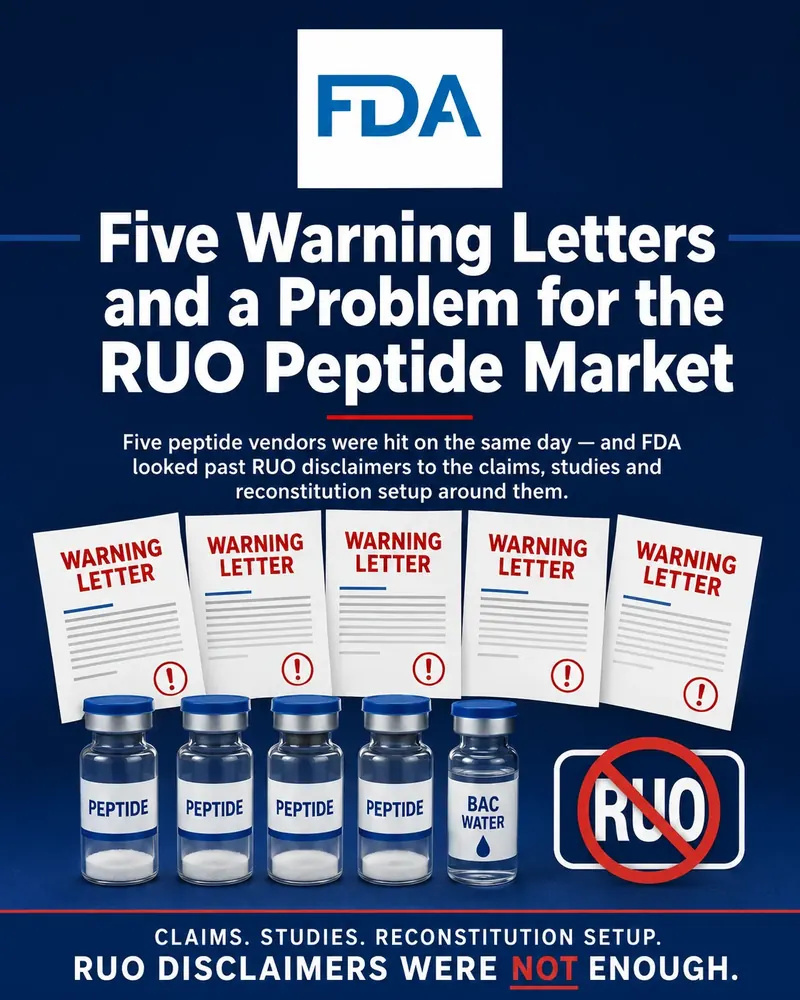
After five more peptide vendors received FDA warning letters on the same day, FDA thought it was time to put together the guide nobody asked for, but quite a few websites clearly still need.
This is light-hearted, but the underlying point is serious. This is not a guide to disguising products intended for human use behind cleverer wording. If that’s what the business is actually doing, there’s no magic disclaimer that turns it into genuine RUO. What follows is simply what FDA warning letters ( and increasingly Eli Lilly’s lawsuits) tell us about the things that keep destroying the “Research Use Only” argument.
Step 1: Actually Mean “Research Use Only”
This seems almost insultingly obvious, yet here we are. Writing RESEARCH USE ONLY, NOT FOR HUMAN CONSUMPTION doesn’t give everything underneath it a free pass, FDA is quite capable of reading the whole site.
FDA has repeatedly cited sites carrying exactly those disclaimers while concluding from the rest of the website that the products were intended for human use. In its March 2026 letter to Gram Peptides, for example, FDA acknowledged the “Research Use Only” and “not intended for human consumption” wording before explaining that other website evidence showed intended human drug use.
Learning Point 1💡The rest of the website has to agree with the disclaimer.
Step 2: Your Product Description Is Not a Weight-Loss Brochure
If you’re selling a research compound, perhaps don’t follow the words “Research Use Only” with paragraphs explaining how wonderful it is for appetite suppression, fat loss, glucose control and body recomposition. Peak Performance Peptides tried something much more subtle. Its pages repeatedly used phrases such as “research settings,” “preclinical models” and “studied for.” FDA still cited statements about body-weight management, appetite suppression, insulin sensitivity, glycemic control, neuroprotection and sexual arousal as evidence of intended use.
Learning Point 2💡 Adding the word research every six words doesn’t turn a weight-loss claim into lab science,
Step 3: A Literature Review Can Still Become Sales Copy
This one matters because many RUO sites have moved away from blatant health claims and towards summaries of published research. Peptide Partners is a perfect example. Its pages discussed studies involving semaglutide and metabolism, tirzepatide and diabetic kidney disease, retatrutide and weight loss, cancer and chemotherapy, SS-31 and retinal protection, tesamorelin and liver health, and PT-141 and sexual function. Much of it was presented as discussion of research.
FDA still used it.
There’s obviously nothing wrong with scientific literature existing. The issue is placing descriptions of human therapeutic effects directly beside a button selling the substance being discussed.
Learning Point 3 💡Your product page probably doesn’t need to double as PubMed for beginners.
Step 4: Sending the Reader Somewhere Else Does Not Necessarily Solve It
NuScience managed to produce one of my favourite examples. Its semaglutide product page linked to PubChem. FDA followed the hyperlink and quoted PubChem’s own discussion of cardiovascular benefit, appetite and weight loss as part of its intended-use evidence. NuScience didn’t write those particular words. PubChem did. FDA still considered the fact that NuScience directed buyers there relevant.
Learning Point 4💡Sending people somewhere else to read the human-use claims doesn’t necessarily keep those claims separate from your product page.
Step 5: Do Not Give Your Researchers a Week-by-Week Medication Schedule
This has been on FDA’s list for years. Helix Chemical Supply labelled semaglutide and tirzepatide “research use only” and “not for human consumption.” Unfortunately, it also provided vial dose amounts by week and a document titled “Standard Dose Protocol for Tirzepatide Research”, which referred to the standard schedule for Mounjaro. FDA understandably noticed the slight contradiction.
Learning Point 5💡If the lab rat is apparently following the Mounjaro titration schedule, you may have wandered off course
Step 6: Reconstitution Is Not Proof of Human Use, But Context Is Everything
This deserves some nuance. Real laboratory research obviously involves reconstituting lyophilised material. The existence of a diluent doesn’t automatically prove somebody intends to inject a product into themselves. But FDA has repeatedly looked at how the diluent is being sold and what it’s being sold with.
In March 2026, Gram Peptides, Pink Pony Peptides, PekCura Labs, Prime Sciences and Mile High Compounds all received warning letters involving BAC water. FDA’s reasoning was that the vendors were selling bacteriostatic water alongside peptide products FDA considered drugs intended for injection and requiring reconstitution. In those circumstances, FDA concluded that the BAC water itself was intended for use in combination for injection and therefore was also a drug. The same argument appeared again in four of the five August letters. Royal Peptides was the exception.
Learning Point 6 💡BAC water does not equal human use, but BAC water + injectable peptides + human-effect claims + administration information is a rather different picture.
Step 7: Perhaps Don’t Sell the Entire Home-Injection Experience
This is where FDA’s evidence and Lilly’s allegations start looking remarkably similar. FDA has cited injection terminology, reconstitution information and dosing schedules. Earlier enforcement also picked up sellers offering insulin syringes alongside peptides and bacteriostatic water.
Lilly went after Pivotal Peptides in 2024 alleging essentially the same contradiction: the products were supposedly “For Research Use Only,” while the business allegedly provided the tools for personal injection and specific dosing instructions and sold direct to consumers without prescriptions or medical consultation. That was Lilly’s allegation in its complaint, not a finding by a court, but it shows exactly what Lilly was looking for.
Learning Point 7💡If your research store increasingly resembles a DIY pharmacy starter kit, the disclaimer may have an uphill battle ahead of it.
Step 8: Stop Building Products Around the Outcome
Blends and kits can also tell their own story. FDA has cited products combining peptides around metabolic purposes, and Royal Peptides’ August letter included a tirzepatide/retatrutide kit marketed around the two substances’ metabolic and weight-management research. That doesn’t mean selling two research chemicals together is automatically unlawful. But if your entire catalogue is arranged as: Fat Loss Stack, Muscle Stack, Libido Stack, Anti-Aging Stack, you may have accidentally saved FDA the trouble of working out the intended use.
Learning Point 8 💡If the name of the stack tells FDA exactly what the customer is supposed to achieve, congratulations, you’ve done the intended-use analysis for them.
Step 9: Calling the Human a “Research Subject” Is Not a Cloaking Device
Another favourite. Earlier warning letters have cited sites that replaced normal consumer language with words such as “research subjects,” “models” and “research applications” while continuing to describe appetite, body weight, glucose, muscle growth and other human effects. FDA looks at substance, not just nouns.
Learning point 9 💡Changing: “You will lose weight.” to: “The research subject may experience altered adiposity.” doesn’t automatically transform Karen from Ohio into a laboratory rat.
Step 10: Your Social Media Counts Too
Don’t spend three weeks sanitising the website and then go onto Instagram and post:
SUMMER SHRED 🔥 RETA BACK IN STOCK 🔥 DM FOR DOSING
FDA has already used social-media promotion in peptide warning letters, and pharmaceutical companies have done the same in litigation. Lilly and other drugmakers have included social posts in complaints as evidence that RUO disclaimers didn’t match the way products were actually promoted. In a 2024 case involving another peptide seller, an Instagram post promoted semaglutide while simultaneously carrying an RUO disclaimer, exactly the sort of contradiction plaintiffs have been highlighting.
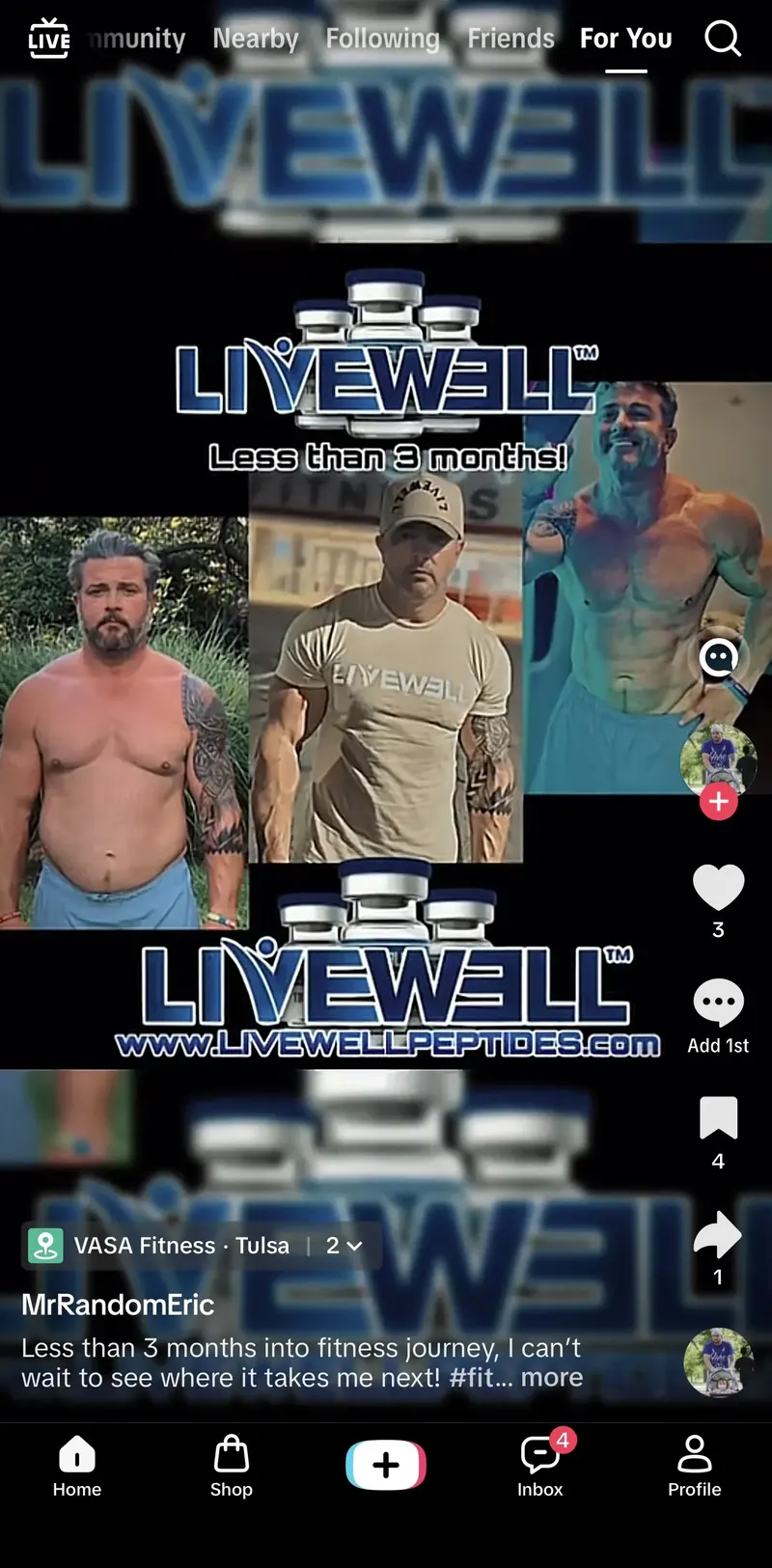
Learning Point 10 💡Your website disclaimer does not control your Telegram, TikTok, Facebook, Instagram or community forum.
Step 11: Customer Testimonials Are Not Scientific Data
If Brenda writes: “Lost 38 lb and my A1C is amazing!!!”Perhaps don’t put that directly underneath your NOT FOR HUMAN USE banner. FDA has already cited customer testimonials and consumer-facing success stories as evidence of intended human use. In the Prime Peptides warning letter, FDA specifically relied on social-media testimonials describing improved health, energy and weight loss.
Learning Point 11 💡Your customer saying the human-use bit for you doesn’t make it any less human-use marketing.
Step 12: Renaming Tirzepatide “GLP-2 T” Does Not Make Tirzepatide Disappear
The latest letters should have killed this idea completely. FDA identified products marketed under names including GLP-2 TZ, GLP-3 RT, GLP-3R and similar shorthand and explicitly connected them to tirzepatide or retatrutide.
Learning Point 12 💡Call it GLP-3R, RT, Triple G, Reta or Ratatouille if you like. If a customer can work out what it is, the FDA probably can too.
Step 13: Do Not Run an Online Pharmacy While Insisting You Are a Chemical Supplier
This is increasingly where private litigation comes in. Lilly’s cases have focused heavily on the allegation that certain businesses present themselves as RUO suppliers while actually operating as consumer drug sellers. Its earlier Pivotal complaint specifically highlighted direct consumer sales, dosing instructions, injection supplies and the absence of prescriptions or medical consultations.
Learning Point 13 💡If you’re genuinely selling laboratory material, your business shouldn’t look like a telehealth clinic that forgot the doctor.
Step 14: Retatrutide Now Comes With an Additional Problem Called Eli Lilly
FDA is no longer the only organisation looking at these websites. On August 12, 2026, Lilly filed six lawsuits over alleged black-market retatrutide sales. Four defendants were RUO peptide sellers, alongside a med spa and a compounding pharmacy. Lilly says some sellers were using “research-use only” labels while actually intending their products for human use. More importantly, Lilly says it has referred more than 200 individuals and entities to FDA, DOJ, state attorneys general, law enforcement and professional licensing boards. It says it’s also reported more than 14,000 websites, advertisements, social-media posts and product listings in more than 100 countries.
Learning Point 14 💡If your compliance strategy is “we’re too small for FDA to notice,” you’d better hope Lilly is looking the other way too
Step 15: The Website Is No Longer the Only Choke Point
This may ultimately be more important than any warning letter. Lilly has publicly called on social-media companies, e-commerce platforms, credit-card companies, payment processors and shipping and logistics carriers to stop supporting what it describes as the illegal retatrutide market. That means an operator can potentially lose: the Instagram account, the store platform, the card processor, the payment account or the shipping relationship without FDA ever needing to send them a beautifully formatted PDF first.
Learning Point 15 💡A legally defensible website is only one part of the problem.
Step 16:Your Affiliates Can’t Do the Dirty Work for You
Cleaning up the main website and then letting affiliates do the human-use marketing for you rather defeats the point. If an affiliate is posting weight-loss results, talking about dosing, explaining how they use the product, or directing people to buy through a discount code, that can create the same contradiction the RUO disclaimer is supposed to avoid. Lilly’s recent actions are aimed at the wider ecosystem around retatrutide sales, not just the product page itself, and it has specifically called on social-media and e-commerce platforms to help shut down what it describes as illegal consumer sales. So:
Website: “For Research Use Only.”
Affiliate: “I lost 30 lb on this. Use my code for 10% off.”
Not ideal.
Learning Point 16 💡Outsourcing the human-use claims doesn’t make them disappear.
So What Should a Genuine RUO Website Look Like?
Probably incredibly boring. Product identity. CAS number. Batch information. Analytical documentation. Technical specifications. Storage and handling information relevant to laboratory work. Actual research documentation.
❌Not a weight-loss blog with a checkout button.
❌Not a dosing clinic disguised as a chemistry supplier.
❌Not a self-injection tutorial carrying an RUO watermark.
And certainly not: FOR RESEARCH USE ONLY followed immediately by:
❌Here is how much our researchers inject every Tuesday.
So the final rule in The FDA Guide to Operating an RUO Website is also the simplest:
✅ If you want to call it RUO, make sure the rest of the business looks RUO too.
FDA isn’t just reading the disclaimer. It’s looking at the product descriptions, studies, dosing information, calculators, reconstitution products, social media, affiliates and everything else surrounding the sale. And now Lilly, payment processors, platforms and shipping companies are being encouraged to look at the same things.
So by all means plaster RESEARCH USE ONLY across the website. Just try not to spend the next ten pages explaining how a human should use it.
Thanks for your cooperation, and for giving us slightly less paperwork next time.
Stay safe, stay RUO compliant
Love,
FDA X
Comments