
First we started noticing a decline in HGH quality, which many people attributed to worsening raw material quality. More recently, however, an increasing number of suppliers have started announcing that they will no longer sell HGH at all. So I started looking into possible reasons why.
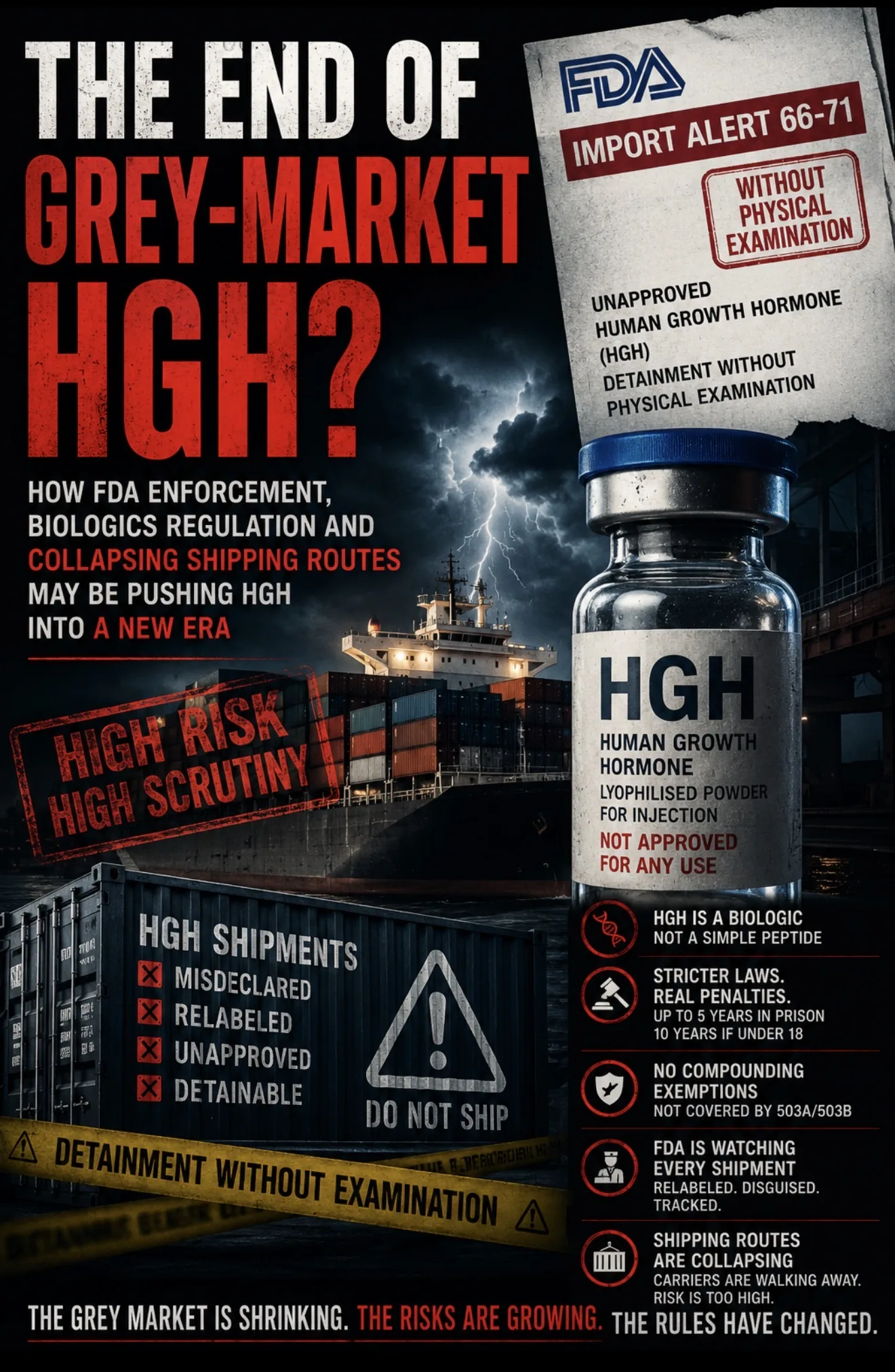
One important piece may be FDA Import Alert 66-71, updated on 7 April 2026.
https://www.accessdata.fda.gov/cms_ia/importalert_204.html
The alert specifically targets unapproved HGH imports and repeatedly classifies HGH as a biologic drug product rather than a simple pharmaceutical raw material or API. That distinction matters far more than many people realise.
The FDA Is Explicitly Targeting Grey-Market HGH
According to the alert, imported lyophilised HGH powders are considered finished dosage-form drugs. HGH falls under biologics licensing requirements, anti-aging, bodybuilding and enhancement uses are not approved indications, and commercial HGH imports can be detained even before full inspection
The FDA also specifically states that imported HGH powders are considered finished biologic drug products, not APIs intended for compounding. In simple terms, FDA is making clear that grey-market HGH is not being viewed as a harmless “research powder” category anymore.
HGH is legally prescribed only for a limited set of recognised medical conditions, mainly growth-related disorders in children and confirmed growth hormone deficiency or short bowel syndrome in adults.
The document also outlines known risks associated with HGH use, including increased cancer risk, nerve pain and elevated cholesterol and glucose levels.
Why the Biologic Classification Matters
The biologic classification is probably one of the most important parts of the entire HGH discussion. A lot of people in the grey market still mentally treat HGH like “just another peptide powder.” The FDA clearly doesn’t. The classification of HGH as a biologic drug product places it under an entirely different regulatory framework from normal small-molecule pharmaceuticals or research chemicals. This is important because biologics are produced using living systems, are more complex and sensitive molecules, require biologics licensing (BLA approval), face stricter manufacturing oversight and have tighter import and distribution controls
In practical terms, HGH occupies a far more heavily regulated category than many peptides currently moving through grey-market “research use” channels and the biologic classification essentially removes much of the ambiguity that some other compounds still operate within.
The Legal Side Is Far More Serious Than Many Realise
The FDA document specifically references Section 303(e)(1) of the Federal Food, Drug, and Cosmetic Act, which prohibits distributing or possessing HGH for non-approved uses such as anti-aging, bodybuilding and athletic enhancement. The alert also makes clear that HGH is not eligible for the normal compounded drug exemptions under sections 503A and 503B of the FD&C Act.
According to the alert, violations can carry up to 5 years imprisonment and fines and up to 10 years imprisonment if the offence involves an individual under 18 years old
Again, this highlights how differently HGH is treated compared with many research peptides.
The “Red List” Is Extremely Revealing
One of the most interesting sections of the import alert is the FDA “Red List” showing companies and shipments flagged for attempting to import HGH under misleading product descriptions.
A repeated pattern appears throughout the document. HGH was allegedly being declared as L-Alanine, Glutathione, antioxidants, peptides N.E.C., proteins and “general purpose reagents.”
FDA repeatedly notes “Product was manifested as [X]; however it was found to contain undeclared Human Growth Hormone.”
Some companies appear to have repeatedly used multiple product categories and customs codes for the same underlying HGH shipments. The document also states that shipments of HGH from companies on this Red List can be detained without physical inspection (DWPE)
Specific HGH products also appear directly, including Hygetropin, Somatropin rDNA for injection and biosynthetic somatropin.
The document spans multiple years, showing this is not a new enforcement issue. FDA has been tracking relabelling tactics, customs-code manipulation, disguised declarations, “research reagent” descriptions and compounding/API arguments for a long time. This may help explain why logistics companies are becoming more cautious. If freight providers know FDA already recognises common relabelling methods, already tracks recurring firms and already monitors disguised declarations, then handling HGH shipments becomes a much higher-risk business proposition.
The repeated references to undeclared HGH, also reinforce why FDA now emphasises that HGH is a finished biologic drug product rather than a simple raw material or supplement ingredient.
The Research Loophole and its Limits
Interestingly, the FDA guidance also reveals that there are still narrow lawful import pathways for certain research-related uses. According to the alert, finished drug products intended solely for in vitro testing, animal laboratory research, instruction, law enforcement, research analysis and testing purposes, may still be lawfully imported under specific regulatory conditions and labelling requirements.
That detail is important because it helps explain why some compounds may still continue moving through “research use” channels despite broader enforcement pressure. However, the distinction is extremely narrow.
The FDA simultaneously makes clear that commercial HGH shipments, anti-aging use, bodybuilding use and improperly declared imports remain subject to detention and enforcement action. In other words, the document doesn’t create a broad loophole for grey-market HGH. Instead, it formalises a much sharper divide between tightly controlled legitimate research use and commercial enhancement-oriented distribution.
That distinction may become increasingly important as regulators, customs agencies and logistics providers become more aggressive in differentiating between the two.
So Why Is This Suddenly Becoming a Problem Now?
It probably hasn’t “suddenly” become a problem in the sense that regulators only just discovered grey-market HGH. The FDA documents clearly show that they’ve been tracking this for years. What seems to be changing now is the combination of pressures happening simultaneously.
HGH occupies a uniquely exposed category because its both a recognised biologic and a product with clearly defined approved and unapproved uses.
The grey-market HGH trade is no longer niche. Telegram vendors, Tik Tok posts, longevity clinics, bodybuilding channels, anti-aging influencers and large China export networks have made it far more visible. At some point, scale attracts enforcement.
Freight companies becoming more risk-sensitive is probably one of the biggest shifts. In the past freight routes were looser, customs enforcement was patchier and logistics companies tolerated higher risk. But now customs data analysis is better, repeat shipment patterns are easier to detect, companies fear seizures and blacklisting and carriers don’t want biologics scrutiny. So even before regulators fully intervene, freight companies begin self-policing.
That may explain why vendors keep describing lines disappearing overnight, packages returning, carriers refusing HGH and tracking numbers dying.
China’s pharmaceutical and export environment is becoming more formalised and traceable. That doesn’t automatically mean “China banned HGH,” but it does mean that there is greater scrutiny and less tolerance for chaotic grey market logistics. The old “ship first, ask questions later” ecosystem becomes harder to sustain.
HGH may have crossed the threshold from “Grey” to “Known Enforcement Target” By consistently treating HGH as a finished biologic drug rather than a research raw or API, FDA dramatically reduces the legal ambiguity the grey market previously relied upon.
The Quality Decline May Be Part of the Same Pressure
Earlier we started noticing declining HGH quality due to worsening raws and suppliers exiting. That may not be coincidence because when export routes become unstable, trusted manufacturers withdraw, risk increases, margins compress and intermediaries multiply, then the market often degrades and creates room for more opportunistic sellers, more corner cutting, weaker QC and lower grade raws. This may explain why the operational problems and quality concerns now seem to be emerging together.
Final Thoughts
Combined with increasing China-side regulatory pressure, growing logistics instability and increasingly aggressive FDA enforcement, HGH may be becoming the first major grey-market category to lose much of the operational ambiguity it previously relied upon. That may help explain why more vendors are now openly warning that HGH has become significantly harder to move internationally.


Comments