
Nothing says laboratory research quite like a physique transformation, a branded T-shirt and a 20% discount code. That contradiction runs through Eli Lilly’s complaint against LiveWell Peptides. Products are presented as research materials, while the surrounding content discusses weight loss, muscle growth, injury recovery and injections. One customer describes an experiment on his own body. The owner publishes a guide to getting started with peptides. Lilly’s lawyers have evidently been doing some research of their own.
Retatrutide is the centre of the lawsuit. Lilly alleges that LiveWell sells products claiming to contain its investigational molecule for human use, using laboratory-research disclaimers as a pretext. The company’s wider peptide marketing provides supporting evidence.
On 8 October 2026, Lilly filed five more lawsuits targeting American Peptides, LiveWell Peptides, Cenexa Labs, Medrein Health & Aesthetics and MedShape Weight Loss Clinic, following six related cases in August.
The LiveWell case names William “Ian” Brown, doing business as LiveWell Peptides, as defendant. It was filed in the Northern District of Texas under 3:26-cv-03514-M. These are civil allegations, not criminal charges or findings of liability.
Update, 10 October: LiveWell’s website was inaccessible when checked. No explanation for the outage has been verified.
Read the full 35-page complaint.
From fitness journey to court evidence
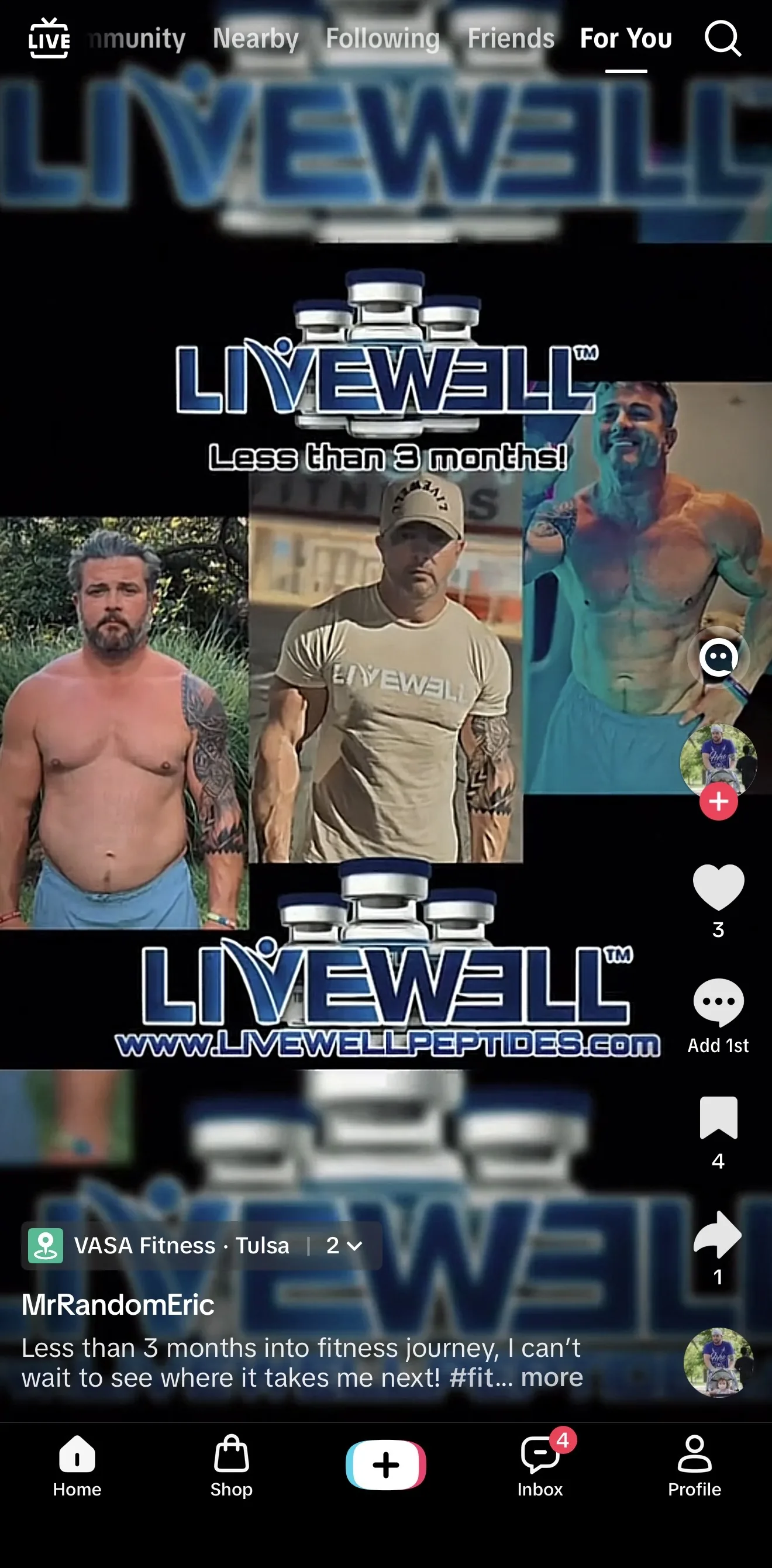

One TikTok shows a series of physique photographs beneath the words “Less than 3 months!”, surrounded by LiveWell branding. Another promotes WALTRIP20, offering 20% off.
The creator is Eric Waltrip, known online as MrRandomEric. He is cited as promotional evidence, rather than named as a defendant. The commercial presentation is the point: a fitness transformation promoted alongside LiveWell branding and a discount code.
The filing cites his WALTRIP20 promotional video and fitness-journey video.
Paragraphs 48 and 49 describe influencers using affiliate links, wearing LiveWell merchandise, tagging the company and attributing their progress to its products. Lilly also points to LiveWell’s own responses: praising progress, thanking supporters and promoting further discussion through Instagram, YouTube and a forthcoming podcast. Other cited posts encouraged consumers to take control of their health and advertised GLP-1 and fitness peptides alongside a sitewide discount.
The research-only label was doing one job. The promotional material, Lilly argues, was doing another.
The experiment was on his own body
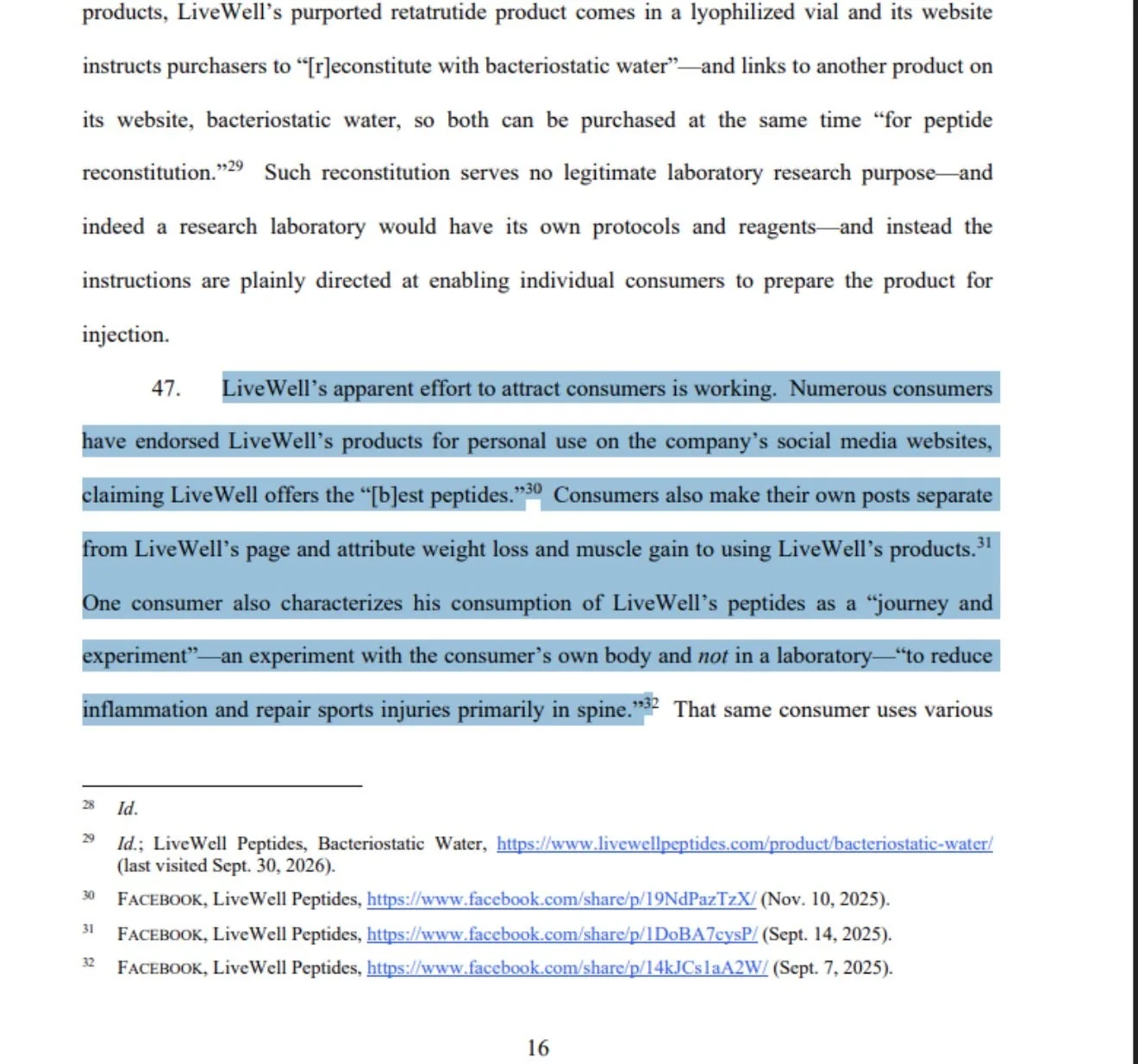
The complaint also cites customers attributing weight loss and muscle gain to LiveWell products. One described a peptide “journey and experiment” aimed at reducing inflammation and repairing sports injuries, particularly spinal injuries.
Lilly draws attention to where that experiment took place: on the customer’s own body, rather than in a laboratory. The same customer recorded side effects and injection pain. For Lilly, this supports its allegation of personal use. Calling something an experiment does not establish laboratory research, particularly when the laboratory appears to be the customer.
The owner’s guide to getting started
Brown’s own content gives Lilly more material. Page 18 describes his “Path to Peptides Community”, covering reconstitution protocols, dosing calculations, safety practices and emerging research. His guidance discusses fat loss and muscle growth, explains administration beneath the skin and recommends combining peptides with nutrition, exercise and sleep.
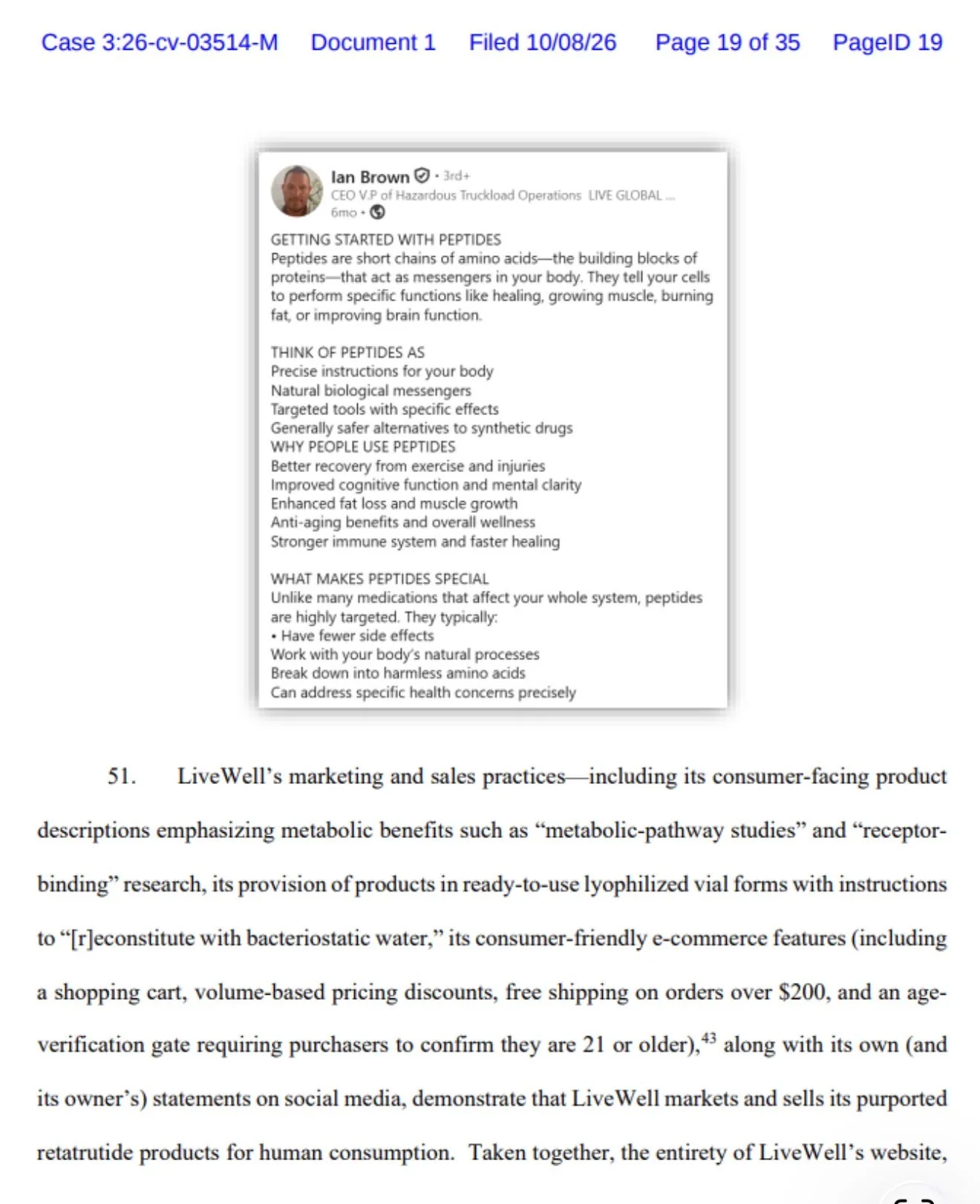
Page 19 reproduces his “Getting Started with Peptides” LinkedIn post. It describes peptides as amino-acid chains acting as messengers in the body and lists reasons people use them:
Recovery from exercise and injuries.
Cognitive function and mental clarity.
Fat loss and muscle growth.
Anti-ageing and general wellness.
Immune function and faster healing.
The post also presents peptides as generally safer alternatives to synthetic drugs, suggesting fewer side effects, natural processes, harmless breakdown products and precise effects on health concerns.
That’s quite a sales pitch for products supposedly destined for a laboratory bench. Lilly uses the practical guidance to argue that the owner was addressing people intending to administer peptides themselves.
Brown’s “Getting Started with Peptides” LinkedIn post.
LiveWell feeds off Lilly’s research. Lilly gets the cleanup bill.
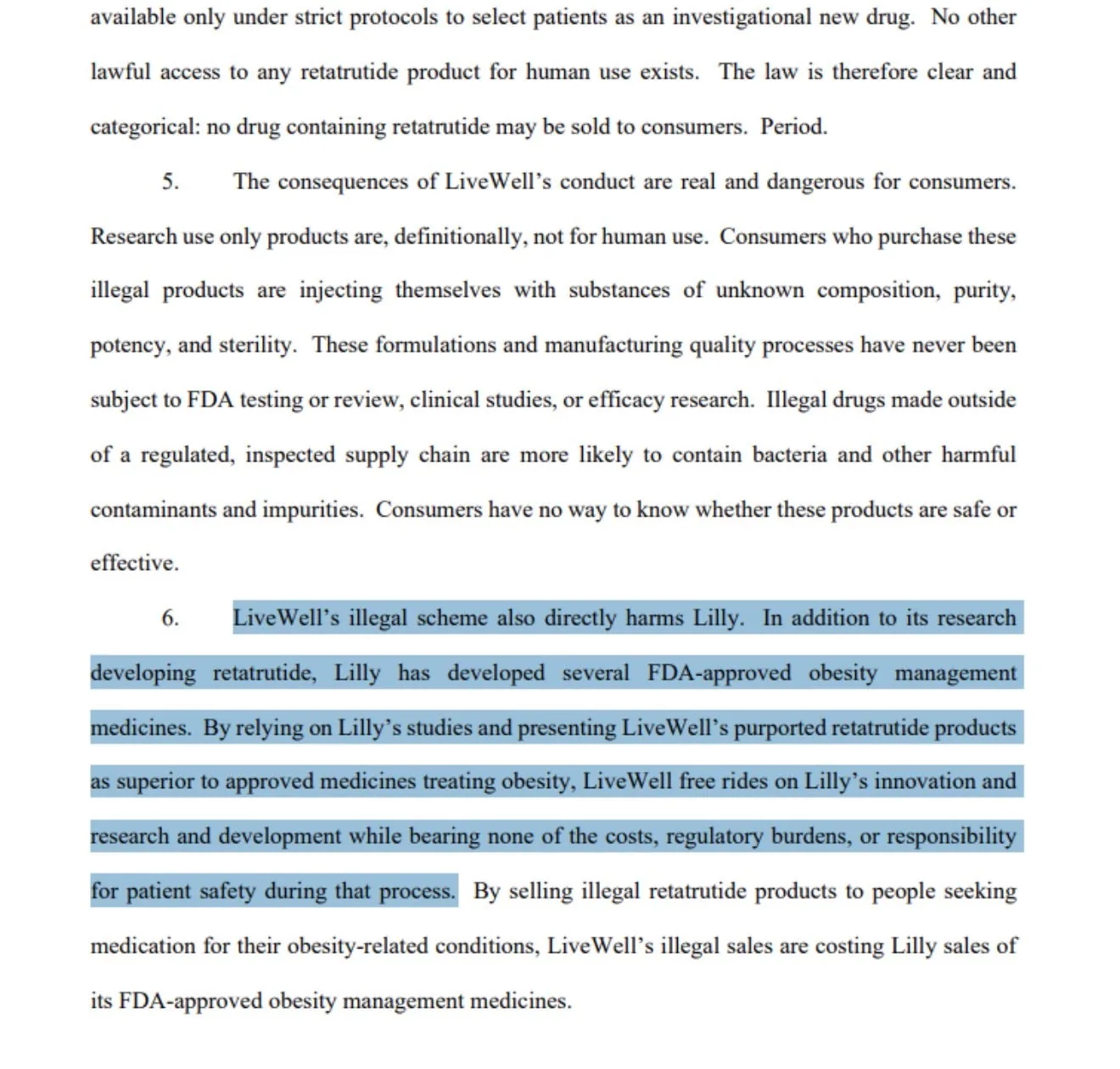
LiveWell’s purported retatrutide product page described GLP-1, GIP and glucagon receptor activity, metabolic pathways, related semaglutide and tirzepatide research, and Lilly’s TRIUMPH trials. According to Lilly, this went beyond explaining the science: it used the company’s research to sell purported retatrutide to consumers and present it as superior to approved obesity medicines.
Lilly paid for the trials. LiveWell allegedly used the results to sell the vials. The complaint describes years of research, clinical trials, investment in manufacturing, regulatory obligations and responsibility for patient safety. It accuses LiveWell of benefiting from that investment while bearing none of the same burdens. The scientific credibility came from Lilly’s investigational medicine; the product in the shopping cart came from LiveWell.
And the shopping cart came with a helpful extra. Purchasers were instructed to reconstitute the product with bacteriostatic water, conveniently linked so they could buy both together. Laboratory research, apparently, with everything you need at checkout.
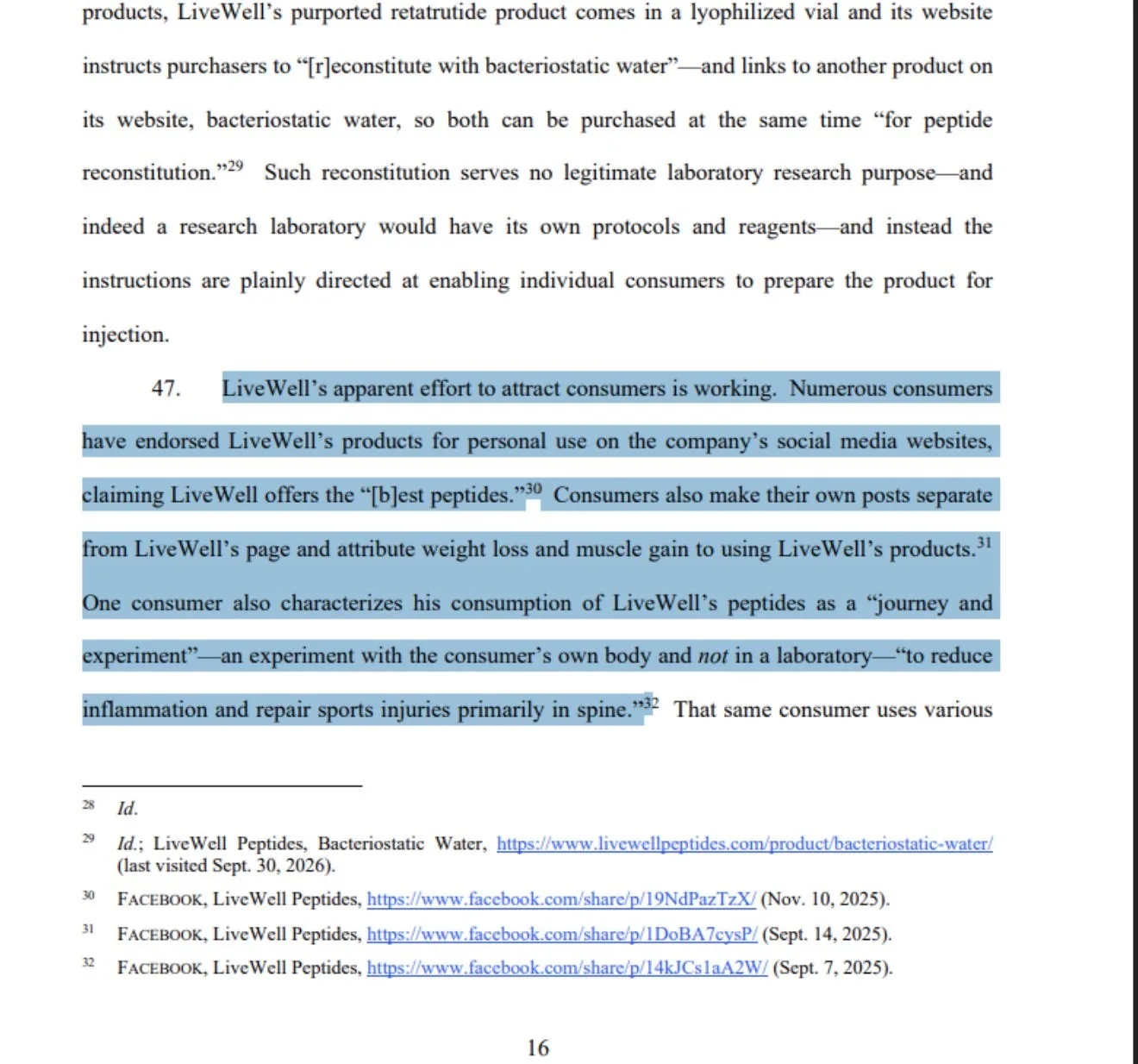
Lilly argues that genuine research laboratories would have their own preparation protocols and reagents. It characterises these instructions as helping individual consumers prepare the product for injection. Its assertion that this serves no legitimate laboratory purpose remains Lilly’s allegation.
Paragraph 51 combines those instructions with product descriptions, social media promotions, the owner’s statements and familiar retail features: a shopping cart, volume discounts, free shipping over $200 and an age gate requiring purchasers to confirm they are at least 21. A birthday check establishes age; it does rather less to establish a research laboratory.
Taken together, Lilly says, the operation targets people seeking obesity-management and metabolic-health medicines. The central allegation is consumer sales of an unapproved retatrutide drug under a research-only pretext. Its language is blunt: LiveWell allegedly exploits clinical trial data, flouts safety standards and profits from that pretext.
The customers Lilly says it is losing
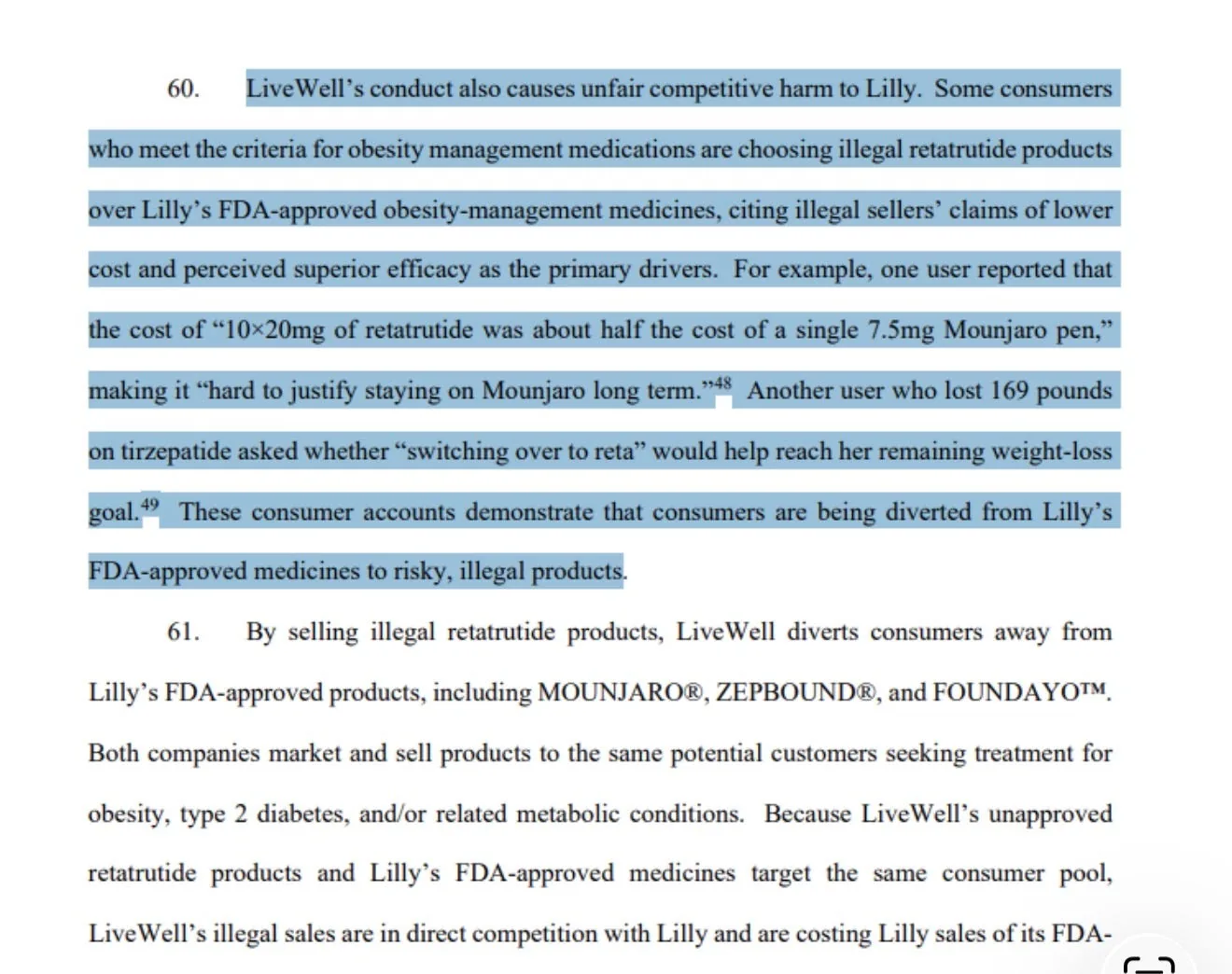
Lilly makes the commercial grievance explicit in paragraphs 60 to 61. It cites one consumer who said ten 20 mg vials of purported retatrutide cost about half as much as a single 7.5 mg Mounjaro pen, making continued Mounjaro use difficult to justify. Another, having lost 169 pounds on tirzepatide, asked whether switching to retatrutide would help reach her remaining goal.
For Lilly, these are potential customers taking their money elsewhere. It alleges direct competition with Mounjaro, Zepbound and Foundayo, driven by lower prices and perceived superior effectiveness.
These accounts illustrate Lilly’s argument about the wider market. They’re not verified price or equivalent-treatment comparisons, and neither establishes that the consumer bought from LiveWell. Nevertheless, the complaint is explicit about its business interest: people seeking weight-management treatment are also potential Lilly customers.
A reputation damaged before launch?
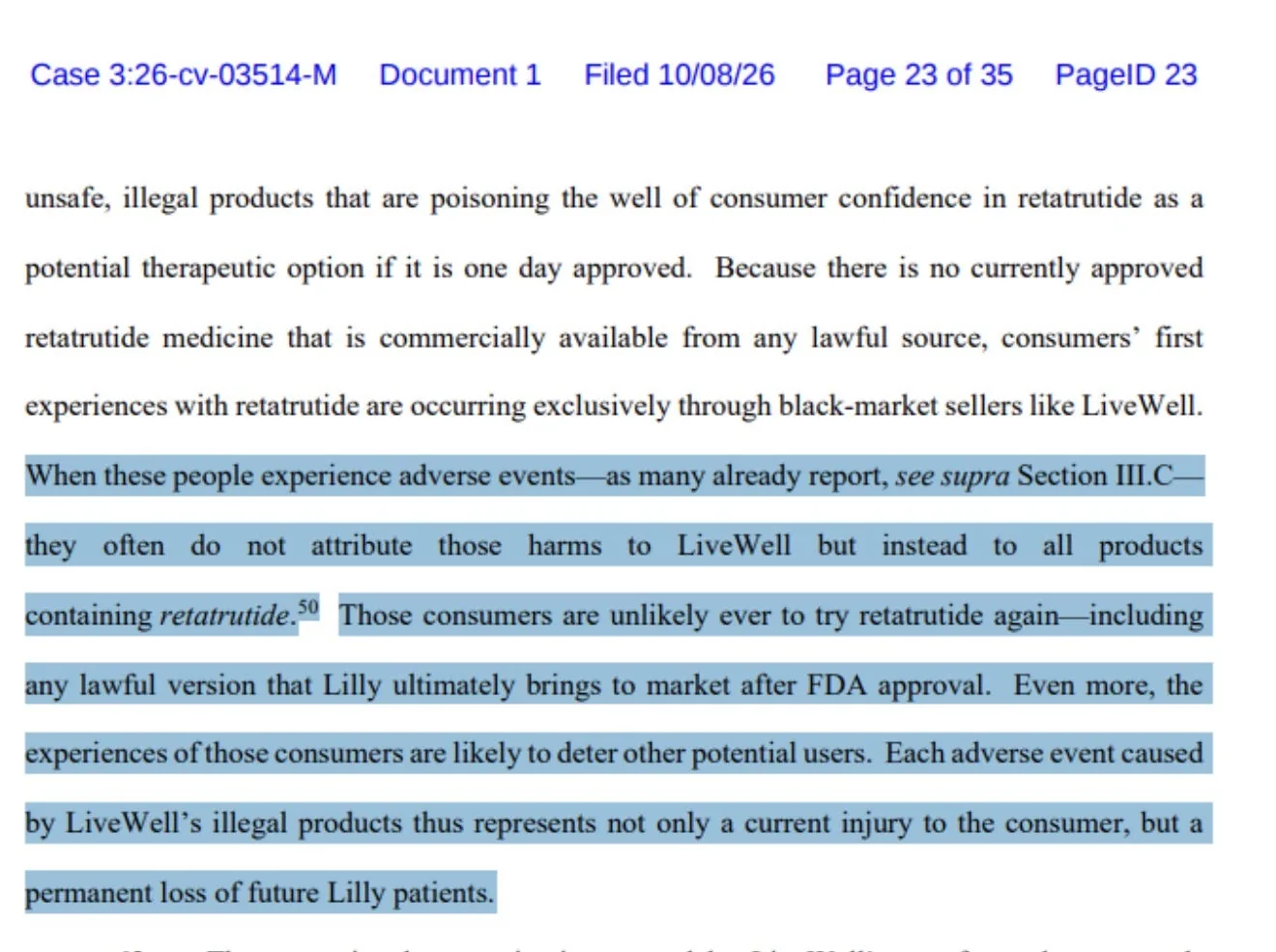
Then comes the damage Lilly says could haunt retatrutide’s future. Consumers who have a bad experience with a grey-market vial may blame the molecule, reject a future approved medicine and warn others away.
Lilly’s accusation is that LiveWell and sellers like it are poisoning the reputation of a medicine before it even reaches the market, leaving Lilly to launch it into a cloud of fear and mistrust. It argues that these experiences could permanently cost it future patients and force it to rehabilitate the product’s reputation.
Apparently, developing the medicine is only the first task; explaining why somebody else’s mystery vial was not yours could become the second.
Attributing that damage specifically to LiveWell requires evidence connecting its products to the experiences cited. An adverse event alone can’t establish whether the cause was contamination, incorrect dosing, an effect of retatrutide itself or something else.
Fund the research, lose the business, then repair the reputation: Lilly says it gets all three. Its commercial interests are stated alongside its safety concerns.
The manufacturing facility, with an office-tower address
The complaint says LiveWell presented itself as a US manufacturer offering research peptides, white-label products and raw materials. It allegedly claimed a cGMP-certified manufacturing facility at 1910 Pacific Avenue in Dallas. Lilly points out that the address corresponds to a high-rise office building.
A manufacturing claim inviting questions about whether the premises contain a peptide facility or a reception desk is an awkward addition to the case. But the address alone doesn’t establish where every product was made. The actual manufacturing arrangements require evidence beyond a mailing address.
Reddit enters the evidence file
Pages 13 and 14 cite discussions in, and about purchasing, dosing and self-administering products from unregulated sources, including Chinese suppliers.
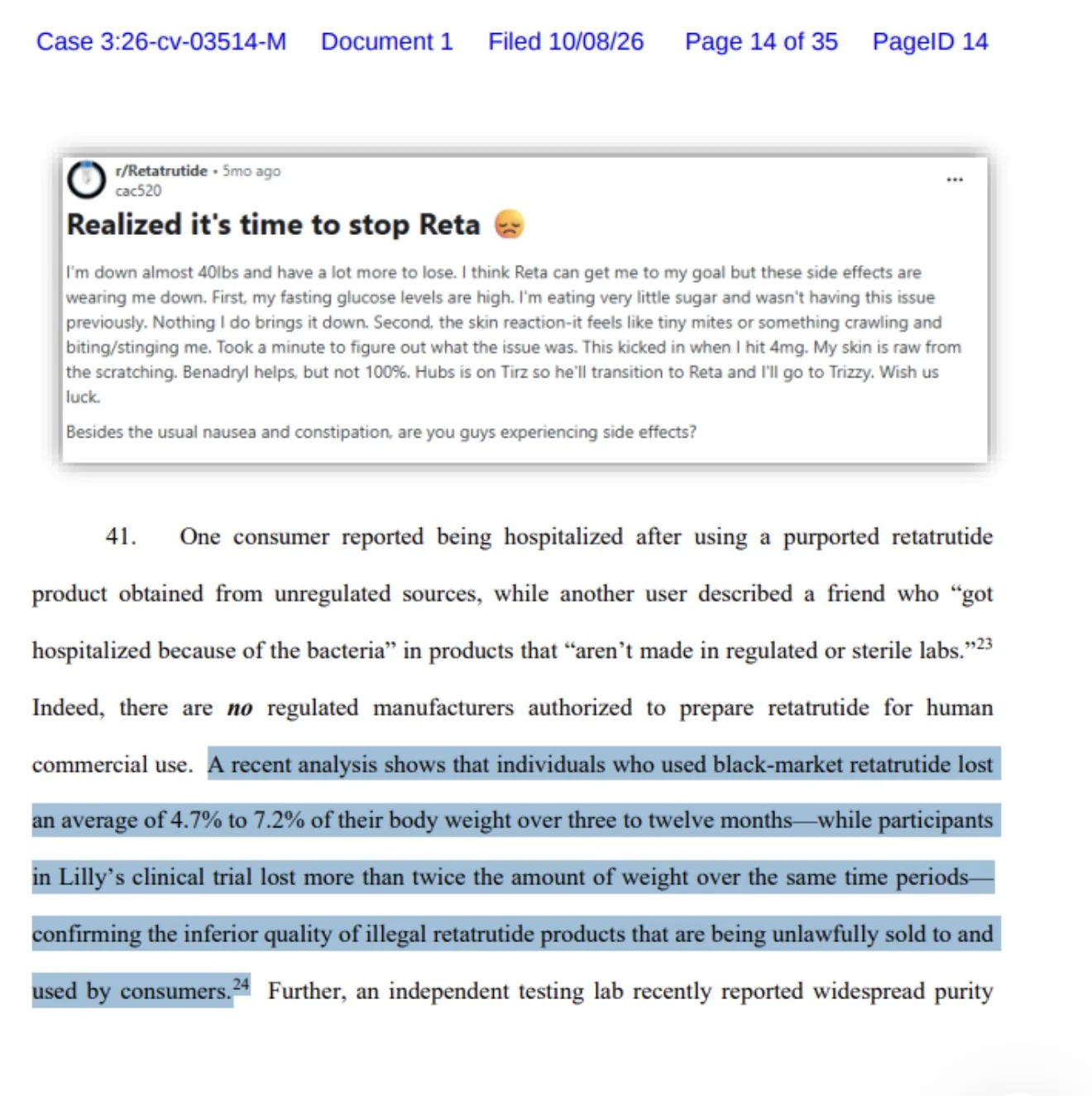
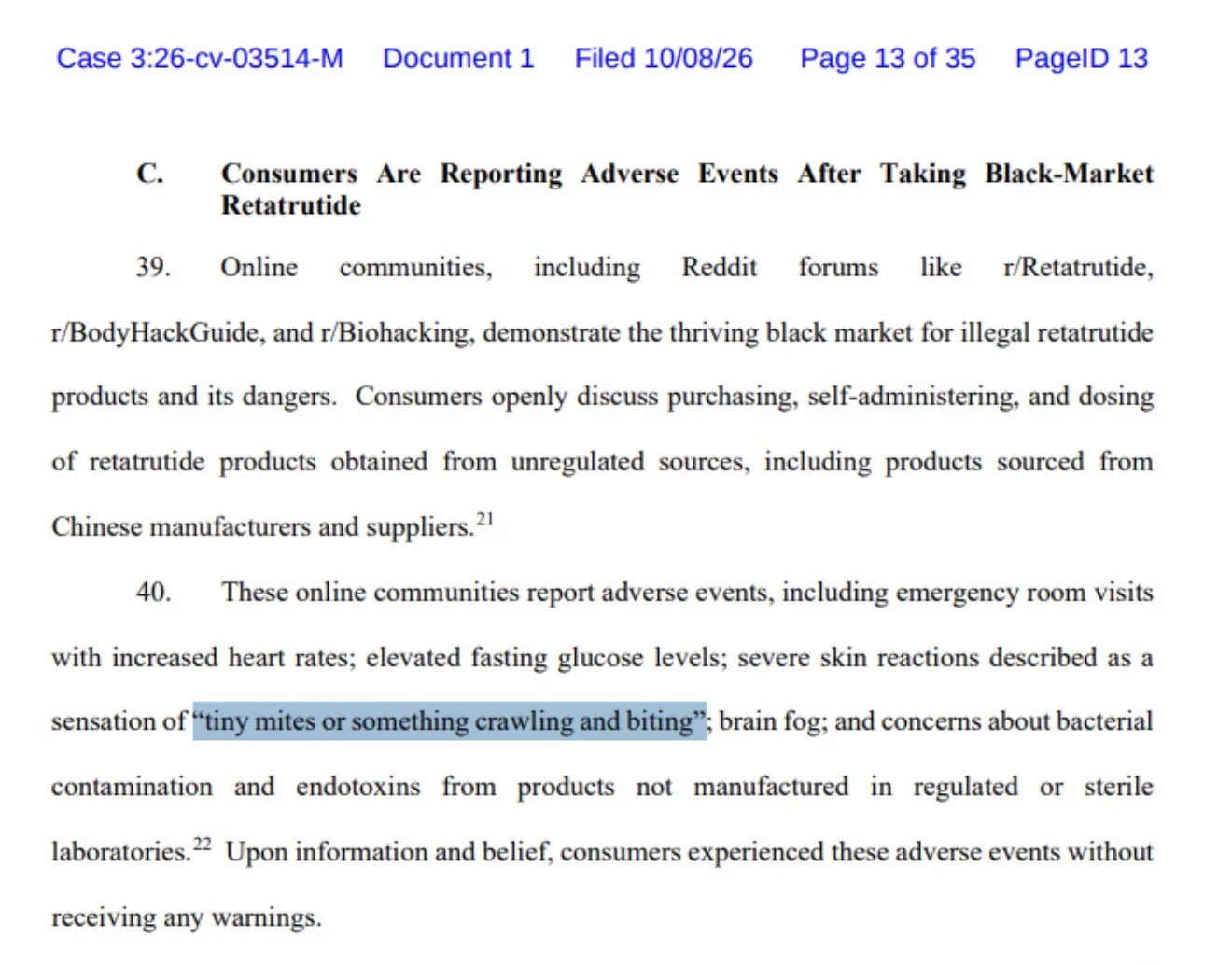
The reported problems include increased heart rates and emergency-room visits, elevated fasting glucose, itching or crawling sensations, brain fog, bacterial contamination concerns and endotoxins. Hospitalisation accounts are also cited. One reproduced post describes a user who had lost almost 40 pounds but intended to stop taking “Reta” after elevated fasting glucose and a severe skin reaction.
These accounts concern the wider grey market. They don’t establish that LiveWell supplied the products involved, independently confirm the vial contents or establish the cause of the symptoms.
The same distinction applies to reports of lead, cadmium and mercury contamination cited in the complaint. Those reports don’t establish that a LiveWell sample contained those metals.
A Reddit account can document what someone says happened. It’s not automatically a laboratory result, a medical diagnosis or proof against a particular supplier.
Lilly’s patients lost more weight. Apparently, that’s the quality test.
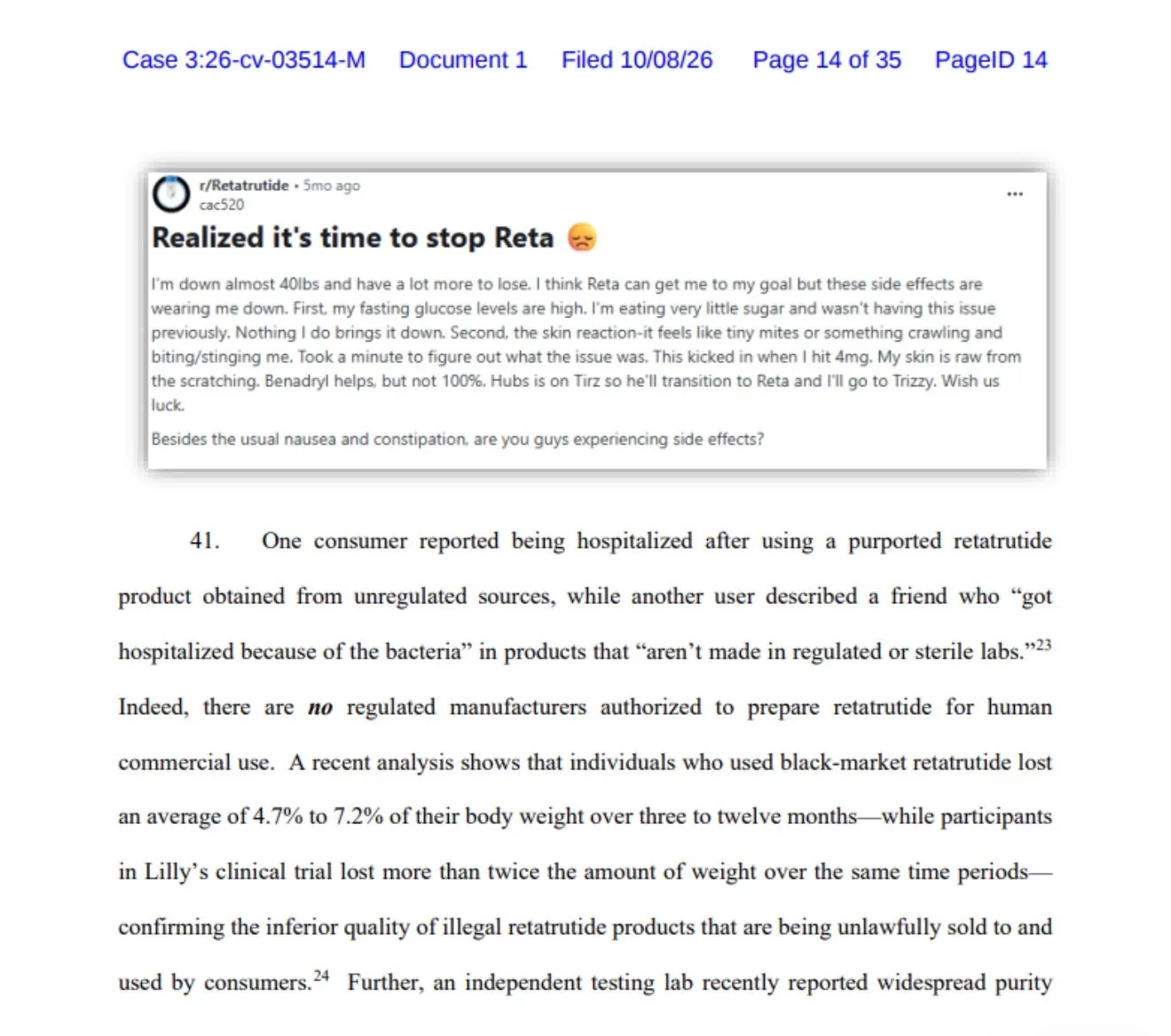
The complaint cites an analysis reporting average weight loss of 4.7% to 7.2% over three to twelve months among grey-market users. It compares that with greater losses in Lilly’s clinical trials and presents the difference as confirmation of inferior product quality.
Lilly’s patients lost more weight, so the other products must be inferior. That is quite a shortcut from the bathroom scales to the laboratory. Dose, duration, adherence, participant characteristics, other treatments and the way results were collected could all affect the outcome. Different average weight-loss results don’t isolate vial quality as the cause.
Money, an injunction and a sworn explanation
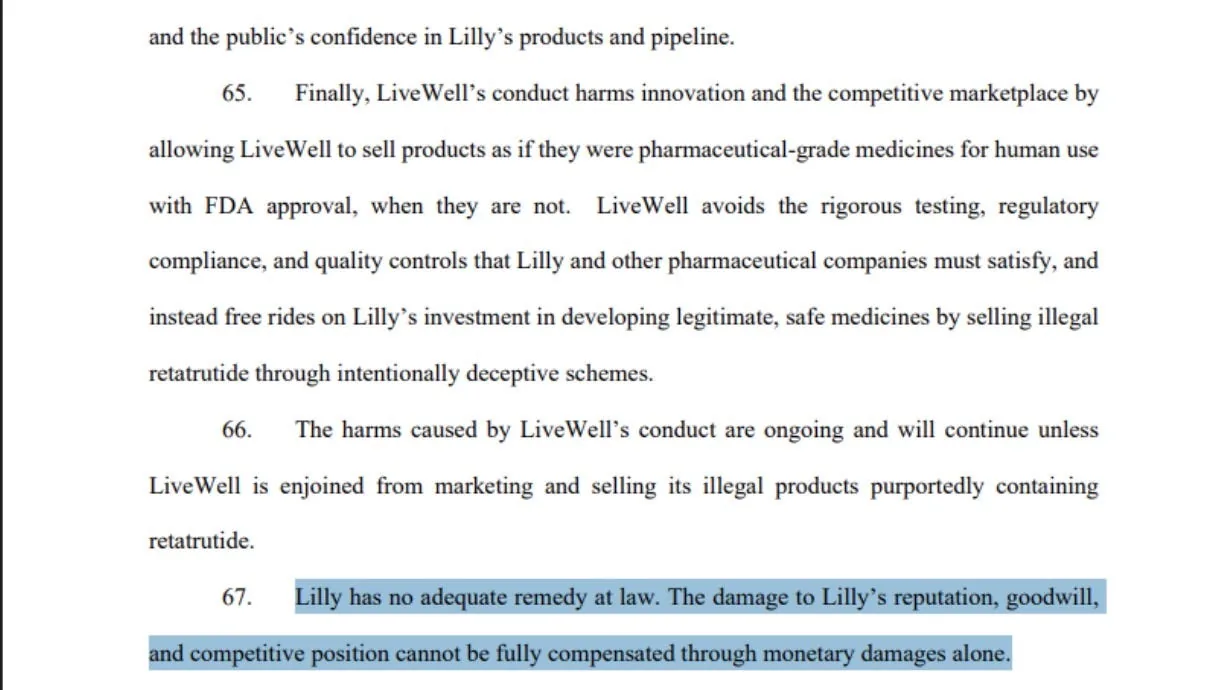
Lilly argues that money alone cannot repair the alleged damage to its reputation, goodwill and competitive position. This forms part of its justification for seeking a permanent injunction.
It requests:
Declarations that LiveWell violated the relevant laws.
A permanent ban on marketing, advertising, distributing, dispensing or selling products containing, or claiming to contain, retatrutide.
A written, sworn compliance report within 30 days of an injunction.
Damages and disgorgement of profits.
Pre-judgment and post-judgment interest.
Legal fees and costs.
Other appropriate relief.
Some counts seek enhanced damages. Lilly also demands a jury trial. These are requests to the court, not orders already granted.
Lilly clearly presents itself as the injured party: it funded the trials, says LiveWell used the results to compete for its customers, and now fears having to repair retatrutide’s reputation before launch. In this telling, even the pharmaceutical giant needs someone to think of its losses. Fortunately, it has lawyers for that.

Comments