
A customer asked a lab a fairly simple question. If its lowest reportable result was <0.01 EU/µg, what would that mean for a 1,000 mg vial of NAD+?
The answer is less reassuring than the tiny decimal makes it appear. One thousand milligrams contains one million micrograms, so:
0.01 EU/µg × 1,000,000 µg = 10,000 EU
A vial containing almost no endotoxin and one containing 9,999 EU could therefore both receive the same <0.01 EU/µg result. That question led to a lengthy debate involving assay sensitivity, dilution, RUO specifications, FDA limits, lawyers, recombinant proteins and whether one gram of NAD+ sounded like rather a lot. Underneath all of it was a much more basic issue: when someone pays for endotoxin testing, what question is the laboratory actually answering?
The Pacific Coast Result
Pacific Coast Biologics initially explained that its next-generation PTS system has a detection limit of 0.01 EU/mL. It also said that samples are prepared at a concentration of 1 µg/mL after determining the total mass in the vial. That confirms the original calculation:
0.01 EU/mL ÷ 1 µg/mL = 0.01 EU/µg
Pacific Coast later clarified that its certificates report the result in EU/µg, rather than leaving it as EU/mL of assay solution. That’s an important distinction because EU/µg is convertible. A customer can multiply it by the mass of the product to obtain the maximum possible endotoxin per vial or dose.
The problem isn’t that the calculation can’t be performed, the problem is what the calculation produces. At a reporting limit of <0.01 EU/µg:
A 100 µg dose would be reported as containing <1 EU
A 60 mg vial would be reported as containing <600 EU
A 500 mg vial would be reported as containing <5,000 EU
A 1,000 mg vial would be reported as containing <10,000 EU
The unit is valid. The result is mathematically convertible. But it may still be far too broad to answer the customer’s vial-level question.
Changing the wording to <10 EU/mg or <10,000 EU/vial would make the implication clearer, but it wouldn’t make the assay more sensitive. Unit conversion can’t recover information that the test didn’t obtain.
Dose Is the Missing Part of the Argument
Pacific Coast made this point after the discussion shifted to whether endotoxin specifications commonly used for recombinant proteins were also appropriate for peptides and other products supplied in much larger quantities. His response was that endotoxin specifications remain the same regardless of peptide or protein chain length. That’s correct in one limited sense: the FDA doesn’t calculate an endotoxin limit according to the number of amino acids in a molecule or whether the product is described as a peptide or recombinant protein. However, that didn’t answer the concern being raised. The important difference wasn’t chain length but dose.
A mass-normalised threshold may provide a useful result for a protein used in microgram quantities while producing an extremely broad upper limit when applied to a product supplied or administered in hundreds of milligrams. The same <0.01 EU/µg reporting limit gives an upper bound of <1 EU for 100 µg, but <10,000 EU for 1,000 mg.
For finished injectable products, the FDA describes endotoxin limits using K/M, where the permitted concentration depends on the route of administration and the maximum dose delivered per kilogram within one hour. The calculation doesn’t change because one molecule has a longer chain than another, but it does change according to how much product could be administered. Chain length was therefore not the issue. The issue was whether a reporting threshold developed or selected for a low-dose product remained sensitive enough when applied to a vastly larger amount.
What “RUO Specifications” Actually Means
Pacific Coast said that he reports according to “RUO specs” rather than USP specifications because his lawyers had advised against presenting results in a way that could be interpreted as a statement about safety or effectiveness. That legal distinction is understandable. A research lab doesn’t need to decide whether an unapproved product is safe for human administration. However, reporting the analytical result in EU/vial doesn’t automatically amount to making a safety declaration. A laboratory can report the total detected endotoxin, or a clearly defined upper bound, while stating that the result is for research purposes only and must not be interpreted as medical advice or approval for use.
No universal governing “RUO endotoxin specification” was identified during the discussion. RUO describes intended use; it doesn’t create one fixed endotoxin limit that applies to every peptide, protein or vial size.
Pacific Coast provided examples of manufacturers and published research using EU/µg. Those examples confirm that EU/µg is a legitimate reporting unit, which was never really in dispute. They don’t establish a universal RUO threshold or show that the same reporting limit remains useful when the product amount increases from micrograms to hundreds or thousands of milligrams.
The Same Test Name, Different Information
“Endotoxin testing” covers several methods, but much of the confusion comes from how labs prepare the sample and present the final result. There are four separate parts to consider:
The method: gel clot, cartridge or plate-reader testing.
The reporting unit: EU/vial, EU/mL, EU/mg or EU/µg.
The analytical limit: the lowest concentration the assay can detect or quantify in the tested solution.
The specification: the limit used to decide whether the sample passes or fails.
These can be combined in different ways. A lab may provide a quantitative result in EU/vial and compare it with a defined EU/vial specification. Another may report a mass-normalised result in EU/µg. A gel-clot laboratory may provide only “detected” or “not detected” at a particular dilution.
The method and reporting format aren’t the same thing. Cartridge and plate-reader results can both be converted back to EU/vial. Gel clot can provide a valid pass/fail result when the effective vial-level limit is known. EU/mL can also be useful when the report identifies which solution the volume refers to and provides the information needed to convert the result back to the original sample.
Depending on the method and reporting choices, the laboratory may be telling the customer:
How many EU were measured or calculated for the vial.
Whether the vial was below a defined EU/vial specification.
Whether the tested solution was below the assay’s detection threshold.
Whether the product met an internal EU/µg specification.
Whether a clot formed at one particular dilution.
A single COA may answer several of these questions. The problem arises when it provides one piece of information without the other details needed to understand what that means for the original vial.
What Each Laboratory Reports
The laboratories discussed present their endotoxin results in several different ways:
Pacific Coast Biologics reports in EU/µg. His lowest reportable result is <0.01 EU/µg, which can be converted into EU/vial when the total product mass is known.
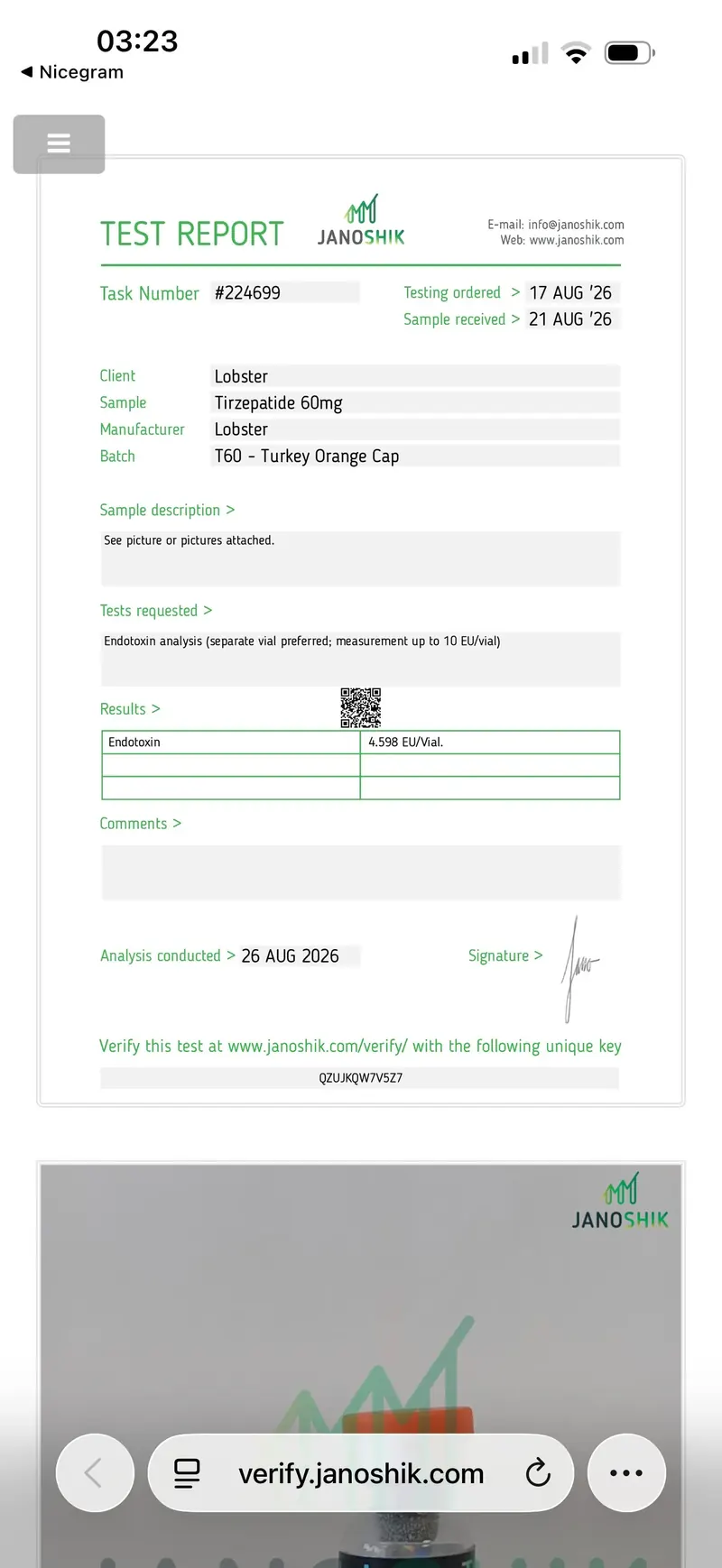
Janoshik reports a quantitative result directly in EU/vial. The example provided reported 2.541 EU/vial.
Chromate reports an upper bound in EU/vial. The example for an 11.92 mg Thymosin Alpha-1 sample reported <2.5 EU/vial.
TrustPointe reports in EU/mL but also provides the original reconstitution volume. Its example reported <5 EU/mL and stated that the complete vial had been reconstituted using 2 mL, giving a calculable upper bound of <10 EU/vial. He also displayed the sample and spike variation together with 99% spike recovery.
BT Labs reports a numerical result in EU/vial and displays the specification used to determine whether the sample passes. Its 60 mg tirzepatide example reported 25.5 EU/vial against a specification of 40 EU/vial, producing a pass. The certificate also disclosed a 3 mL volume and lysate sensitivity of 0.25 EU/mL.
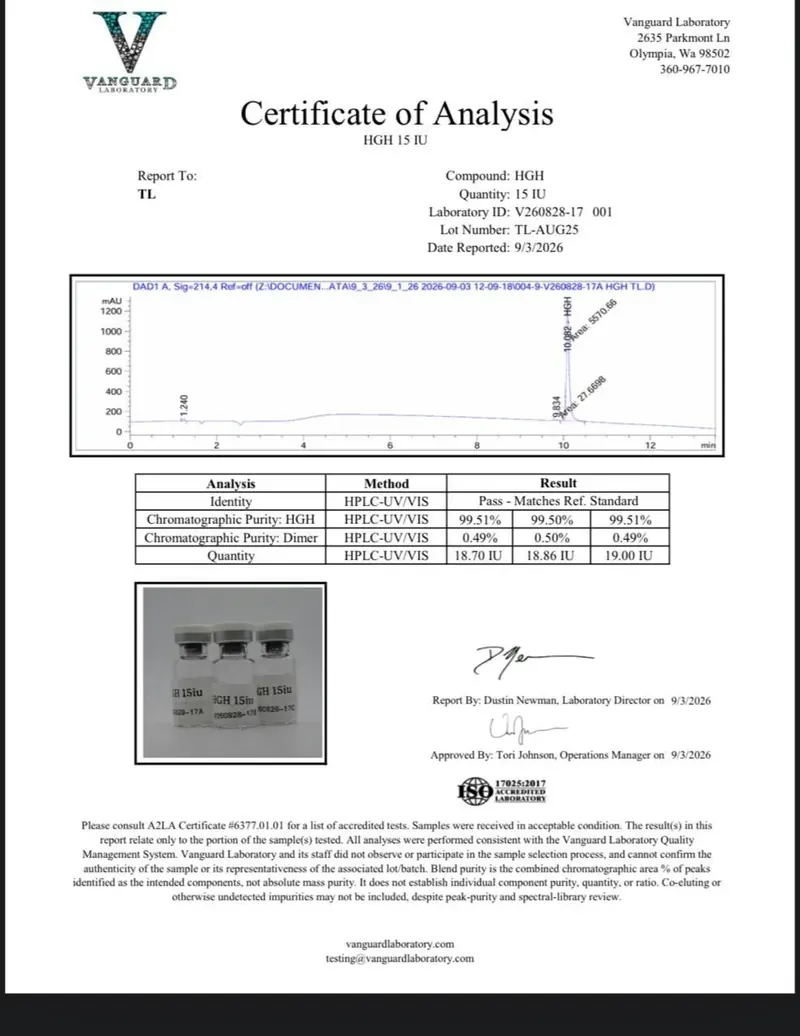
Vanguard Laboratory reports in EU/vial by default. Vanguard said he previously reported in EU/mL, but this confused customers. He will still provide EU/mg or EU/mL when requested.
Kovera Labs uses LAL testing with Charles River Endosafe readers and says he’s upgrading to an automated Nexus system. He usually provides quantitative results but may switch to qualitative reporting. An example COA already uses a qualitative format, reporting PASS against a displayed criterion of ≤0.5 EU/mL. It doesn’t show a numerical endotoxin result, the reconstitution volume or any subsequent dilution, so the effective EU/vial boundary can’t be calculated from the COA alone.
Freedom Diagnostics uses a qualitative gel-clot limit test. His reports provide “PASS” or an equivalent detected/not-detected result alongside an assay sensitivity of 0.05 EU/mL. The certificate doesn’t provide a numerical endotoxin concentration or state the effective EU/vial boundary represented by the pass.
(These examples involve different products and shouldn’t be used to compare the endotoxin levels found by each laboratory. They just show the differences in reporting)
Some labs give the customer the total endotoxin measured or bounded in the vial. Others provide enough preparation information for the customer to calculate it. Pacific Coast supplies a mass-normalised upper bound, while Freedom provides a binary result without showing what that result excludes from the original vial.
All are performing endotoxin testing, but they’re not giving the customer the same type or amount of information.
Why BT Labs Reports Per Vial
BT Labs uses Charles River cartridges at a 1:400 dilution and, more commonly, a plate-reader method at 1:500 with a 1.25 EU/mL spike to check recovery. She then reports the result in EU/vial. One BT COA for a 60 mg tirzepatide vial reported 25.5 EU/vial against a specification of 40 EU/vial, showing both the numerical result and the pass/fail boundary.
BT says reporting per milligram can be misleading because the labelled peptide amount isn’t necessarily the total mass inside the vial. All of the material, including peptide and excipients, may contain endotoxin. A vial labelled as containing 10 mg of peptide could contain 100 mg of material in total, creating a tenfold difference depending on which mass is used in the calculation. Reporting EU/vial avoids that ambiguity because it describes the total endotoxin attributed to the submitted vial.
The important difference isn’t that BT avoids dilution. She records the dilution, checks recovery and provides a numerical result for the original vial.
Freedom Diagnostics: Two Passes and Still No Number
A Freedom Diagnostics certificate for two approximately 30 mg R30 vials makes the problem particularly clear.
The certificate reports:
Endotoxin replicate 1: PASS
Endotoxin replicate 2: PASS
Assay sensitivity: 0.05 EU/mL
He states that testing was performed using a Limulus amebocyte lysate assay (LAL) gel clot limit test, in accordance with USP <85> under validated laboratory conditions. The number beside “PASS” looks reassuringly like an endotoxin result. Freedom specifically describes it as the assay sensitivity, however, rather than the measured endotoxin content or acceptance limit. Freedom has stated that he typically reconstitutes lyophilised samples using 1 mL, although the exact volume can vary depending on the sample and testing requirements. That still leaves several missing pieces.
If an entire vial were dissolved in exactly 1 mL and tested without any further dilution, a sensitivity of 0.05 EU/mL might correspond to an approximate boundary of 0.05 EU/vial. If the reconstituted sample were subsequently diluted tenfold, the effective boundary would become approximately 0.5 EU/vial. At a 100-fold dilution, it would become approximately 5 EU/vial.
Freedom’s COA doesn’t state the reconstitution volume used for that sample, any subsequent dilution, the effective EU/vial cut off or the product specification against which “PASS” was awarded. It also lists two endotoxin replicates alongside two submitted vials without explaining whether each vial was tested separately or whether the entries are duplicate tests from one prepared sample. Running an undisclosed pass mark twice gives the customer two passes, but no more understanding of what either pass excludes.
Qualitative Testing Is Not the Problem
A qualitative endotoxin result isn’t automatically inferior to a quantitative one. It answers a different question: whether the sample is above or below a defined limit, rather than how much endotoxin was measured.
Gel clot is one established qualitative method recognised under USP <85>. It uses prepared Limulus amebocyte lysate reagent (LAL), rather than raw horseshoe-crab blood. If a firm clot forms at the specified test concentration, endotoxin has been detected at or above that level. If it doesn’t, the result is negative at that level.
Qualitative reporting isn’t limited to gel clot. A lab using cartridge or plate-reader equipment can also provide a pass/fail result against a defined threshold.
The problem isn’t the absence of an exact number. It’s whether the lab tells the customer what “PASS” excludes from the original vial. That requires the effective limit, reconstitution volume, further dilution and assay sensitivity to be known.
Controls must also show that the sample hasn’t inhibited the reaction. Dilution can overcome interference, but excessive dilution may push endotoxin below the assay’s detection range. This is why testing must remain within the maximum valid dilution.
The issue isn’t qualitative versus quantitative, or gel clot versus cartridge. It’s whether the final report explains what the result means for the submitted vial.
What an Endotoxin Certificate Should Show
A research COA doesn’t have to decide whether a product is medically safe. It should give the customer enough information to understand the analytical result.
At minimum, it should disclose:
The result in EU/vial, or the reconstitution volume and subsequent dilution needed to calculate it
The assay’s detection or quantification limit and the resulting upper bound for the original vial
The specification used for any pass/fail decision
Whether product-interference controls passed
Whether replicates came from one preparation or separate vials
EU/mL is useful when the report identifies which solution the volume refers to. EU/µg or EU/mg can also be useful when the denominator is clearly defined. For someone asking about the total contents of a submitted vial, EU/vial is usually the clearest format.
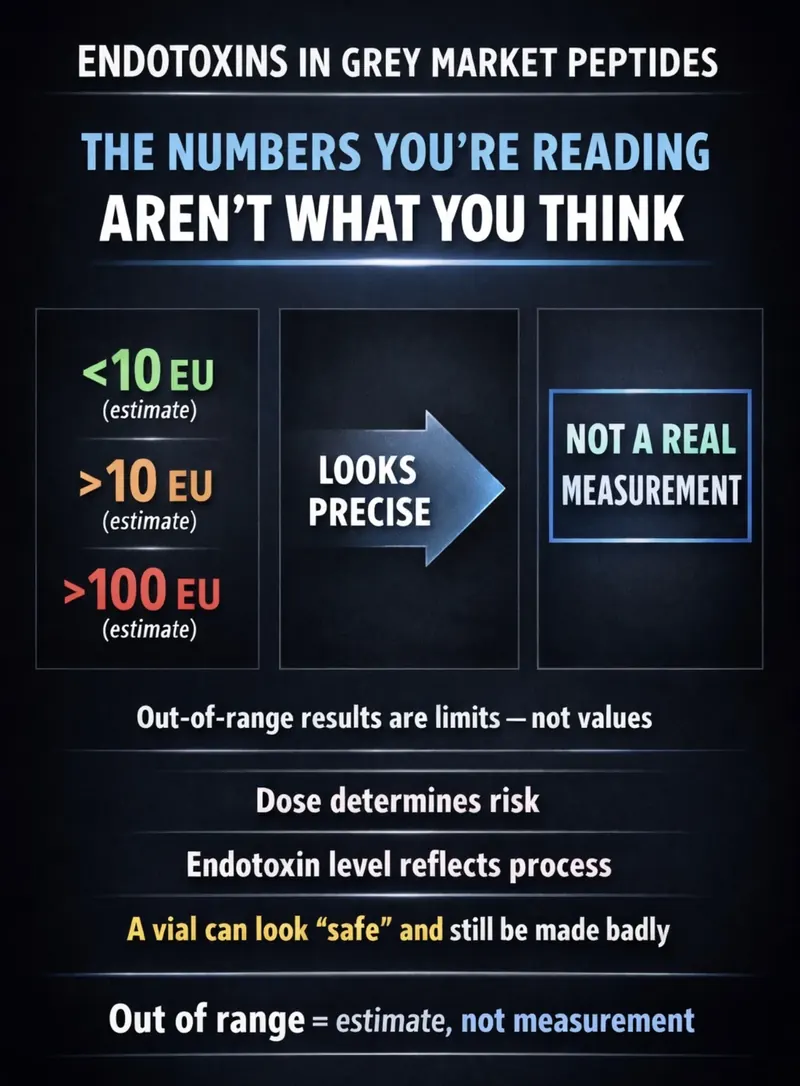
“Not detected” doesn’t mean zero. “Less than” still describes a range. “Pass” means very little unless the pass mark is shown.
What the Evidence Does Not Prove
None of this proves that any particular vial is safe or unsafe, that Pacific Coast or Freedom fabricated results, or that their assays were performed incorrectly.
It shows that Pacific Coast’s result produces a very broad vial-level upper bound for high-mass products, while Freedom’s certificate doesn’t disclose enough information to calculate its vial-level boundary at all. A lab may have followed its internal procedure exactly. That doesn’t mean the certificate answers the question the customer believed they’d purchased.
Pass, But Against What?
The discussion became tangled in chemistry credentials, lawyers, FDA limits and whether other laboratories disclose their preparation protocols. The original question was much simpler. If one 1,000 mg vial contained 0.07 EU and another contained 9,999 EU, could a reporting system based on <0.01 EU/µg distinguish between them?
No. Both fall below the same reporting threshold.
If a certificate says PASS, what amount of endotoxin has it ruled out in the original vial? Without the preparation, dilution and pass mark, there’s no answer. The issue was never which unit looked most scientific. It was whether the customer could determine what the result actually excluded.
Comments