
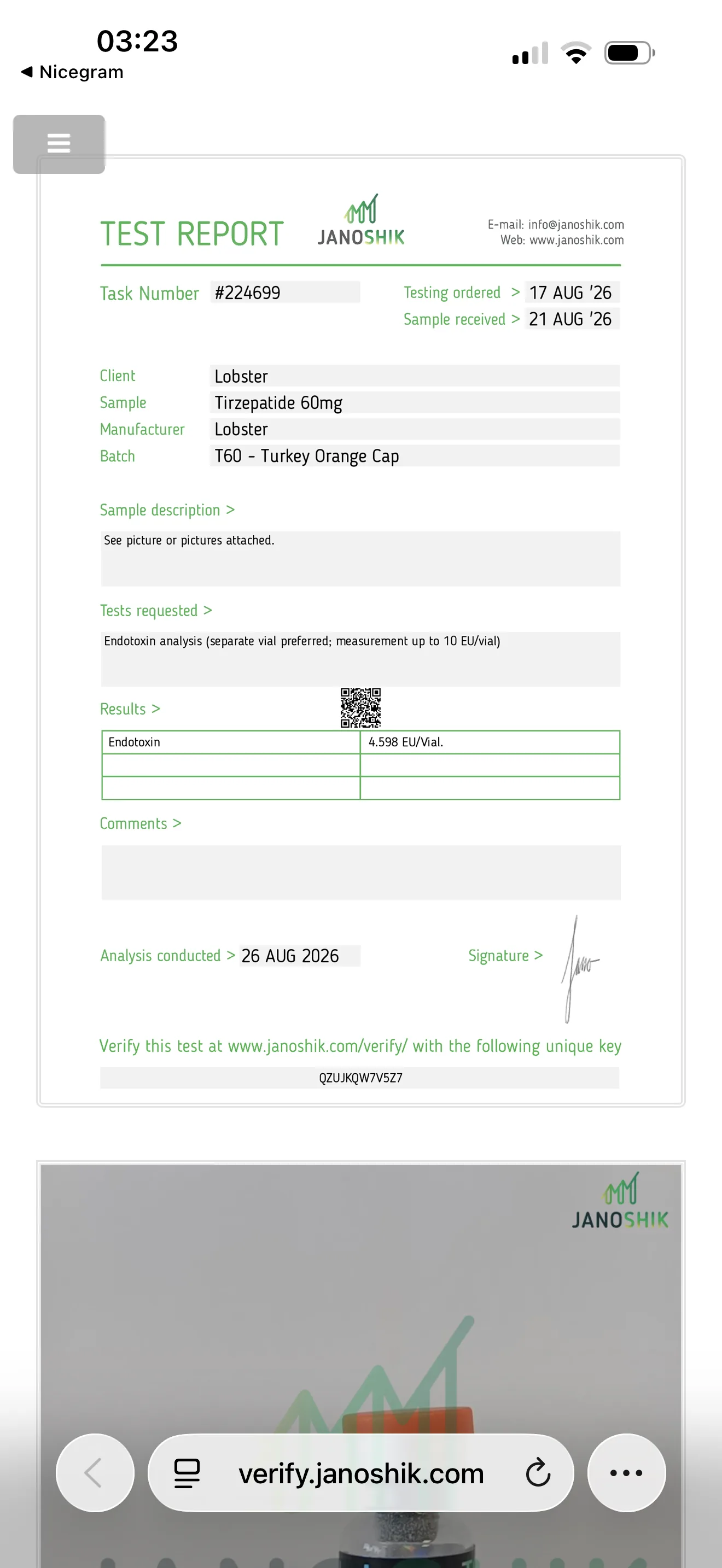
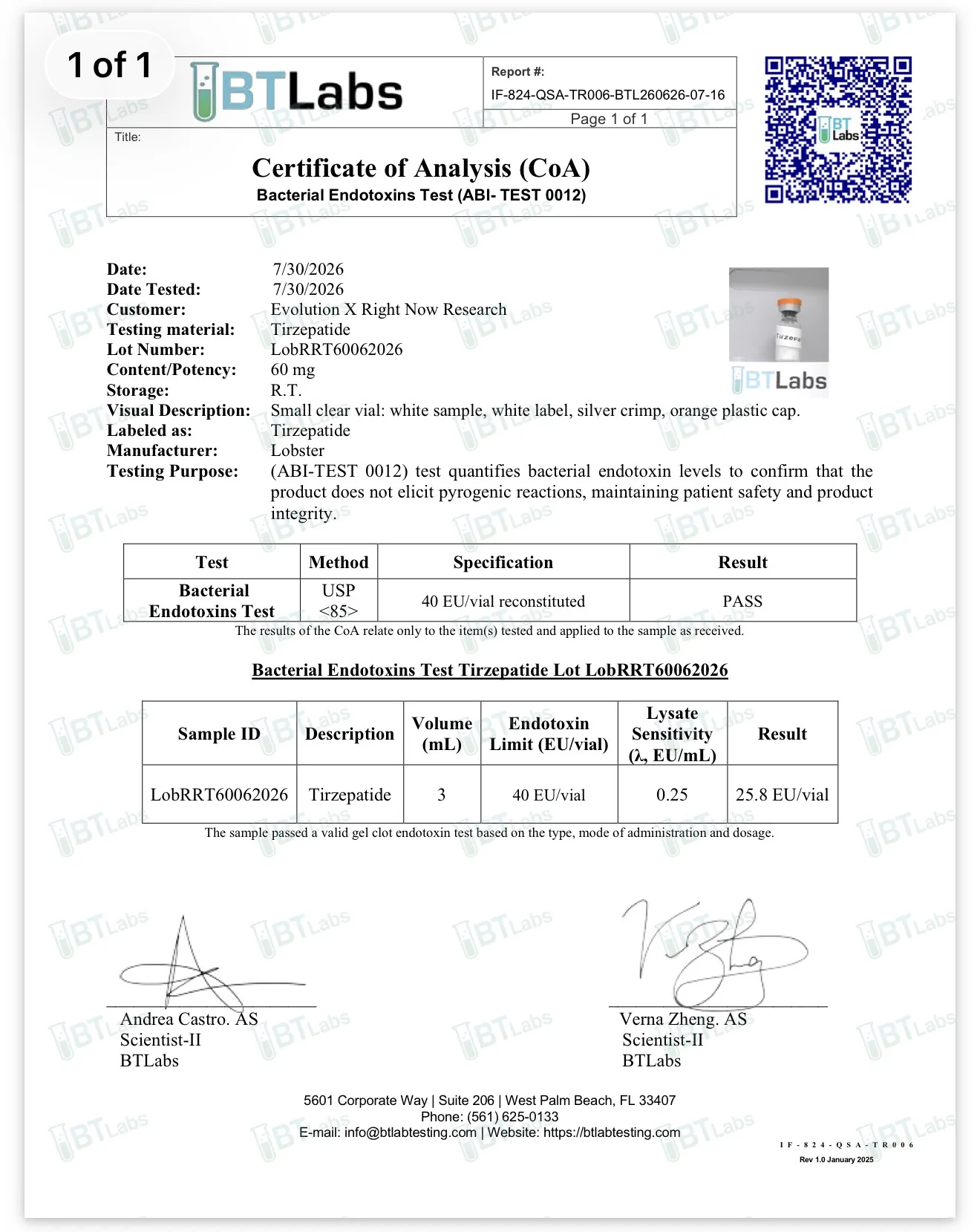
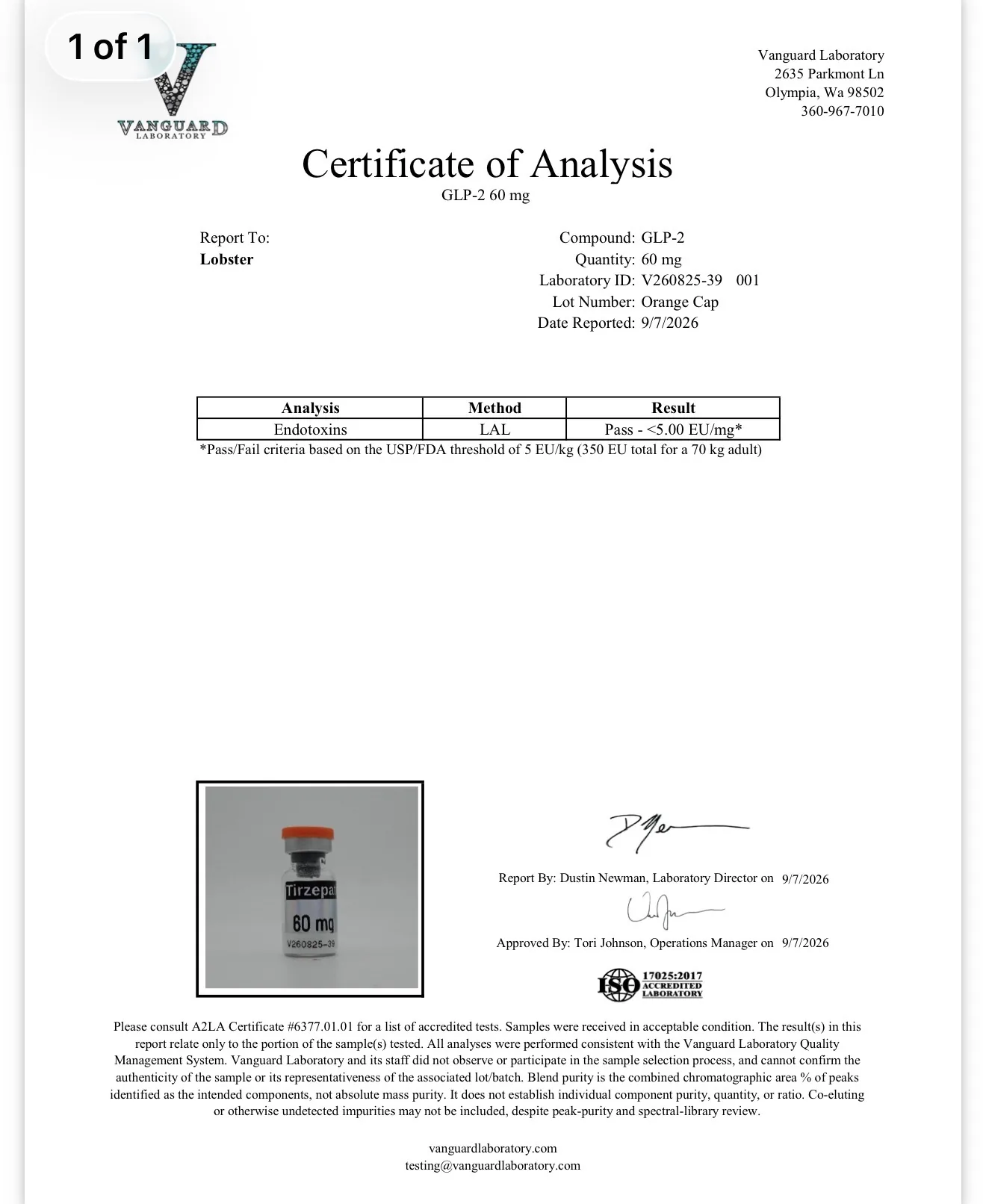
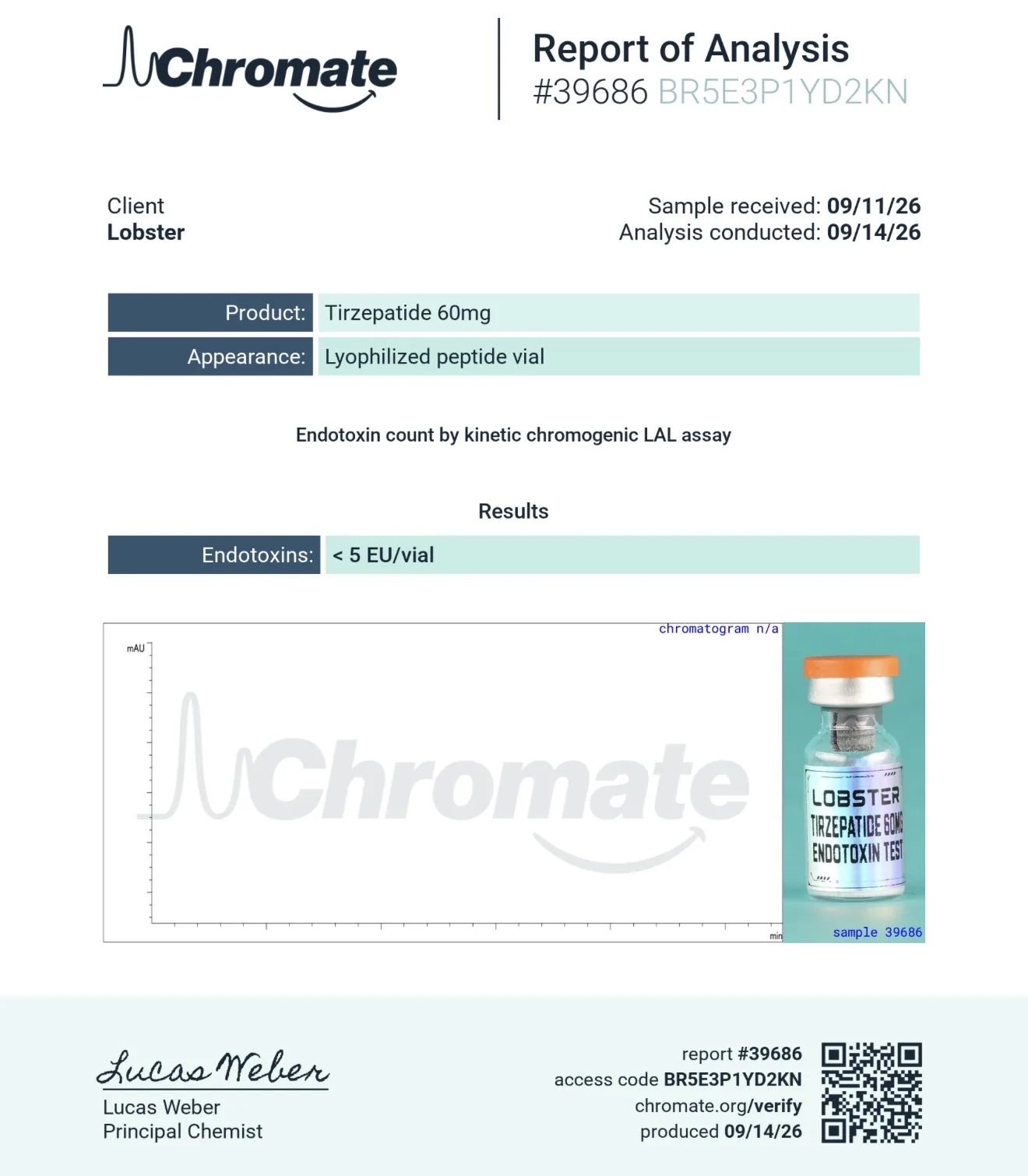
At first glance, it looks like a laboratory shoot-out. Four vials of Lobster tirzepatide 60 mg were reportedly taken from the same product box and sent to four different laboratories for endotoxin testing. Janoshik reported 4.598 EU/vial. BT Labs reported 25.8 EU/vial. Chromate reported <5 EU/vial, while Vanguard reported <5 EU/mg.
Same product, same claimed batch and even the same box, yet one result appeared more than five times higher than another. It would be easy to decide that one laboratory must have got it wrong. The COAs show a more fundamental problem: these were not four laboratories answering exactly the same question in exactly the same way. They tested different vials, used different methods, reported in different units and applied different limits. In one case, later statements raised questions about whether a precise reported number was within the applicable range of reliable quantification.
So what does this comparison tell us, and what does it not?
The four results
Janoshik, 4.598 EU/vial
The COA doesn’t name the analytical kit, although Janoshik separately identified it as a Thermo Pierce endpoint chromogenic LAL kit. No pass/fail limit is shown; the requested measurement range was stated as up to 10 EU/vial.
BT Labs, 25.8 EU/vial
The COA identifies USP <85>, a gel-clot endotoxin test, a 3 mL volume and lysate sensitivity of 0.25 EU/mL. The sample passed against a specification of 40 EU/vial reconstituted.
Vanguard Laboratory, <5.00 EU/mg
The method is recorded only as LAL. The sample passed against a limit based on 5 EU/kg, or 350 EU total for a 70 kg adult.
Chromate, <5 EU/vial
Chromate used a kinetic chromogenic LAL assay. No separate pass limit is shown on the report.
The first important point is that Janoshik and Chromate don’t conflict. A result of 4.598 EU/vial fits within Chromate’s result of less than 5 EU/vial. On the face of the certificates, BT’s 25.8 EU/vial is about 5.6 times higher than Janoshik’s result. It’s the apparent numerical discrepancy in the set, although BT’s later explanation substantially changes how that figure should be interpreted. Vanguard’s result cannot resolve it because Vanguard used a different denominator. For a nominal 60 mg vial, <5 EU/mg only establishes that the whole-vial result was somewhere below 300 EU/vial. It could be below 5, it could be 25.8, or it could be considerably higher. All would satisfy the stated result. That doesn’t make Vanguard’s result false, but it does makes it too broad to compare with the other three in the way it was presented.
Although the vials were reportedly taken from the same product box, the laboratories did not all use the same analytical assay. BT’s certificate identifies a USP <85> gel-clot test, Chromate used a kinetic chromogenic LAL assay, Janoshik identified an endpoint chromogenic LAL kit, and Vanguard recorded only “LAL.” These methods don’t produce results in precisely the same way. Reagents, standard curves, dilution, sample preparation and inhibition or enhancement can all affect what is detected and reported
BT’s 25.8 result in context
Although BT Labs also passed the sample, their COA was the only one to return a substantially higher exact result: 25.8 EU/vial. The certificate identifies a USP <85> gel-clot test, gives a lysate sensitivity of 0.25 EU/mL and records the sample as passing against a specification of 40 EU/vial.
Questions were later raised about whether 25.8 EU/vial could be treated as a confidently quantified result. BT subsequently described a raw assay limit of detection of 0.005 EU/mL and limit of quantification of 0.05 EU/mL. After accounting for dilution and sample preparation, the laboratory said these could correspond to product-level limits of approximately 5 EU/vial and 50 EU/vial.
That distinction is important. The limit of detection is the lowest level at which a response can be distinguished from background. The limit of quantification is the lowest level at which the lab can assign a number with acceptable accuracy and precision. A sample may therefore contain detectable endotoxin without supporting a reliable exact measurement.
If the 50 EU/vial quantification limit applied to this sample, the reported 25.8 EU/vial would fall below the level BT later said they could confidently quantify. In a direct follow-up, BT described this as their “old method per original Jano calculation,” which they now regard as “not quite right,” adding that they “wouldn’t consider it at all.” BT also said endotoxin results had been “all over the map” and pointed to subsequent efforts to standardise reporting.
This doesn’t mean the sample failed or that BT detected no endotoxin. It means the exact figure of 25.8 shouldn’t be compared too literally with Janoshik’s 4.598 EU/vial. The apparent gap could reflect differences in method, calculation and reporting, as well as possible differences between the individual vials.
Raw assay sensitivity is not the same as sensitivity per vial
This distinction is essential when comparing the reported figures. A lab may describe an assay as capable of detecting 0.005 or 0.01 EU/mL. That figure applies to the solution reaching the assay, the original vial may have been reconstituted and then diluted, sometimes substantially, to reduce the effect of the peptide or other material on the test. In simplified form:
Effective limit per vial = assay limit in EU/mL × dilution factor × reconstitution volume
Any additional preparation factors also have to be included. Without those details, an assay-level limit of 0.005 EU/mL can’t simply be compared with a COA reporting 4.598 EU/vial. The units may look close while describing different stages of the calculation.
Vanguard provided a useful worked example from its own method. The laboratory said the lower quantitative limit of its cartridge is 0.005 EU/mL. If a reconstituted sample can be tested at a 1:400 dilution, that becomes:
0.005 EU/mL × 400 × reconstitution volume
That would produce an LOQ of 2 EU/vial when a vial is reconstituted with 1 mL, or 4 EU/vial when it’s reconstituted with 2 mL. Vanguard also stressed that a 1:400 dilution won’t work for every peptide, so the final LOQ must be calculated from the dilution actually used.
This is exactly the information missing from many COAs. It also shows why figures from different laboratories can’t be compared by looking only at the sensitivity printed for the underlying assay. BT described 0.005 EU/mL as an LOD; Vanguard described 0.005 EU/mL as the lower quantitative limit of its cartridge. The same number can occupy a different place in each laboratory’s method and still produce a different reporting limit once the sample preparation is included.
The laboratories have agreed to change the reporting
It’s been argued that even human diagnostic labs don’t always use identical units, formats or methods, making uniform reporting an unreasonable expectation. But that misses the point. The labs don’t have to use identical analytical methods to present the information consumers need in a comparable format. A result can be reported in EU/vial alongside the method, reconstitution volume, actual dilution, LOQ and any separate LOD statement.
Vanguard confirmed that his analysis is already quantitative and said he will begin reporting EU/vial for this market. BT Labs said the two labs were in agreement and would begin reporting the LOQ, with an additional statement addressing the LOD. Vanguard uses the LOQ for routine numerical reporting; a separately validated LOD could support wording such as “not detected below X,” but shouldn’t be presented as a quantified result.
This doesn’t retrospectively repair the four existing COAs or tell us which vial contained what, but it’s still a worthwhile outcome. Future reports from the two labs should be easier to compare, and a reader should be able to distinguish a measured concentration from a result that was merely not detected above the method’s effective limit.
A “pass” is only as meaningful as the limit behind it
The COAs also used very different pass criteria. BT passed the sample against 40 EU/vial. Vanguard referred to the familiar general parenteral threshold of 5 EU/kg, translating it to 350 EU for a 70 kg adult. Those aren’t the same specification.
The 5 EU/kg figure is an exposure limit applied through a dose calculation, it’s not a universal allowance that can be attached to every vial regardless of how much product the vial contains or how much is administered within an hour. The relevant product limit depends on the maximum dose and route of administration. A vial containing several potential doses can’t automatically be assigned the entire adult threshold simply because the vial exists.
The FDA’s March 2026 guidance says current endotoxin limits should be established using the calculation methods in USP or AAMI standards and justified for the particular product. It also warns that older generic limit tables may not reflect current strengths and dosing regimes. FDA guidance on pyrogen and endotoxin testing
This is why “pass” should never be read as shorthand for “no meaningful endotoxin found.” It means the result met the specification selected by that laboratory or client. If the specification, assumed dose or calculation isn’t disclosed, the word tells the reader very little.
The same problem appears in the claim that anything below the limits of detection and quantification was “safe to use.” A lab’s inability to detect or accurately quantify below a certain level doesn’t itself establish safety. The relevant questions remain the effective detection limit, the maximum administered dose, the route, the suitability of the method and whether sample interference was properly controlled.
Could separate vials genuinely contain different amounts?
Yes, but this comparison doesn’t prove that they did. Endotoxin contamination doesn’t have to be distributed evenly across every vial in a production run. A problem introduced during filling, handling or another localised part of production could affect some units more than others. This is why representative sampling is important and why one vial can’t establish the condition of thousands.
The FDA recommends scientifically sound sampling that considers the manufacturing process and the risk of contamination. Its guidance also warns that pooling can dilute a contaminated unit with cleaner ones and recommends no more than three units in a composite sample, with the maximum valid dilution adjusted accordingly. FDA guidance
Vanguard states that individual vials are used for some tests and that endotoxin samples can be composited, although a composite would be identified on its certificate. The Lobster certificate contains no composite notation, so it appears to concern one vial, but that remains an inference from the COA. Four different vials can therefore return different genuine results. The problem is that this experiment can’t distinguish vial-to-vial variation from method-to-method variation because both variables changed at the same time.
Endotoxin testing is not a simple count
The Truth of Endotoxin Values explains why apparently valid endotoxin tests can disagree. These assays measure biological activity in endotoxin units, rather than counting a fixed physical mass of endotoxin. The authors describe variation arising from LAL reagents, standard curves, sample composition, endotoxin masking and beta-glucan interference. They report that a 1% change in the intercept of a standard curve can produce a change of up to 35 % in measured endotoxin activity. In one example, the same manufacturing sample returned about 6.5 EU/mL using a chromogenic LAL method and about 0.8 EU/mL using a turbidimetric method. Both tests passed their controls; beta-glucan interference was considered the likely explanation. Read the paper
Although the paper explains how two valid endotoxin tests can produce very different numbers, it can’t tell us why these four Lobster vials did. Beta-glucan interference, masking and method sensitivity are all possible explanations, but not established ones.
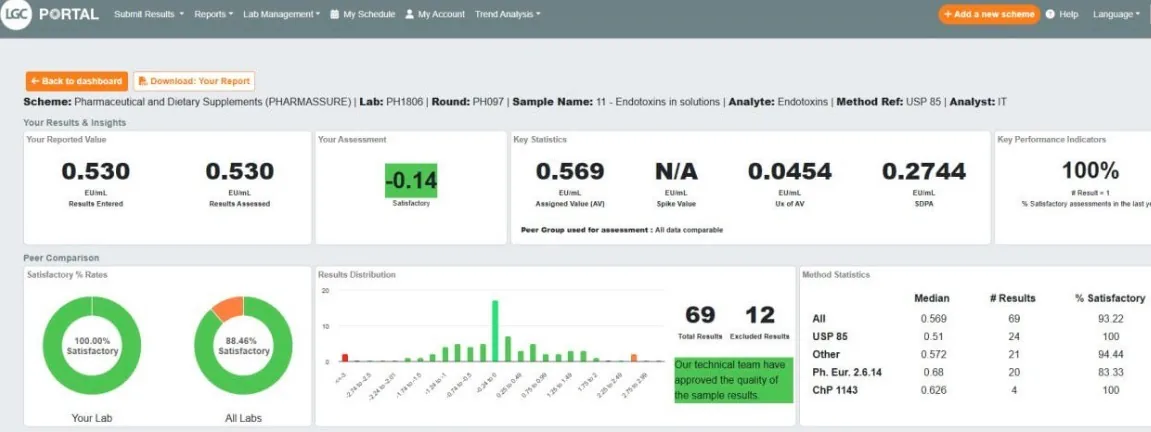
Vanguard also shared an LGC pharmaceutical proficiency test. Their result was 0.530 EU/mL, against an assigned value of 0.569 EU/mL, and they passed. The permitted range for that proficiency test was 0.020 to 1.118 EU/mL, showing how much variation can exist between participating laboratories. That wide interval was the boundary for passing the proficiency test, however, not proof that every result within it was equally close to the assigned value. It just confirms that Vanguard performed satisfactorily on that sample, but it doesn’t make the Lobster result of <5 EU/mg any more precise.
What would a proper comparison look like?
If the aim is to compare labs, the sample should be held as constant as possible. If the aim is to assess consistency across a batch, multiple vials should be tested using the same method. This comparison attempted to do both at once but could conclusively do neither. A meaningful comparison would require confirmed batch details and chain of custody, multiple vials, consistent reporting in EU/vial, and enough information about each method’s sensitivity and sample preparation to interpret the results fairly. Any pass limit should reflect the intended dose and route of administration.
The FDA makes a similar point when discussing transitions between endotoxin methods: equivalence should be demonstrated by comparing detection limits, inhibition or enhancement, spiked product and suitable positive field samples. Simply placing certificates from unrelated methods next to one another is not a method-comparison study. FDA guidance
So which laboratory was right?
The evidence doesn’t support choosing a winner. Janoshik and Chromate produced compatible results. BT’s certificate records a higher figure, but BT later qualified the older method and calculation behind it and said it wouldn’t consider that result in the comparison. Vanguard’s result is too broadly reported to determine whether it agrees with any of the others.
The COAs don’t independently prove that all four vials came from the same manufacturing batch, despite the claim that they came from the same box. The lot descriptions differ or are incomplete, and there was no documented split-sample chain of custody. The comparison was nevertheless presented as four passing results. BT and Vanguard explicitly marked their samples as passing, while Janoshik and Chromate reported low results without showing a separate pass limit on their certificates. That doesn’t establish that the entire batch was uniformly clean or safe to inject; each result applies only to the individual sample tested under that laboratory’s method and conditions.
What this comparison does show is how easily four “endotoxin tests” can be presented as though they were interchangeable when they’re not. Two results are compatible, one has since been qualified by the laboratory that issued it, and one is too broadly reported to settle the comparison.
One practical improvement has already emerged: BT Labs and Vanguard have said they will move toward reporting the information in the same useful format for this market. If that commitment is carried through, future COAs should make the result per vial, the LOQ and any separate LOD statement clear instead of leaving consumers to reverse-engineer the calculation themselves.
The biggest difference in this case may not be between the vials at all. It may be between what each laboratory chose to measure, calculate and place on the certificate.
Comments