
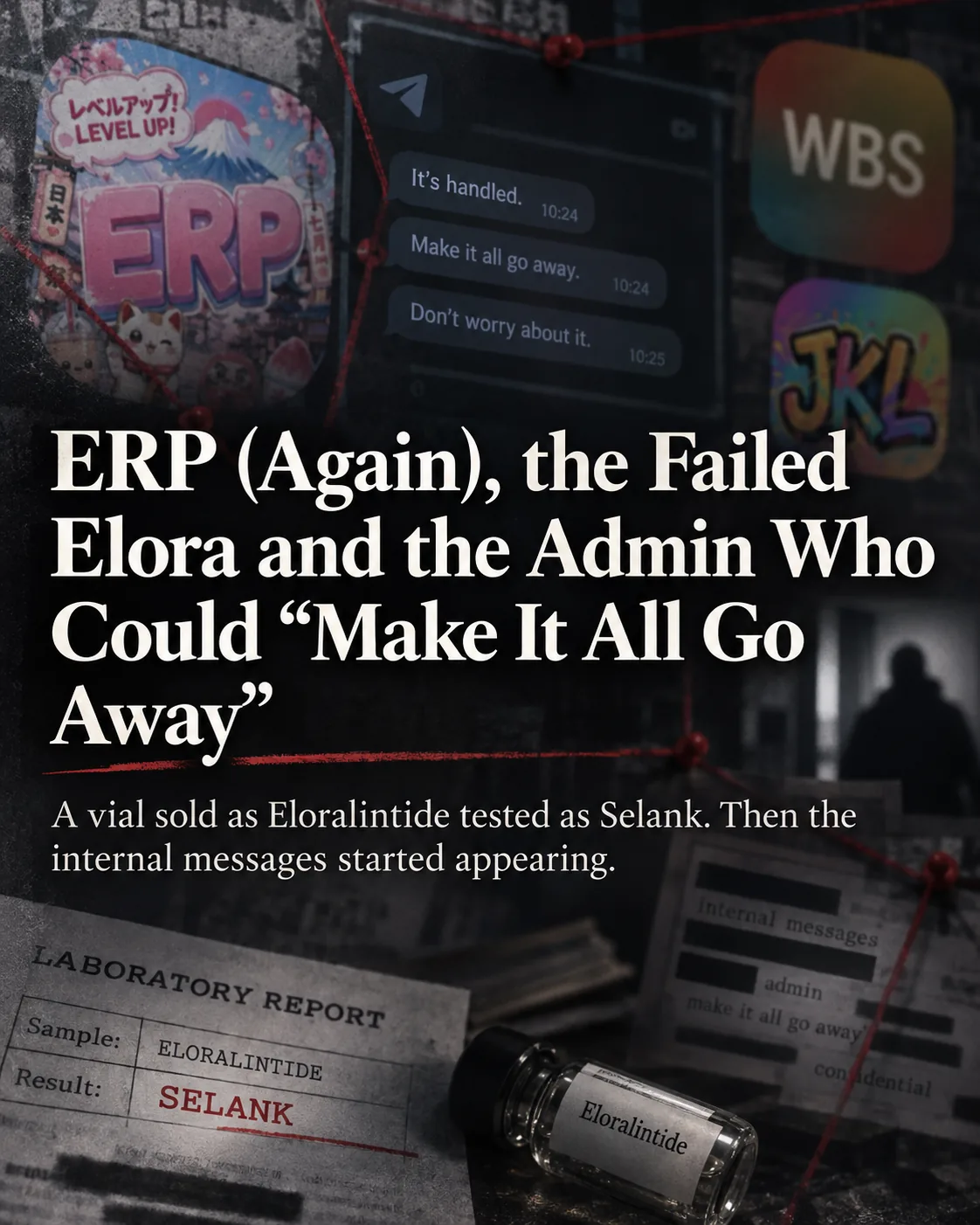
ERP is becoming quite a regular topic in my articles, but unfortunately for all the wrong reasons, so it probably comes as no surprise that here we are again with yet another ERP story.
ERP recently featured on K-Hole’s new Vendor Wall of Shame, and we all know how one particular toddler reacted to that by throwing his toys out of the pram. He’s now, unsurprisingly enough, an ex-ERP admin. But this article isn’t about his tantrum. It’s about why ERP chose him as an admin in the first place, what his own messages say he was there to do, how that relationship eventually fell apart and why he was removed.
And sitting right in the middle of it all is another ERP problem: an Eloralintide 10 mg vial that failed identity testing and came back as Selank, followed by what appears to have been an attempt to keep the result under wraps rather than immediately warn customers.
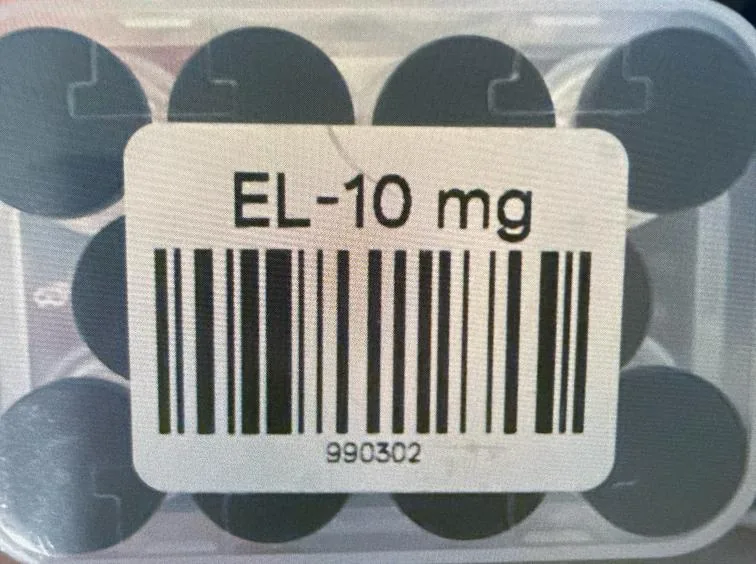
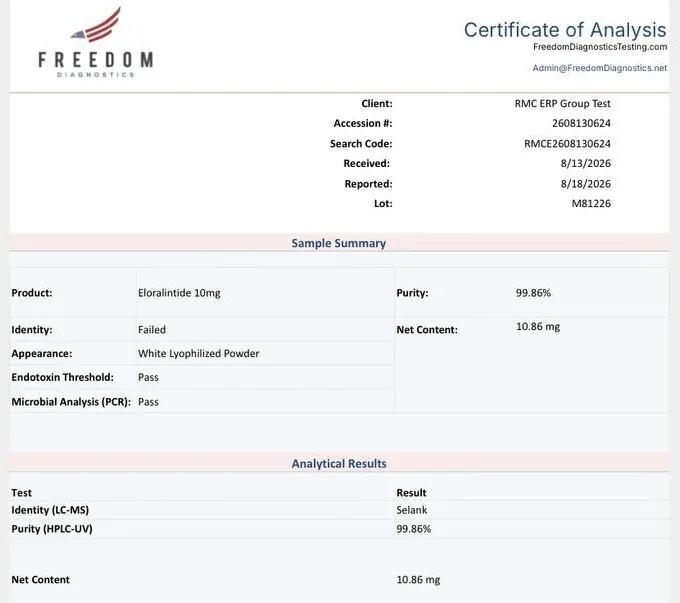
A vial labelled Eloralintide 10 mg was sent to Freedom Diagnostics for testing by a testing group. It failed identity. Freedom identified the material as Selank. The report lists: Product: Eloralintide 10 mg Identity: Failed LC-MS identity: Selank Purity: 99.86% Net content: 10.86 mg
The Admin Who Quit Over Elora
The failed Elora result didn’t come from some random vial posted anonymously on Telegram. It was sent by an ERP testing group, hosted by an ERP admin. One of the members of that group later spoke publicly about what had happened. He said he’d personally been involved in the group testing and that the ERP admin repeatedly pushed ERP to do something about the failed result, even if that was simply making an announcement and warning customers while they worked out what had happened. Instead, he says ERP largely ignored him.
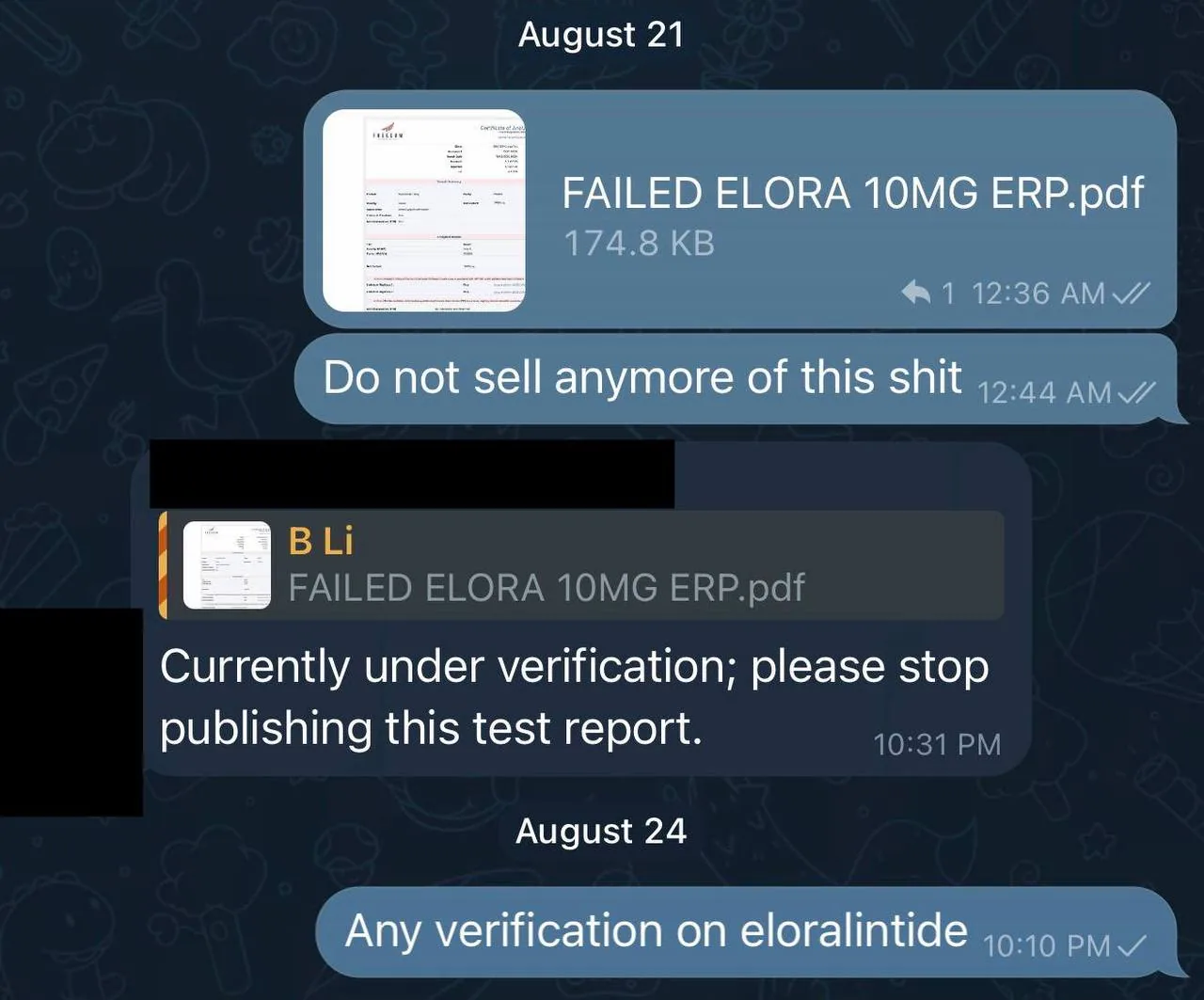
On one of the occasions they did respond, the message was:
“Currently under verification; please stop publishing this test report.”
According to the source, the admin became increasingly frustrated by the lack of action and eventually quit ERP because of how the situation was being handled.
Still Selling Elora
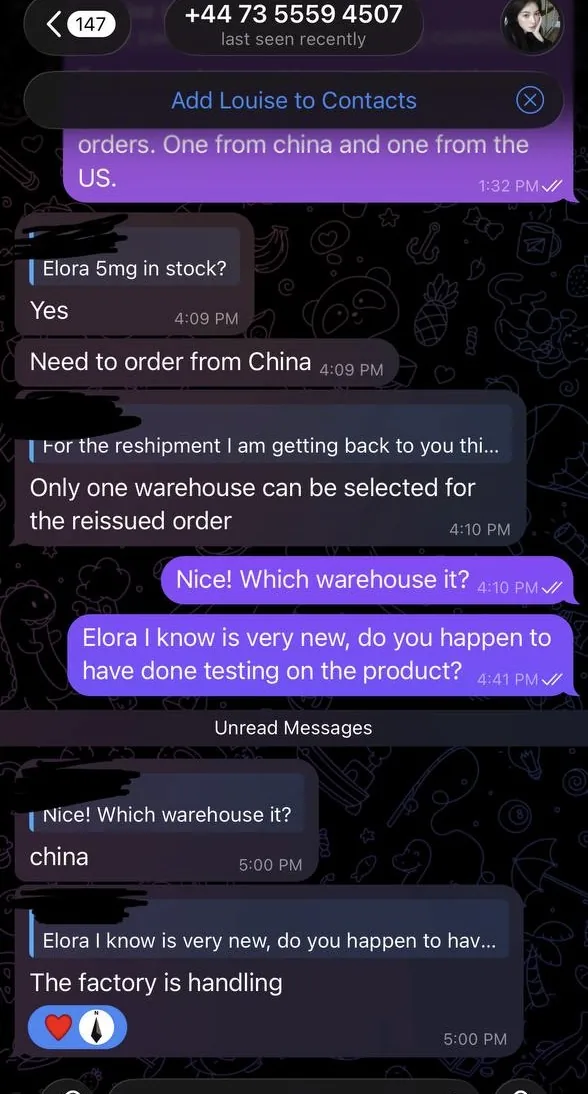
The source then decided to see what would happen if a normal customer tried to buy Elora from ERP. He contacted one of their sellers pretending he wanted to place an order. It seems ERP was perfectly willing to supply it. When asked whether testing had been completed, the answer was essentially no, they were still waiting for it, with the seller saying: “The factory is handling”
The sales rep apparently had no idea that the person asking the questions was also in contact with the ERP admin involved in the failed group test. So behind the scenes there was already a Freedom Diagnostics COA showing a vial labelled Eloralintide 10 mg had failed identity and tested as Selank, an ERP admin was pushing for action, ERP had asked for the report not to be published while it was being verified. Yet a customer could apparently still approach an ERP seller and be offered Elora while the seller admitted the testing wasn’t yet available.
Was ERP Scammed Too?
ERP’s unofficial explanation, which they told their other ex admin, is that it was a labelling error at the warehouse, but there was no official explanation. Knowing what we know about the current state of the grey market with masses of bunk products in circulation, it’s unlikely that ERP deliberately bought Selank and decided to pass it off as Eloralintide. It’s more likely that ERP itself may have been scammed by one of the factories supplying its raw peptide material. But that’s just speculation.
Eloralintide is one of the most expensive and hyped new peptides entering the grey market, and vendors are clearly expecting it to become a major seller. If ERP had invested heavily in what it believed was genuine Elora and subsequently discovered that the material was something far cheaper, ERP may have been left sitting on a very expensive problem. In which case ERP was a victim too. However, it doesn’t excuse what happened after ERP learned there was a serious identity problem.
Historically, ERP has supplied good products, however, increasingly they’ve been involved in several poorly testing products and their handling of those results is throwing away the trust they’d built up. The bigger problem is what this tells us about how ERP responds when testing goes badly. If a failed identity result can be kept under wraps while the product apparently remains available for sale, what confidence can customers have that other serious failures will be handled any differently?
We don’t even have to imagine the hypothetical.
The HCG Result Was Challenged Too
A separate ERP HCG 5k red-cap vial was tested by Janoshik and returned 3,438 IU against a 5,000 IU label claim ( around 31% below the stated amount) and an endotoxin result above 1,000EU/vial, with Janoshik estimating the level at 1,424.920 EU/vial. ERP’s response wasn’t to refund or credit the customer, instead, the results were challenged on the basis of what the factory said should have been in the vial. Their response stated:
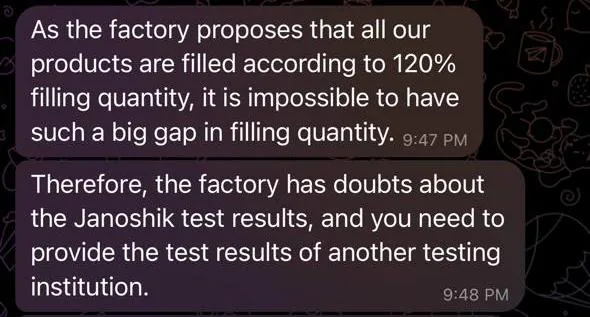
“As the factory proposes that all our products are filled according to 120% filling quantity, it is impossible to have such a big gap in filling quantity.”
They continued:
“Therefore, the factory has doubts about the Janoshik test results, and you need to provide the test results of another testing institution.”
That’s an extraordinary way of dealing with an independent result, especially as their policy is to only accept Janoshik Lab results for disputes. The argument was essentially that the test couldn’t be right because the factory said it overfilled its products and they should retest with a different lab.
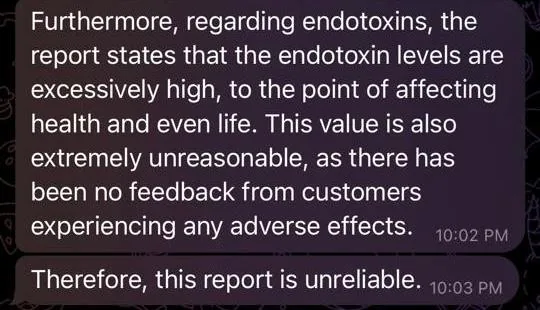
Their response to the endotoxin result was much the same, dismissal. An ERP representative wrote that the endotoxin result was; “extremely unreasonable, as there has been no feedback from customers experiencing any adverse affects” concluding:
“Therefore, this report is unreliable.”
That’s precisely why the handling of the Elora result matters beyond Elora. If a vendor can simply question, delay or contain an inconvenient test result rather than immediately warning customers and investigating it openly, then customers are left wondering what happens the next time there’s a problem.
When Janoshik Is Trusted, Until He Isn’t
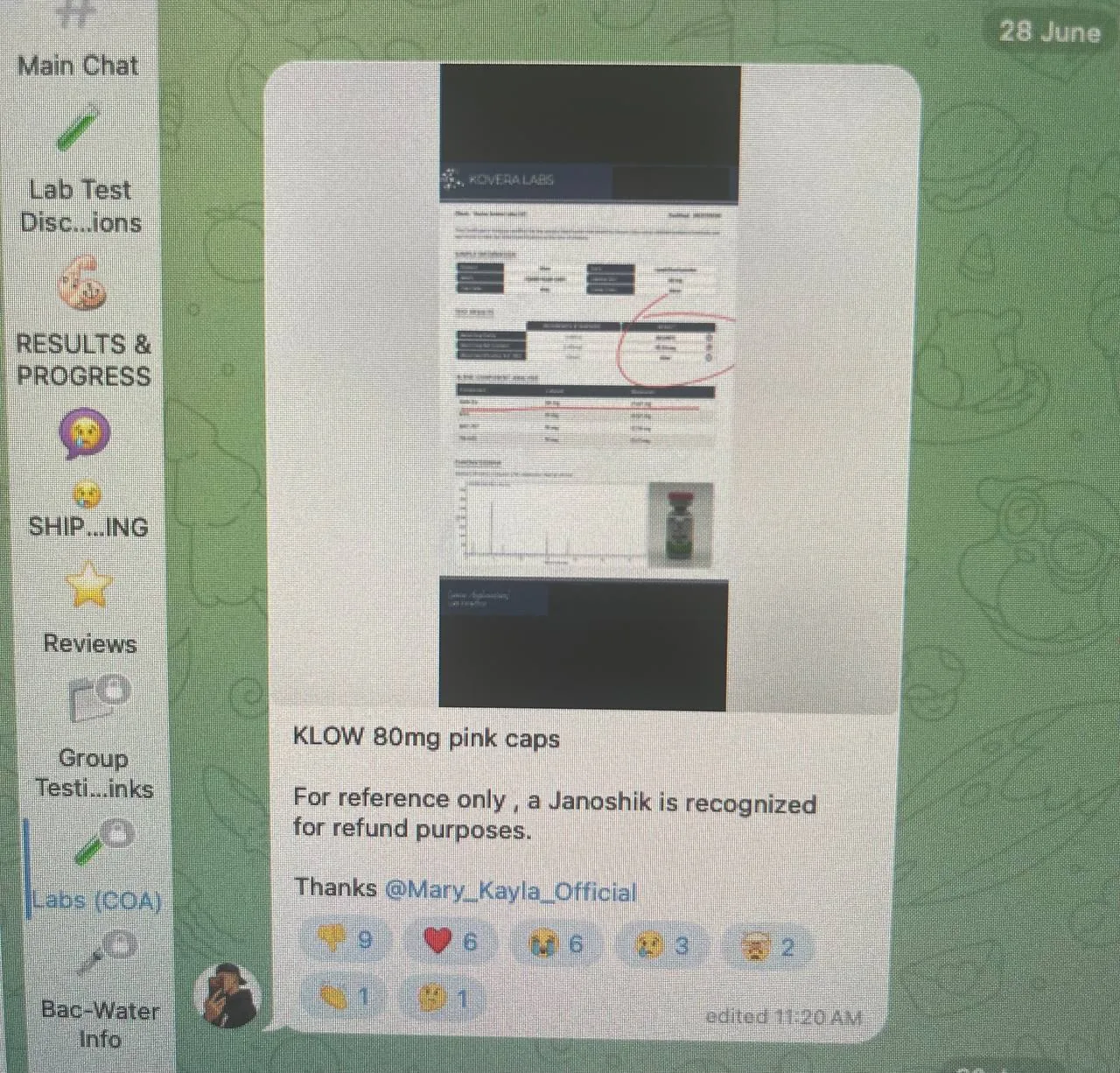
ERP’s own posts create another awkward contradiction. On June 28, beneath a result from another laboratory, ERP stated:
“For reference only, a Janoshik is recognized for refund purposes.”
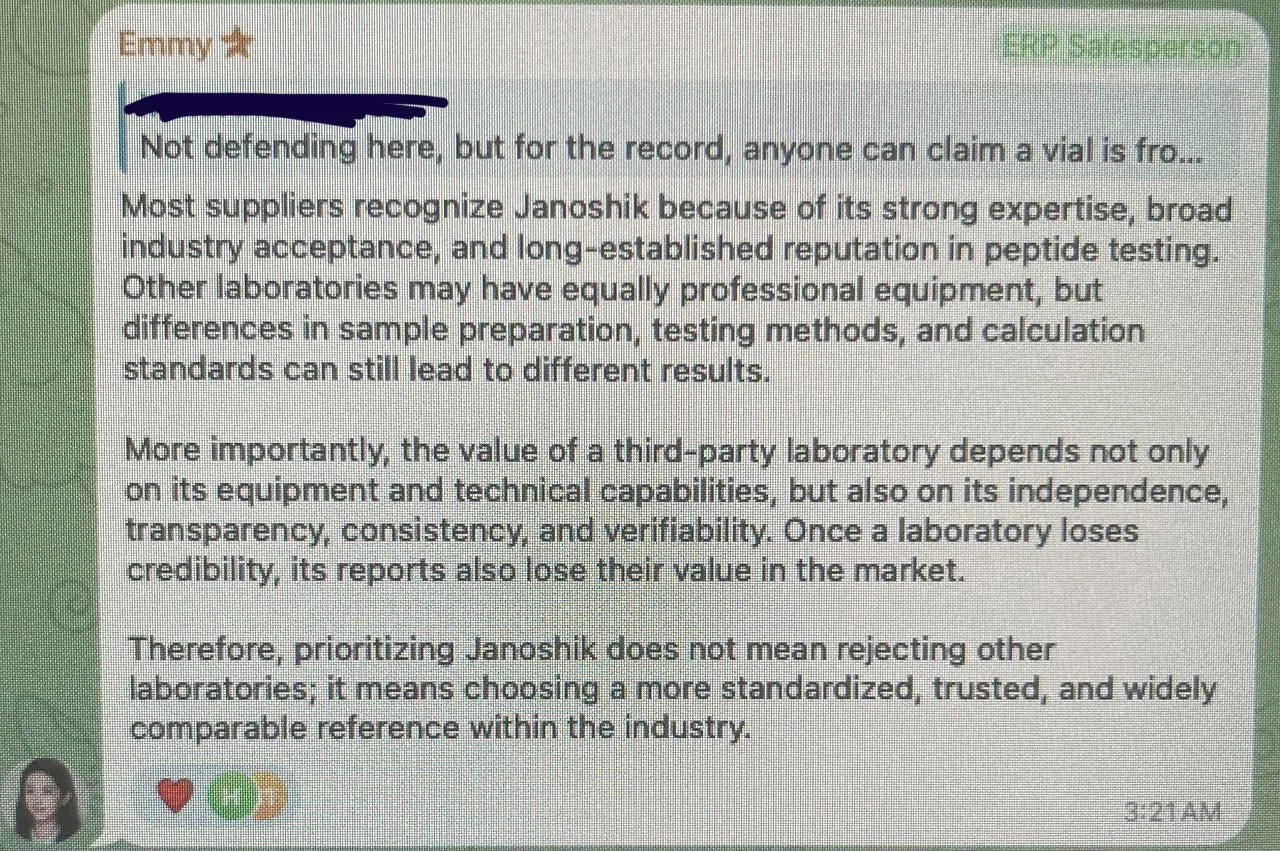
An ERP salesperson later explained the reasoning in even stronger terms, describing Janoshik as having “strong expertise, broad industry acceptance, and long-established reputation in peptide testing”, and saying that prioritising Janoshik meant choosing a:
“more standardized, trusted, and widely comparable reference within the industry.”
That position seems perfectly clear. Janoshik is the trusted reference. Janoshik is recognised for refunds. Yet when Janoshik later returned results that were unfavourable to ERP, that confidence suddenly disappeared. Customers were told the results were “impossible” or “unreliable”, and in one case were asked to obtain testing from another laboratory. That’s the contradiction. You can’t promote Janoshik as the lab customers should use for refund purposes, praise it as the trusted industry reference, and then move the goalposts when its results would actually require you to honour that policy.
Then The Admin Walked
The administrator pushing ERP for an answer eventually gave them a deadline. He said if nothing was done to rectify the Eloralintide situation by August 28, he would leave ERP. A subsequent message from the admin simply directed a customer to contact Louise to handle the matter. So he did eventually leave.
The Man Who Could “Make It All Go Away”
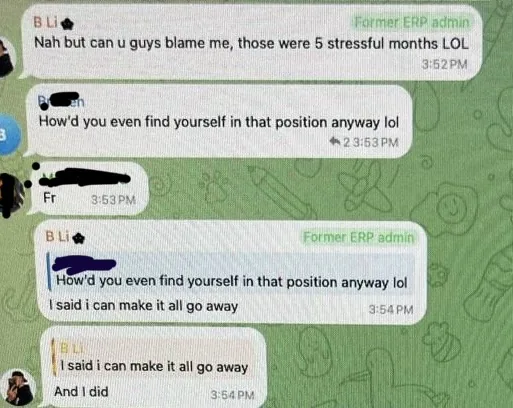
And this is where B Li, another former ERP admin, enters the story. By the time the Elora problem erupted, B Li had already spent months on the other side of ERP’s controversies. After leaving, he was surprisingly candid about what he believed his role had been. When somebody asked how he’d ended up as an ERP administrator in the first place, his answer was:
“I said i can make it all go away”
A moment later:
“And I did”
When pressed on what exactly he meant by “all,” he started listing some of the problems ERP had faced during his time there: SS31 endotoxins. Brazil seizures. Australia reships. Then he reduced the whole lot to two words: “All negativity”
This makes you wonder exactly what “make it all go away” involved. It doesn’t establish that ERP formally instructed B Li to censor every complaint or suppress every negative test, but it’s B Li’s own description of the job he thinks he’d done for them. And apparently it wasn’t an easy one too. He said “those were 5 stressful months LOL”
The Straw That Broke the Camel’s Back
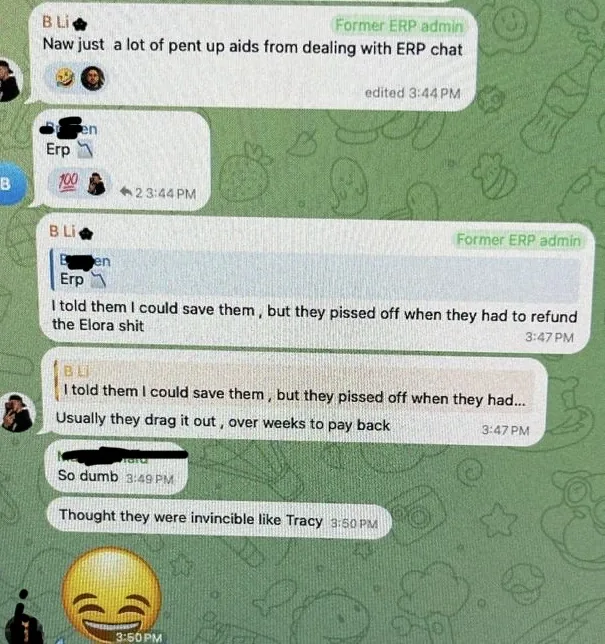
Elora appears to have been the point where things became considerably harder to smooth over. Discussing the failed Elora incident afterwards, B Li wrote:
“I told them I could save them, but they pissed off when they had to refund the Elora shit”
He then added: “Usually they drag it out, over weeks to pay back”
That comment fits closely with what customers have been saying about ERP themselves. One customer said ERP rejected their Janoshik result and demanded another third-party test before accepting it. According to that customer, a refund only became a serious discussion after they threatened to release what had happened publicly, and even then, they were still waiting to actually receive it. The same customer described criticism inside ERP’s Telegram group being met with memes, insults, deleted comments and bans. Taken alone, those would simply be customer allegations, but B Li’s comments are harder to dismiss in the same way. This is ERP’s former admin describing refunds as something they would routinely “drag out, over weeks to pay back,” while elsewhere describing his role as dealing with ERP’s “negativity” and making it “go away.”
When the Man Who Made It “Go Away” Became the Problem
For five months, B Li had apparently been the person ERP relied on when things got messy. By his own account, he had dealt with the SS31 endotoxin problem, seizures in Brazil, reship complaints from Australia and whatever other “negativity” came his way. But eventually the relationship between ERP and the man who had spent months defending them began to unravel. B Li was told:
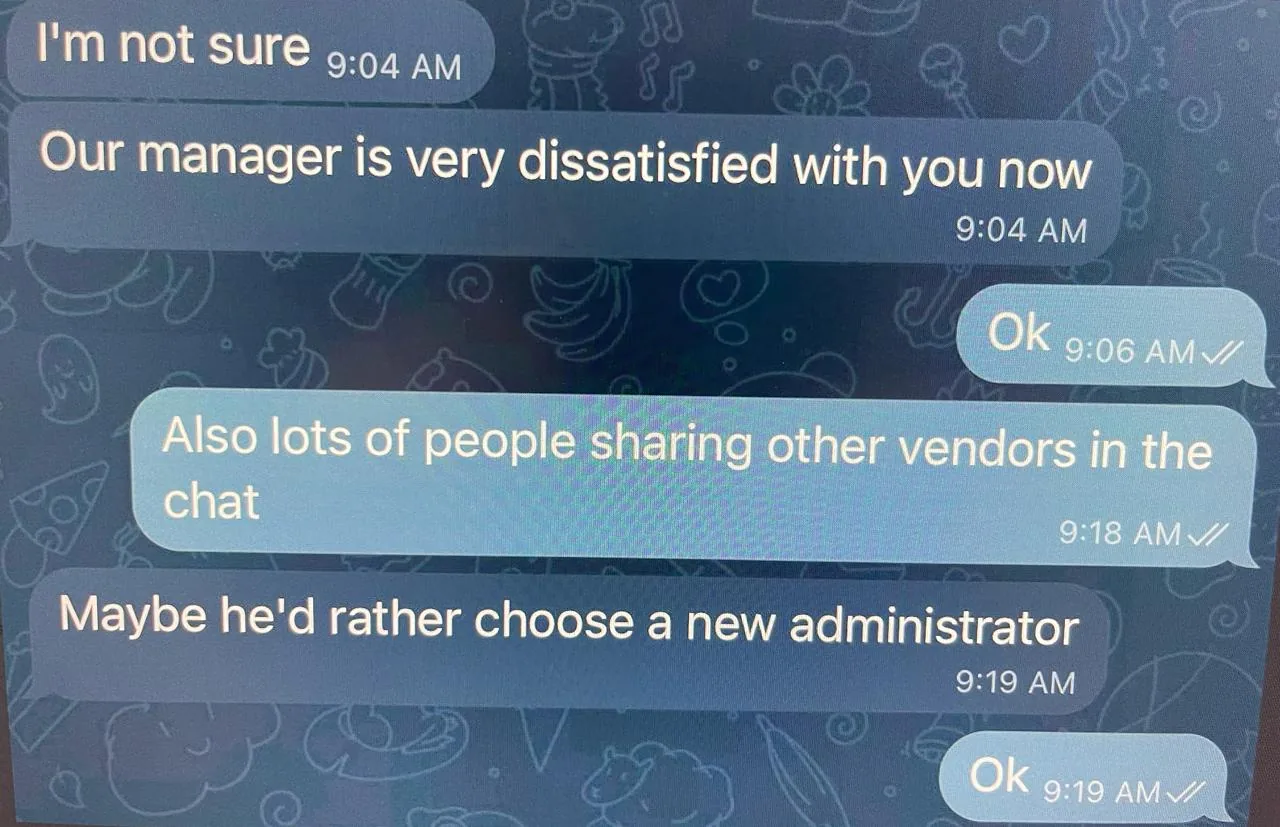
“Our manager is very dissatisfied with you now”
The disagreement appears to have been over what was happening inside ERP’s Telegram group. B Li responds that members were sharing other vendors in the chat. The reply is rather revealing: “Maybe he’d rather choose a new administrator”
For somebody who’d spent the previous five months dealing with ERP’s problems, it was a fairly abrupt change in tone. B Li had gone from being the person who claimed he could make ERP’s problems disappear to apparently becoming a problem himself. And not long afterwards, that is exactly what happened. His Telegram label changed to:
“Former ERP admin.”
By then, the relationship appears to have deteriorated badly on both sides. His later messages hardly read like those of someone leaving on particularly good terms. There’s a certain irony to it. For months, B Li says he was the person dealing with ERP’s “negativity.” Once he was no longer the admin, some of the most revealing negativity about ERP started coming from B Li himself.
And Then There Is WBS and JKL
One customer raised another issue which may become a separate story altogether. They claimed that ERP, WBS and JKL aren’t really separate operations at all, but share products and warehouses while presenting themselves as different companies.



Comments