
This article came from an idea suggested by Phil Finish (@lifeoflyo), who flagged that UBT251 is apparently starting to show up across grey-market API supplier lists. If that continues, we can expect to see this one appearing in the peptide market soon.
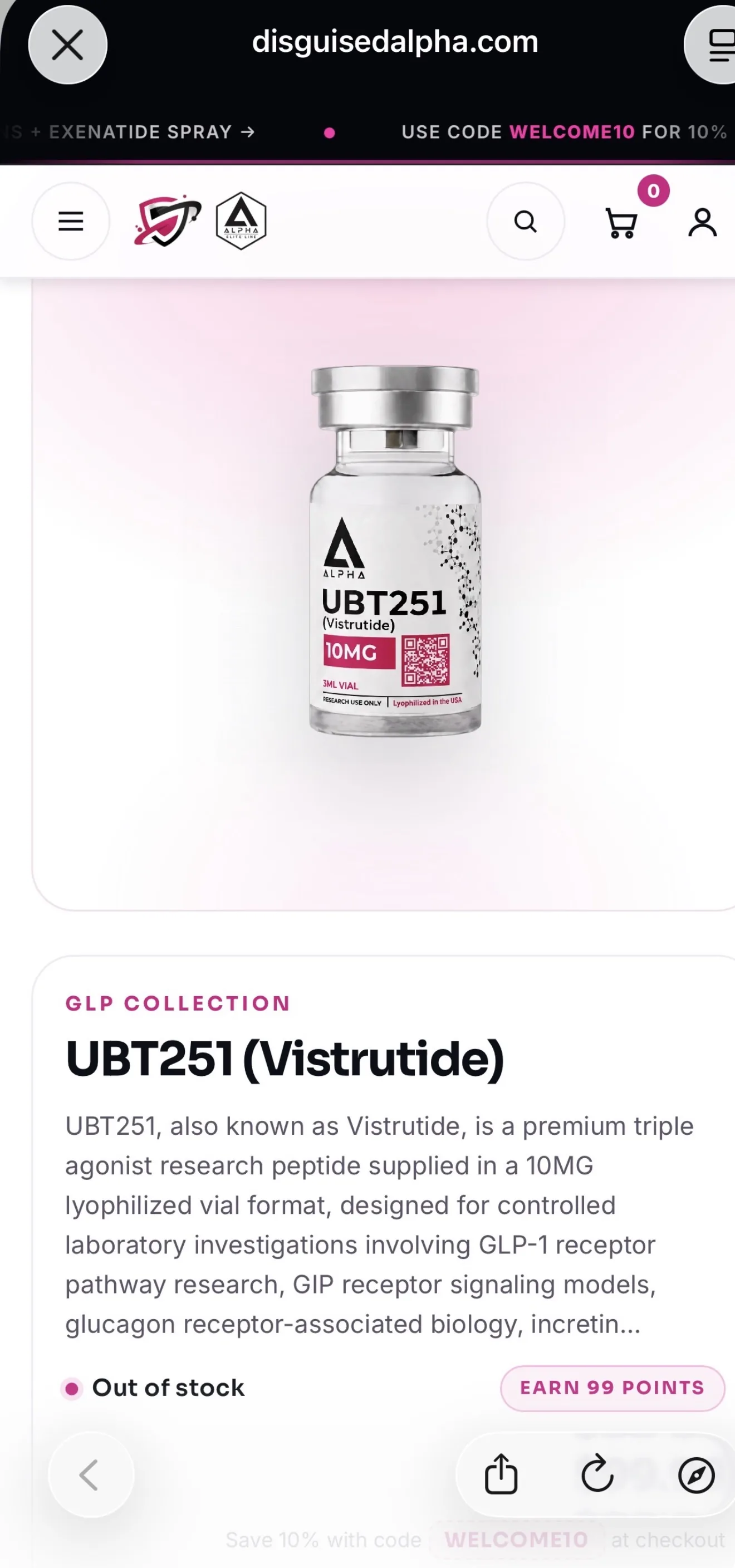
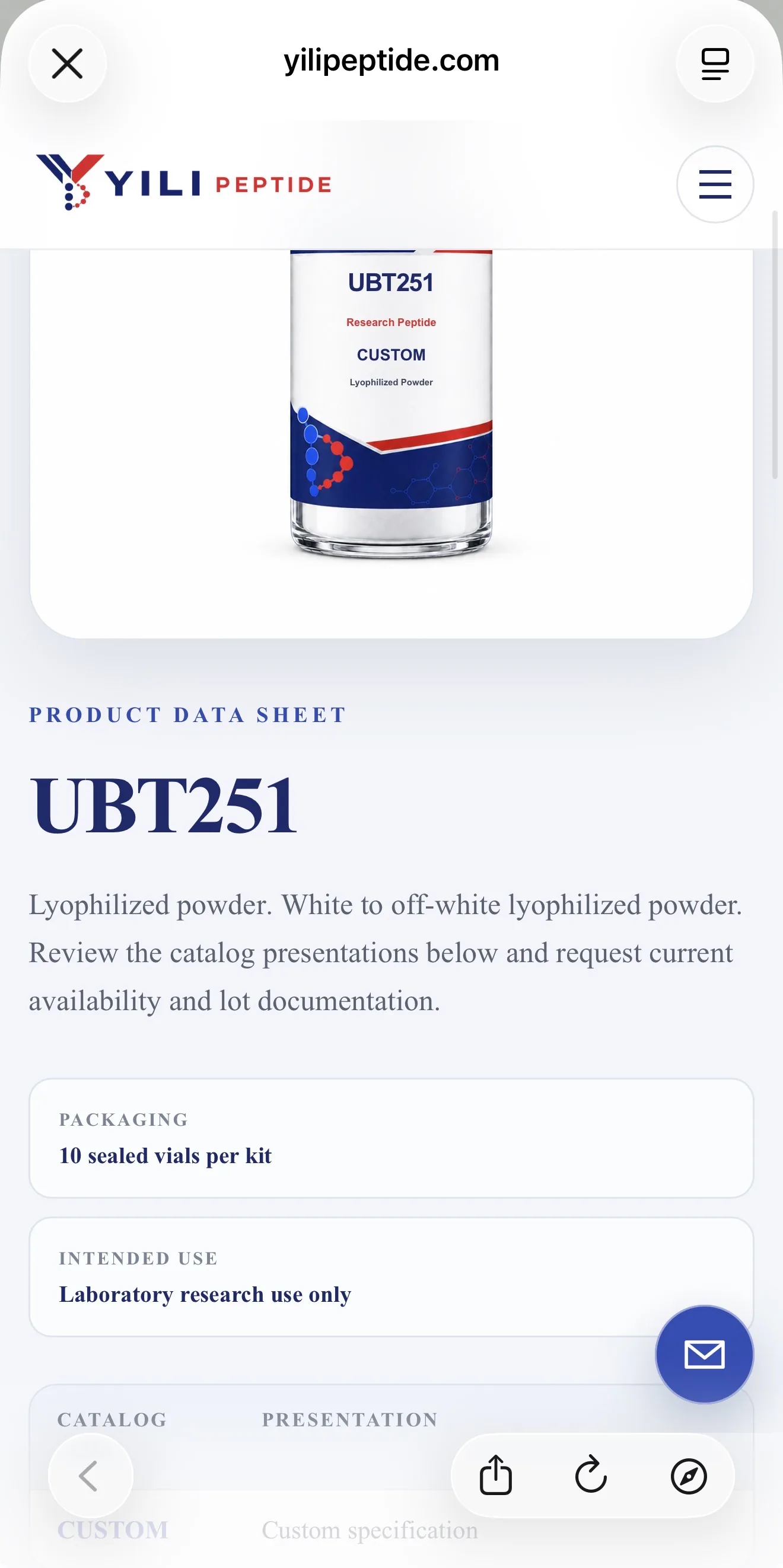
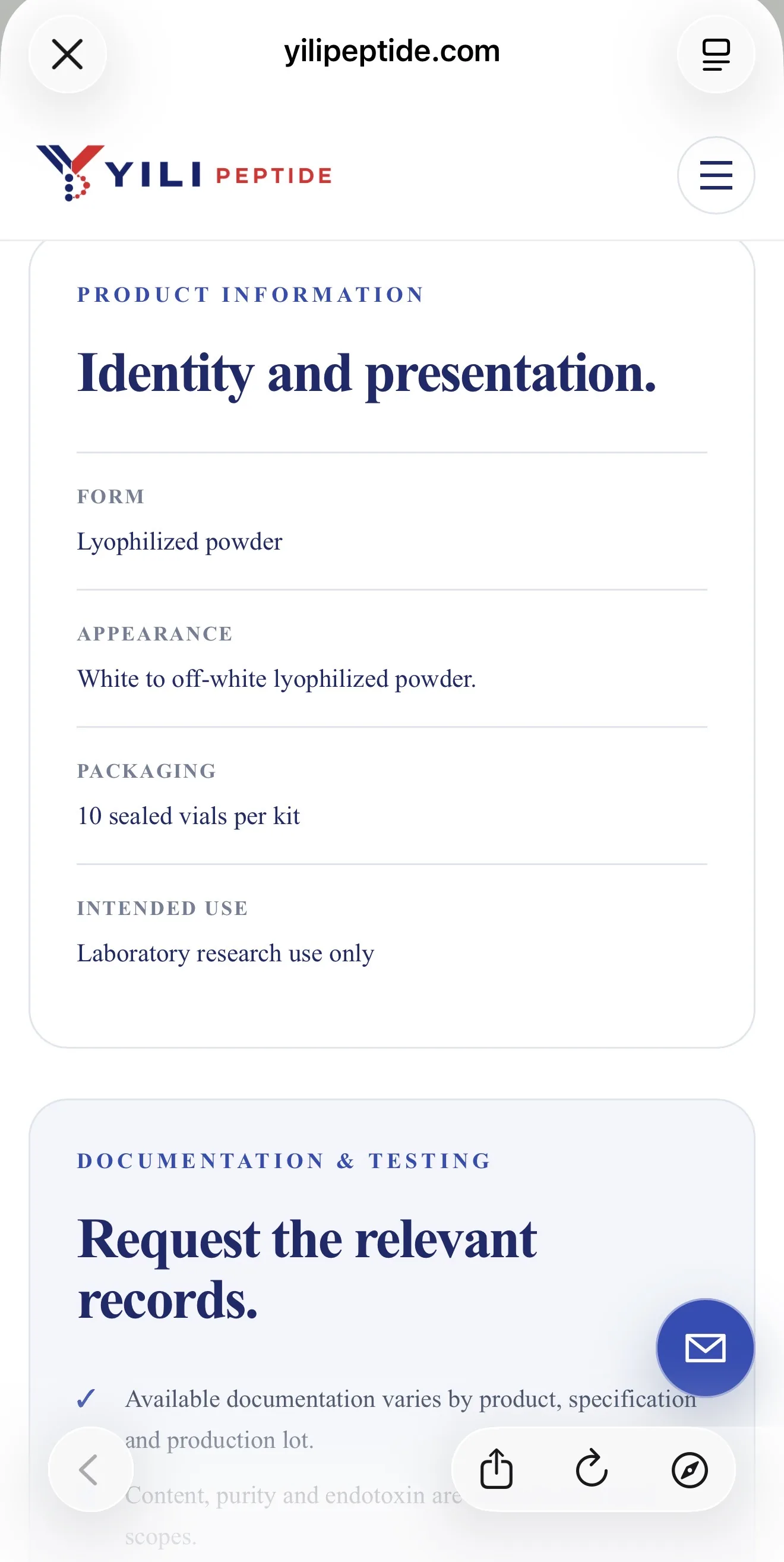
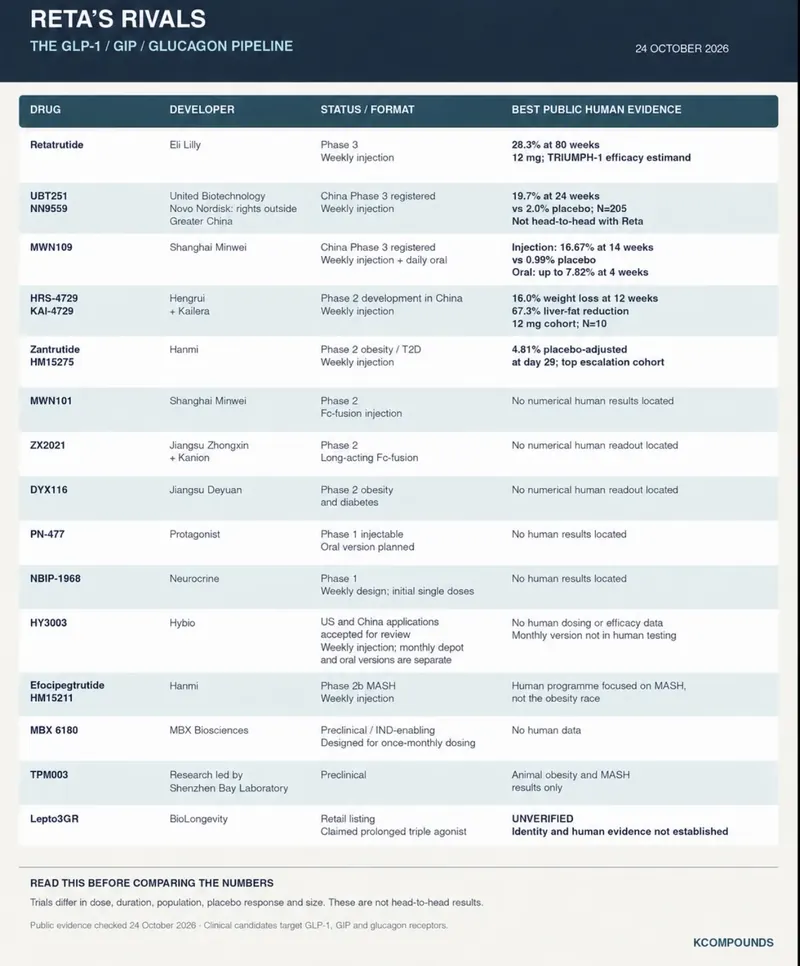
UBT251 is a clinical-stage GLP-1/GIP/glucagon triple agonist developed by United Biotechnology and licensed to Novo Nordisk outside Greater China, where it’s also known as NN9559. Two public advertisements are already up. Chinese wholesaler YiliPeptide advertises UBT251 by quotation, while US retailer Disguised Alpha advertises a 10 mg product as “UBT251 (Vistrutide)”, although it’s marked out of stock.
But there is a problem: it still isn’t clear which of the compounds in United Biotechnology’s patent is actually UBT251.
TL;DR
United Biotechnology’s patent contains 45 numbered compounds but doesn’t explicitly label any of them UBT251 or NN9559.
Compound 3 stands out because it’s the only molecule reported across all five examined in-vivo study areas. The granted Chinese patent narrows things further: Claim 1 specifically covers Compound 2 or Compound 3.
That makes Compound 3 the strongest candidate from the evidence examined, but the final link between Compound 3 and clinical UBT251 hasn’t been found.
Meanwhile, products labelled UBT251 are already being listed on advertised, including one using the unofficial name “Vistrutide.” The question is whether manufacturers have correctly reconstructed UBT251 from the patent before its clinical structure has been publicly tied to a particular compound number.
Introduction
UBT251 is a clinical-stage GLP-1/GIP/glucagon triple agonist developed by United Biotechnology and licensed to Novo Nordisk outside Greater China, where it’s also known as NN9559. Products using the UBT251 name are already being advertised in the grey market API supplier lists, but which of the patented compounds is actually UBT251 remains unclear.
Two direct advertisements were verified. Chinese wholesaler YiliPeptide advertises UBT251 by quotation but provides no confirmed stock status or product-specific COA. US retailer Disguised Alpha advertises a 10 mg product for $99.99 as “UBT251 (Vistrutide)”, although it’s marked out of stock. “Vistrutide” appears to be an unofficial seller-used name of unknown origin.
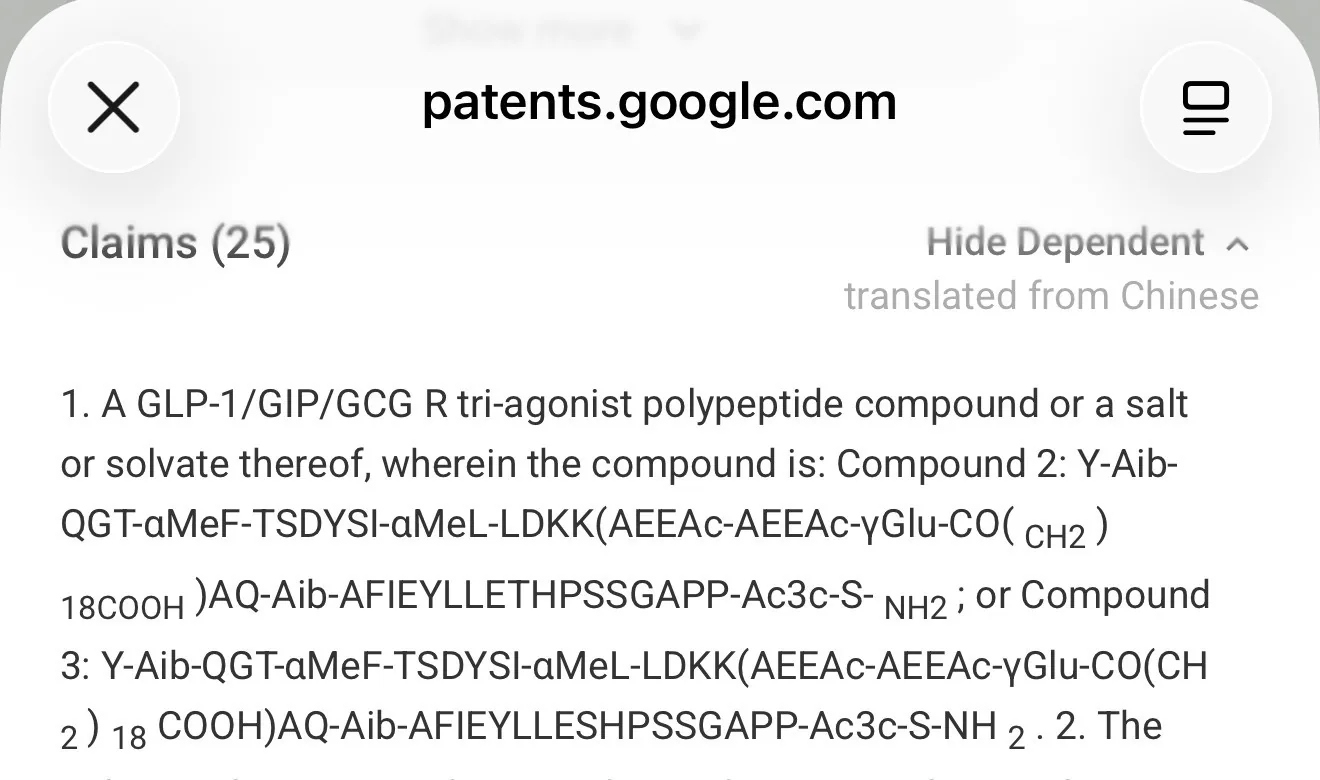
The likely route to reconstructing UBT251 is United Biotechnology’s patent family. It discloses 45 numbered compounds, but one stands out: Compound 3 is the only molecule with results reported across all five examined in-vivo study areas. The granted Chinese patent adds another clue. Although the specification contains 45 numbered compounds, Claim 1 specifically covers Compound 2 or Compound 3.
So how have suppliers decided what UBT251 is? Have they independently reconstructed the clinical molecule from the patent, or are they advertising the candidate they think is most likely?
Another Triple Agonist to Rival Retatrutide?
Retatrutide has made triple agonists one of the most marketable areas in peptides. Now UBT251 has started appearing in direct advertisements, with unofficial branding following. The interesting part is that the public patent doesn’t simply say: this is UBT251. Instead, manufacturers looking for the structure are faced with 45 numbered compounds and a trail of experimental data that may point towards the molecule that eventually entered clinical development.
A patent with 45 possibilities
The relevant US application is US20250129135A1, Multi-Agonist and Use Thereof, assigned to The United Bio-Technology (Hengqin) Co., Ltd. Its priority date is 26 May 2021 and it was published in the United States on 24 April 2025. It discloses 45 numbered peptide compounds, plus comparator molecules, with variations in sequence, non-standard amino acids and lipid attachments. Compound 3 isn’t explicitly labelled “UBT251” or “NN9559,” nor is any other numbered compound. The structures themselves therefore aren’t secret, but the missing piece is which numbered compound became UBT251.
Why Compound 3 stands out
The strongest clue comes from the patent’s experiments. Of the 45 numbered compounds, Compound 3 is the only one with results reported across all five examined in-vivo areas: body weight, blood lipids, glucose and insulin, liver triglycerides, and rat pharmacokinetics.
Different groups of compounds appear in different experiments, but Compound 3 repeatedly appears across them. That makes it the strongest candidate from the experimental pattern examined.
Its published sequence is:
Y-Aib-QGT-αMeF-TSDYSI-αMeL-LDK-K(AEEAc-AEEAc-γGlu-CO(CH2)18COOH)-AQ-Aib-AFIEYLLESHPSSGAPP-Ac3c-S-NH2
The patent reports a calculated molecular weight of 4,986.62 Da and an observed value of 4,987.2 Da. Compound 3 also performed strongly in the disclosed experiments. In the diet-induced-obesity mouse study, the highest reported dose produced a 51.6% reduction in body weight, compared with 50.5% for Compound 22 and 32.6% for the tirzepatide comparator.
Among the four compounds included in the rat pharmacokinetic experiment, Compound 3 had the longest reported half-life at 19.1 hours and the highest exposure, with an AUC of 6,687.2 nmol·h/L.
Compound 3 also reduced liver triglycerides, with a reported mean of 32.2 mg compared with 181.5 mg in the control group, although Compounds 20 and 24 recorded lower means of 26.7 mg and 30.7 mg respectively
Then the Chinese patent gets interesting
The granted Chinese patent CN117062618B, Claim 1 makes the trail considerably narrower. Despite the specification describing 45 numbered compounds, Claim 1 specifically covers just two: Compound 2 or Compound 3. That doesn’t identify either one as UBT251, but when combined with Compound 3 appearing across all five examined in-vivo study areas, it makes Compound 3 particularly interesting. Four later amendments in the Chinese prosecution history were unavailable, so the reason Claim 1 ultimately narrowed to those two compounds is unknown.
So what are suppliers advertising?
An advertisement carrying the UBT251 name doesn’t tell us how the supplier arrived at its structure. A manufacturer could read the patent and independently reach Compound 3. It could choose Compound 2. It could receive a structure from another source. One supplier could also make a different inference from another.
That’s why the distinction between “UBT251 is being advertised” and “this material has been shown to be clinical UBT251” matters. The same applies to Vistrutide. Disguised Alpha uses the name alongside UBT251, but its origin is unknown. Nothing examined connects that name to United Biotechnology or Novo Nordisk.
Routine HPLC purity wouldn’t answer the identity question either. HPLC area percentage can show the relative chromatographic composition under that method, but it can’t by itself establish the complete sequence and modifications of a peptide. Even matching intact mass would only take the identification so far. Stronger evidence could include high-resolution mass spectrometry, fragmentation or peptide mapping capable of locating the relevant modifications, ideally against an appropriately characterised reference.
Have manufacturers worked it out?
They may have. The patent contains enough information to manufacture Compound 3, Compound 2 and the other disclosed structures. What makes Compound 3 different is the amount of experimental attention it receives.
That leaves two separate unknowns:
Which patent compound became UBT251?
Compound 3 is the strongest inference from the evidence examined.
What structure is actually associated with the products now being advertised as UBT251?
The advertisements don’t tell us.
Those are not necessarily the same question.
What would settle it?
The cleanest answer would be an authoritative source explicitly mapping UBT251 or NN9559 to a sequence, SEQ ID, patent compound number or complete structure. A September 2026 clinical paper is indexed on PubMed, but only the abstract is freely available. The original priority filing and complete prosecution history were also unavailable.
For the products being advertised, analytical identification of the material would answer a different part of the puzzle: what did the manufacturers actually make?
Conclusion
So this is one to watch. UBT251 is apparently already appearing across grey-market API supplier lists, and public advertisements have started appearing too. Expect the name to become much more familiar. Compound 3 is the strongest inference from the material examined. Whether that inference is correct, and whether the products now being advertised as UBT251 actually use that structure, is the part we still don’t know.
Comments