
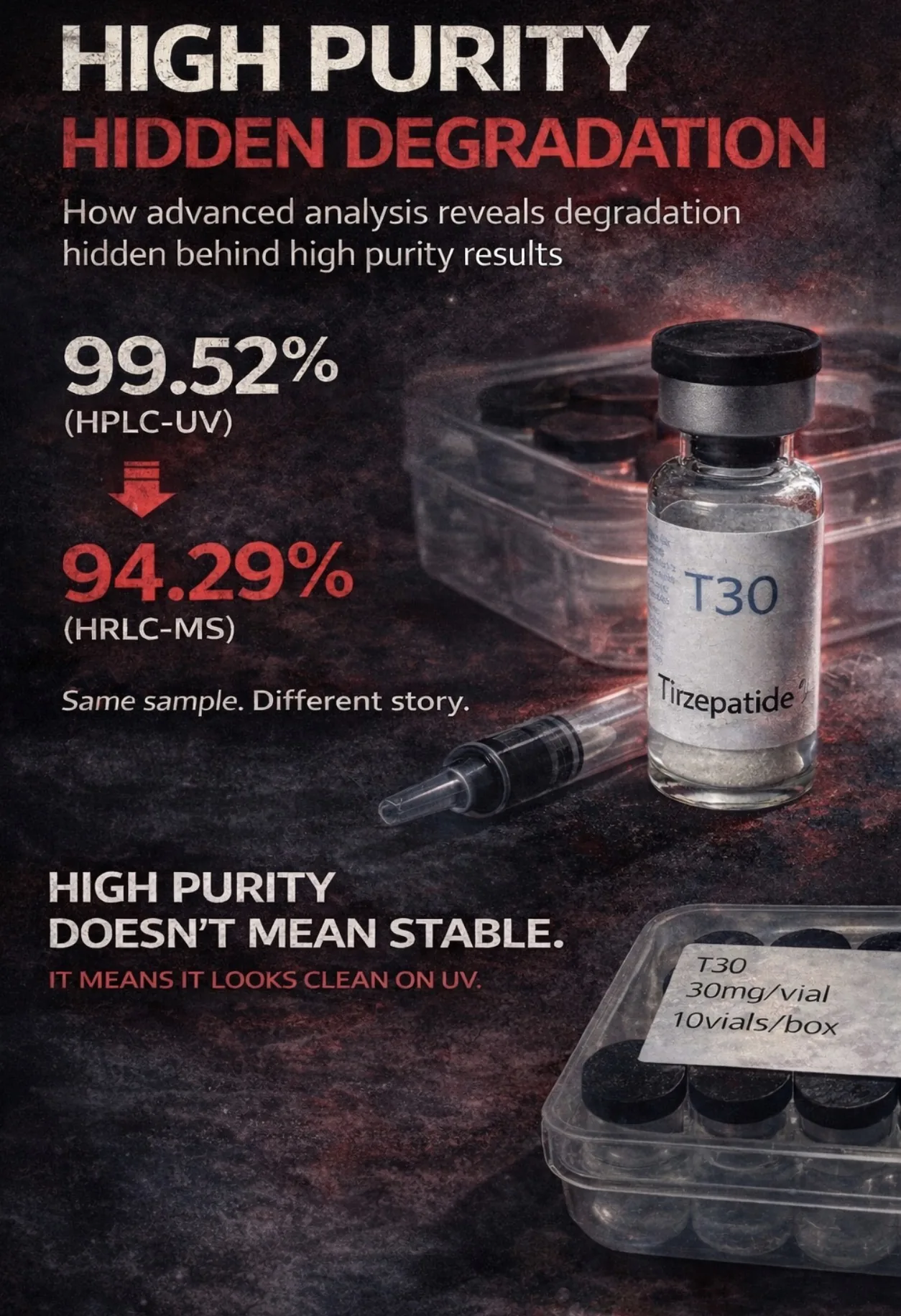
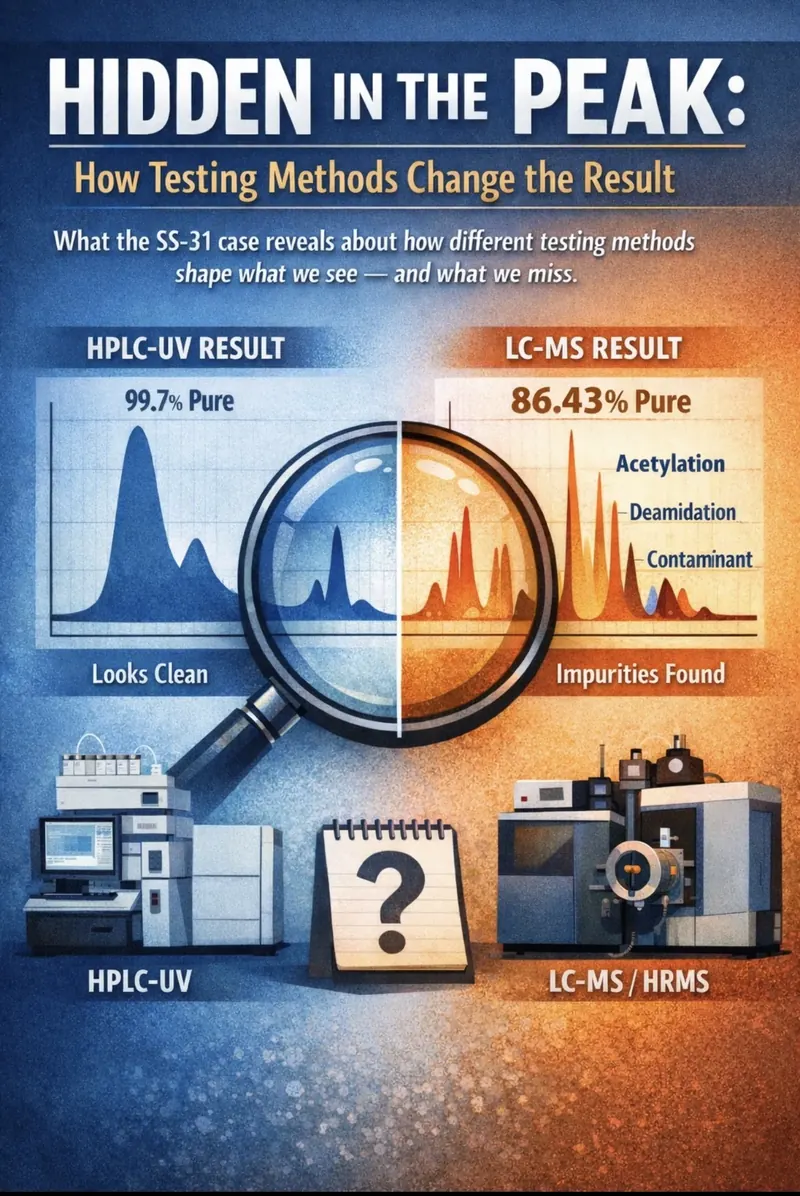
The COA below is for my T30 from Luna Shanghai Keta Biotech. Using standard HPLC-UV, the purity looks excellent at 99.52%. But once HRLC-MS is used, the purity drops to 94.29%.
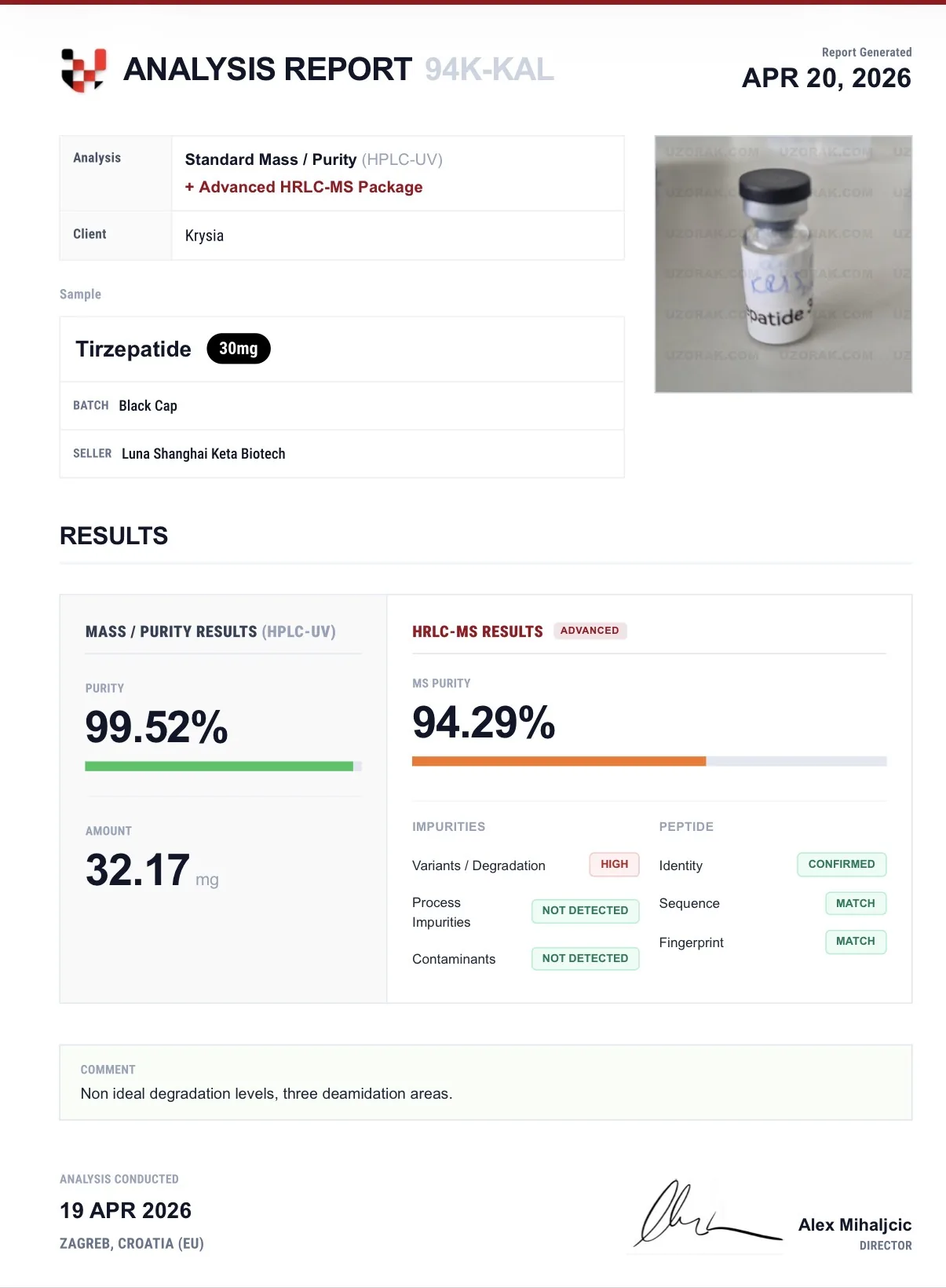
What HPLC-UV is actually showing
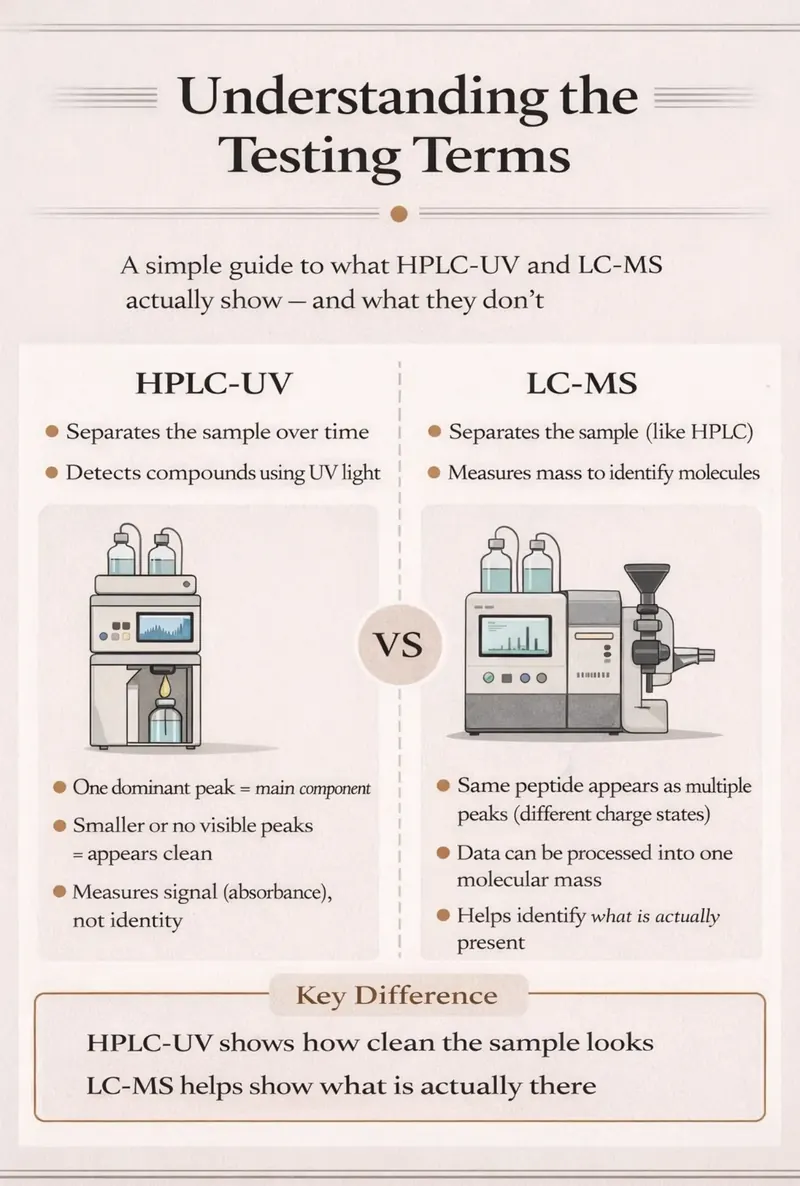
Just to recap, HPLC-UV involves dissolving the peptide in solution, and running it through a column such as a C8 column. The different constituents separate based on how they move through the column, and a UV detector measures them based on their absorbance.
The result is a chromatogram.
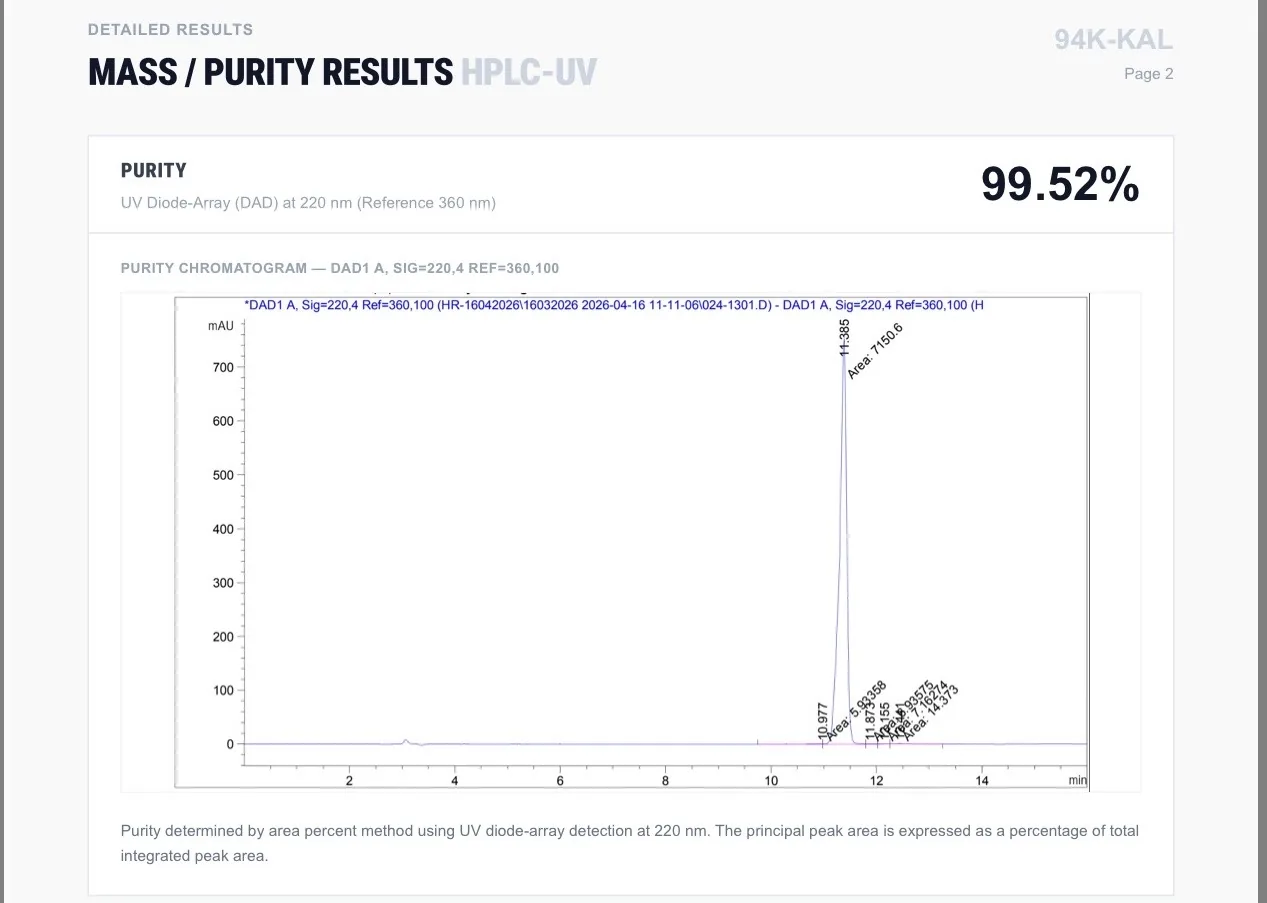
In this case, the chromatogram shows a very clean profile dominated by a single, sharp main peak, which represents the target peptide. That peak accounts for 99.52% of the total UV signal, which is where the purity figure comes from.
The purity is calculated using an area-percent method, meaning the lab measures the area under each detected peak at a specific wavelength (here 220 nm) and expresses the main peak as a percentage of the total area.
There are a few very small secondary peaks, but they are minimal relative to the main peak, which is why the reported purity is so high. However, this result is limited to what:
separates on the column, and
absorbs at the UV wavelength used
So anything that co-elutes with the main peak, or does not absorb strongly at 220 nm, may not be clearly resolved in this purity figure.
What HRLC-MS reveals
HRLC-MS provides more precise separation and then uses mass spectrometry to analyse substances by molecular weight. In this case, the advanced analysis shows:
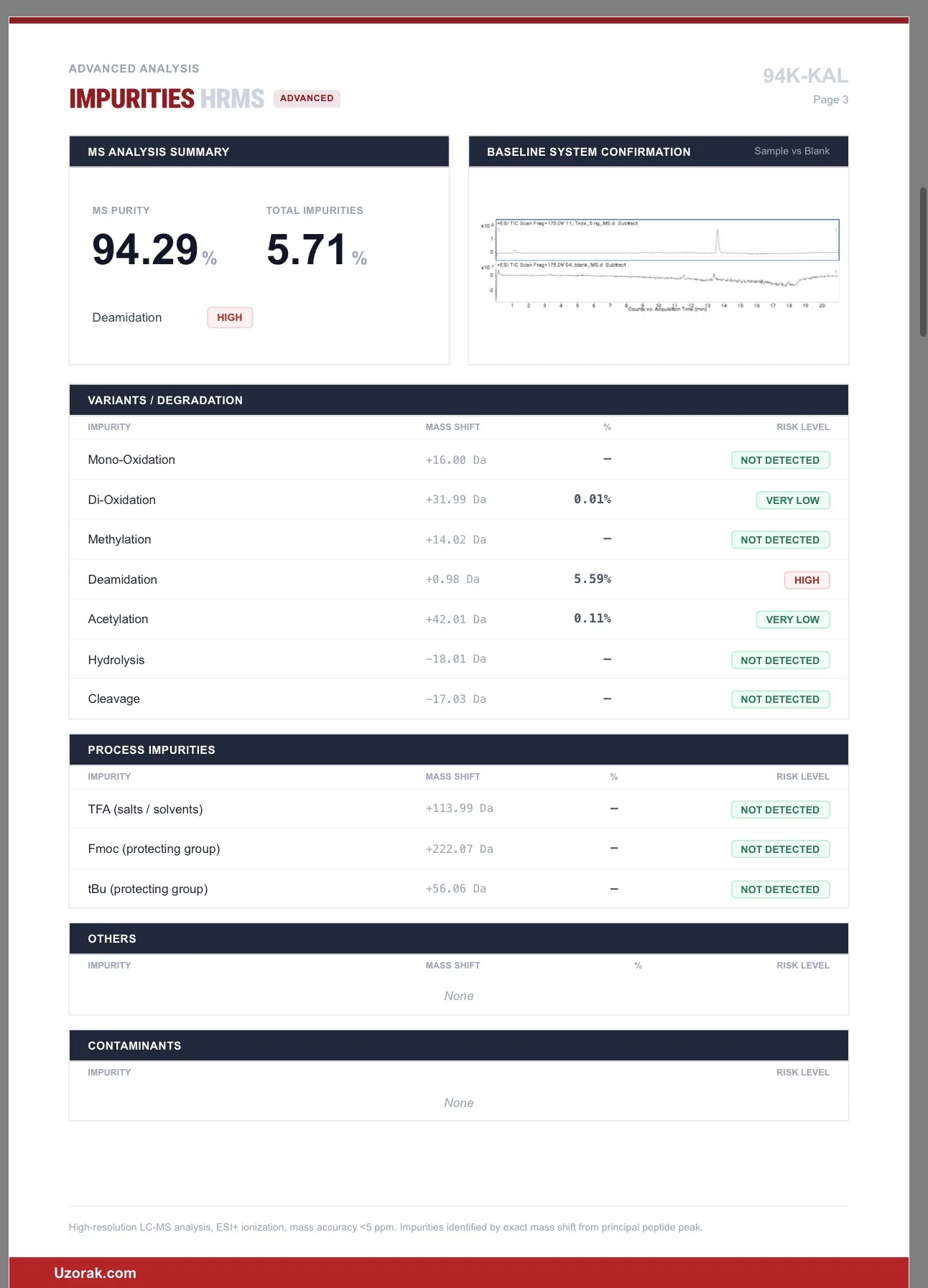
5.71% total impurities
5.59% deamidation (high)
0.11% acetylation (very low)
0.01% di-oxidation (very low)
This reduces the overall purity to 94.29%.
What that actually means
The key point here is that deamidation is not a synthesis impurity, it’s a degradation product ( chemical change that occurs over time). So what this result is showing is not poor synthesis, but post-production degradation.
Why this matters
What’s particularly interesting here is that the process-related impurities, such as Fmoc and tBoc, were not detected, while di-oxidation was present only at a very low level of 0.01% and acetylation at 0.11%.
That’s not random.
It suggests the peptide was properly synthesised and purified, in a way that is much closer to standard pharmaceutical practice than many would expect in this market. In simple terms, it points to good raw material quality and competent manufacturing upstream.
But that’s only part of the picture, because even when a peptide is made well, it can still degrade after production and that is exactly what we are seeing here.
The dominant impurity is deamidation (~5.59%), which is not a synthesis impurity, it’s a degradation marker. It tells you that the peptide has undergone chemical change over time, rather than being poorly made in the first place. So what this result shows is a split:
well-made raw material
degradation occurring after manufacture
That degradation can come from:
lyophilisation conditions
transport
storage time
temperature exposure
or in-use handling
Even something as simple as sitting in stock for extended periods can drive this process. A peptide can remain in circulation for months or even years, and over that time degradation will continue to accumulate. From a practical standpoint, this sample is still usable. The level of degradation seen here is within ranges that can be observed in clinical material, but the starting point matters.
Because if a product is already sitting at around 5 to 6% degradation, it has less stability margin going forward. That means it can degrade further relatively quickly compared to a fresher sample.
So while it may be fine to use now, it is not something you would want to sit on.
Realistically, it’s best used within a short timeframe, rather than stored long-term, otherwise, as it’s entirely possible for degradation levels to rise significantly, potentially into the 20 to 30% range over time, depending on conditions.
This actually reinforces the bigger point:
you can have a peptide that is well made, high purity on HPLC-UV, and still meaningfully degraded by the time it reaches you and a high HPLC-UV purity number doesn’t always tell the full story.
Because purity is not just about how the peptide was made, it’s also about what has happened to it since.
Comments